1-2-3 NL Bet Sizing Strategy by Street (one-third pot or range betting vs. two-third pot vs. overbet)
I'm trying to come up with a rough idea of when to bet 1/3 pot, 2/3 pot, and overbet and here is what I have. Please provide any feedback on adjustments I should make. I was recently introduced to the concept of "range betting" and "overbetting" and am trying to incorporate it into my poker strategy. I used to just bet 2/3 pot every time but am trying to make adjustments to my old style.
FLOP Bet Sizing:
-1/3 Pot (33%)
When: Static, dry boards (e.g., A72r, K83r)
Why: Allows betting wider range, denies equity from overcards, keeps weak hands in
Example: You have AQ on A72r, bet 1/3 pot to target KQ, 99, etc.
-2/3 Pot (66%)
When: More dynamic, wet boards (e.g., QJ9ss, T87)
Why: Protect vs draws, extract from top pairs and strong draws
Example: You have KQ on QJ9ss, bet 2/3 pot to charge draws and worse pairs
-Overbet (>100%)
When: You’re polarizing your range (e.g., nuts/bluffs), opponent is capped
Why: Maximize value, pressure capped range, bluff efficiently
Example: You check flop (K84r), turn 6. Now you overbet turn with KK, 88, or missed straight draws
TURN Bet Sizing:
-1/2 to 2/3 Pot
When: Your range is still ahead but villain has more equity
Why: Value vs top pair, protection vs draws
Example: You have AK on K93r, turn 6d. Bet 2/3 pot to charge KJ, KQ, JT
-Overbet (100–150%)
When: You need to polarize and set up river shove (reduce SPR)
Why: Forces decisions with medium strength hands, sets up stack-to-pot ratio
Example: Pot is $150, you bet $140 on turn with middle set to make river shove easier
RIVER Bet Sizing:
-Small Bet (1/4 to 1/2 Pot)
When: You want thin value from weak hands
Why: Gets called more often by bluff-catchers
Example: You have AQ on A72T3, bet small to get called by A9
-Big Bet (2/3 to Overbet)
When: You’re polarized
Why: Maximizes value from strong hands, applies pressure on bluff-catchers
Example: You have 77 on Ac7h3sKc2d, jam into Ax or bluff missed flush draws
6 Replies
For some reason, when I overbet rivers live, they rarely call. I guess I should work way more bluffs in this range.
Online micros 5nl/10nl, they call way way way more than live on river overbets. lol
Sure maybe my image is way nittier live than online. But live is 9 max, whereas online it's 7max(coinpoker). Live players don't like folding preflops/flops. Their call 3bet% is way way up in the sky. As for 4bets, none of my 4bets have worked like ever. Well some nits can fold to 3bets, but most players can't fold period.
Also, they only calling overbets when they have super strong hands (2pairs+) or if they are calling stations.
Even when I was taking bet check bet line, with overbets on river, they weren't even thinking about calling, they snap fold.
As for flop sizing, overall, I think 1/3 is flop sizing is too small. Aggro players attack on them. Vs passive players, you're missing too much value.
Maybe bet small with polarized range, bet 1/2-2/3 on flops with decent vulnerable hands.
Of course, these are all from 2 months of live experience. Very small sample size and different player pool than yours.
Maybe your player pool is more station, likes to click call on overbets.
Another thing I've picked up, when I have lost a gigantic pot earlier on the night, they are more willing to call down my big overbets/shove even on river. Maybe I look like I'm tilting from earlier hands.

Their call 3bet% is way way up in the sky. As for 4bets, none of my 4bets have worked like ever. Well some nits can fold to 3bets, but most players can't fold period.
This would suggest that you should 3-bet and 4-bet a linear range, keeping in mind that even low limit players who lightly call 3-bets likely aren't making light 3-bets themselves.
As for flop sizing, overall, I think 1/3 is flop sizing is too small. Aggro players attack on them. Vs passive players, you're missing too much value.
Maybe bet small with polarized range, bet 1/2-2/3 on flops with decent vulnerable hands.
Aggro players are attacking your small c-bets because they can tell that you're not balanced and likely betting small with a weakish hand or a whiff. I'm curious if you're c-bet frequency is too high?
@Always Fondling - any feedback on my bet sizing strategy?
Aggro players are attacking your small c-bets because they can tell that you're not balanced and likely betting small with a weakish hand or a whiff. I'm curious if you're c-bet frequency is too high?
I only cbet high frequency in headsup pot on good boards in position.
Oop, low frequency, unless board is really good to cbet or if player is passive/fishy.
Multiway pots, only cbet my nutted range/draws and sometimes with tpgk+ depending on players, board, and position.
The thing with aggro players live is that they're aggro in some spots for no reason. Last night, an aggro player open on btn, bb(female probably tight player) 3bets with like only 200-300 stacks, aggro player calls.
Flop AATr, bb cbets small, aggro player raises???????? bb jams with only like 2.2x of his raise size, he folds????
This type of stuff happens alot.
I was done the same thing on 77J vs another aggro player on similar board/position/3bet pot, I cbet/3bet ship, she folded after committing over 1/3 of her stack. Note, I have a nitty image as well.
They have no clue what they rep, or what I rep. They just want to rep a super thin range(trips/boats) and pray we fold?
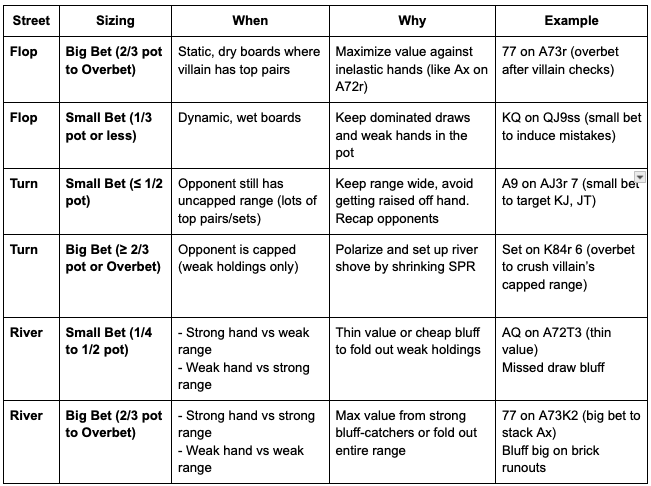
FLOP - you have it backwards. We want to size up on dry and static boards, and size down on wet and dynamic boards.
TURN - we want to bet 1/2 pot or less when we want to re-cap opponents, 2/3 pot or more (and really, full pot or more) when opponents are already capped. We really shouldn't be betting 1/2 to 2/3 pot ever.
RIVER - our bet sizing should be determined by what our hand wants to do versus V's range:
Weak hand vs strong range - bet small to fold out weaker parts of V's range.
Strong hand vs strong range - bet big to target strong parts of V's range.
Strong hand vs weak range - bet small target the weaker value hands in V's range.
Weak hand vs weak range - bet large to fold out V's entire range.
The above assumes we're IP. When we're OOP we can check to induce, or block bet.
Your feedback makes sense. Let me know how this new adjusted strategy looks: