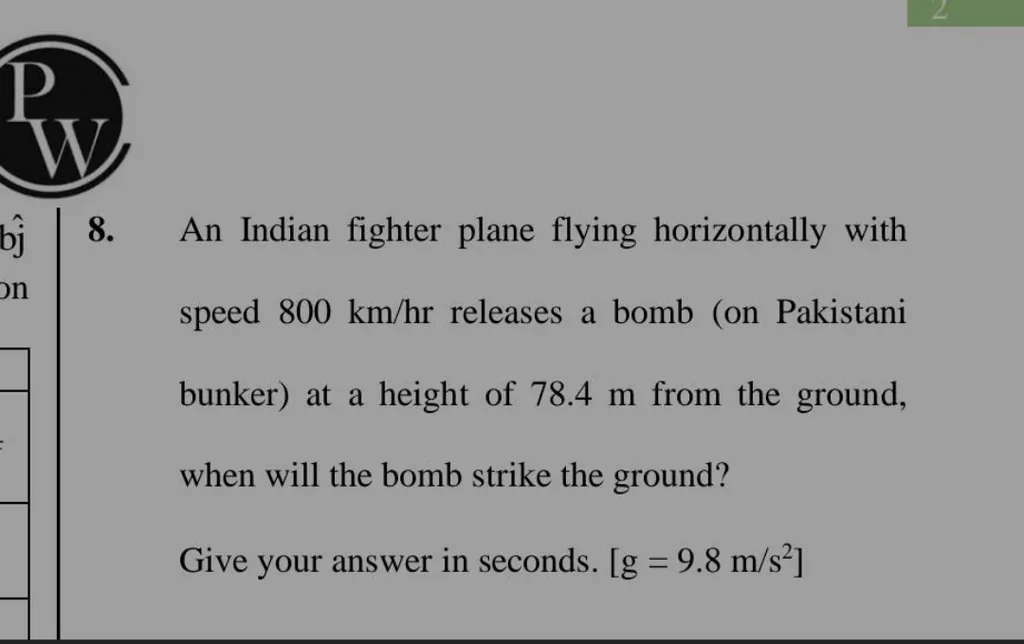
[Math problem] Everyone is saying 4 seconds but I got 3.5

Try to ignore the context.
14 Replies

Give your answer in seconds.
3.5 rounded (up) to the nearest second is 4.

t = sqrt(78.4/4.9) = 4.

Your mom=ass so fat the whole world goes around it.

The speed it is released at is irrelevant. It falls 9.8m the first second and 9.8m/s faster in each additional second. So the first second it has descended 9.8m, the second it goes another 19.6, for a total of 29.4, the third another 29.4 for a total of 58.8, leaving it 19.6m off the ground, when it will go another 39.2 meters in the fourth second. While it would seem like that is 1/2 of it's final speed, remember that it won't have the time to get up to 39.2m/s, as it will hit before gravity gets it that speed. It will take just a bit over 3.5 seconds.

s = 1/2 a*t^2
2s = a*t^2
2s/a = t^2
t = sqrt(2s/a) = sqrt (2*78.4/9.8) = sqrt (16) = 4
The speed it is released at is irrelevant. It falls 9.8m the first second and 9.8m/s faster in each additional second. So the first second it has descended 9.8m, the second it goes another 19.6, for a total of 29.4, the third another 29.4 for a total of 58.8, leaving it 19.6m off the ground, when it will go another 39.2 meters in the fourth second. While it would seem like t
IIRC an object only falls 4.9m the first second.
But it's been a while and the world moves faster these days.

IIRC an object only falls 4.9m the first second.
But it's been a while and the world moves faster these days.
It is correct that the object does not hit a speed of 9.8 m/s until the first second has elapsed, meaning after 1 second, it cannot possibly have fallen 9.8 meters yet.
In other words:

69

Not exactly 3.5, but about 3.5?

Even with air resistance it's still essentially 4s. I thought it'd be longer. I asked ChatGPT4 about the Indian Air Force MK-83 bomb:
3. Acceleration Phase
Given how huge the terminal velocity is (390 m/s), and given that falling only 78.4 meters is not much, the bomb will not reach terminal velocity in that short fall.
Thus, we can approximate it as free fall, just slightly slowed by drag.
Quick Estimate:
Without air resistance:
Time is about 4.0 seconds (calculated before).
With minimal drag:
Maybe it takes fractionally longer, but the MK-83 is aerodynamic enough that drag will barely affect it over just 78.4m.
Be honest, who else converted the speed to metres per second before realizing it was a red herring?

Google AI's analysis
Okay, this image contains the physics problem. Here's how to solve it:
The Problem:
An Indian fighter plane flying horizontally with a speed of 800 km/hr releases a bomb from a height of 78.4 m above the ground. How long will it take for the bomb to strike the ground? Use g=9.8m/s
2
.
Solution:
Identify knowns:
Initial vertical velocity (v
iy
): 0m/s (since the plane is flying horizontally, the bomb has no initial downward speed).
Vertical displacement (Δy or height h): 78.4m.
Acceleration due to gravity (g): 9.8m/s
2
(acting downwards).
Initial horizontal velocity (v
x
): 800km/hr (This information is not needed to find the time it takes to fall).
Choose the right formula: We need to find the time (t) it takes for the bomb to fall 78.4 m under the influence of gravity, starting with zero initial vertical velocity. The kinematic equation for vertical motion is:
Δy=v
iy
t+
2
1
gt
2
Since v
iy
=0, this simplifies to:
Δy=
2
1
gt
2
Solve for time (t):
Rearrange the formula to solve for t
2
:
t
2
=
g
2Δy
Substitute the known values:
t
2
=
9.8m/s
2
2×78.4m
Calculate:
t
2
=
9.8
156.8
s
2
t
2
=16s
2
Take the square root to find t:
t=
16
s
t=4s
Answer:
It will take 4 seconds for the bomb to strike the ground.
This confirms the answer mentioned as "4 seconds" in the forum post from the previous image. The value "3.5 seconds" appears to be incorrect.


