Is this well-known claim actually true?

I have heard the claim numerous times that if there were no blinds in Texas Holdem, then the only hand any GTO player would open is AA.
But is this actually true? Surely that would be an exploitable strategy, as your range becomes one hand - which is completely transparent - and nobody is going to give you action, as they would need around 50% equity to call, and no hand has that against AA, other than the remaining AA in the deck.
Wouldn't you need to be bluffing some of the time, in order to remain balanced and to give other players some incentive to call your bet? And why wouldn't you also open other strong hands like KK and QQ?
First of all, why would you bluff? There is nothing in the pot to win. Bluffing gains nothing if successful and loses if not successful. Next think about calling ranges for an open. If you knew that a rational opponent will not bluff, then your calling range must be strong. You lose nothing as a caller by only calling with AA and folding everything else. Why would you call, even with KK, when you know the opener is not bluffing and could very well have AA? Hence, you really only can call with AA. Bluffing as the opener does not change anything. Sure another player might fold KK against opener’s QQ, but so what? Folding KK vs QQ didn’t cost you anything.
Another way to think about it: what is the EV of folding to an open with any two cards? That strategy would have zero EV. If opener decided to open anything other than AA, then caller could simply fold everything except AA and wind up with a +EV. Where does that +EV come from? It must come from opener having a -EV. Opener has a zero EV option as well — only open AA. Therefore opening only with AA has better EV than any other strategy (except never opening ANY hand, which also would be zero EV).
The point is that blinds are necessary for any action to occur. Without blinds you would have everyone fold to an open unless they have AA. Since that’s the case opener would only ever have AA and most hands would have no action, and most of the few where there was action would be chopped pots.
Let's say you shove a range of AA,KK. I only call with AA. You gain 0 chips when I fold, but I gain your entire stack when I call and win. How are you exploiting me?
There’s no incentive for bluffs to take down an empty pot, and therefore no incentive to bluff-catch. It costs nothing to just sit and wait for the best hand.
First of all, why would you bluff? There is nothing in the pot to win. Bluffing gains nothing if successful and loses if not successful. Next think about calling ranges for an open. If you knew that a rational opponent will not bluff, then your calling range must be strong. You lose nothing as a caller by only calling with AA and folding everything else. Why would you call, eve
You'd be bluffing for "balance" and to give opponents some incentive to call you with hands other than aces, ensuring that you do get action when you do open the pot with aces.
You don't "know that a rational opponent will not bluff" - even in regular Texas Holdem, people make irrational decisions all the time. You can be certain that if a game was played at low stakes with no blinds, all the recs would be making all kinds of preflop calls, trying to hit hands despite not getting the right price.
If you only call with aces then you have the same problem as only opening the pot with aces - no balance and a face-up range.
I understand what you're saying, but I just can't accept that only opening with aces is a sound strategy.
Let's say you shove a range of AA,KK. I only call with AA. You gain 0 chips when I fold, but I gain your entire stack when I call and win. How are you exploiting me?
There’s no incentive for bluffs to take down an empty pot, and therefore no incentive to bluff-catch. It costs nothing to just sit and wait for the best hand.
Yeah I see what you're saying, but I wasn't claiming I was exploiting you. The point is simply that hero only opening with aces clearly has some leaks. Let's say in regular NLHE, if a player is only 3betting aces, then you never give him action right? But if he's 3betting wider you have more incentive to call - that's the kind of angle I mean.
You are prioritizing vague concepts like "balance" and "being face up" rather than just solving this from first principles. What matters is making the most money.
Solving this from first principles, the pot odds are 1:1 so the defender should call any hand that has at least 50% equity. The MDF is 0%, meaning the aggressor's bluffs need 100% folds to break even (which can't happen if you call at least AA). So bluffing is a dominated strategy and we cannot bluff. Therefore the best strategy is to bet hands that are ahead when called, and defend hands that are ahead when called, which inevitable degenerates into nothing but the nuts. In short, you need blinds to generate action.
But ok maybe you don't believe in game theory, so let's just let's try your strategy and see how much money it makes.
100bb deep, HU.
You employ the Telemakus strategy and open shove (TT+,AK) based on vibes. The defending player exploits you by only calling hands with more than 50% equity, (QQ+).
Now, most pots someone will fold and no one makes any money. But when you shove and get called, your range has 34% equity, they have 66% equity, and you lose on average 32bb.
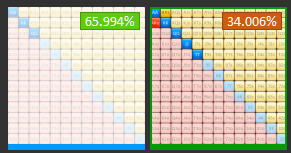
Let's take a look at your equity matrix. yes, you increased your EV with AA, but nuked your EV with all these bluffs.
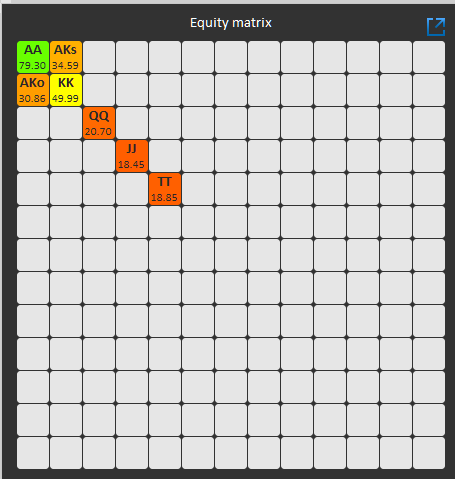
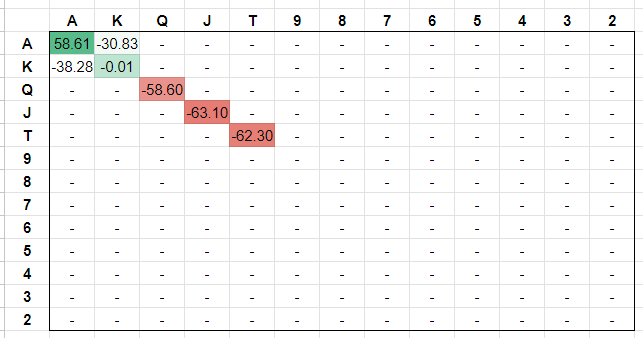
The expected value of any hand here is Equity - (1 - Equity) * 100bb. Congratulations, you've accomplished your goal of making AA more profitable, but it no where near makes up for the cost of your bluffs:
IÂ’ll try again. This doesnÂ’t require any real calculations or anything. A Nash Equilibrium strategy is a strategy that does not lose EV regardless of what your opponents do. With no blinds, both the opener and the caller have a trivial Nash Equilibrium - namely never open and never call an open. Since there are no blinds, that strategy for each player has zero EV. That EV doesnÂ’t change regardless of your opponents strategy.
There is another NE strategy, though. If opener only opens AA, then caller has a strategy that makes this also zero EV - namely calling only with AA. Any other calling strategy would be +EV for opener. Therefore openerÂ’s strategy of opening only AA is likewise a NE strategy. Nothing caller does can make openerÂ’s strategy -EV. Likewise callerÂ’s strategy of calling only with AA is a NE strategy. If opener deviates from his NE strategy, called will gain EV. No deviation would cause caller to lose EV.
These nontrivial NE strategies are optimal since they outperform the strategy of always folding when opponents deviate from the NE strategy. If you open anything other than AA, caller can gain EV by only calling AA. Likewise if you call anything other than AA vs a NE open strategy you lose EV. Thus game theory says that no-blinds hold em degenerates into a game with action only when two players have AA.

To be as fair to OP as possible, it is not precisely true that GTO would open a range of [AA] without blinds.
What Is Actually True
The most accurate, general statement you could make is that without blinds, the maximum EV you could earn in theory is exactly 0, so you actually cannot improve upon the strategy of folding every hand that is dealt to you.
Playing any hand other than AA would decrease your EV, and AA is the only hand where you could put money into the pot, but even that hand is wholly indifferent* between any strategy whatsoever, including fold. (Not to be confused with the Indifference Principle, which relates to a different matter).
Trying to perform any EV math likely produces a "divide by zero" error at equilibrium. You would have to assume that opponents don't fold the nuts (ie: AA) to even demonstrate that AA is 0EV and anything else is -EV, otherwise it's undefined.
Whenever I see the claim in OP, the purpose is usually to demonstrate that, in theory, there is no game without the blinds. So if anything, the theoretical reality could be even more strongly stated than saying it just becomes nuts vs nuts.
Adding Rake to the Equation
All of the above assumes no rake. When you add rake to the game, then even calling AA becomes -EV in theory. So every opponent folds their entire range against any bet, which means AA remains a 0EV hand to bet with.
Where Theory Meets Practice
And of course, all of this is in theory. When applying theory in practice, there is at least some margin of error, even at a table of rational players. There is some marginal chance they accidentally drop a chip in the pot or happen to be telling a story where they say "call" when the action is on them or misread A4o as Aces, etc.
And since betting AA cannot possibly lose EV (without rake), you can do no worse than improve your EV by some unknown amount by shoving it.
Even solvers aren't "theory" per se. They are tools for approximating equilibrium strategies. Some programmatic glitch or imprecision from "only" solving down to 0.0001% pot leaves some marginal room to improve your EV by always playing AA. And again the minimum EV for shoving AA in a rakeless game is literally, actually zero regardless of any theoretical or practical consideration, so you only improve that EV by playing it regardless of how infinitesimal and/or improbable the EV gain is.
To OP's question, you could create some imagined scenario where betting a "bluff" and showing it when everyone inevitably folds then creates an overcorrection by otherwise rational opponents to where you generate some positive expectation for when you get dealt AA an average of 4 hours later. But at that point we're straying far enough away from "rational opponents" that we're really not discussing theory at all.
If there is rake, then in practice you would have to weigh the above mistakes/rounding errors/etc against the amount of money lost in an AA vs AA scenario.
To be as fair to OP as possible, it is not precisely true that GTO would open a range of [AA] without blinds.What Is Actually TrueThe most accurate, general statement you could make is that without blinds, the maximum EV you could earn in theory is exactly 0, so you actually cannot improve upon the strategy of folding every hand that is dealt to you.Playing any hand other than
Thank you, ChatGPT
You know, technically if there are no blinds then you would open bet rather than open raise. And you could check rather than limp. So optimal strategy is to check everything except AA.
That's fair.
I originally clicked post and then saw it was just a block of 20 paragraphs that no one would ever read, so I thought I'd make it a little more bite size and let people jump around and skip whatever they didn't care about.
Frantically formatting the post before it got edit-locked had the unfortunate downside of making my headers dogshit.
You know, technically if there are no blinds then you would open bet rather than open raise. And you could check rather than limp. So optimal strategy is to check everything except AA.
It is confusing that the rules of the game aren't specified (whether there is still a minimum contribution players need to make to the pot in order to continue in the hand), though it's ultimately inconsequential.
Without a pot, all of the math for equity denial, etc, would similarly return "undefined." And if every player sees the flop (/ turn / river), then 1) no hand can improve their EV from 0 by putting the initial money in the pot, 2) the current nuts are the only hand that can possibly put money in without decreasing its EV, and 3) every player would fold anything but the current nuts whenever anyone else puts money in the pot.
Of course, AA wins the pot less often by not taking it down preflop and possibly getting out-flopped, but there was no money in the pot to begin with so betting and taking down the pot (or racing against AA), or indeed even asking to not be dealt into the hand at all, are all functionally the same outcome.
So the example's certainly more convoluted without knowing all the rules of the game, but it really doesn't matter. There is functionally no game regardless.
You are prioritizing vague concepts like "balance" and "being face up" rather than just solving this from first principles. What matters is making the most money.Solving this from first principles, the pot odds are 1:1 so the defender should call any hand that has at least 50% equity. The MDF is 0%, meaning the aggressor's bluffs need 100% folds to break even (which can't happe
Interesting, thanks for the detailed response, I do get what you're saying, but it's fun to play devil's advocate here.
If I know you're only opening with AA, I'm never giving you action, and you're not going to make any money. If you're opening with a broader range of hands, then more hands have the equity to call, and it will create more action in the game - including the times when you have AA.
Also, nobody said that this is a shove/fold situation. If we are 200bbs deep and I know your range is exactly AA I can make your life very difficult on wet boards, etc.
What about if we significantly reduce the number of bluffs in the example that you gave; what happens then?
IÂ’ll try again. This doesnÂ’t require any real calculations or anything. A Nash Equilibrium strategy is a strategy that does not lose EV regardless of what your opponents do. With no blinds, both the opener and the caller have a trivial Nash Equilibrium - namely never open and never call an open. Since there are no blinds, that strategy for each player has zero EV. That EV doe
Sure, this sounds correct.
To be as fair to OP as possible, it is not precisely true that GTO would open a range of [AA] without blinds.What Is Actually TrueThe most accurate, general statement you could make is that without blinds, the maximum EV you could earn in theory is exactly 0, so you actually cannot improve upon the strategy of folding every hand that is dealt to you.Playing any hand other than
Sure, this sounds correct too, thanks for the input.
In a perfect theoretical world, of course this is what happens. In reality, if you put 9 recreationals at a table with 200bb stacks and made them play this game, I'm sure pots would eventually start getting played, even though "you're only meant to play aces bro lol". In that case, surely only playing AA would not make as much as widening your range a little.
You know, technically if there are no blinds then you would open bet rather than open raise. And you could check rather than limp. So optimal strategy is to check everything except AA.
Yeah, this is a really good point. The whole table would check and see a flop a lot of the time. Surely there would be some "cooler flops" where both players hit. But I believe the game would break down when one player bets and the other needs x amount of equity to call (around 50% I assume) which they are usually not going to have without the nuts or some kind of monster draw. Is there a glimmer of hope for action in this game...?
Without a pot, all of the math for equity denial, etc, would similarly return "undefined." And if every player sees the flop (/ turn / river), then 1) no hand can improve their EV from 0 by putting the initial money in the pot, 2) the current nuts are the only hand that can possibly put money in without decreasing its EV, and 3) every player would fold anything but the current
Interesting, thanks. I'm certain players would start putting money in the pot if this was actually played live. That would be a mistake of course, but people make mistakes all the time in poker.
Current nuts might put money in - and get called by current nuts plus redraw? So perhaps there is some chance for action a la Omaha redraw coolers?
The rules of the game are simply regular Texas Holdem with no blinds. Checking preflop is allowed to see the flop; that's pretty much it.

Sure, this sounds correct too, thanks for the input. In a perfect theoretical world, of course this is what happens. In reality, if you put 9 recreationals at a table with 200bb stacks and made them play this game, I'm sure pots would eventually start getting played, even though "you're only meant to play aces bro lol". In that case, surely only playing AA would not make as muc
But in your OP you asked about "any GTO player". Can't have it both ways.
Well, you start off asking about a GTO player. Then you switch to not being a GTO player because others are probably not. These are different things. I'm going to take a guess that you have a misconception about what GTO is.
Well, you start off asking about a GTO player. Then you switch to not being a GTO player because others are probably not. These are different things. I'm going to take a guess that you have a misconception about what GTO is.
Try reading the thread from begining to end. The OP was about GTO players, and the discussion lead to what might happen if such a game was played by low-stakes recs. Apparently it's news to you that the topic and discussion of threads can change as they progress (or perhaps you just like being pedantic rather than offering meaningful input to a debate).
I've read many, many books on poker theory, and I have a very good understanding of game theory in poker.
If you knew someone was only playing AA wouldn't any other call/raise be -ev? And in equilibrium you know the other persons entire strategy. Perhaps opening small and shoving have the same ev then.
If you knew someone was only playing AA wouldn't any other call/raise be -ev? And in equilibrium you know the other persons entire strategy. Perhaps opening small and shoving have the same ev then.
Yeah, I'm not sure - perhaps one of the wizards can answer. The equity required to call will be the same either way anyway, as (pot/pot+call) x100 expressed as a percentage will always be 50% if there is nothing in the pot to begin with.
Equilibrium strategy for opener is to only open AA. Equilibrium strategy for any caller is call with AA only. The equilibrium strategy for opener is zero EV against the equilibrium calling strategy. It is +EV against any calling strategy other than the equilibrium one. Bet size makes no difference against equilibrium calling strategy, but the larger the bet the larger the EV against a non-equilibrium caller. Shoving is optimal sizing for equilibrium opener (plus that prevents any chance of making errors postflop).


