The Box of Chocolates Thread (You never know what you're going to get!)

Welcome to the General Discussion thread. If you have a topic that doesn't warrant its own thread, post it here. Have a

True, though it's not as bad as that ridiculous Brad Pitt movie Fury. Fury does feature a guest appearance by the British Tank Museum's preserved Tiger, but otherwise it's just daft.
what i loved about fury though is they very accurately depicted that any civilian would have sucked your dick for a candy bar back then


generation kill is probably the most accurate telling of modern warfare out there - notably because it's just how it actually happened for an embedded journalist
Never heard of this series. Just finished it. The dude who played Ray was great. His arc in the last episode was written really well.
yet oddly the data disagrees with all of thisit's telling that i'm talking about people who are killed and you go to the much broader term "casualty" which includes people removed from the front lines due to stomach bugs, stds, and toothaches holding an elementary classroom to your rigorous standards we'd find the same 100%+ casualty rate over the course of a semester - let tha
I'm sorry, but that's drivel. Of course I didn't say 'everyone died', because fatal casualties were about 20% of the total. I used to know a survivor of 5th Battalion The Wiltshire Regiment, 43rd Wessex Division, and he knew a few other survivors of his company, the original B Company. They'd all become casualties, though, and everyone they knew was killed or wounded. They were warned before embarkation that they must expect to become casualties within six weeks of reaching the front line, and that was pretty much what happened.
You're completely wrong about riflemen making up 20% of Second British Army. It was nothing like that. They made up about 25% of an infantry division, but most troops did not serve in the fighting divisions, they served in the army's 'tail' and seldom if ever went near the front line. In a Normandy rifle company, almost everyone got hit, around 98%, of which about a fifth were killed. Then almost all their replacements got hit, in the later stages in Normandy, in Market Garden and particularly in the Rhineland, and then about half of those replacements' replacements got hit before the end of the war.
On 10-11 July 1944, 43rd Wessex took over 2,000 casualties in combat with four SS-Panzer divisions (1st SS Leibstandarte, 12th SS Hitler Jugend, 9th SS Hohenstaufen and 10th SS Frundsberg) at Hill 112 near Caen. Recall that the division's riflemen only numbered about 4,500, and that almost all the casualties fell on the rifle companies. This was normal. A major Allied attack in Normandy usually cost about half the attacking riflemen.
As it happened, 5th Wiltshire got off very lightly that day, because their supporting Churchill tanks didn't turn up, so they attacked without the tanks and the Germans barely spotted them until they'd dug in on the objective. Then of course the SS counter-attacked their forward company, C Company, and got mown down in rows by Bren and rifle fire. The Wiltshires appear to have inflicted casualties on the SS at the rate of about 10 for 1, though that still wouldn't be good enough for Hollywood.
But on 6 August, at La Variniere, a crossroads village at the foot of Mont Pincon, then the last bastion of German defence in Normandy, the 500 men of 5 Wilts' rifle companies were reduced to just 66 by casualties, mainly due to mortar fire. The CO was killed by a sniper (who was immediately shot out of his tree by a corporal with a Bren gun), the chaplain was killed by a mortar bomb and every company commander was killed or wounded. With the support of half a dozen Shermans from 13/18th Hussars, the last sixty rifles, under command of the adjutant (who would shortly lose an arm to a mortar fragment), made one final attack and took the village, which had been held by two German grenadier divisions. At that time a German division was only as big as a full-strength British battalion, but there were still over a thousand defenders -- all the same, they chose to get out. The remaining 5th Wiltshires then dug in and held the village against counter-attacks by the remnants of 21st Panzer and 9th and 10th SS, while the Hussar tanks and 4th Wiltshire climbed Mont Pincon and captured the German garrison at the top, who surrendered because, with La Variniere in Allied hands, they could not be reinforced or resupplied.
The new 5th Wiltshire, consisting mainly of replacements, underwent a similar bad day in the Rhineland in February 1945, when they had to fight 15th Panzergrenadier Division for another vital crossroads by the Reichswald. The CO, all the company commanders and almost all the other officers were killed or wounded, and the signals officer, Capt MacMath, ended up in command. Casualties among the riflemen were similar to Mont Pincon. They still won the battle, of course, and the division went on to capture the cities of Goch and Cleve.
In total, from D-Day to VE-Day, about 1,500 men served in 5th Wiltshire's four rifle companies. The battalion's casualties for the campaign, most sustained by the rifle companies (HQ and Support Companies did take casualties, but nothing like as often), came to 1,277. Note, that is about 250% of the nominal strength of the rifle companies. Of these, about 334 were killed in action or died of wounds. If you were in a rifle company that landed in Normandy in June 1944, you were about 98% certain to get hit and about 20% certain to get killed. If you were a replacement, the odds didn't get much better till the last few months of the war.
you're talking about something you fundamentally don't understand and cherry picking outliers to boot to represent something on a grand scale
just very bad faithed posting that severely conflicts with the actual data of the number of those who served in the front lines and the number killed
like i said earlier, any elementary school is going to have a 300% or higher casualty rate each year just to underscore the absurdity of you clinging onto that metric as a way to demonstrate survival rates


I can't speak for most people, but I certainly would have distinguished between deaths and casualties. In other words, I would have counted the guy who came with one foot as a casualty.
57, if i'm not mistaken, the last time we spoke d-day you were the person talking about how everyone in the first wave was killed not knowing that we only had 2 waves in total
Like I said, I don't know how commonly understood this distinction is.

I'd have thought that if figures are quoted as "x deaths and y casualties" rather than "[x+y] deaths" or "[x+y] casualties", it should be obvious to even the mongs of this world that the inference is that a casualty is something other than a death.
It's 10 PM; do you know what time it is?

An accusation made at no one in particular and at many in this sub forum.

I re-read 1984 the other day, and my takeaway has remained constant.
The backdrop of the book is certainly that of a totalitarian regime. However, to my eyes the main theme of the book is that the main character is a naive fool who mistakenly thinks he is smarter than people around him, has a naive understanding of the world, thinks his thoughts and ideas automatically makes sense to smart people, and at the end of the day...
Spoiler
...he is completely useless and accomplishes nothing.
Which strikes me as poignant and forces you (the reader) to reflect a bit on yourself.
I'm sure my take isn't fresh, nor am I saying that this is somehow the only way to read the book. Still, it is a point I do not see mentioned much when reading other people's opinion on it.
I re-read 1984 the other day, and my takeaway has remained constant. The backdrop of the book is certainly that of a totalitarian regime. However, to my eyes the main theme of the book is that the main character is a naive fool who mistakenly thinks he is smarter than people around him, has a naive understanding of the world, thinks his thoughts and ideas automatically makes se
yes the protagonista Is a liberal in a communist world.
both the protagonist and the world suck hard I agree
yes the protagonista Is a liberal in a communist world.
both the protagonist and the world suck hard I agree
If you Google "x" you can find a link to Twitter and share your valuable insights with the world.

I mean Orwell was a colonial police officer and informant for mi6. He hated the SU more than the Nazis. So I would say that Lucy's analysis is pretty much correct.
I mean Orwell was a colonial police officer and informant for mi6. He hated the SU more than the Nazis. So I would say that Lucy's analysis is pretty much correct.
Do you see anything wrong with this picture?
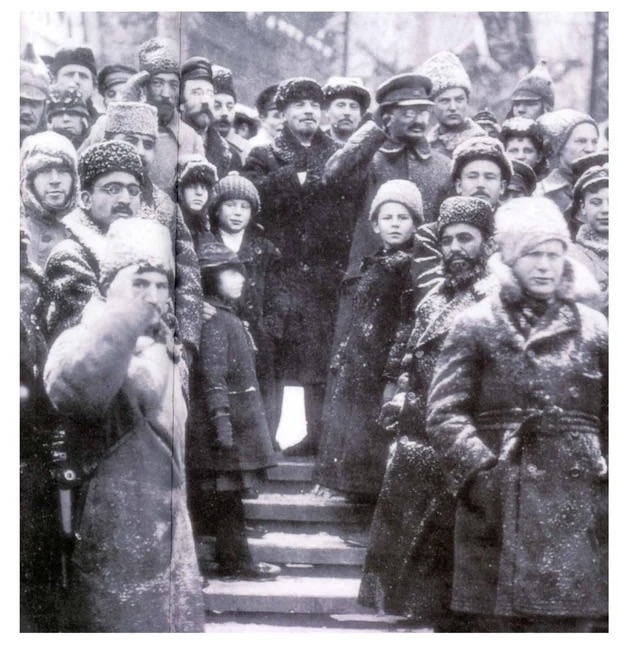

Lenin's left leg appears to be bent at some unnatural angle? Hopefully that's it and I win something.
Lenin's left leg appears to be bent at some unnatural angle? Hopefully that's it and I win something.
You trolling bruh?
I don't know what the relevance of this picture is, but the first thing that stuck out to me is that there is what looks to be a rather obvious splice about a quarter of the way from the left edge, so it's seemingly 2 partial pictures spliced together.


