The Supreme Court discussion thread

7 States have passed bills this year which place new restrictions on abortion. Alabama's new law, in particular, is a ne

Just quit.
Months ago, you kept referring to cases seeking injunctions against the federal government as class actions, which they weren't, and you kept referring to the court orders as giving relief to a class, which they didn't.
I specifically noted, months ago, that you could change the rules to require that such cases meet the requirements for a class action, and I explained why I didn't think that was a good idea.
Can't SCOTUS just outline a procedure where plaintiffs at the district level can immediatly ask for review at appellate level (immediatly after filing at the district level, without waiting for the district level decision that would only apply to the defendants there), in order to seek a nationwide injuction because of egregious violations , and then it's the appeal court that
I confess that I haven't researched this question, but I don't think so. That would effectively be granting original jurisdiction to an appellate court, which I don't think the Supreme Court can do. The Supreme Court certainly can't expand its own original jurisdiction.
And the Supreme Court surely can't do so on a case by case basis.
Isn't there some kind of situation where the Supreme Court can act on something without it first going through lower courts? Seems like that has happened within the last several years.
The Supreme Court has original jurisdiction over a very, very limited category of cases. It can't expand that original jurisdiction on its own.
I confess that I haven't researched this question, but I don't think so. That would effectively by granting original jurisdiction to an appellate court, which I don't think the Supreme Court can do. The Supreme Court certainly can't expand its own original jurisdiction.
And the Supreme Court surely can't do so on a case by case basis.
Wouldn't it be more like enlarging what interlocutory appeals can already do, but only in some specific cases?
Wouldn't it be more like enlarging what interlocutory appeals can already do, but only in some specific cases?
No. An interlocutory appeal is a discretionary appeal of a decision by a lower court that is not case-dispositive. Interlocutory appeals are not a mechanism for allowing a plaintiff to simply bypass getting a ruling from the lower court.
And they certainly aren't a mechanism for ordering broader relief than the plaintiff is seeking. In your world, an individual can't seek the relief of a nationwide injunction, and the lower court can't order such relief. Even if there was a decision by the lower court, the appellate court in your world wouldn't be able to order a nationwide injunction.
No. An interlocutory appeal is a discretionary appeal of a decision by a lower court that is not case-dispositive. Interlocutory appeals are not a mechanism for allowing a plaintiff to simply bypass getting a ruling from the lower court.And they certainly aren't a mechanism for ordering broader relief than the plaintiff is seeking. In your world, an individual can't seek the
I get it how that works currently i was thinking how it could work with changes (if SCOTUS can make such changes).
In some countries (like in Italy) , the judge himself can ask a higher court for constitutional clarifications besides the demands of the parts involved, could that work in the USA? a district judge presented with something he considers egregious and requiring nationwide injuctions, could ask his appellate court for that? and that would start 2 parallel proceedings , one involving only the parties that sued at the district level, and an appellate level decision that anyone who can prove standing for can appeal to scotus?
I get it how that works currently i was thinking how it could work with changes (if SCOTUS can make such changes).In some countries (like in Italy) , the judge himself can ask a higher court for constitutional clarifications besides the demands of the parts involved, could that work in the USA? a district judge presented with something he considers egregious and requiring nati
The Supreme Court itself cannot make the changes you are describing. Congress of course can pass whatever laws it wants, assuming the president is on board or there are enough votes to override a veto.
The only thing that is remotely close to what you are describing is when a federal court certifies a question to a the highest court of a state. That happens when a federal has to apply a state law and it believes that the law in the state is unsettled. There is no analogous process for a federal district court kicking a question of federal law to a federal appellate court without first deciding the issue.

The birthright citizenship SC oral arguments on Friday were pretty interesting. I did not go back and listen from the beginning but the Solicitor General (Feigerman?) from New Jersey appears to be a brilliant appellate lawyer.

It's mind-boggling how many topics that luciom knows more than anyone else about. Sorta like Trump.

Stunning interview of ACB by the NYT.
You can read her words verbatim about crucial judicial philosophy topics and just jaw drop in awe at her immense majesty.
Stunning interview of ACB by the NYT.
You can read her words verbatim about crucial judicial philosophy topics and just jaw drop in awe at her immense majesty.
I will say that compared to what I was expecting her to be like (really really bad) she has exceeded my expectations. Don’t know if that’s just a matter of strategy on her part.
I will say that compared to what I was expecting her to be like (really really bad) she has exceeded my expectations. Don’t know if that’s just a matter of strategy on her part.
You are supposed to find every judge on the right really bad if you mean that to say "they vote for interpretations of the constitution I disagree with".
That is , if you believe in the "living constitution" judicial philosophy (which iirc you said you do).
You are supposed to find every judge on the right really bad if you mean that to say "they vote for interpretations of the constitution I disagree with".
That is , if you believe in the "living constitution" judicial philosophy (which iirc you said you do).
I’m kind of agnostic as to the living constitution question. I just think the originalism position is self-defeating. If we are meant to only interpret the constitution as originally intended by the people that wrote it, why did no one identify as an originalist up until the 1980s. Just seems clear that originalism is not an originalist position and thus can be eliminated as it entails a contradiction.
If we want to say that we should weigh the original interpretation of the text when we construe the meanings of certain parts of the constitution as an important factor among many, well then that’s obviously going to be agreed on by a lot of people, even people that believe the most extreme versions of the living constitution theory.
But I mean, certain parts of the constitution just obviously need to be interpreted in light of new technology and actually in light of changes to the constitution, like the incorporation of the bill of rights.
I’m kind of agnostic as to the living constitution question. I just think the originalism position is self-defeating. If we are meant to only interpret the constitution as originally intended by the people that wrote it, why did no one identify as an originalist up until the 1980s. Just seems clear that originalism is not an originalist position and thus can be eliminated
I think we both agree that the constitution is basically a list of what the government (in all it's parts, including state and local gvmnts, for the federal constitution) cannot do to the people, other than a list of procedural rules to institute the various parts of government (and divide power among them).
So let's discuss the relatively easier set of issues related to the division of powers first. There are 3 branches, with specific powers, sometimes interconnected sometimes exclusive. Necessarily in real life you get overlaps and strongarming of one power against the other(s) because not everything fills squarely in the described and prescribed divisions.
Now, what else than originalism should we use and why to determine how those powers have to be divided? it seems to me that originalism (and/or textualism) are the only possible approaches unless you actually simply want to devolve gigantic and potentially unlimited powers to the courts (so ultimately to SCOTUS).
Technology shouldn't matter in the slightest there at any point , do you agree? the idea that "the world is more complex so the feds have to do more stuff" is insane right? i mean it isn't as a political position, but in order for that to become the constitution, it's a clear cut case where you would need an amendment to pass those political considerations into constitutional mandates, right?
So what's the scope and depth of the 10a? that leaving to the states *all powers* not explicitly attributed to the federal government? answer can only be found in "what the people writing and ratifying that amendment intended" , do you agree? there is nothing else, and nothing that ever happens in society should change that by a single iota , with the specific exception of constitutional amendments.
And yes the passing of the 14a amendment, even under originalism, gives a different reading to the 10a, because the civil war was at the end an issue of state rights and the constitution was amended to reduce them a lot, specifically to guarantee that a bunch of rights (protection from gvmnt violence) were ensured in their enforcement in every single state.
Now textualism would be "in order to understand what people meant, we should just read what they wrote verbatim". Originalism can take other events at the time, other stuff written "around" the ratification of that amendment (or the writing of the original constitution), and the real life application of that amendment in the first generation of legal cases that used it to grasp what they actually intended. Whatever you choose to give more weight to, it has to be stricly and only about what they actually passed as the constitution.
Not what you would like it to be, for divisions of power. It's the basic rules of the game the way society intends to play it, with rules about how to change the rules, why would you allow judicial interpretation to change those rules when amendments exist as a possibility and have been used a lot to achieve exactly that?
Now if we agree on this we can move to the more complicated general issues that come from the list of prohibitions to gvmnt actions
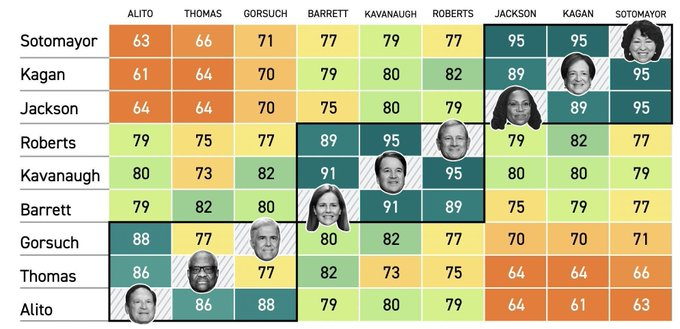

Interesting - I guess this is the percentage of times one justice agreed with another?
I'm surprised that Alito and Thomas aren't higher than 86%.
Interesting - I guess this is the percentage of times one justice agreed with another?
I'm surprised that Alito and Thomas aren't higher than 86%.
Yes this is how often the two judges vote the same (I think this is for every occasion they had to vote for the same decision since they are on the bench, not just the last terms)
Kavanaugh agreeing with Sotomayor more often than he agrees with Thomas is the most striking thing imho

Yes this is how often the two judges vote the same (I think this is for every occasion they had to vote for the same decision since they are on the bench, not just the last terms)
When I look at those crazy left inclining judges, they still seem to more often then not , agree with each other compared to someone like you …..
I think we both agree that the constitution is basically a list of what the government (in all it's parts, including state and local gvmnts, for the federal constitution) cannot do to the people, other than a list of procedural rules to institute the various parts of government (and divide power among them).So let's discuss the relatively easier set of issues related to the div
If we only limit originalism to those issues which are clear in the constitution I’m afraid we’d have way too many unanswered questions. In that sense, if we want to consider this neutered originalism we’d be left with a very weak principle that isn’t able to tell us much except in very specific cases.
Instead I think the originalist wants to have a principle for nearly all cases, and be able to say that even on the most difficult cases we can tale an originalist approach and come to the correct legal interpretation, and that correct legal interpretation is based off of having all the right info to determine what it originally meant.
Technology shouldn't matter in the slightest there at any point , do you agree? the idea that "the world is more complex so the feds have to do more stuff" is insane right? i mean it isn't as a political position, but in order for that to become the constitution, it's a clear cut case where you would need an amendment to pass those political considerations into constitutional mandates, right?
I mean the internet is never mentioned in the first amendment, or the phone. Or nukes for that matter. But somehow we are able to decide constitutional issues about those things. It may have a tangential relation to original meaning, but at that point it’s really hard to say what the first amendment+the incorporation clause+common law would say about how the “original” interpretation reacts to these new situations.
So what's the scope and depth of the 10a? that leaving to the states *all powers* not explicitly attributed to the federal government? answer can only be found in "what the people writing and ratifying that amendment intended" , do you agree? there is nothing else, and nothing that ever happens in society should change that by a single iota , with the specific exception of constitutional amendments.
And yes the passing of the 14a amendment, even under originalism, gives a different reading to the 10a, because the civil war was at the end an issue of state rights and the constitution was amended to reduce them a lot, specifically to guarantee that a bunch of rights (protection from gvmnt violence) were ensured in their enforcement in every single state.
Now textualism would be "in order to understand what people meant, we should just read what they wrote verbatim". Originalism can take other events at the time, other stuff written "around" the ratification of that amendment (or the writing of the original constitution), and the real life application of that amendment in the first generation of legal cases that used it to grasp what they actually intended. Whatever you choose to give more weight to, it has to be stricly and only about what they actually passed as the constitution.
Not what you would like it to be, for divisions of power. It's the basic rules of the game the way society intends to play it, with rules about how to change the rules, why would you allow judicial interpretation to change those rules when amendments exist as a possibility and have been used a lot to achieve exactly that?
Now if we agree on this we can move to the more complicated general issues that come from the list of prohibitions to gvmnt actions
But then we are just privileging the most recent amendments over and above the original meaning of the other amendments. If you make an amendment such that the 14th and 10th suddenly interact with each other and all the rest of the amendments, well that’s just going to completely introduce a new set of mysteries and gray areas that will then be determined by future courts.
Yet the originalists will have us believe that this methodology should be traced back to the earliest intention possible. Well how does that hold if we are re-writing what original meaning actually means every time the constitution is amended?
Again if we’re just sticking to very clear entailments, well the original meaning usually lines up very nicely with the plain meaning. And in other cases if the original intent is very broad and unclear so as to allow for good governance, then we need another standard to determine what it means to be good governance in a judicial sense. That may weigh what the original people thought was good governance or it may not. And sometimes what they thought was good governance doesn’t even make it in the text.
weird splits in the latest decisions, and tomorrow will be fireworks day with several important decisions yet to come.
Riley v Bondi reads like an IQ test
ALITO, J., delivered the opinion of the Court, in which ROBERTS, C. J.,
THOMAS, KAVANAUGH, and BARRETT, JJ., joined in full, and in which
SOTOMAYOR, KAGAN, GORSUCH, and JACKSON, JJ., joined only as to Part
II–B. THOMAS, J., filed a concurring opinion. SOTOMAYOR, J., filed an
opinion dissenting in part, in which KAGAN and JACKSON, JJ., joined in
full, and in which GORSUCH, J., joined except as to Part IV
Hewitt v USA looks too technical for me to understand (and about topics i never learnt the intricacies of) , but 3 liberals+ roberts + gorsuch is very rare to see
JACKSON, J., delivered the opinion of the Court with respect to Parts I,
II, and III, in which ROBERTS, C. J., and SOTOMAYOR, KAGAN, and GORSUCH, JJ., joined, and an opinion with respect to Parts IV and V, in which
SOTOMAYOR and KAGAN, JJ., joined. ALITO, J., filed a dissenting opinion,
in which THOMAS, KAVANAUGH, and BARRETT, JJ., joined.
Lol. So our esteemed court finds the government is irreparably harmed by being denied the ability to exercise a clearly unconstitutional executive order that is has never attempted to exercise in a couple of hundred years.
Political corruption at its finest.
Lol. So our esteemed court finds the government is irreparably harmed by being denied the ability to exercise a clearly unconstitutional executive order that is has never attempted to exercise in a couple of hundred years.
Political corruption at its finest.
Which decision? Scotusblog live is illegible for me


