The Simplest Poker Strategy - A Thought Experiment
My wife and I have a trip to Las Vegas in August, and she expressed interest in trying poker. I'm working my way through Maria Konnikova's book about learning to play, and so far it's been eye-opening how difficult it is to start if you don't have the basics to work off of. But my wife's not trying to be a winning player at $10k's. She's just trying to experience the game at a random casino's daily.
I was originally going to max-late reg her in something and drill a 10 BB push/fold chart, but she rightfully blew up the concept of exclusively one-street poker. She is a lab scientist and spends all day carefully following complex instructions. "Can't you write an instruction sheet for poker that I can use to actually play?" At first the obvious answer was no, that's not how poker works. But told her I'd get back to her.
What follows is my attempt to write a logical, instruction sheet that she can reference while practicing microstake tournaments online to memorize the instructions and have a solid base before attempting to play live:
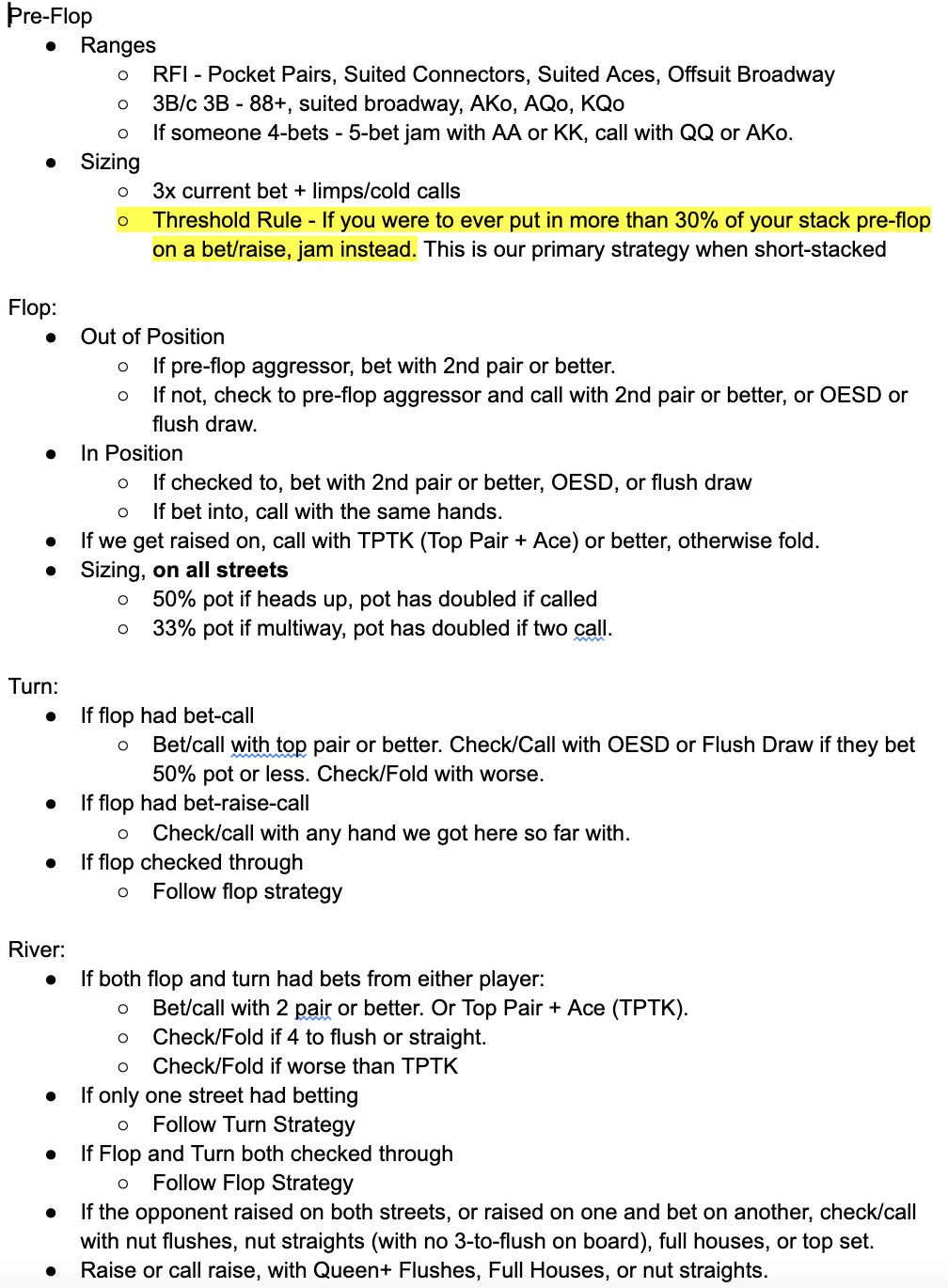
I tried to use only basic poker terms that she's picked up from hearing me talk about the game. I tried to also write it like a true-to-life instruction sheet, cover all situations, so there is an unambiguous step to take.
But, there are some weird quirks I took in the name of simplification:
Pre-Flop
-Ranges are position agnostic.
-We are playing a 3-bet or fold strategy.
-We do not have a 4-betting range, but are 5-betting our nutted hands.
-Push/Fold, which will come up quickly in a tournament like this, is entirely dictated by the threshold rule (highlighted).
Post-Flop
-Board Texture and ranges are largely ignored, just hand strength.
-We are using one sizing for heads up and one sizing for multi-way, to avoid typical beginner sizing leaks and make pot size calculations easy.
-We will never be raising flop/turn.
-On the river, we are "balancing" our thick value with SDV hands that optimally we'd be checking back.
The economist in me originally wanted to crowdsource competing "instructions" (with a cash prize) and see how much EV they give up vs. GTO, but I honestly can't think of an easy way to uniformly test that, but figured my "solution" was worth throwing up on here to get the **** roasted at my attempt.
Once testing on my subject (life partner) has started, I'll probably hop back in here to report results, as well as respond to the obvious exploits that come up...let's hope nobody decides to jam 600% pot on the flop and she calls them down with second pair.
8 Replies
While I’m not a lab scientist, I am a mathematician, which may be close in terms of how we think quantitatively.
If you are going to write an instruction sheet, I think the sheet should consist of not an algorithm for how to play, but instead a set of criteria for evaluating the relative strength of her hand at various points in the hand. Can also include common types of draws and the pot odds you need to draw to them. She probably can think through the arithmetic herself, but understanding when her hand needs to be folded is one of the top things that will save her money.
instead a set of criteria for evaluating the relative strength of her hand at various points in the hand. Can also include common types of draws and the pot odds you need to draw to them. She probably can think through the arithmetic herself, but understanding when her hand needs to be folded is one of the top things that will save her money.
I think the issue with that approach is it requires some amount of experience to conceptualize. The same way that if you don’t play chess, evaluating a mid-game board position is pretty difficult. This effectively is the chess equivalent of just giving the value of the pieces and knowing that 80% of the time it won’t be marginal and that basic step will be enough.
Any studied player is evaluating their hand strength subconsciously when thinking about a matrix of ranges, configuration, board texture, effective stack sizes and prior action. But you can’t get that down to a cheat sheet, so I went with the most influencing variable (prior action), and did my best to bring in the most important aspects of the rest (checking to pre-flop aggressor, IP/OOP, 4-to-flush/straight, and threshold rule) while having it still fit on a single page.
There are two pieces from your comment that are definitely implementable. Number one would be if she gets enough hours where her intuition deviates from the sheet correctly, taking away the training wheels. Number two is pot odds and implied odds, basic math that nullifies a lot of rare, but incredibly -EV situations that arise as a consequence of the rules.
On that last point, I’ve never had a reason to look at CLP’s beginner content. I know n8ball did a basics of LiveNL course, might be worth using that as teaching as well once she has the very basics down.

Would look at whatever the best current poker-101 course is, and buy it ... you might be the best in the world, but that doesn't mean you are a great teacher.
Would also start with cash games and not tourneys.
Also if she's competitive and wants to win more than have fun playing a game you play ... I would heavily lean towards showing her GG's thread.
Would look at whatever the best current poker-101 course is, and buy it ... you might be the best in the world, but that doesn't mean you are a great teacher.
Would also start with cash games and not tourneys.
Also if she's competitive and wants to win more than have fun playing a game you play ... I would heavily lean towards showing her GG's thread.
Completely different goal set, she just wants to play and have some idea of what she's doing. $60 tournament is both a lower investment than a $500 cash buy-in, but more importantly, a much friendlier crowd in my experience. Walking past Mandalay Bay's room where people are just trying to pound as many drinks as possible before they go bust is always a treat.
Did some googling around, most of what I found relied on some level of knowledge going in. For some reason, someone got us a MasterClass gift card as a wedding present. DNeg's course on there looks like it starts really simple, and she's familiar with who he is.
I think I got way to cutsey with this idea. Been way too deep in poker for so long, ultimately the basic game is fairly simple, and reps easy enough to get online that the sort of algorithmic starting point I proposed is far too boring and clunky, and removes the aspects of learning that can make a new hobby fun.
Any studied player is evaluating their hand strength subconsciously when thinking about a matrix of ranges, configuration, board texture, effective stack sizes and prior action. But you can’t get that down to a cheat sheet
Can't you though?
Maybe configurations are too much to deal with, but you can certainly try to teach board texture, positional advantage, and how to narrow someone's range based on prior action. You can "cheat" when it comes to effective stack sizes by teaching implied odds and reverse implied odds (in my opinion if you try to skip these 2 concepts it's a complete recipe for disaster). You don't need to cover every stack size but you do need to teach how bigger stacks mean bigger bets later, which means planning for the future can be more important than the strength of our hand currently.
I think it's too complicated for new players.

She might have blown up at the concept of one street poker but if she does not know how to play it is her best chance to win. The lower you are in skill the more you want the game to be about luck.


