$15 MTT Folding Kings at river?

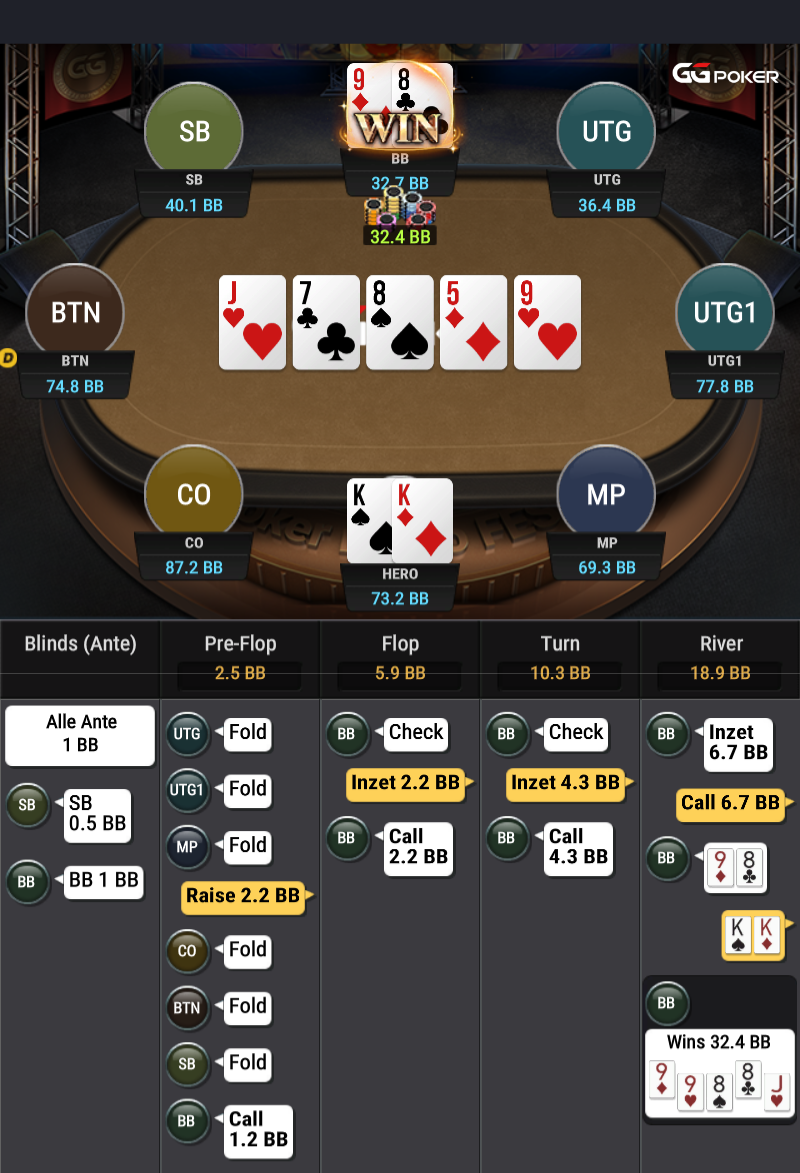
The straight got there on the river, although that wasn't what villain had. I called. What should I have done different in this hand?
14 Replies

I found it hard to fold as well. But with him calling all the way I can see him play suited connectors which might give him a straight or two pair on this flop. Should I have bet bigger on one of the streets to let him fold those hands?

I would scale up flop and turn, yes. You unblock top pair and want to give yourself a chance to stack it, and there are a lot of pair+gutshot type hands you want to charge. He could have T9 (or 96 on the turn) but you can't really stay worried about the worst-case scenario.
River really sucks with two one-card straights out there, but folding would be tough for the price.
I'm never quite sure I'm reading GG histories right-- if I am, BB started the hand with about 45BB? 48.1 if I did it right.
Size up the turn. Impossible to fold river as played.
Don't show results when you post hands, it's impossible to give an objective opinion when we know the outcome.
I would size up on the flop. That flop is better for his range so it becomes a check or bet large, and given how dynamic it is I would opt for bet large.
As played I admit it would be hard to fold river, but when you stop and think through it you're never going to be ahead there. He can have so many hands that beat your KK there.

I'm not folding river getting that price. You will run into straights and two-pair, but with that sizing I think villain can also mix in bets with one pair hands. You will likely win enough to justify the call given the pot odds you're getting.
I would also have considered checking back turn. The five is much better for big blind's range than yours. By checking you induce some river bluffs out of low equity flop floats that would fold to a turn bet.
Not that I'm saying the turn bet is bad. As Nath pointed out we can get value out of all the Jx. I would be interested to see what a solver would do. Our exact hand has some good incentives to bet but I think our range is going to want to be checking a fair amount.
ran a solver for cEV at 50bb
BB checks 100% of range, our range here is split 70% b75 / 30% check, we always b75 KK here, 98o always calls (9% of the time 9s8d raises small, we don't have to worry about that)
turn BB has a miniscule portion of small leads (less than 2%) so basically always checks, and definitely with this hand
with KK we b75 again almost all the time, small % of b50 (about 10% of the time without the Kd and 13-14% of the time with it)
river BB donks b25 a lot with this hand (almost all the time without the 9h)
we actually mix folding, calling, and jamming (presumably as a bluff), but this specific combo almost always calls. Kh hands fold the most, especially with a black king
I'm not totally sure why we choose certain suits. The turn b50 frequency I assume has something to do with the backdoor flush draws, and the river folding KhKs and KhKc more than KhKd too. Maybe we block certain combos of bluffs with the Kh and that's why we fold more. The kind of rabbit hole worth digging into and figuring out, that's the point of solver study.
ran a solver for cEV at 50bbBB checks 100% of range, our range here is split 70% b75 / 30% check, we always b75 KK here, 98o always calls (9% of the time 9s8d raises small, we don't have to worry about that)turn BB has a miniscule portion of small leads (less than 2%) so basically always checks, and definitely with this handwith KK we b75 again almost all the time, small % of b
Thanks for checking out the spot Nath. Thinking it over some more KK is likely just too strong (also unblocking top pair) to check turn. While the 5 turn gives the BB some straights and two pair, it also gives them a ton of pair plus draw hands that we can charge. If we're going to bet I prefer the larger size in practice.
I would assume our overall range is checking quite a bit on that turn though? I would be curious about the overall betting frequency with our range?
That's interesting about the suit effects, and the mixed river calls, folds and raises with kings. That actually makes me lean more towards a river fold in practice. There are likely some weaker combos in the BB's range that the solver calls with on the turn and turns into river bluffs/weak block bets that most humans are just overfolding with on the turn.
Another interesting aspect to explore would be how the effective stack sizes change the action. Like at this stack depth I'm assuming that if we bet turn with kings and get check-raised we're pretty much just happy stacking off with them according to the solver? Or do we start mixing folds?
When the flop goes x/b75/c, BB has a small fraction of small turn leads, mostly 9x hands (incl. 96o but not T9o) and some of the weakest jacks.
When BB checks this turn, our range is split into x 42% / b50 12% / b75 46. We check back a lot of our Ax hands but we always bet AJ+, we pretty much always bet AT and A9s (A9o checks a lot though). We actually check QJ almost all the time and KJ a significant part of the time, but we always bet JT and J9s. The only hands that prefer betting the smaller size more often are JJ and 99.
When we b75, BB only check-raises 11.6% of the time. 4.7% of the time it' a b50 check-raise, 6.9% of the time it's all-in. The most common check-raises are sets and two pair (although J7 just calls a lot), or 64s for the lowest straight, with some portion of JT/J6 check-raising (and even a slim amount of 65o and Q9s).
KK is always supposed to get it in on the turn after a check-raise.
I play on Pokerstars and I doubt it's profitable there to call here on this level of BI, unless you know villain is a real, real fish you have seen doing stupid bluffs before. A good, tricky player with a hand like A8 might turn it into a bluff OTR, but would most certainly bet bigger. Plus would this type of player call turn, instead of CR?
In absence of any particular reads I would give the player credit for at least two pair here. An ordinary player will be fully aware you can eaisly have a straight here yourself (and hence should be afraid of trying a bluff). And there arent really (m)any busted draws OTR that we can expect a bluff from.
Maybe there are many more fishy bluffs or stupid Jx-value bets on american sites, I have no idea.
When the flop goes x/b75/c, BB has a small fraction of small turn leads, mostly 9x hands (incl. 96o but not T9o) and some of the weakest jacks.When BB checks this turn, our range is split into x 42% / b50 12% / b75 46. We check back a lot of our Ax hands but we always bet AJ+, we pretty much always bet AT and A9s (A9o checks a lot though). We actually check QJ almost all the ti
Interesting, thanks Nath.
That's what I was suspecting, that KK would always be getting it in vs. a turn check raise at this stack size.
I was mainly wondering if we're a little deeper whether kings would start mixing folds (maybe 60-80 bb, not sure?). There's got to be a point where stacks are too deep for kings to want to stack off.
I'm wondering if kings start mixing turn checks in at some point as stacks get deeper and they can no longer comfortably stack off? Or maybe they just keep betting with the risk of becoming indifferent bluff catchers after a raise?
Anyway I don't expect you to keep looking things up but it's just something to think about.
Without looking into it, even deeper I doubt they'd check the turn. From what I can tell the solver's goal is to try to get all the money in any time you have the best hand, and to play it safer when you have a decent but not great hand. I think it would keep betting big assuming KK was the best hand until you got an indicator otherwise - like I could see if you overbet the turn and got check-raised anyway that the solver might fold KK.

