GTO open vs reality

Excuse me if I'm not the first to discuss this, but the chances of winning the blinds if we open UTG in a 9-handed ring game vs GTO opposition is around 50%. Online Micros are around 13% chance, and I'm positive that live games are less than 5%.
This should really change our strategy when opening in early positions. Basically GTO strategies for opening in early positions are probably way too loose.
17 Replies

Speaking specifically to live games, yes we get called more but we also get 3-bet less. The risk of a 3-bet is one of the main factors limiting our opening range.
Speaking specifically to live games, yes we get called more but we also get 3-bet less. The risk of a 3-bet is one of the main factors limiting our opening range.
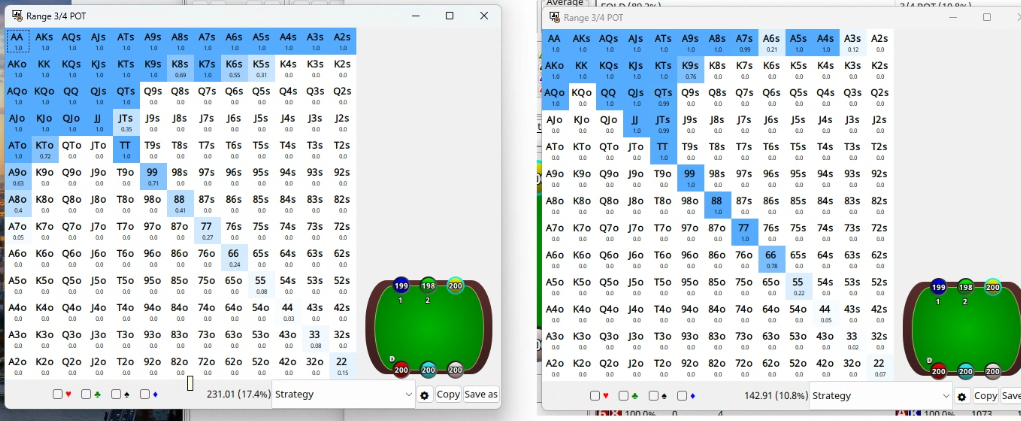
So I set up Monker to play 6-way 100BB with open of 3/4POT first GTO and then modified with two dumb dumbs in HJ and CO who call 20% of the time and only raise the top 2% of hands. Our LJ open goes from 17% to 10%.
So all else equal having callers in the first round does lower our ability to play some more marginal hands

It basically hinges on how well you're realizing your equity postflop... Indeed, if you lower folding frequencies preflop, then generally the bottom of the RFI ranges will go away as they are gaining most of their EV from folds. However, depending on how bad your opponents are then you may be able to just gain this EV back or more in the postflop nodes by still make them overfold in many postflop nodes while also getting lots of money in with the best hands. You're not really going to be able to easily sim this using something like HRC/Monker/simple postflop.
If hands are going multiway a lot, then hands that perform well in multiway situations will improve in EV... hands like pocket pairs and suited aces. A hand like K6s might end up being -EV RFI, but a low pocket pair or weak suited connector might have its EV jump up considerably. So, in my opinion, yes you should fold weak RFI hands that do not perform well multiway, but maybe increase RFI with hands that do... suited connectors/aces/pp.

The reality of playing against bad players is the opposite of what Monker is telling you. In solver fantasy land, mistakes made on earlier streets are not only identified, but perfectly corrected so as to minimize any original ev loss. Back in reality, not only do mistakes made on earlier streets pass by unidentified, but they get compounded down the game tree, and a -0.2bb preflop call turns into a -20bb river decision. As a general principle of the game, remember that the only way to effectively deter betting is by raising with a balanced range. In the absence of raising one very quickly gets to the point where one can bet his entire range for exactly the amount each individual hand is worth.
Speaking specifically to live games, yes we get called more but we also get 3-bet less. The risk of a 3-bet is one of the main factors limiting our opening range.
So I set up Monker to play 6-way 100BB with open of 3/4POT first GTO and then modified with two dumb dumbs in HJ and CO who call 20% of the time and only raise the top 2% of hands. Our LJ open goes from 17% to 10%.
Thanks for this! Super informative. A 7% decrease in open range is massive.
I wonder if there's a similar big discrepancy as well when 3-betting vs RFI.
e.g. BU vs LJ. Assuming LJ overcalls vs BU 3B by calling all pocket pairs and suited Ax, how would BU's 3bet/flat preflop morphology change?
If you'd be so kind to run the simulations and share them, that would be great too!
So I set up Monker to play 6-way 100BB with open of 3/4POT first GTO and then modified with two dumb dumbs in HJ and CO who call 20% of the time and only raise the top 2% of hands. Our LJ open goes from 17% to 10%. So all else equal having callers in the first round does lower our ability to play some more marginal hands
I missed your response when you first made it, but it surprises me that the effect is this large.
That being said, I agree with Brokenstars take. The sim assumes that the players are making this big mistake preflop, but then adjusting and playing perfect postflop. In reality their mistakes will continue to compound postflop, which will improve our EV and allow us to profitably play more hands.
Also in your sim you presumably let the computer solve the button's, SB's and BB's ranges in response to the HJ's and CO's node-locked over calling? The GTO response from them is going to include a lot of aggressive squeezing in response to the configuration you set up. That may or may not be the case in practice, but if that's the case you would definitely need to tighten up.
Again it's the threat of a 3-bet that is the biggest limiting factor for our opening range. If you modified your sim so that all players were over calling and under 3-betting then I suspect that our opening range should be wider than the 10% you cited.
Enjoyed following the discussion. I can’t get excited about suited connectors unless it’s paint, but I like suited aces & pocket pairs in early position.
Not sure anyone is considering that villain might 3bet a later street making it best to fold now. The talk was of making villain fold post-flop, but it could be villain’s plan to apply pressure in position.
Another take is that I just can’t 3bet enough in position. Nobody is opening tight enough.
Enjoyed following the discussion. I canÂ’t get excited about suited connectors unless itÂ’s paint, but I like suited aces & pocket pairs in early position.Not sure anyone is considering that villain might 3bet a later street making it best to fold now. The talk was of making villain fold post-flop, but it could be villainÂ’s plan to apply pressure in position.Another take is th
Good points here.
My approach from early positions is similar (mostly playing mid-stakes live games). I typically won't open the small suited connectors, but will open every suited ace. If the table is soft I open all pairs but if the table is tougher then I'll typically only open 66+ or 77+.
Good point too about how opponents can call in position and make our life difficult with postflop aggression. That's going to be a factor that makes us want to tighten up our preflop range.
In reality I think the best players have a bunch of different factors that they're using to mentally calibrate their ranges.
I picture it kind of like someone tuning a soundsystem with all the switches and dials. Good aggressive player to my immediate left- tighten this knob. Fish in the BB- flip switch to expand range and max exploit... Impatient looking short stack-tighten knob to skew starting range towards hands that can raise-call. That kind of thing.
Good post OP and I've been thinking about these things as well, although just for online 6-max. The sims I've run suggest similar range adaptations especially for EP, but CO and BTN seem not to care that much about later position wide cold call ranges, more about the risk of facing a 3bet, or the lack of it. So as early as cut off, the exploit open range is already as wide as GTO, but with more for an example KXs, QXs, low pp's, and less hands like JTo and A5o. The effect is more pronounced earlier, but then also with a slightly tighter overall range.
Also, once we start inputting higher than solver 3bet percentages from CO, BTN and SB, which online becomes a thing on some tables due to many people simplifying to mostly 3b/fold from those positions, and often overdoing it with some low/mid suited connectors, broadway offsuits or whatever, then the tightening effect is even more dramatic. That was not ofc your thread's point, but I think it's pretty important to know how overall table dynamics should affect our strategy. Meaning we have a better idea what to do in a loose passive table, a loose aggressive table, and a table where Vietnam vets are keeping themselves awake by consuming excessive amounts of coffee.
Anyways good post, thank you, and I like the fact that I'm not the only one thinking about these table dynamics and how we could learn solver logic behind solutions we find.


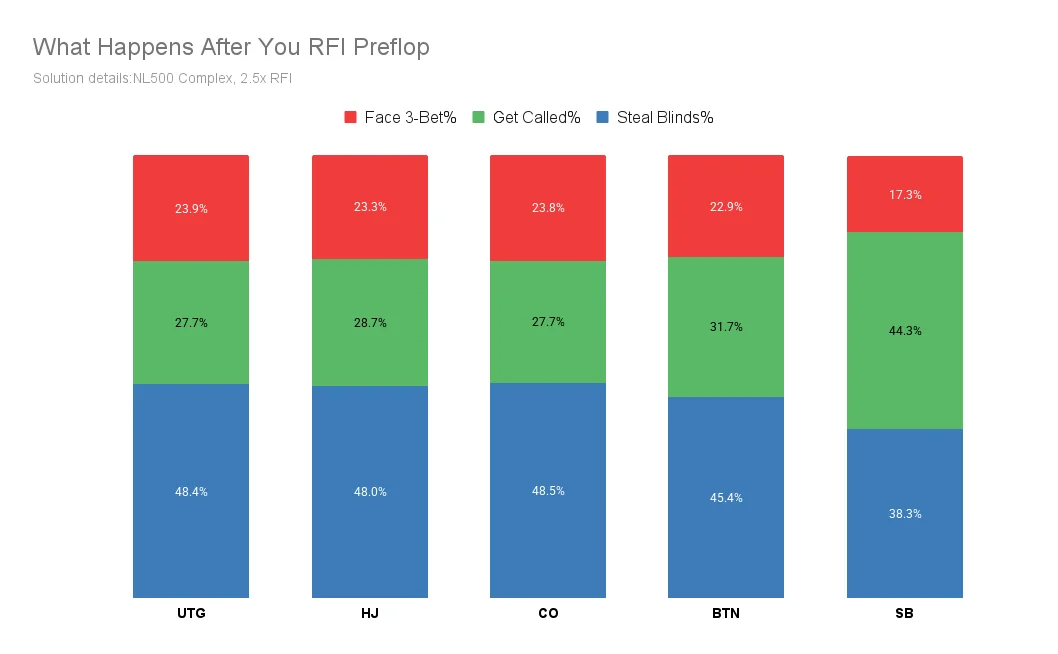
So it would seem the correct adjustment would be to tighten up from early position and loosen up from late position.
What about bet sizing though? Do you have any thoughts? I have seen stats showing that opening for a slightly larger size from late position and smaller size from early position outperforms using the same sizing for both.
That seems to conflict somewhat with the adjustments here though? If we're tightening up from earlier position wouldn't we want to use a larger sizing assuming inelastic ranges from our opponents and us having a more value-heavy range? That's the opposite of what I've seen good players stats suggest we should do.
In late position it would seem like we would want to use a smaller sizing with an expanded range to steal more blinds, but this conflicts with stats I've seen from real players who outperformed in late positions by using a larger sizing.

I believe the solver's preference for using bigger opens in late position is a consequence of the fact that you get called more and raised less overall.
But if you're nodelocking population's response, then the exploitative approach is to open with big sizes and tight ranges UTG, and small sizes with wide ranges on the Button.

I believe the solver's preference for using bigger opens in late position is a consequence of the fact that you get called more and raised less overall.
And probably positional advantage plays a part.
We want to keep the pots small when we are OOP to minimize positional disadvantage and bigger when we are IP to capitalize on our positional advantage.
But it also depends on SPR/implied odds/"effective jam principle".
And also equity when called.
I found a diagram you made.
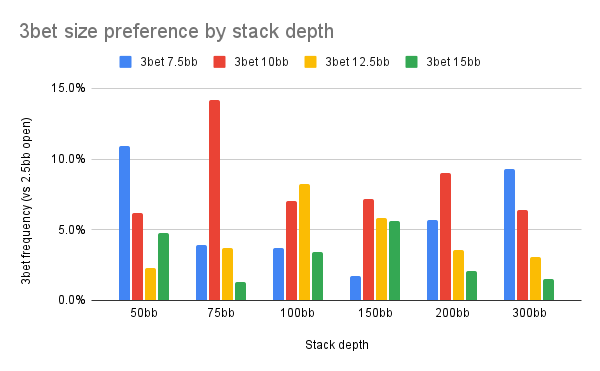
I believe the solver's preference for using bigger opens in late position is a consequence of the fact that you get called more and raised less overall.
But if you're nodelocking population's response, then the exploitative approach is to open with big sizes and tight ranges UTG, and small sizes with wide ranges on the Button.
Thanks. Yeah there's just tension between the exploitative approach in theory compared to in practice. I don't have the data to post, but I saw some stats from a good online grinder who showed they were achieving higher winrates using larger sizes in late position (not extremely larger, I think they were comparing something like 2.7x vs 2.5x). It's been a while and I don't remember the exact numbers, just that larger opens in late position were over-performing in practice over hundreds of thousands of hands.
And probably positional advantage plays a part.We want to keep the pots small when we are OOP to minimize positional disadvantage and bigger when we are IP to capitalize on our positional advantage.But it also depends on SPR/implied odds/"effective jam principle".And also equity when called.I found a diagram you made.
Thanks. Yeah see the tension I'm talking about? If human players are over calling vs early position opens but under-defending vs late position opens then you would think we would respond by opening larger with a tighter range from early position and smaller with a wider range in late position.
However this ends up bloating pots more when we're OOP. I'm thinking the informational advantage of being in position post flop might be enough to counteract the preflop effects? I'm still not sure what the best way is to hone our sizing and opening ranges.
Looking for takeaways from this discussion…
In position, large or small sizings - all options are on the table, because I can play many hands in many ways depending on the action I have seen.
OOP going strictly large, because I’m not playing AT or KQ like many people - my polarized range is premiums for value and little pairs as bluffs. Probably exploitable, but I know where I’m going.
I see many players open weak hands OOP without a plan of any kind & get 3 callers. In theory, everyone should fold to an UTG bet often, but they don’t which explains the bloated pots. Yet, if you are way ahead, you want the money in there.
I think most people understand wider ranges from the button, but I think few understand how tight to play OOP. Your strong hands are rewarded with people calling way too much.


