Flop strategy and turn overbets
I've been using a simplified flop strategy where in position vs fish I bet 1/3 with my whole range and I size up to 2/3 with tp+. Currently I don't use turn over bets but I use 85 percent as a larger sizing. Maybe it's time to add overbets into my strategy and utilize a more complex flop strategy? I know when I move up I will need to make some changes. This is working well at NL10 but I could probably get more sophisticated. Any tips for when to implement turn over bets and flop sizings?
17 Replies

turn overbets will be utilized predominantly on blank cards or cards that are particularly good for your range...
turn overbets will be used significantly less on turns that shift equities... so think most pairing turns, flush completing turns, and turns that add straight possibilities (when they exist in OOP range).
just general statements.
turn overbets will be utilized predominantly on blank cards or cards that are particularly good for your range...
turn overbets will be used significantly less on turns that shift equities... so think most pairing turns, flush completing turns, and turns that add straight possibilities (when they exist in OOP range).
just general statements.
Kind of different than what I would've thought. I thought it would be turns where we have a polarity advantage but the turn gives the villain some smooth equity. Like turns that add a flush draw to a rainbow flop or a bd straight draw
Kind of different than what I would've thought. I thought it would be turns where we have a polarity advantage but the turn gives the villain some smooth equity. Like turns that add a flush draw to a rainbow flop or a bd straight draw
Generally speaking not really.
Also it sort of depends on flop sizing... a smaller flop sizing with a higher c-bet frequency means that OOP is supposed to raise most of their stronger hands on the flop... so when they x/c and turn is a blank OOP's range is comprised primarily of bluff-catching hands and IP is very much uncapped. This leads to larger sizings and a more polar bet sizing strategy.
For turns that complete flushes you will really not see overbets used in equilibrium much at all, however, after they x/c turn for let's say a 75% sizing and a river comes that is a blank (so basically no paired river), then nut flushes = nuts and you'll start to see overbet jams again (~3-4x pot). So, again, generally speaking, if there are equity shifting turns then that does not preclude IP from having overbets on the river at the very least with a subset of their betting range... one that includes nuts... so strong trips/boats/flushes/straights on those equity shifting turns.

turn overbets will be utilized predominantly on blank cards or cards that are particularly good for your range...
turn overbets will be used significantly less on turns that shift equities... so think most pairing turns, flush completing turns, and turns that add straight possibilities (when they exist in OOP range).
just general statements.
This is something that I have been wondering about so if you don't mind me jumping in a couple of questions:
Is this a correct time to do it?
I don't see turn overbets much in the wild (5/10nlz) but when I do see them it's often where the turn card has created a second flush draw.
So, let's say flop is K♥ 2♠ 6♠ and then the turn is 8♥
That's when I'll see someone overbet the turn (I suspect with a completely unbalanced value heavy range because they are afraid of being outdrawn with these new backdoor possibilities).
Is it theoretically correct to overbet in that spot?
Best bluff candidates on dry bloard
In order to have a balanced overbet range we need to have bluffs
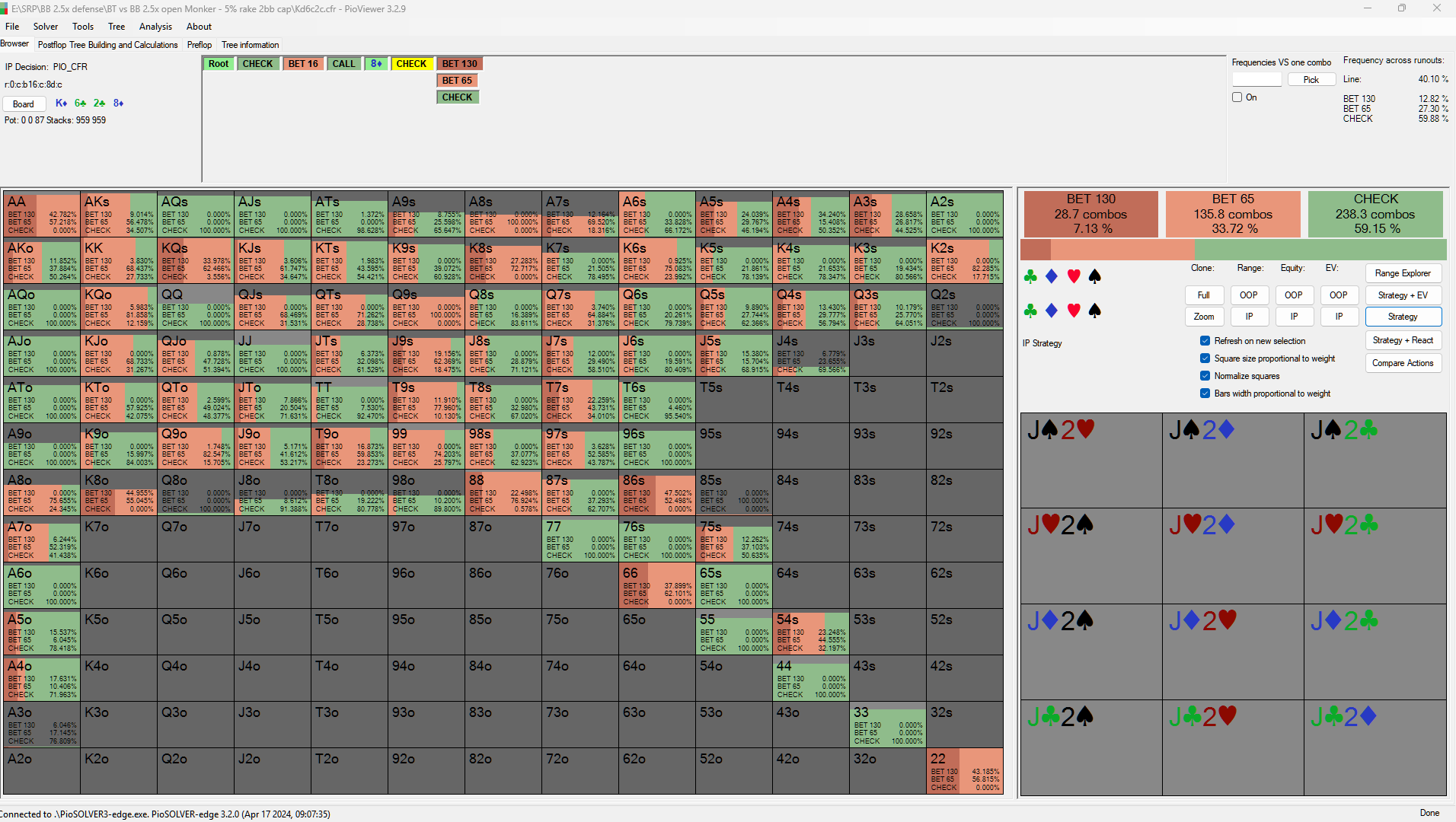
Let's say the board was K♥ 2♠ 6♦ turn is 8♣
What would be a good candidate for overbetting here as a bluff for an in position player after they raised preflop and the flop went check-bet-call ?
H2 is more of an overbet than H1, because H2 has more equity shifting rivers and some floats of OOP picked up additional equity... Difference is small though.
Potential bluff candidates are flush draws in h1, straight draws, or possibly some mix of middling hands or AX combos that are weak. Middling combos like JT/QJ block some of the better KX combos, have decent equity when called vs. lower pairs and make AX combos fold. For the AX bluffs you have equity vs. KX, and make better AX and weaker pairs fold.
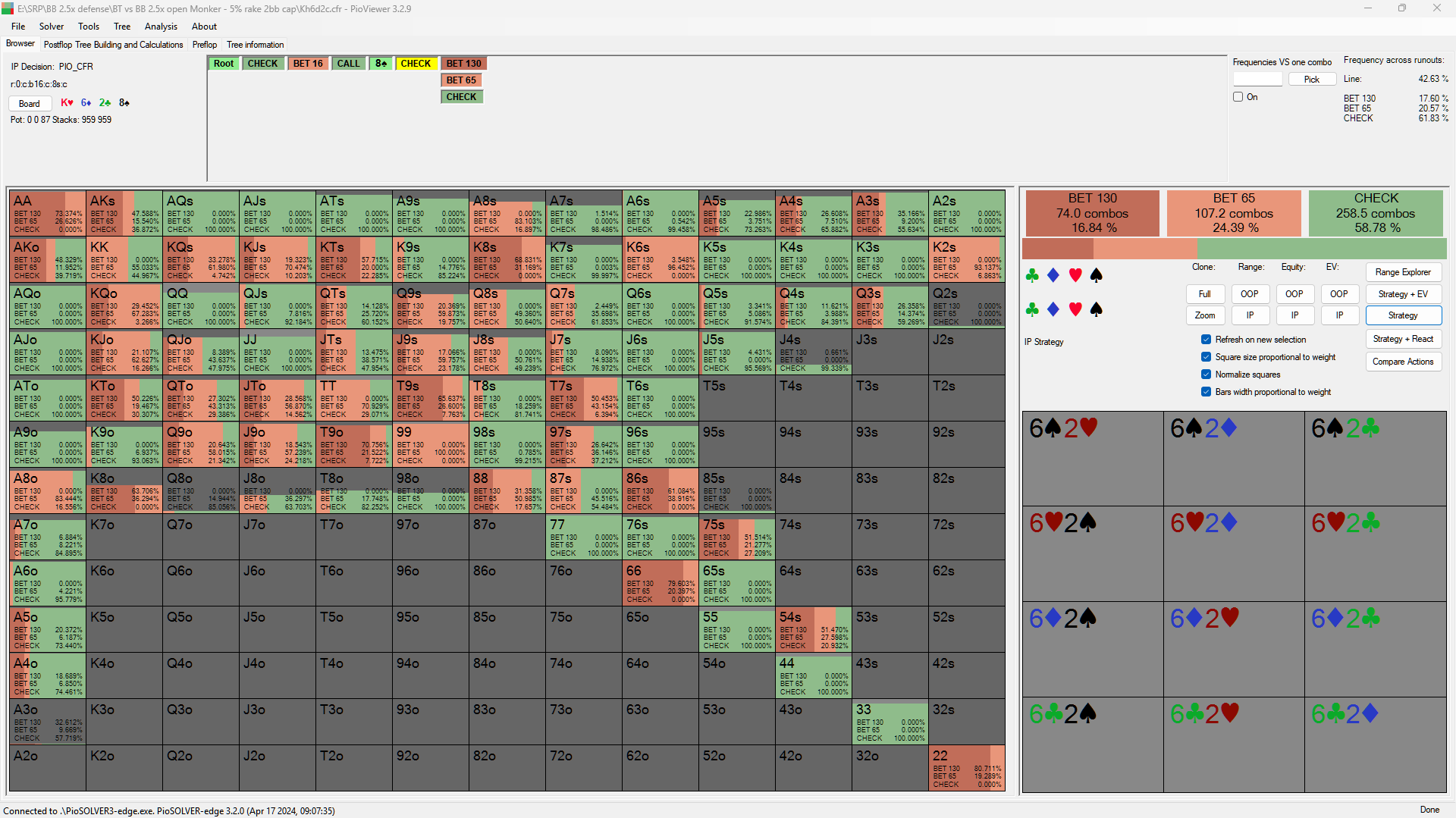

I've been using a simplified flop strategy where in position vs fish I bet 1/3 with my whole range and I size up to 2/3 with tp+. Currently I don't use turn over bets but I use 85 percent as a larger sizing.
To add to brokenstars' generalizations, I'll also add a generalization that the difference between the two turn sizes you're utilizing (B67 and B85) is too narrow to warrant analyzing too deeply.
Geometric pot increases mean that subtle differences in sizes can matter more on earlier streets, so a minraise vs 2.5bb RFI size will have a notable impact on SPR, and range betting B25 will lose notable value versus B33 if used in the wrong situations. On the flipside, by the time you get to the river, you can honestly limit your bet sizes to just B20, B75 and B300 and have almost all your bases covered.
Obviously turn bet sizing is somewhere in the middle, and you don't need to go 4x's as big to have a meaningful impact on EV. But the difference between B67 and B85 is literally smaller than the difference I used in the flop sizing example (B85 is just 27% larger than B67 whereas B33 is 33% larger than B25).
Now, subtle differences in sizes can matter as more of a psychological matter than a theoretical one. So just barely overbetting the pot may get outsized respect compared to betting exactly pot relative to the difference in pot odds. For this, you'd want to perform some MDA.
All that is to say: If you want to learn important theoretical differences in turn bet sizing, I would start your study with spots where sizing is notably different; say, spots where underbets are favored versus overbets versus B50-B100. Brokenstars' post is a great, quick, general primer on this. You may also want to look at the differences between betting in-and-out of position, different SPRs, and broken-versus-continuous-versus donk lines.
If you want to understand specific exploitabilities, I'd perform MDA, either yourself or consult existing resources. Obviously you'll want to favor sizes that are overfolded with your bluffs and sizes that are overcalled/raised with your value.
IME range splitting sizes based on your specific hand is something best done as an exploit, at least until you get to the river. If you want to get into the nitty gritty of range splitting into different sizes OTT as a theoretical matter, then godspeed you brave king!
I'll also add to Brokenstars' excellent points that blanks exist on a spectrum. (And indeed overbets exist on a huge spectrum).
In the K62 example, if it's a sufficiently wide configuration (ie: most single-raised pots), even an offsuit 8 will help the defender pick up a set of 8s and some 86/K8 type two pairs. If you reverse the order of the runout and say it's a K86 2 runout, that 2 will be even more of a blank. This might make the first runout more of your B111 type "overbets" whereas a truly dead undercard may be more of your B133+ type overbets.
Effective blanks are more common in tighter configurations, so the K62 8 runout may allow for gaudier overbets in (say) UTG vs BB 3bp, assuming stacks are deep enough that SPR doesn't make the geometric bet size much smaller.
This may undercut my point about not sweating very subtle differences in bet sizes, but here it is nonetheless 😃
To add to brokenstars' generalizations, I'll also add a generalization that the difference between the two turn sizes you're utilizing (B67 and B85) is too narrow to warrant analyzing too deeply.Geometric pot increases mean that subtle differences in sizes can matter more on earlier streets, so a minraise vs 2.5bb RFI size will have a notable impact on SPR, and range betting B2
Ty for this. Ive successfully used an oversimplified strategy that I know will need fine tuning as I move up. Could you give an example of a board that would strongly prefer small sizing on the turn? I'm getting a feel for what the overbets spots might look like
Ty for this. Ive successfully used an oversimplified strategy that I know will need fine tuning as I move up. Could you give an example of a board that would strongly prefer small sizing on the turn? I'm getting a feel for what the overbets spots might look like. Maybe a Q658? Where I assume we have a range advantage but we lost our nuts advantage? I'm thinking about maybe usin
You can have a simplified strategy at high stakes also... But you will certainly need overbets for turn. You can still just use one sizing for turns and I don't think you're going to give up a lot of EV... just don't use one sizing for "all" turns, but like one sizing for a specific turn... as in don't split your ranges with sizings ott and I think that's okay. Now, rivers you basically have to split sizings or you'll give up too much EV in my opinion, but that's a separate topic kind of.
Small turn sizings would probably be something like a 4-flush turn board or something. Not using small sizings for turns IP is also not really going to give up EV though. Just do something like 75% or 150% and you're covering your bases fine.
You can have a simplified strategy at high stakes also... But you will certainly need overbets for turn. You can still just use one sizing for turns and I don't think you're going to give up a lot of EV... just don't use one sizing for "all" turns, but like one sizing for a specific turn... as in don't split your ranges with sizings ott and I think that's okay. Now, rivers you
Ty very much broken. Using 75% and 150% (or some overbet amount) feels very manageable. Rn at my current games I think I can make plenty of mistakes with two sizings and still be winning
You can have a simplified strategy at high stakes also... But you will certainly need overbets for turn. You can still just use one sizing for turns and I don't think you're going to give up a lot of EV... just don't use one sizing for "all" turns, but like one sizing for a specific turn... as in don't split your ranges with sizings ott and I think that's okay. Now, rivers you
Sorry to keep hammering you with questions. I assume OOP it would be necessary to include a smaller size. Like maybe simplifying to using b50 on some turns, and b75 on others. Are overbets used OOP?
Sorry to keep hammering you with questions. I assume OOP it would be necessary to include a smaller size. Like maybe simplifying to using b50 on some turns, and b75 on others. Are overbets used OOP?
Block sizings are significantly more important OOP... depending on the situation it can be very good for you to include. Some spots could be simplified to more polar strategies and not include them without losing much EV, though.
So, depends.
Block sizings are significantly more important OOP... depending on the situation it can be very good for you to include. Some spots could be simplified to more polar strategies and not include them without losing much EV, though.
So, depends.
Is 50% small enough to be your small size OOP or does it need to be 33%?
Ty for this. Ive successfully used an oversimplified strategy that I know will need fine tuning as I move up. Could you give an example of a board that would strongly prefer small sizing on the turn? I'm getting a feel for what the overbets spots might look like
Kind of a hot take: While I agree with everything that's been said in this thread on the matter (including by myself), I think the board is lowkey the most overrated factor for bet strategies.
Factors that would make me bet smaller OTT include:
1) The geometric bet size is less than 50% pot
2) Villain's range is too weak and too inelastic to bet sizing (eg: a common low stakes and fish leak is checking back flop as the PFR and folding to any bet size OTT)
3) Being OOP doesn't allow for us to bet as polar in general due to a) splitting aggression ranges between leading and x/ring and b) the incentive to block bets that doesn't exist IP where you can simply close the action of a street by checking
4) Multiway pots force you to bet smaller due to the effects of pot odds/MDF math and equity protection math when changing the denominator
5) Whether I'm the previous street's aggressor, its defender, or it's a broken line
6) Donking - obviously this combines elements of #3 and #5, but underbetting is so predominant in these lines I thought it deserved its own line.
The above makeup the majority of my justifications for sizing down.
The one board-related justification for sizing down OTT would be because there are very few bluffs in my range, eg: You can often range bet for
This is why I said you should play around with different positions and nodes and stack sizes, etc to see how they affect bet sizes, but I guess I kinda just spoonfed many of the answers. Oopsy daisy!
Kind of a hot take: While I agree with everything that's been said in this thread on the matter (including by myself), I think the board is lowkey the most overrated factor for bet strategies.Factors that would make me bet smaller OTT include: 1) The geometric bet size is less than 50% pot 2) Villain's range is too weak and too inelastic to bet sizing (eg: a common low stakes
These are exploitative adjustments. If you can exploit, then you should do so. If you think a specific sizing has higher EV for your specific hand and vs. a specific opponent, then definitely use it. All good points.
TBF only #2 is purely exploitative.


