Figuring out the equity needed in bounty tournament MW spot
23+2 USD Big Bounty MTT. The starting bounty is 16 USD, so 69.5 % of the buy-in sans rake. Starting stack is 10K. BTN bounty (that I win) is 8, SB is 52.
NL Omaha $23+$2 (350BB)
HJ ($9950)
CO ($36322)
BTN ($19000)
SB ($66470)
BB ($36720)
HERO ($76173)
Dealt to Hero: Q♦ 4♣ 4♦ Q♠
HERO Raises To $1275, HJ Calls $1225, CO Calls $1225, BTN Calls $1225, SB Raises To $7750, BB Folds, HERO Calls $6475, HJ Folds, CO Folds, BTN Raises To $19000 (allin), SB Raises To $66470 (allin), HERO Calls $58720
Size of main pot after my call is 60K, side pot 95K.
I feel pretty confident it is a snap call given the huge bounty on SB, but regardless I would like to have some method of figuring out a rough number for the equity needed in-game.
4 Replies

Let's simplify it to one pot. You're calling 60k and the pot will be 155k after you call. You cover and can win a $60 instant bounty (60/8 = 7.5x starting bounties).
Starting bounty in chips as a % of starting stack = Bounty Prize Pool% * Instant Bounty% = 69.5% * 50% = 34.8% of a starting stack.
The starting stack is 10k chips, so a starting bounty is worth ~3475 chips at the beginning of the tournament. Therefore, 7.5x starting bounties are worth ~26k chips.
Pot odds = 58720 / (155k + 26k) = 32.4%, corresponding to a risk premium of about -5.5%.
Ok so that's not bad. But it's important to note that the bounty is worth more chips as the tournament progresses. The reason for this is that the value of a chip diminishes as prizes and bounties get paid out. So that same $60 bounty might be worth closer to 40k chips near the bubble.
The general method is to define some conversion factor, and translate the bounties into prizes:
Exchange rate = Chips / Prizes
- Prizes = Remaining Bounty Pool + Remaining Prize Pool
- Chips = Total chips in play for everyone in the tournament (entries * starting stack)
That gives you a way to translate dollars into chips and vice versa at any point in the tournament. Multiply their bounty by the conversion factor and plug it into the reward side of a pot odds equation.
Here's what my bounty calculator spits out:
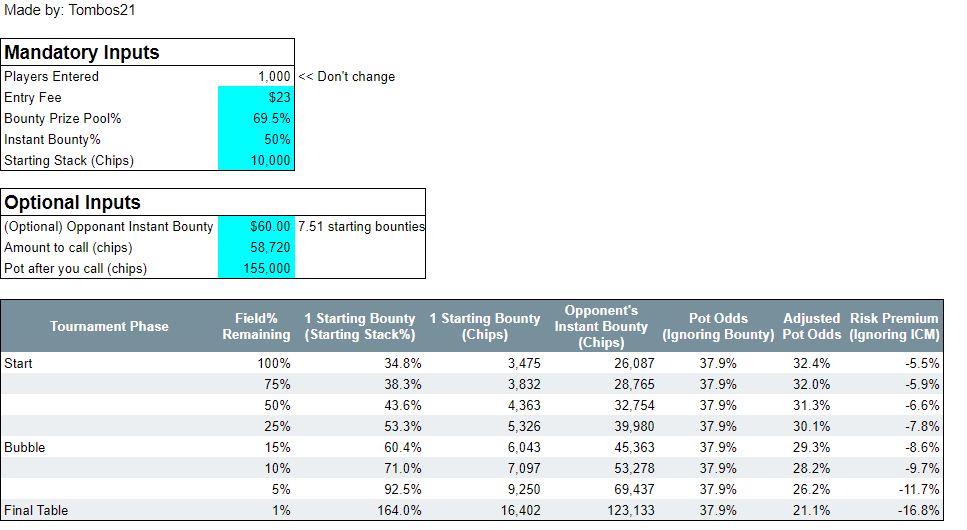
Assuming 1k runners:
$60 bounty * 10M Chips / $23k Prizes = 26, 087 chips at start of tournament.
But when 50% of the field remains some of the prizes have been paid out, so the value of a $60 instant bounty jumps up to 32, 754 chips.
Read more:


Limitations:
1) The proper way to do this is to calculate your equity in the side pot separately from the main pot. So you have two separate pot odds calculations.
2) This conversion factor is a chip EV method that loses accuracy when ICM becomes a major factor. It's a good shortcut but it's not the most accurate way. The way to calculate this properly is demonstrated in this article:

Hey tombos,
Fantastic answer, thank you. I was reading through the section about future bounty EV and was somewhat surprised that we increase our value by 122% by doubling up at the first hand of the tournament, in contrast to 97.5% for a normal tournament. It makes sense that it's over 100 %, but I didn't know it would be quite this much. That means it's +EV to stack off if we have more than 40% equity, which is not exactly hard to achieve in Omaha. GGPoker also have the PLO-NL format which makes it very easy to realize your equity post-flop. So I'm wondering how that should shape our strategy. On the one hand it makes sense to play hyper-aggressive, but on the other hand we suffer a comparatively big drop in EV if we lose a small pot on the first hand and no longer cover anyone at the table.
Regarding covering players at the table, well, that's where I was wondering if the method of calculating future bounty EV gets too simplistic, especially at a final table where the bounties vary wildly and there are no more table changes.
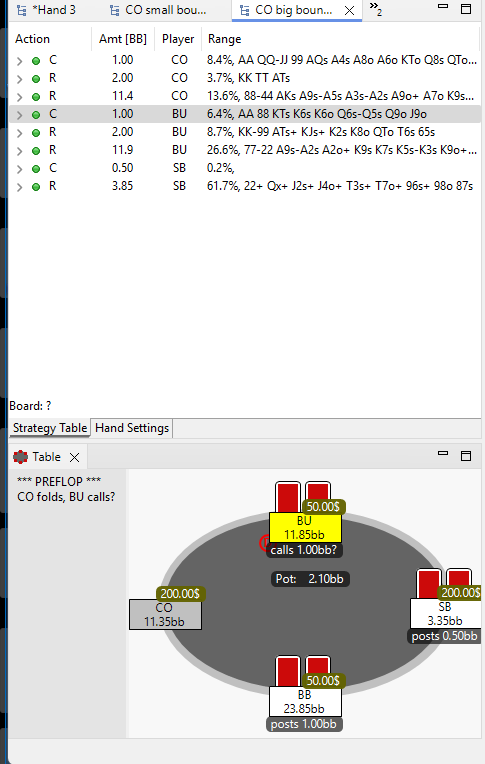
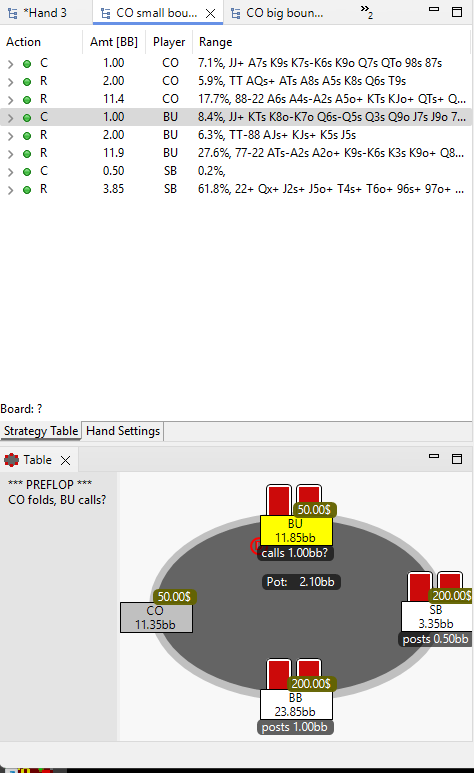
Consider a situation where we are on the button and we cover CO by half a big blind. They fold to us. The BB covers us. Now, if the BB has a small bounty and the CO has a big bounty, we would want to play more shoves compared to limps than if we switch the bounties around. I ran the two scenarios in HRC, which does seem to succeed in accounting for this. Unfortunately I don't have a Elite subscription to GTOwizard at he moment, so I can't see if you account for this as well.
Fantastic answer, thank you. I was reading through the section about future bounty EV and was somewhat surprised that we increase our value by 122% by doubling up at the first hand of the tournament, in contrast to 97.5% for a normal tournament. It makes sense that it's over 100 %, but I didn't know it would be quite this much.
For context, the example in
was doubling your stack first hand of a 50% PKO: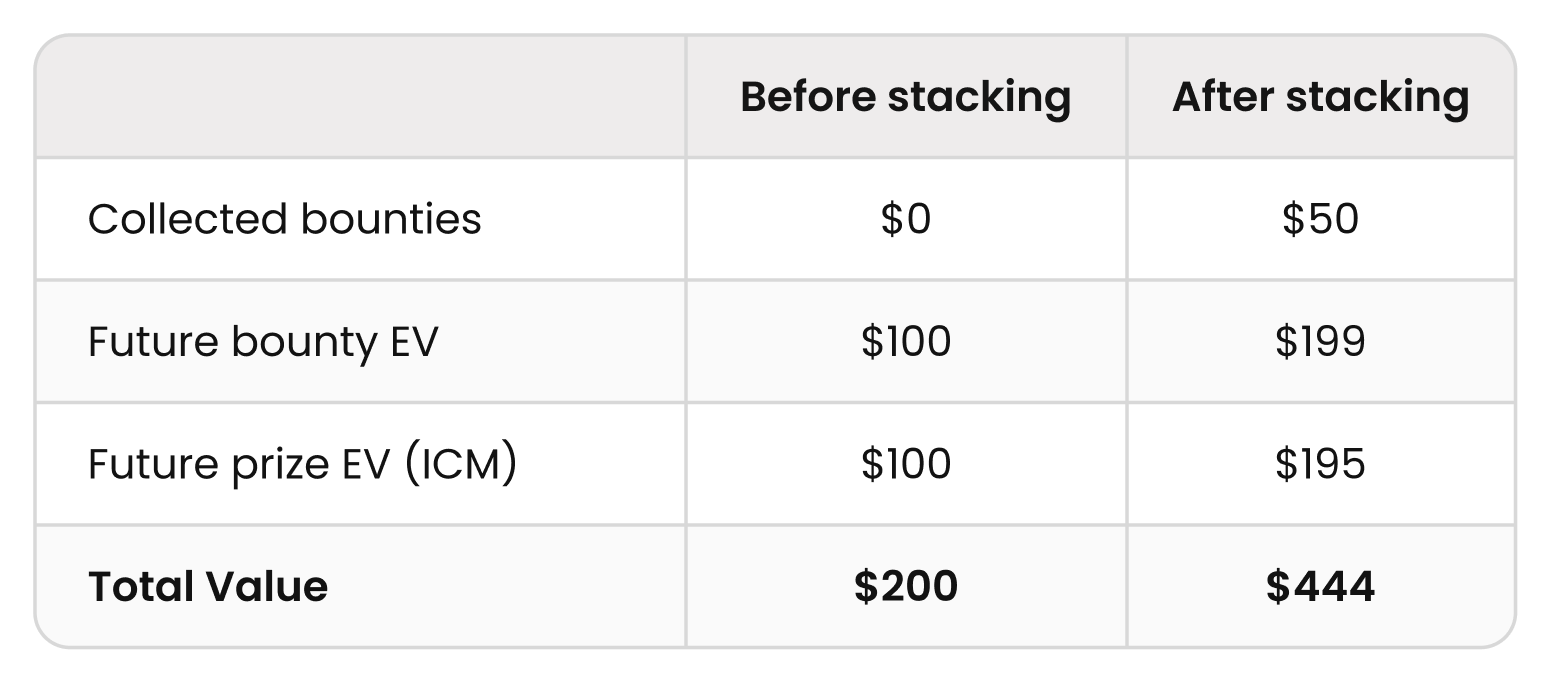
One way to think about it is that you get an (almost) 100% boost from the double up, plus a 25% boost from the bounty, because the bounty was worth 25% of a starting stack in that example. In your games I guess it would be closer to ~135% boost because the bounties are bigger.
Regarding covering players at the table, well, that's where I was wondering if the method of calculating future bounty EV gets too simplistic, especially at a final table where the bounties vary wildly and there are no more table changes.
The proportional bounty model (future bounty EV = bounty prize pool * chip portion) is surprisingly accurate for larger fields. This is what GTO Wizard as well as HRC uses. ICMizer has something called a TrueBounty model that predicts the future collisions between players. TrueBounty is computationally intensive so they still rely on the proportional model for large fields.
Consider a situation where we are on the button and we cover CO by half a big blind. They fold to us. The BB covers us. Now, if the BB has a small bounty and the CO has a big bounty, we would want to play more shoves compared to limps than if we switch the bounties around. I ran the two scenarios in HRC, which does seem to succeed in accounting for this. Unfortunately I don't have a Elite subscription to GTOwizard at he moment, so I can't see if you account for this as well.
GTO Wizard doesn't yet have a multiway preflop solver so I can't run some comparison sim for you. But HRC and GTO Wizard essentially use the same framework for solving knockouts: ICM + Proportional bounty model.
HRC and GTO Wizard essentially use the same framework for solving knockouts: ICM + Proportional bounty model.
Alright, I see. So it was just noise in the calculation then, because the ICM and Proportional bounty value remains exactly the same across both hands.
I'm sufficiently curious about this now that I'll compare the strategies for the same spot with ICMizer's TrueBounty model in the near future.

