Bet size when both players frequently have the nuts?
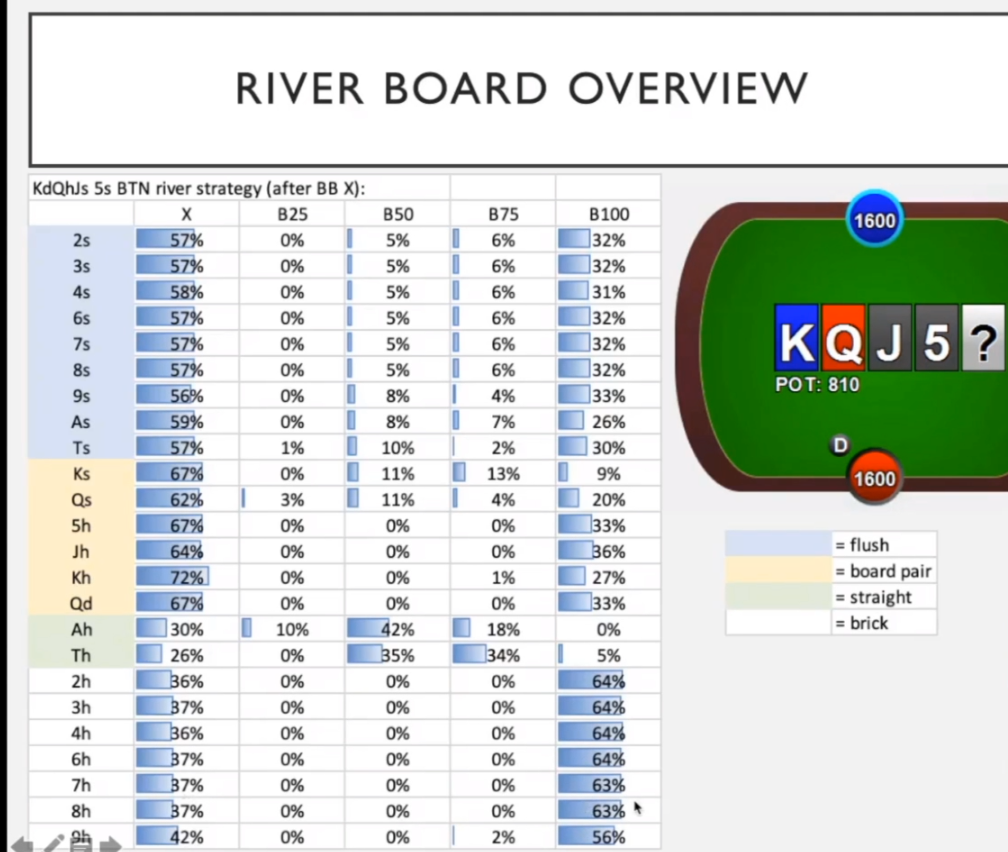
This chart show's BTN river bet sizes on a variety of rivers, after betting flop and turn.
BTN favors a B100 or check strategy on almost all rivers, except the offsuit A and offsuit T (bringing in 4 to a straight), where it prefers a medium sizing.
The explanation given in the course is that both players will frequently have the nuts, and because of card removal, it's hard to get called by worse when we have and block the nuts. (This explanation makes perfect sense).
However, a clear exception is when we have the nut flush. We still B100, and expect to get called by worse when we know for a fact they can't have the nuts.
I feel there is a theoretical concept that explains why we can B100 with the nuts (and nut blockers) in some situations, but we B50 with nuts/ nut blockers in other cases. Does it have to do with the ratio of value and bluffs in our range? Or is it simply because it's easier to have the nut straight on a 4-straight board, whereas it's less likely combinatorically to have the NF on a flush board?
5 Replies

Let's say the river is As for example and we have KQssT9....we want to B50 to target smaller flushes and we block the main flush we would want to targe with a large bet size
There are certain players B33% can be good bc they will always call with a straight here and since the flush is BD and we have it they're even less likely to have it. As well as the fact that small flushes don't interact with this board well on the flop so that lowers the flushes we run into even more
I’m pretty sure it has to do with the nut straights being able to be shared, and so common (more than 1 combo exists in both ranges simultaneously), where there’s only 1 nut flush available, so the blocker is more relevant, and you won’t be raised by shared nuts. When the flush comes in, the nut blocker and nuts are always testing non nuts.
When the straights come in, nut blockers and nuts are still in both ranges, even if you hold them. That’s not the case for the flush.
What’s the response to the b50 line from bb?
There’s only 1 nut flush but there’s multiple nut straights available.
How deep is the sim at?
Sent from my iPhone using Tapatalk
Let's say the river is As for example and we have KQssT9....we want to B50 to target smaller flushes and we block the main flush we would want to targe with a large bet sizeThere are certain players B33% can be good bc they will always call with a straight here and since the flush is BD and we have it they're even less likely to have it. As well as the fact that small flushes
The solver is still B100 with As. It only B50 with offsuit A.
I’m pretty sure it has to do with the nut straights being able to be shared, and so common (more than 1 combo exists in both ranges simultaneously), where there’s only 1 nut flush available, so the blocker is more relevant, and you won’t be raised by shared nuts. When the flush comes in, the nut blocker and nuts are always testing non nuts. When the straights come in, nut block
I didn't run the sim, I'm not really sure how BB responds to B50.
I agree with you that the big distinction is that there is only one NF possible on the flush boards (As is the ultimate blocker), whereas on straight boards, no blocker has ultimate power and both players can have straights.
But it's not intuitive to me why we can't B100 with our straights. Perhaps it's because we can't B100 with our straight blockers, because they aren't as powerful. Our ability to B100 ultimately comes from the power of our NF blocker?
Or does it somehow have to do with the ratio of our value and bluff hands? (I remember reading an old poker theory book that argued the more bluffs we have in our range, the larger we can bet.)
I didn't say "with" As....I said when river comes As which is what it looks like this chart is showing unless I am reading it wrong. And it shows what bet size/% on each river
On As river it's B50 8%. I was giving you an example of a hand I believe would fall into that 8%, tho the more you block the likely flushes they could have with Ks/Qs/Ts the more you should consider betting even smaller as having a low flush is hard to do on this board since the flop is so disconnected from low/middling cards
Also we should never be playing poker GTO, we should be forming a baseline for how to play thru the solver then playing an exploitative style
You need a polarity advantage to be able to bet big


