A thread for unboxing AI

The rapid progression of AI chatbots made me think that we need a thread devoted to a discussion of the impact that AI i

I mean, it isn't missing anything. It is exactly what these current models do. They predict the next token to come up based on probability. This is called guessing.
And I'm well aware of Geoffrey Hinton, I suspect I have heard and read him more than most in this thread. If you actually watched the first 10 minutes of the video you linked for me to gain "a basic understanding", you would seen him describe current AI models pretty like I have done in my posts you take issue with, for example in this timestamp: https://youtu.be/IkdziSLYzHw?t=479
People treat these machines as if pointing out their mechanics is somehow an insult.

You need to get past the 'insult' thing
In your clip he is explaining that the model learns features of words and how words interact. That is the 'clever bit' That is the AI. It's a model of language
It's language model which is far more powerful and intelligent then a dictionary model
Her's an AI oiverview (😀) of Hinton's view on this. You think is substantially incorrect about what he says?
AI Overview
Geoffrey Hinton believes that Large Language Models (LLMs) do understand and aren't just glorified "autocomplete" systems; he argues that they form causal representations and can infer, explain, and plan, suggesting that many people fail to grasp how LLMs work and mistakenly believe they are fundamentally different from humans, rather than simply more powerful learners.
Hinton's Argument for LLM Understanding:
Not Just Predicting Text:
He contends that LLMs go beyond simply predicting the next word or symbol. Instead, they are developing internal, causal representations of the world, allowing them to perform complex tasks like reasoning, inferring, and planning.
Like Humans:
Hinton notes that human brains also have a complex and not fully understood way of processing information and generating meaning, and that LLMs share some fundamental learning mechanisms with humans.
Emergent Abilities:
He emphasizes that these models can learn new tasks very quickly with just a few examples (few-shot learning), even logical tasks they weren't explicitly trained to do, indicating a deeper form of learning.
Why People Misunderstand:
Underestimating LLM Capabilities:
Many critics, like Gary Marcus, misunderstand how these models function, mistakenly believing they are just "pastiche-ing" text.
Confusing Simulation with Understanding:
Hinton implies that there's a reluctance to admit that true understanding is emerging in LLMs, partly to avoid increasing ethical responsibilities.
In essence, Hinton's view is that the emerging capabilities of LLMs suggest a level of understanding comparable to or even exceeding human abilities in certain contexts, and the current debate often stems from a misunderstanding of their internal workings and learning processes.
Happyy to debate where we think Hinton may be wrong but I dont think you can argue that he agrees with your claim about LLMs
You need to get past the 'insult' thing
In your clip he is explaining that the model learns features of words and how words interact. That is the 'clever bit' That is the AI. It's a model of language
It's language model which is far more powerful and intelligent then a dictionary model
Yes, it is a model. From large datasets the model is trained to pick up probable relationship between words stored as tokens. This creates a large web of overlapping relationships, aka a neural network. This is the "language model" which the machine uses to later make answers. An answer is made by using its model to predict one token at a time, until an end token is predicted. It's like laying a brick road one brick at a time, and continue the roadbuilding by guessing where the next brick will go or if you are finished laying the road.
When we say we don't understand exactly how these machines work, we are referring to the sheer scale and complexity of these neural networks, which contain far too many probabilities for us to grasp the relationships they contain, nor can we know where a query will lead. Similarly, the datasets we feed them are too big to be fully known by a single person.
However, their mechanics are simple. The code that makes an AI tick is not complex, nor are the rules this code binds it too.
Her's an AI oiverview (😀) of Hinton's view on this. You think is substantially incorrect about what he says?
Happyy to debate where we think Hinton may be wrong but I dont think you can argue that he agrees with your claim about LLMs
He reiterates the exact same points I'm making in this thread in regards to how these machines work. Which is what I'm interested in.
-
If you want to expand it further, this AI summary you offer is not really a fair summary of Hinton's case on the nature of AI and potential for cognitive abilities. His case is more about the possibility of these things, than conclusions. Which is in itself an interesting commentary on AI and relying on it, but I digress.
Essentially, his argument is that due to the complexity and scale of the neural network, we can't say that these machines don't possess more advanced cognitive abilities. He also points to similarities between our electro-chemical neural networks and these digital neural networks. And since the the query through the network looks superficially similar to our neurons firing when we think, and because the output can be similar to what a human produces, he argues that machine possesses some of the cognitive abilities we do. Basically, certain constellations in the neural network would be the equivalent of a cognitive ability.
While intriguing, Hinton knows that to make this into a strict claim would be logically fallacious. It would ignore that maybe neither of us has cognitive abilities, and it also ignores that different processes can give similar results. You can add 2 and 2 together and you can spell boobies when held upside down, that doesn't mean you function internally like TI-92 calculator or come with a COS-button.
Still, a lot of people are swayed by this argument, because they think a neural network is something very mystic. It isn't. It's a set of nodes with connections between them, going in all directions. Imagine tying string between all the possessions in your apartment with varying degrees of slack (slack would represent the probabilities between tokens in the language model). Now, thousands of items were connected to a thousands items and millions of pieces of string criss-cross everywhere with various levels of slack. It would be mostly impossible to predict what happens if you pull on a string, because the size and complexity of the network makes it impossible to have full knowledge of the system. However, the mechanics of what happens is very simple. And the complexity and unknown qualities of the network does not mean it is justified to start speculating about your apartment's newfound abilities.
So while these speculations are exciting to some, it is mostly a neat party trick. It masquerades the fact that our neural networks aren't hooked up to binary computers making floating point operations based on fully known and simplistic rule-making that decide how they are formed and what they output. A bit more complex than a pullable piece of string, but still a fully known quality.
Do I think this speculation is incorrect? Well, speculation can't really be incorrect. I would say it is not very interesting, for the same reason that a discussion on invisible gnomes living in my basement isn't very interesting. Superficially intriguing, but ultimately pointless.
Of course it's a neural net. The issue is whether neural nets can achieve understanding and Hinton clearly argues it does.
There's quite a good interview here:

In the video earlier he gives his lego explanation and claims ithat's what understanding is:
Here's some more on it from that article
Professor Geoffrey Hinton: Yes. And I'm going to assume that they operate on words or that they operate on word fragments because it's easy to describe if they operate on words. So rather than taking a sentence made of words and converting that into an unambiguous logical form, what they do is take these word symbols and convert the word symbols into big vectors of neural activity, big sets of active features. And of course, you can't always decide what set of active features you use for a word because it depends on context. If I give you the word male, that could be a month, it could be a woman's name, or it could be a model, I want to assure you. And so you don't initially know how to convert it into a big set of features. So you sort of hedge your bets. And then use multiple layers of neural net to gradually disambiguate it, to clean it up by interacting with the feature vectors for other words in the context. And once you have turned these words into the right feature vectors, that is understanding. Now, the interactions are quite complicated, but create the right feature vectors. So let's take an example where we understand modeling. If I take any distribution of 3D matter, I can model it up to a certain accuracy by using Lego blocks. I can take the shape of a Porsche. If I'm not worried about the shape of the surface, I can model that shape quite nicely with Lego blocks. So Lego blocks can model any 3D distribution of matter up to a certain resolution. Words allow Lego blocks but for modelling anything. So Lego blocks are three-dimensional. Words have feature vectors that are maybe a thousand dimensions, so they're much more complicated. What's more, each Lego block, and each word has a name, which is the name of the word, but that doesn't totally determine the shape. In Lego, you have different shapes of Lego blocks, but they're not deformable. With words, they're deformable, and they deform to fit in with the other words in the context. So that gives you shades of meaning. Also, the way they interact is more complicated than Lego blocks. So Lego blocks, you have a little plastic cylinder that goes into another plastic hole, and that's it. With words, if you want a model of what's going on in chapters, think of each word as a high-dimensional Lego block that's got an approximate shape, but that will deform to fit in with the other words. Think of the Lego block as covered with little hands, and if you deform the Lego block, the shape of these hands changes, and they have to shake hands without the Lego blocks, and they have to choose which other Lego blocks to shake hands with, plus with attention. Multi-head attention is these multiple hands. And so, for a normal person, a good model of what's going on is the names of the words telling which Lego blocks to use. The Lego blocks are deformable, and they deform around to try and shake hands without the Lego blocks in the context to make a nice structure. Once they've done that, that's understanding. And you can see it's quite like the protein folding problem. With proteins, you have a bunch of amino acids, and you have to figure out what shape they're all going to make, and which amino acids shake hands with other amino acids. So understanding is much more like protein folding than it is like turning each sentence into a logical form. So the whole model that linguists and symbolic AI people have had of understanding is just wrong.
Alok Jha: I think it's neural networks all the way.
Professor Geoffrey Hinton: It's neural networks all the way.
So yes of course it's a neural net but he thinks neural nets at the level of LLMs understand. Like the brain which is also a neural net in his (and many peoples) opinion
The speculation is another matter but you're confalting it with what he claims is the case now. He clearly (I say that but not as clearly as he claims LLMs understand) is being a bit tongue in cheek at times when specualting but he also seems to think that LLMs might go all the way.
It takes a very special case of minimal effort to post an AI summary that wrongly takes speculation by Hinton about possibilities to be his conclusions, and then accuse me of being the one to conflate the two.
It's fine that you can't be bothered to read my posts, but you should at least read your own.
oh okay. The understanding stuff isn't speculation. He is describing LLMs. He also like to indulge in specualtion about how far it can go and how quickly
but whatever.
chez and t_d,
Part of the difficulty with comparing how LLMs work to how human brains work seems to be our relatively limited understanding of the intricacies of how human brains work.
Indeed. Neural nets is like that.
The dispute with TD is about this 'What these machines are doing is literally word guessing, or token guessing if you want to be pedantic'
I say (and I'm sure hinton agrees) that The 'clever' bit is the model encapsulated* within the neural net.
I suspect much of the difference is semantic.
[as a side nostalgic note I'm fairly sure I read Hinton's paper on back propogation about 40 years ago. I'd really like to say i read it before T_D was born but I can't be sure I did read it or how old he is)
*not sure that's the right word.

chez and t_d,
Part of the difficulty with comparing how LLMs work to how human brains work seems to be our relatively limited understanding of the intricacies of how human brains work.
All you're really doing is comparing the similarities of the result and not the inner workings or the actual process.
Comparing LLMs to the human brain is like comparing a car engine we built to an alien engine. The engineer knows exactly how the pistons and spark plugs work together. With the brain, we can only see the result and that it works. But both engines getting the car down the road in the same way is a farcry from saying that they are doing it in the same way. But I have no idea if people are even saying that or not.
chez and t_d,
Part of the difficulty with comparing how LLMs work to how human brains work seems to be our relatively limited understanding of the intricacies of how human brains work.
That is one part of the puzzle yes, for the human brain we have good knowledge on the micro-level and on the macro-level. Meaning we understand a fair bit about the cells and how they work and communicate. We also understand well how the major components interact anatomically. But we know very little of how you go from the micro-level to the macro-level, or why it all works.
However, what surprise many people is that we know also know very little about what goes on between the micro-level and macro-level in an LLM. We know how the data is stored, but the neural nets and connections / weights stored reaches levels of complexity that is simply not interpretable. This part of the machines is why we often call these LLMs "black boxes". Though to be fair, the term "black box" is a bit misleading. We know very well how chatbots store stuff and what the data looks like. It is simply that the scale of the thing that makes it impossible to interpret it a meaningful way. The amount of connections that get triggered by queries is too big to model. If you imagine the query as an opening shot in a game of pool, except you have a 1000 billion pool balls on the table, you sort of understand why.
Somewhat interestingly, we are actually better as visualizing the networks in our brain than in the digital machine. Here is an simulation of a very small part of a "thought" in such a web of connections. You're looking at about 30 000 simulated neurons firing in a rat's cortical column, a type of structure that makes up the cerebral cortex in both rats and humans:
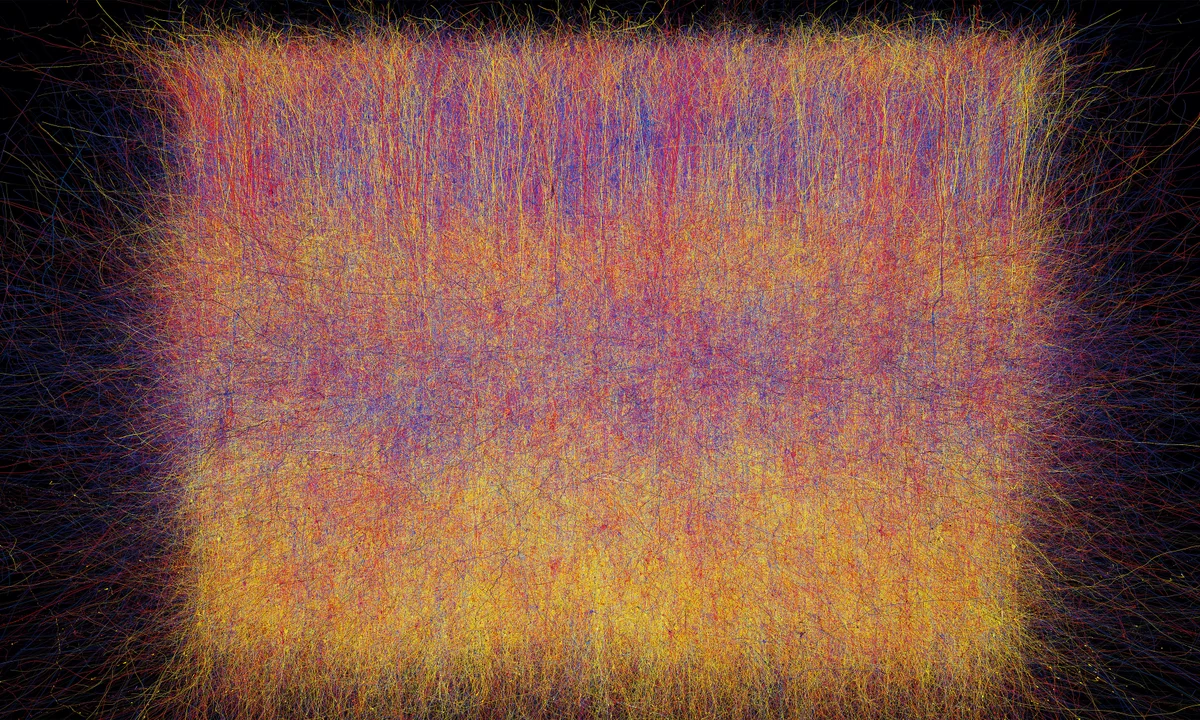
Of course, this is a moment frozen in time. You would see these connections form, shift, go elsewhere and blink out as thinking progresses. Some neurons can fire about 1000 synapses per second. It would also be on a bigger scale. Even for a a rat this is a microscopic portion of its cerebral cortex, and we humans have some 100 billions of these neurons in our brains, connected via 1000+ trillion connections. It is also just a map of the electrical synapses, it does not account for messaging via chemicals / molecules. Nor does the simulated visualization take into account the work of other cells or blood vessels.
-
Hinton's speculation is in essence that inside the equivalent structures of a chatbot's tokens and weights, there could very well be emergent properties equivalent to human cognition and thus the machine might have the ability to understand, plan and reason. He uses the inscrutability of the stored data system and queries as an argument against people who say that this is not what an LLM does.
An astute observer might note that this is not exactly a scientific approach, but more akin to a "god of the gaps", whereby ambiguous evidence and lack of evidence is claimed to support a position. Which is fine, these are Hinton's views as a speaker, advocate and author.
It is also the reason for his rage-boner for Chomsky. Since he is essentially arguing that chatbots might have learned to think, this is the polar opposite of the nativism view of some abilities being innate, a paradigm with whom Chomsky is the most known personality due to his language theories. Personally I view this more as a religious schism between bishops than a clash of science.
That is one part of the puzzle yes, for the human brain we have good knowledge on the micro-level and on the macro-level. Meaning we understand a fair bit about the cells and how they work and communicate. We also understand well how the major components interact anatomically. But we know very little of how you go from the micro-level to the macro-level, or why it all works. Ho
This is fair.
I suspect that you and chez would agree that we are headed eventually for some interesting philosophical discussions about whether the distinctions between the way humans "think" and the way that our machines "think" is dispositive for the purposes of evaluating rights and obligations.
Given your respective interests in the topic, I would recommend the book Blindsight by Peter Watts if you haven't read it. It "hard" in both the sci-fi sense and the philosophical sense, but good if you have the patience for such things.
Let's take another stab at this. I'm not in any way claiming that the understanding that LLMs have is akin to human understanding. I dont think it is but agree it's philosophically a very interesting area. (Much of the philosophically/legal stuff has already become a reality )
Neural nets create an evolving model that converts inputs to outputs. That model contains an understanding of the relationships between the data. There's no god of gaps. There's no requirement that's it's a correct understanding or human like or that we udnerstand it's understanding or anyhting. We can speculate on the nature of that understanding, how well it works etc etc but the correctness of that is specualtion doesn't alter that it is an understanding.
LLMs work very well. That means that the understanding of the model created by the neural net impresses us with the outputs it produces from the inputs. So impressive that to dismiss the importance of the model/understanding of language because of obscurity is a big mistake. However the model understands language it's significant to us because it works so well. Missing that part in our understanding of LLMs misses everything interesting about them.
Let's take another stab at this. I'm not in any way claiming that the understanding that LLMs have is akin to human understanding. I dont think it is but agree it's philosophically a very interesting area. (Much of the philosophically/legal stuff has already become a reality )Neural nets create an evolving model that converts inputs to outputs. That model contains an understand
Calling it “understanding” is a stretch. When I hit the “H” key, the right pixels light up because circuits close--there’s no concept of “H” in the machine, just cause and effect. Same if we ask what is two plus two: for the computer, the “answer” is just the right pixels to fire to make the shape “4.” That’s not comprehension, it’s output matching. A neural net does the same at scale. It can run through iterations or effectively guess which “pixels” to light up until the pattern looks right, but that’s not the same as going from not understanding to understanding. It’s parameter tuning.
As t_d noted, brains and LLMs look a lot like black boxes at scale. But where the brain gets around it with abstraction and meaning, LLMs do it with brute-force correlations. Think pre-Maxwell: all the experiments in electricity and magnetism already contained the laws of electromagnetism. The data was there, but only a unifying theory made sense of it. Maybe today the “Grand Unified Theory" is already buried in the massive physics or cosmological datasets and we need AI to sort through them. Powerful but still not the same thing as the human understanding that makes sense of it all.

the brain gets around it with abstraction and meaning, LLMs do it with brute-force correlations
wondering how far ai capabilities need to advance before human exceptionalists give up the ghost on the "but our brains actually think" argument
Calling it “understanding” is a stretch. When I hit the “H” key, the right pixels light up because circuits close--there’s no concept of “H” in the machine, just cause and effect. Same if we ask what is two plus two: for the computer, the “answer” is just the right pixels to fire to make the shape “4.” That’
I think understanding is exactly the right word but it's semantics. Lets call it's 'discolumberguzenelipping'. discolumberguzenelipping is the interesting bit and to ignore it because we dont underrstand it is missing nearly everything interesting aabout what is going on. There will always be people who insists that discolumberguzenelipping never qualifies as understanding. I think it's an interesting philosohical question but one that will increasingly become semantically speciest or organicist.
Neural nets and LLMs in particular do do a bit of abstraction. If that's what required then discolumberguzenelipping is some level of understanding. I also would say they do reasoning but we probably need a different word for what AI does. I'll let someone else make that word up.
'Meaning' is one of my favorite philosophical topics. People generally haven't got a clue and say silly things like 'words have meanings'. LLMs at least do better than that. It's an area where I believe we are going to see the next big step forward in discolumberguzenelipping . Probably with robotics more than with chatbots. That's because an internal model of our world to discolumberguzenelipping and 'talk about' is going to look so much like what us humans do.
I didn't think there was much here that was new but it was quite interesting that 'Interpretability' was a thing that Anthropic (and I guess others) are working on. It's about understanding what is going on in AIs

Honestly, intuit may actually be pretty accurate, more accurate than thinking as we understand it in humans.
Neural studies have more or less agreed that what we call "intuition" is mostly a recall from medial temporal lobe/hippocampus (you can call this long term memory bank), with minor engagement from prefrontal (rough equivalent to evaluating, or "inference"), based on a set of likely default parameters ingrained into basal ganglia and parietal regions associated with default responses (rough equivalent to trained parameters).
In some ways, the machine is doing very well in terms of habit forming to be like the perfect intuition machine based on its own experiences (for chatgpt, apparently Reddit is the biggest source of texts it trained on). One could say it has gotten extremely close to being as perfect as it could be, given the way it's told to practice.
The problem is practice only makes perfect if you know what perfect is. And right now we don't know what perfect is. A lot of bandwidth is spent on manual/semi-manual work (putting more weights on reputable sources, cheating with actual calculators where AI realizes it's doing a calculation etc.) but at this point in time, unsupervised learning is prone to producing trash/difficult to understand results and supervised learning often runs into a problem of garbage in and garbage out. I've seen hybrid approaches tha tended up with the worst of both worlds.
I didn't think there was much here that was new but it was quite interesting that 'Interpretability' was a thing that Anthropic (and I guess others) are working on. It's about understanding what is going on in AIs
[...]
Plenty of people say that they are working on interpretability in deep learning models, and as far as I can see, it is mostly just vapid air. You can reach some levels of explainability, but it is not interpretation of causal relationships but rather methods that have more in common with social science statistical analysis... for example with libraries like Shap. But hey, the buzz got Anthropic a contract with Palantir, so I wish them luck in building ethical AI models (lol).
At the end of the day the problem is fairly simple. Assume we make a simple spellchecker using these three methods. All of these examples are simple things that most people can do at home easily with a modicum of programming experience.
1. We download an open source dictionary and write a classic program that looks through the dictionary looking for a given word using some standard library for searching lists / sets / hashes / whatnot.
2. We load an AI model into our program and ask it if the given word exists.
3. We load an AI model into our program, feed it an open source dictionary and asks it if a given word is in the dictionary.
Now, say your program falsely says that a word is correctly spelled.
1. The first program is fully interpretable. You can go through it decision by decision and find out exactly where the error is.
2. The second program is only interpretable in the basic input and output function. Other than that, you will never be completely sure where the error is. Using methods for explainability, you could at best find out what might have caused the error.
3. The third program is interpretable in your input and output routine like program number one. Additionally, the contents of your dictionary is also available, so it would be interpretable if the error was there. Beyond that, you face the same problem as in program number 2.
Now, if you desperately need a program to be 100% reliable, you can't use 2 or 3, because they can throw errors you can't find. If you don't need 100% reliability or intepretability, 2 and 3 is fine... obviously not for this simple task, since they are gargantuan resource hogs compared to program number 1. However, if you wanted them to scan 3 million photos looking for features, X % reliability could be good enough.... and they might be far more effective than any other approach.
Of course, as software grows huge and cumbersome, and its development spans thousands of people, years of development and millions lines of code, you do reach similar problems in traditional development. However, you can still isolate particularly critical components.
To be clear, there are AI approaches that are interpretable, like decision tree algorithms. However, these machines are not what we refer to when discussing LLMs.
who on earth wants or expects anything like 100% reliability or interpretability?
This is AI. The benchmark is animal and humans intelligence.
and the same problems exist with real I dont they? (I can't deside whether to put ' ' around the 'real' or the 'I' or both
who on earth wants or expects anything like 100% reliability or interpretability?
This is AI. The benchmark is animal and humans intelligence.
and the same problems exist with real I dont they? (I can't deside whether to put ' ' around the 'real' or the 'I' or both
I mean, you're the one posting AI summaries and videos with strong claims in them. If you don't want to discuss them, then I can only suggest that you don't post them?
Interpretability is important in most software development, and so is reliability. For most billions of software applications where we rely on these qualities, this isn't that problematic - because we don't need AI to do those tasks. You want to do some simple math, then use a calculator... not a machine that can win a math Olympiad, but sometimes still inexplicably claims that 2+2=3.
However, there are plenty of areas where companies want AI to take over for traditional software or human-machine interfaces where being unable to find or fix bugs is not acceptable. You don't want your (hypothetical) self-driving car to suddenly hallucinate that red means go, you certainly don't want to be unable to understand why it did it, and least of all you want to be unable to figure out how you can stop it from doing it again.
Now, if you want to reply to that to humans drivers are sometimes crap too, great for you. However, it is still a shitty answer to a completely legit engineering and development conundrum.
As I thought tI said, the interesting bit to me was the fact that they were studying it.
I kinda disagree profoundly on the rest. The safety metric for driving cars will be 'safer than humans' driving cars. Becuase we are a bit wierd we will demand 'massively safer' as the standard. Sure we will study these AI's internals but as the complexity rises it rapidly becomes like studying brains. Where we need more certainty they will use tools like we do e.g calculators (or algorithms) for enginerering calculations. An interesting difference is they may have these tools 'built in' - then again so may we.
If there is a specific problem with some AIs such as driving through red lights. then like humans they wont be allowed to drive or they will receive more training.
As we're talking abaout AIs doing things like driving a really interesting (to me) aspect is them being trained in virtual worlds rather than in the real world. I dont know how advanced this currently is but it will supercharge everything with AI and robotics. To say development becomes much cheaper and faster doesn't being to describe it.
Development can probably become cheaper. Coding AI applications is easy compared to more traditional approaches, since you essentially get a big function you can throw fuzzy inputs at. Training or fine-tuning to make your own agents is not difficult either from a coding perspective. Though somewhat ironically you might want communications, language or linguistics people involved in setting up training material. Oh how the tables have turned etc.
Robotics... perhaps. The problem again will be that with no interpretability, you will lack accuracy in predictions of what your AI will do. That makes it a ethical problem to give instructions to one. If you tell the black box to do A, and it does B... what is the ethics in telling it to do A and what is the ethics of it doing B, when you knew beforehand that it would not always be predictable. This is not a straightforward question, and people who pretend it is aren't doing AI development any favors.
In other applications it becomes a legal problem. Because with no interpretability, you can't find what causes bugs and you can't fix them. So who is responsible when nobody can tell what caused a mishap? If AI-assisted surgery goes wrong and there is no interpretability and thus no way to find the cause, is the responsibility with the surgeon, hospital, robot manufacturer or software developer? And sure, you can probably write all that up in contracts or terms, but that means someone has to accept that responsibility.
Now, you have patches and hacks you can apply. Human-in-the-middle, human executive, AI "constitutions", software decisionmakers attached to the AI that use more traditional and interpretable decisionmaking. However, these are just that: Patches. They don't really resolve the underlying issue. And while they might alleviate one backdraw, they add backdraws of their own.
The "people aren't any better"-reply has become something if a catch-all reply to these issues from AI-proponents. Which firstly is a dubious claim, we all know a bit more about human decisionmaking than we do deep learning model decisionmaking. Secondly, if your goal is automation, that reply is pretty much a resignation.
Interesting, looks like data is pretty clear, and worldwide women use LLMs less than men
https://www.wsj.com/tech/ai/ai-gender-ga...
For example, in one part of the study the authors found that women made up 42% of the roughly 200 million average monthly users at ChatGPT, 42.4% at Perplexity and 31.2% at Anthropic’s Claude. This data was collected between November 2022 and May 2024 and reflects monthly averages.
The gender gap was even more pronounced when the authors looked at AI usage on smartphones. Between May 2023 and November 2024, only 27.2% of total ChatGPT application downloads are estimated to have come from women. Similarly low shares of mobile downloads by women were seen on Anthropic’s Claude and Perplexity.
/
.. the trend was clear “in high-income countries like the U.S., Canada and Japan, and low- and middle-income countries, like India, Brazil and Kenya. It was shocking
/
I don't understand the motivation given tbh : "In some studies, female participants expressed concern that using AI would penalize them professionally or allow colleagues or peers to question their competency."
What does the bold mean?

