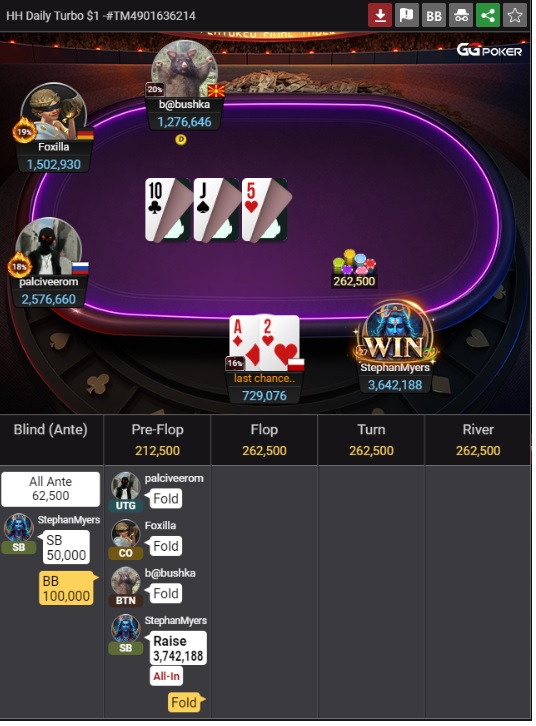
FT 4handed with A2o
I'm the shortest stack with 7bb
rest are: 13, 15, 25, 36bb
the largest one shoves into me from SB
I'm on BB with A2o
My thinking is that I don't have much to lose if I lose this hand since I'm already first to be out stackwise
I folded and in the very next hand I shoved 75o SBvsBB and won but..
maybe it's better to call when possibly ahead than to shove trash later?
20 Replies
It’s 5 handed, sorry, I already excluded myself subconsciously. Also, what hand would be better to call with here, A2o, KTo or QJs? I don’t fully understand the reasons behind calling ranges from BB vs SB being the way they are. I always thought it’s about the highest possible cards, meaning that A2o is better to call with than KQs assuming that SB is shoving 80-90% and the pocket pairs themselves are considered rare, meaning that in most cases sb is shoving two random cards, but I guess It doesn’t work that way

It’s 5 handed, sorry, I already excluded myself subconsciously. Also, what hand would be better to call with here, A2o, KTo or QJs? I don’t fully understand the reasons behind calling ranges from BB vs SB being the way they are. I always thought it’s about the highest possible cards, meaning that A2o is better to call with than KQs assuming that SB is shoving 80-90% and the po
Get something like Equilab (it's free) and start assigning a shoving range to SB and run those hands against it and you'll get an answer.
I don't know exactly how much equity vs. range you need to have to call off here, though. I wouldn't be surprised if all three hands were fine calls.
I just did. A2o is like 50% vs a 64% range (a reasonable one?), while KTo and QJs being 53 and 54%. I’ve tried to do some math, let’s say SB is 10,5bb, I’m on BB with 10bb. SB shoves, if I call the total pot will be 23bb (including ante). 10/23 is 43,5% and that’s what I have to be vs his range to be breakeven in the long run? Ofc I will be calling 50%+ only but I want to set a baseline here

It’s 5 handed, sorry, I already excluded myself subconsciously. Also, what hand would be better to call with here, A2o, KTo or QJs? I don’t fully understand the reasons behind calling ranges from BB vs SB being the way they are. I always thought it’s about the highest possible cards, meaning that A2o is better to call with than KQs assuming that SB is shoving
Don't forget with a hand like KTo you often have two cards to hit when behind, compared to only one with A2o. There are also lots of draws in the case of QJs.
So if you have KTo versus 77, or versus 78s that hits a 7 on the flop, you can overtake by pairing either the king or the ten. However with A2o you can only overtake by hitting an ace.
Its true KTo is doing worse that A2o when up against hands like KQo, KJo, but that is not a massive part of his range......
Not sure if this link will work:
Don't forget with a hand like KTo you often have two cards to hit when behind, compared to only one with A2o. There are also lots of draws in the case of QJs.So if you have KTo versus 77, or versus 78s that hits a 7 on the flop, you can overtake by pairing either the king or the ten. However with A2o you can only overtake by hitting an ace.Its true KTo is doing worse that A2o w
Yes, this was my understanding also, I’m better off calling high broadways than baby A, against a range and 3/4 of pairs too. This particular spot was interesting for me due to an ICM. I think it was a call being below 10 bb. Link leads to an AA empty hand, screenshot could help if you have time. Thanks

I would fold. If you call, you are out 50% of the time. When you push, you have FE. There is also some ICM effect, as someone else could bust in the next few hands.
You also dominate more Kx and Qx hands with those hands. There are a lot more of those in his shoving range than 2x hands.

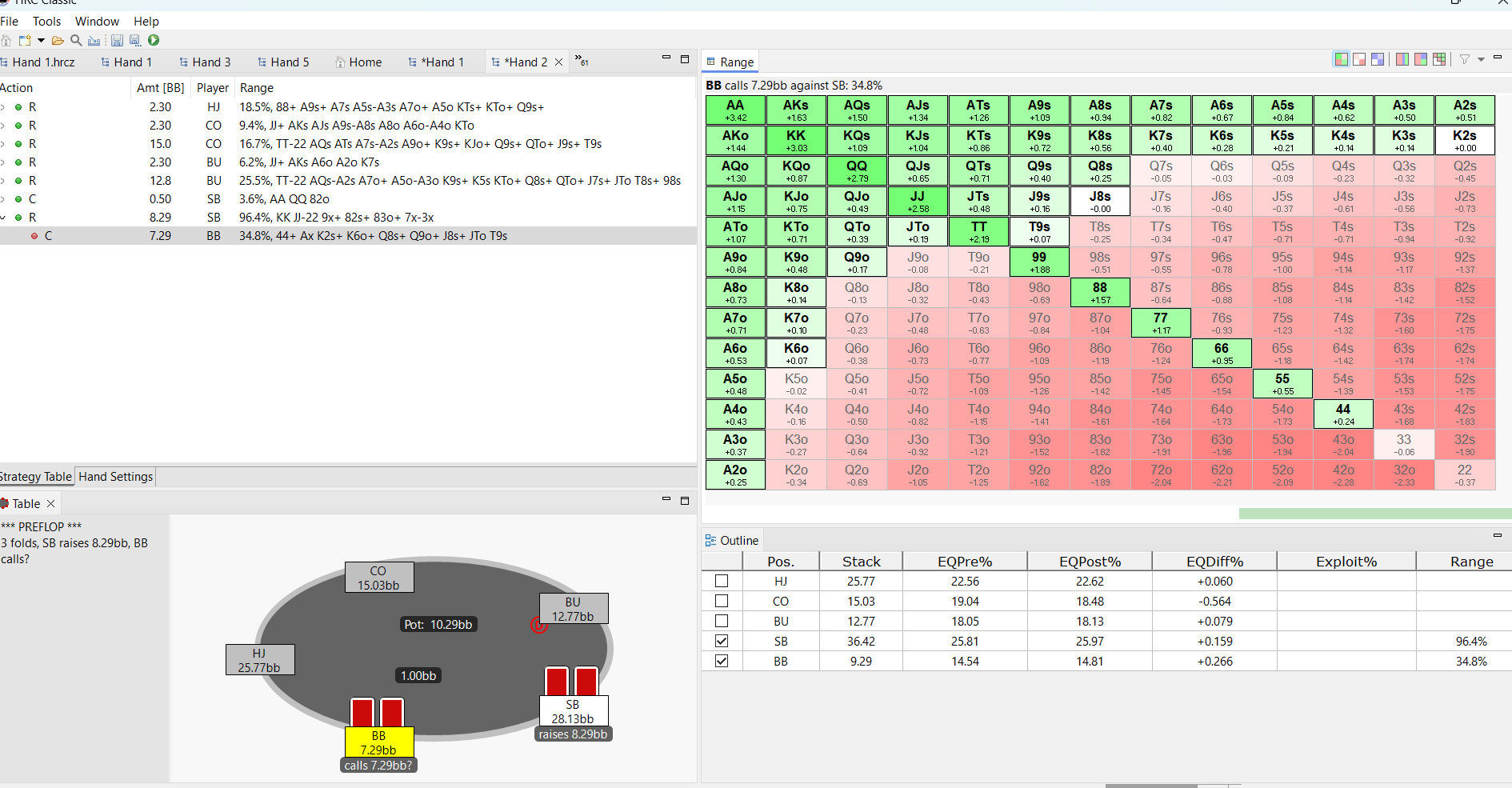
I ran a couple ICM sims for you. The GTO results are that A2o is a call and 75o is a fold. There are a couple assumptions that might alter these results.
In the first spot SB is basically supposed to shove 100% of hands. Technically they're shoving over 96% with a tiny limp range including monsters like AA and QQ along with 82o, but effectively they're shoving 100%. So if you think your human opponent is shoving much tighter, then A2o could potentially become a fold, even though it's a pretty easy call if they're shoving as wide as they're supposed to.
BB calling range vs SB shove:
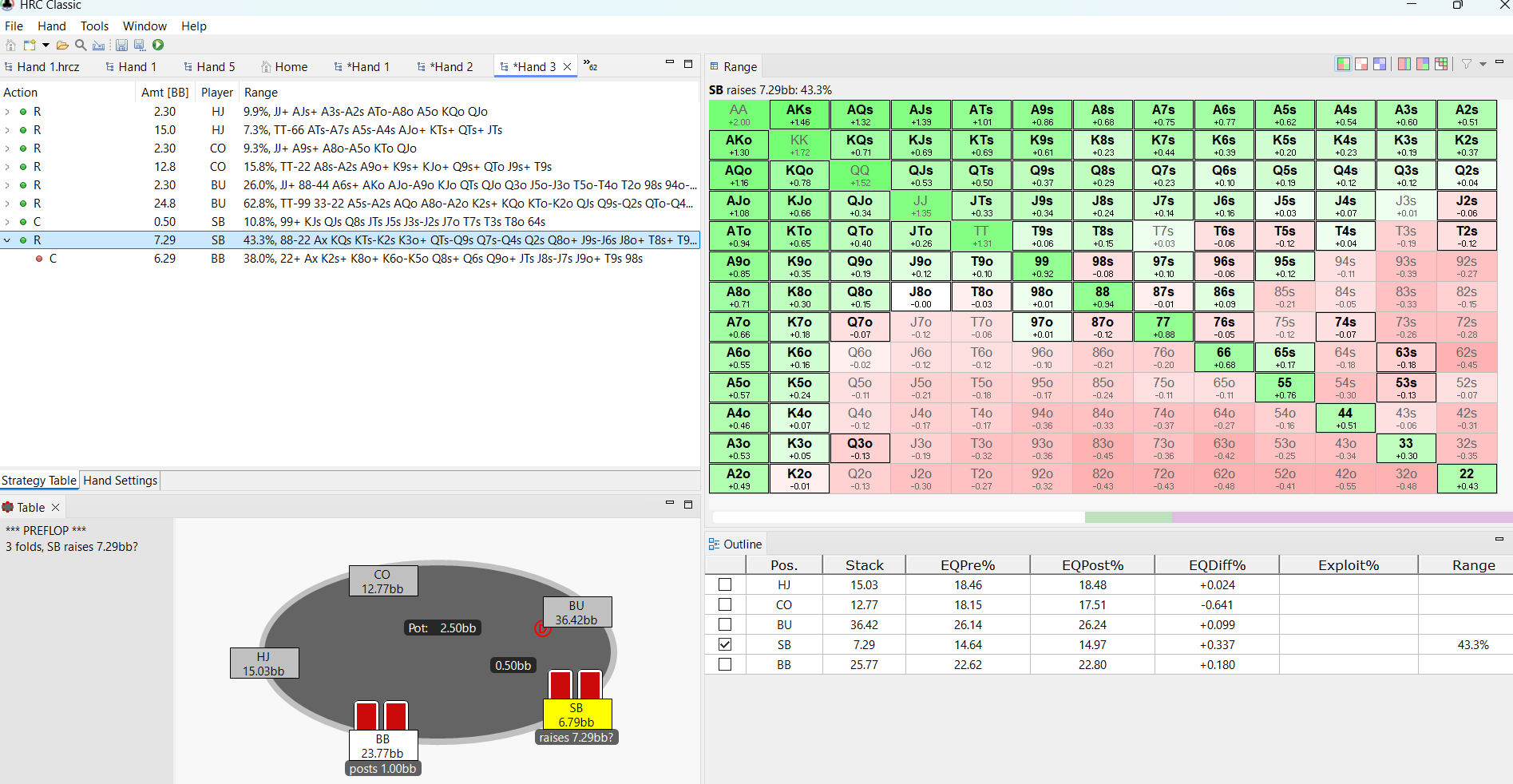
In the second spot 75o is almost certainly a fold, but even here you can make an argument for shoving if BB is massively overfolding. BB is supposed to be calling you with 38% of hands (assuming the relatively tight SB shoving range posted below). They're supposed to be calling with K2s and K5o. So if they're doing stuff like folding A8s, you could possibly make an argument that your shove would be correct. That's quite an assumption though and the 75o shove seems like a bit of a punt. Also note that SB in this spot is supposed to be limping with more than 10% of hands (polarized between monsters and hands not quite strong enough to shove).
SB shoving range in second spot:
That is beyond helpful. Thank you GWF.
Ran it against a 100% shoving range and QJs is actually the best of the three at 60%, KTo is at about 59%, and A2o is about 54%.
Probably he's not shoving 100% of hands, but I think he's shoving wider than 64%. And the hands he's most likely to fold are 2x hands (32o / 72o / 82o / etc.), which means the gap in reality between A2o and the other two hands may even be a little wider.

In vacuum Id go with A5 / A7 + and in 2nd spot 97 +
but Id have a more clear idea of my opps by that moment anyway and then deviations in both directions are probable
One thing to keep in mind in this spot is not only your own ICM considerations, but the mistakes other players might be prone to make. Like in this spot according to ICM you shouldn't be overfolding because you are the short stack and not a middle stack and therefore are most likely to bust and don't have anyone who will blind out before you, BUT if your opponents are allin left and right you can prob fold yourself into a better pay place due to their mistakes. Idk what stakes you grind but I play the micros and it happens literally every tournament. Just the other day I was short stack at a final table and middling stacks were busting left and right with marginal hands. I ended up being gifted like 3 places higher than I should've cashed. So it's part exploitative to individual opponents and part population exploit I think. But, on the other hand, absolutely don't feel you have to nit up when you're the smallest stack in any given tournament. According to ICM you actually get to play like a maniac to try and make chips (unless of course you have a great reason not to). Just make your best judgement.
One thing to keep in mind in this spot is not only your own ICM considerations, but the mistakes other players might be prone to make. Like in this spot according to ICM you shouldn't be overfolding because you are the short stack and not a middle stack and therefore are most likely to bust and don't have anyone who will blind out before you, BUT if your opponents are allin lef
Micros. Precisely. Im a super nit 9handed at FTs, only shoving around 10BB sbVSbb or with premiums when larger stack (but mostly opening). Im just sitting and watching people don’t understanding ICM play. Then, around 6-5 handed I start to “play” which in my understanding is oveshoving in 1-2-3 players widely. Maybe it’s against the book, I need to study GWF response today carefully, but this is how I “play” now
Or should it be the other way around?
One thing to keep in mind in this spot is not only your own ICM considerations, but the mistakes other players might be prone to make. Like in this spot according to ICM you shouldn't be overfolding because you are the short stack and not a middle stack and therefore are most likely to bust and don't have anyone who will blind out before you, BUT if your opponents are allin lef
I agree that it's reasonable to play tighter if you're assuming the middle stacks will make big mistakes and ICM punts.
The part of your response I somewhat disagree with is the part about loosening up as the shortest stack. You actually are still supposed to play tight as the short stack according to ICM. It's just that the context of the situation matters.
Like believe it or not in the ICM sims I posted that actually is considered "tight" in the context of 7 BB blind vs blind battles. The ranges just get wide because it's under 10 bigs and blind vs blind.
Nath also makes a good point when he said they're probably not shoving 100%, and that the weak 2x that A2o dominates are least likely to shove. I think a lot of people won't shove 32, 42, 52, 62, 72, 82, 92, etc. So you can make a reasonable argument that folding A2o could be a good exploitative adjustment, whereas a hand like QJs is more of a "snap call."
I agree that it's reasonable to play tighter if you're assuming the middle stacks will make big mistakes and ICM punts.The part of your response I somewhat disagree with is the part about loosening up as the shortest stack. You actually are still supposed to play tight as the short stack according to ICM. It's just that the context of the situation matters.Like believe it or no
Interesting. I've been under the impression that the shortest stack never has ICM pressure for a while now. Could you point me towards any relevant reading pertaining to this concept? The most I'm familiar with is Doug Polk's advocating for playing more like a maniac in general in a tournament, with his justification being that when he is deep stacked his increased edge outweighs the EV he loses by disregarding ICM considerations at other stages/stacks of the tournament.
Interesting. I've been under the impression that the shortest stack never has ICM pressure for a while now. Could you point me towards any relevant reading pertaining to this concept? The most I'm familiar with is Doug Polk's advocating for playing more like a maniac in general in a tournament, with his justification being that when he is deep stacked his increased edge outweig
I don't have anything handy offhand, but from my understanding: There's always at least some small ICM pressure, because if you bust, you can't win any bigger prizes or ladder up. And you said it yourself: Even as the shortest stack, there's still the possibility for other people to get it in or make big ICM mistakes, which makes you money.
I think in general, leveraging your fold equity is really valuable, too. (I mean, it's the most obvious statement on the surface, but if you get everyone to fold, there's a 0% chance you bust the tournament.) So passing marginal stacking-off spots to find future first-in spots would be a sound way to play by ICM.
Ahh ok so your own ICM considerations begin to take into account the considerations of other players, sort of like how GTO play takes into account the actions of others. I had previously thought of folding as the short stack as non-ICM/purely exploitative but I get how it can be considered ICM in and of itself.
Interesting. I've been under the impression that the shortest stack never has ICM pressure for a while now. Could you point me towards any relevant reading pertaining to this concept? The most I'm familiar with is Doug Polk's advocating for playing more like a maniac in general in a tournament, with his justification being that when he is deep stacked his increased edge outweig
For the best in depth explanation I would highly recommend Endgame Poker Strategy: The ICM Book by Dara O'Kearney.
I did a quick Google search and didn't find anything directly discussing ICM specifically as it relates to the shortest stack. You might have to read the book referenced above for that, but the risk premium concept discussed in this article is what's relevant.
https://www.pokerstrategy.com/strategy/s...
You're typically going to have a higher risk premium and have to tighten up your calling ranges more against stacks that cover you. So ICM effects the shortest stack much more than it does a massive chip leader who covers everyone. You might want to try running a few spots as the short stack using the method described in the article to get a better feel for it.
Yeah, I'll second Endgame Poker Strategy as being worth a read on this topic.
And as that link suggests, there's always some ICM risk at any point of a tournament, because chips won are not as valuable as the chips you already have-- most easily seen in the example where doubling up does not double the $EV of your stack.
In an MTT early on it's going to be pretty minimal, especially if there's re-entry, but it's still there.


