[2-4]: River bet sizing with straight against likely trips
BN Hero 900€
Straddle/UTG Villain 800€
Villain is a guy around 45yo. Not much experience with him, but what I'
yeah idk too many words in the thread to read.
turn makes very little sense to me and i think its difficult to range him on anything let alone likely trips. would shy away from these complex over adjusting strategies and just try to play well
my issue with the turn is you don't think he bluffs and he isn't putting in more money than he would if you just bet big and he c/c. doesnt appear to lose a ton of ev in the solver though and if i give it multiple options sometimes it will use the small sizing ott and 97 will make it in occasionally
yooo before I write my proper reply, let me just say that I genuinely appreciate you taking the time to discuss this with me (and actually making logical arguments). Minus the psychoanalyzing/accusations of inconsistency, but I'll still take it.
Right up front you say you don't have a lot of experience with him, so in general we should take a Bayesian approach here and look at typical 1/3 players. Given what you've said about him, everything is consistent and reinforces the likely Bayesian Prior that he's a loose pasive rec. - we use this as the primary prior, becauuse that's what the majority of low stakes players are. And how many of those Call Flop, Raise Turn with anything other than a big hand? Virtually none. It's completely reasonable to primarily range him as 2p+ here 90% of the time, with some sort of 10% nonsense factor.
"...the typical, non-scary live player. Almost no bluffs, calls too wide... There was one hand before where, after calling a Flop raise, he donked TPTK small on a blank Turn."
So he *calls* too wide, has almost no bluffs, and *DONKED* turn with TPTK in an earlier hand (rather than going for a check raise).
If that read were to hold true 100% of the time, how likely is it he's check raising this fairly innocuous turn with TPTK or a bluff? It would seem very unlikely. He donks TPTK, and has almost no bluffs. This turn x/r shouldn't be TPTK, and would rarely be a bluff, because he calls too wide, which would typically mean he check-calls with his draws and 1P hands that are worse than TPTK.
If he CALLS too wide, donks TPTK, and rarely bluffs, what sort of hands is he likely to check raise on this turn card? Seems like it would mostly be 2P and sets. Maybe he also has 74, JXcc, 76, and perhaps 97, but the 7 in our hand cuts down on some of those 7x combos.
Are any of those hands check-raising the turn and folding to a 3B?
Still going to make a big EV post (likely Friday/Saturday when I'm not playing) but I think it's better to post the reveal now.
Reveal:
Spoiler
I was thinking very much along these lines:
Wonderful, so then you should go allin. If you think he folds trips then you should be bluffing 100% of hands against by jamming allin every single time. You cant have it both ways.
Flip positions, if you make it to this river with a straight/boat are you ever checking to induce? Of course not, you would lead 100% of the time.
I didn't go all-in but I bet 400. Villain tanked for a quite a bit, then folded. He said he had a Jack with "a really bad kicker", and that he was "giving me a better jack or maybe a set". That I could have two non-paired cards below T didn't seem to have occurred to him.
I know people overfold to me, but folding trips for just a slight overbet on the River? :c I have to bluff more if people go this far.
I'm sorry for potentially spoiling the result in the title, will be careful not to add interpretations from now on. I think I mostly thought the Jack was possible because of my Turn sizing and the anecdote from OP, but of course it's possible there was luck/hindsight bias/survivorship bias as well.
op, I feel you need to tighten up pre and be much looser OTT and OTR at this stack depth. In both hands, TT and 97, I would suggest being very aggressive OTT so that you are in the driver’s seat to win a big pot (200bb deep with 97). I would definitely 3-bet to around 300 in the 97 hand and raise the lead with TT. To mix it up, both spots could also be bluffed with FDs you pick up OTT.
op, I feel you need to tighten up pre and be much looser OTT and OTR at this stack depth. In both hands, TT and 97, I would suggest being very aggressive OTT so that you are in the driver’s seat to win a big pot (200bb deep with 97). I would definitely 3-bet to around 300 in the 97 hand and raise the lead with TT. To mix it up, both spots could also be bluffed with FDs you pick
Doesn't action in the TT hand suggest that I only got the BN stacked because I didn't raise the first Flop bet? BN tanked quite a bit before the call
Still going to make a big EV post (likely Friday/Saturday when I'm not playing) but I think it's better to post the reveal now.Reveal:
So he had J7. Very likely it was J7cc. He called wide pre, flopped a weak top pair, and turned a massive combo-draw that bricked out, but he improved to weak trips. That all makes sense.
He wasn't folding to a turn 3B, and probably wouldn't have folded the river for a less than all-in jam if he called our turn 3B (assuming we didn't 3B-jam the turn). He probably would have snap called a $100 bet and maybe sigh-called a $200 bet here.
The fact that he put you on a better jack or a set demonstrates what I was saying about how he'll view your range when he x/r's the turn and you flat call - he'll become concerned he's behind, he won't barrel the river, and he won't pay you off if he checks and you bet big, because he doesn't beat anything.
The fact that he couldn't put you on a turned straight is more support for jamming turn. They don't know how to hand-read, and tend to focus on the most obvious explanations which support what they want to do. He wanted to go with his hand, and would have put us on an over-pair or combo-draw if we 3B-jammed.
The takeaway shouldn't be that he's over-folding weak trips to your river over-bet, and thus you should bluff more rivers. How you got to the river matters. He's not folding trips if you go bet-bet-bet and he just check-calls the whole way with QJss, and he's not folding if you bet smaller.
The takeaway should be that turn x/r's from passive low stakes rec-fish are almost always going to be high equity hands that are almost never check-raise-folding to a 3B, even an over-bet jam.

Doesn't action in the TT hand suggest that I only got the BN stacked because I didn't raise the first Flop bet? BN tanked quite a bit before the call
If you were 95% certain that villain would raise, you played this perfectly. I didn’t read into that tbh.
If villain isn’t raising but cold calling, he can play the hand cheaply and perfectly vs us (with a straight draw or FD) by calling $20 to win about $120 with position on the river. Personally, I would much rather raise in that spot myself and put the villains in tougher spots so they make, on average, costlier mistakes.
Given that BTN checked behind OTF, it’s actually a bit counterintuitive that they raise/stack off here without exactly 97, since it’s hard for them to connect with the incoming card well enough to raise in that spot (only QT, T8 … and T8 even seems a bit thin).
yeah i mean this is the issue with clicking buttons. if he really had j7 u got him to put in maybe slightly more than a normal bet would have done ott, and then significantly less otr resulting in much lower total betting volume
is also possible he lied about the stregnth of his hand and just tanked to save face in which case maybe your turn bet was genius. this seems equally plausible to me tbh
yeah i mean this is the issue with clicking buttons. if he really had j7 u got him to put in maybe slightly more than a normal bet would have done ott, and then significantly less otr resulting in much lower total betting volume is also possible he lied about the stregnth of his hand and just tanked to save face in which case maybe your turn bet was genius. this seems equally p
People rarely lie about their hand imho, especially after the fact. I don't think J7 in particular has most of the probability mass, but would be very surprised if his description is inaccurate. Also if you tank for show, you tank 15 seconds, not 2 minutes.
We play in very different games apparently.
True although I can think of at least one player who clearly did not get enough attention as a child who absolutely will tank for 2 minutes.
It's possible, but maybe you're also remembering some deception as in the same category as lies? Zach Elwood wrote an entire book about how most poker players lie surprisingly rarely even during the hand, but they are frequently deceptive about their hands, by saying things that are true-but-misleading. And the more specific the statement is, the more likely it is to be true; and probably the weaker the player, the more likely it is to be true. "I had a Jack with a really bad kicker" is very specific, and it was after the hand so with no incentive to lie (the guy isn't good enough to think about disguising his playing style). So just as a live "tell" alone, I think it's very likely to be true.
Alright so as I alluded to, I decided to make a more detailed EV calculation. Before I get into it, let me just clarify that I don't expect anyone to actually go through this, it's pretty long and no one owes me anything, no one forced me to do this, so if you don't want to bother, that's totally fine. With how much time I spend playing, I should probably do something like this sometimes, and I've never done it before, so I think it was worthwhile just for myself. No pressure to anyone to engage.
That said if we did want to make progress on figuring this out, I think this is a more useful approach than continuing talking on a high level. Language is so imprecise that we could debate forever without reaching a conclusion or even saying anything falsifiable. Now at least if you think I did something wrong, you can be specific. E.g., instead of "the River card will kill the action and you won't get paid", you can say "your model assumes that if the River is the Ah and Villain has a Jack, you win another 180€ on the River, but I think this is too optimistic and that you only win 100€", or whatever.
Structure/Notes
I'll give Villain a defending range, then a range to call the Flop bet, then a range to raise the Turn, a range to call a Turn raise to 320, a quick-and-dirty simplification to skip having to think about the River, and then a system to determine River behavior for the line where I don't raise the Turn. I'm going to calculate +EV starting from the Turn (because that's how far both lines play the same). So if the hand ended right there, it would be +100; it doesn't matter that some of those 100 in the Pot are paid by me since that's the same in both lines. If it goes 30 - 120 - 320 - fold, then the net result is +220 since we won +100 plus the extra +120 from Villain. I think you get it. I'll do both lines separately.
The Shared Part (Everything up to the Turn Decision)
Spoiler
(A a reminder, the board is 6♦J♥5♣ ((8♣)) Pot=100 (340))
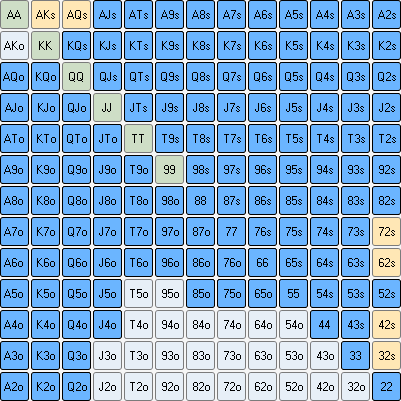
I raised the straddle to 20. Most people raise much higher (28 is perfectly normal). Villain is bad and has too much money. So I assume he defends super wide. I gave him this range Preflop, which is just hands from 4th to 75th percentile according to Equilab. All the hands that matter get filtered out in the next step anyway, so this range doesn't really matter.
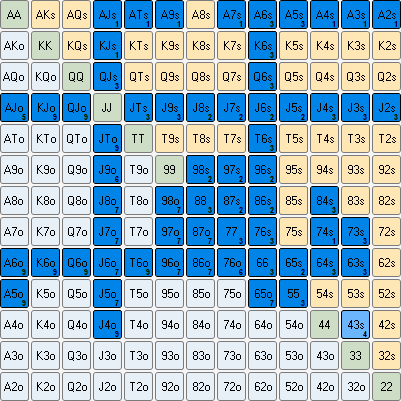
I had him call the Flop bet with every 6, every J, some good 5s, and decent draws including the AcXc (spoiler for the range).
Spoiler
8d8h, 8d8s, 8h8s, 7h7s, 7h7c, 7s7c, 6h6s, 6h6c, 6s6c, 5d5h, 5d5s, 5h5s, 43s, AdJd, AsJs, AcJc, KdJd, KsJs, KcJc, QdJd, QsJs, QcJc, AdTd, AhTh, AcTc, JdTd, JsTs, JcTc, Ad9d, Ac9c, Jd9d, Js9s, Jc9c, Ad8d, Ah8h, Jd8d, Js8s, 9d8d, 9s8s, Ah7h, Ac7c, Js7s, Jc7c, 9s7s, 9c7c, 8h7h, 8s7s, Ah6h, As6s, Ac6c, Kh6h, Ks6s, Kc6c, Qh6h, Qs6s, Qc6c, Js6s, Jc6c, Th6h, Ts6s, Tc6c, 9s6s, 9c6c, 8h6h, 8s6s, 7h6h, 7s6s, 7c6c, Ad5d, Ah5h, As5s, Jd5d, Js5s, 6h5h, 6s5s, Ad4d, Ah4h, Ac4c, Jd4d, Js4s, Jc4c, 8d4d, 8h4h, 8s4s, 7h4h, 7s4s, 7c4c, 6h4h, 6s4s, 6c4c, Ad3d, Ah3h, Ac3c, Jd3d, Js3s, Jc3c, 7h3h, 7s3s, 7c3c, 6h3h, 6s3s, 6c3c, Ad2d, Ah2h, Ac2c, Jd2d, Js2s, Jc2c, AdJs, AdJc, AhJd, AhJs, AhJc, AsJd, AsJc, AcJd, AcJs, Ad6h, Ad6s, Ad6c, Ah6s, Ah6c, As6h, As6c, Ac6h, Ac6s, Ad5h, Ad5s, Ah5d, Ah5s, As5d, As5h, Ac5d, Ac5h, Ac5s, KdJs, KdJc, KhJd, KhJs, KhJc, KsJd, KsJc, KcJd, KcJs, Kd6h, Kd6s, Kd6c, Kh6s, Kh6c, Ks6h, Ks6c, Kc6h, Kc6s, QdJs, QdJc, QhJd, QhJs, QhJc, QsJd, QsJc, QcJd, QcJs, Qd6h, Qd6s, Qd6c, Qh6s, Qh6c, Qs6h, Qs6c, Qc6h, Qc6s, JdTh, JdTs, JdTc, JsTd, JsTh, JsTc, JcTd, JcTh, JcTs, Jd9s, Jd9c, Js9d, Js9c, Jc9d, Jc9s, Jd8h, Jd8s, Js8d, Js8h, Jc8d, Jc8h, Jc8s, Jd7h, Jd7s, Jd7c, Js7h, Js7c, Jc7h, Jc7s, Jd6h, Jd6s, Jd6c, Js6h, Js6c, Jc6h, Jc6s, Jd5h, Jd5s, Js5d, Js5h, Jc5d, Jc5h, Jc5s, Jd4h, Jd4s, Jd4c, Js4d, Js4h, Js4c, Jc4d, Jc4h, Jc4s, Td6h, Td6s, Td6c, Th6s, Th6c, Ts6h, Ts6c, Tc6h, Tc6s, 9d8h, 9d8s, 9s8d, 9s8h, 9c8d, 9c8h, 9c8s, 9d7h, 9d7s, 9d7c, 9s7h, 9s7c, 9c7h, 9c7s, 9d6h, 9d6s, 9d6c, 9s6h, 9s6c, 9c6h, 9c6s, 8d7h, 8d7s, 8d7c, 8h7s, 8h7c, 8s7h, 8s7c, 8d6h, 8d6s, 8d6c, 8h6s, 8h6c, 8s6h, 8s6c, 7h6s, 7h6c, 7s6h, 7s6c, 7c6h, 7c6s, 6h5d, 6h5s, 6s5d, 6s5h, 6c5d, 6c5h, 6c5s
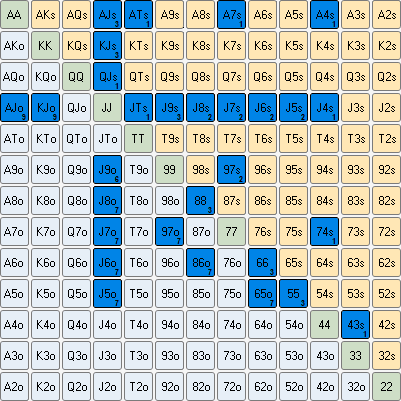
And I had him raise the Turn bet with every straight, every set, almost every two pair (only took out 4 combinations), AJ, KJ, and every other Jack that also has a combo draw except the idiot gutshot (J4o). And a few random draws (Ac7c, 4c3c, etc.); I don't actually think he raises those, but I'm just including them to hedge since players do weird things. That's also why I've taken out a few two pair and didn't include QJ (I think he does raise QJ, but who knows). This is 124 combinations.
Spoiler
8d8h, 8d8s, 8h8s, 6h6s, 6h6c, 6s6c, 5d5h, 5d5s, 5h5s, AdJd, AsJs, AcJc, KdJd, KsJs, KcJc, QdJd, QsJs, QcJc, AcTc, JcTc, Jd9d, Js9s, Jc9c, Jd8d, Js8s, Ac7c, Js7s, Jc7c, 9s7s, 9c7c, Js6s, Jc6c, 8h6h, 8s6s, Jd5d, Js5s, 6h5h, 6s5s, Ac4c, Jc4c, 7c4c, 4c3c, AdJs, AdJc, AhJd, AhJs, AhJc, AsJd, AsJc, AcJd, AcJs, KdJs, KdJc, KhJd, KhJs, KhJc, KsJd, KsJc, KcJd, KcJs, QdJs, QdJc, QhJd, QhJs, QhJc, QsJd, QsJc, QcJd, QcJs, Jd9s, Jd9c, Js9d, Js9c, Jc9d, Jc9s, Jd8h, Jd8s, Js8d, Js8h, Jc8d, Jc8h, Jc8s, Jd7h, Jd7s, Jd7c, Js7h, Js7c, Jc7h, Jc7s, Jd6h, Jd6s, Jd6c, Js6h, Js6c, Jc6h, Jc6s, Jd5h, Jd5s, Js5d, Js5h, Jc5d, Jc5h, Jc5s, 9d7h, 9d7s, 9d7c, 9s7h, 9s7c, 9c7h, 9c7s, 8d6h, 8d6s, 8d6c, 8h6s, 8h6c, 8s6h, 8s6c, 6h5d, 6h5s, 6s5d, 6s5h, 6c5d, 6c5h, 6c5s
And that's it because now the two lines diverge.
The 3bet Line
Spoiler
I assume I 3bet to 320, and I had him call/jam the 3bet with this (63 combinations)
Spoiler
8d8h, 8d8s, 8h8s, 6h6s, 6h6c, 6s6c, 5d5h, 5d5s, 5h5s, AcJc, KcJc, QcJc, Jc9c, Jd8d, Js8s, Ac7c, Jc7c, 9s7s, 9c7c, 8h6h, 8s6s, Ac4c, 7c4c, AdJc, AhJc, AsJc, AcJd, AcJs, Jd8h, Jd8s, Js8d, Js8h, Jc8d, Jc8h, Jc8s, Jd6h, Jd6s, Jd6c, Js6h, Js6c, Jc6h, Jc6s, Jd5h, Jd5s, Js5d, Js5h, Jc5d, Jc5h, Jc5s, 9d7h, 9d7s, 9d7c, 9s7h, 9s7c, 9c7h, 9c7s, 6h5d, 6h5s, 6s5d, 6s5h, 6c5d, 6c5h, 6c5s
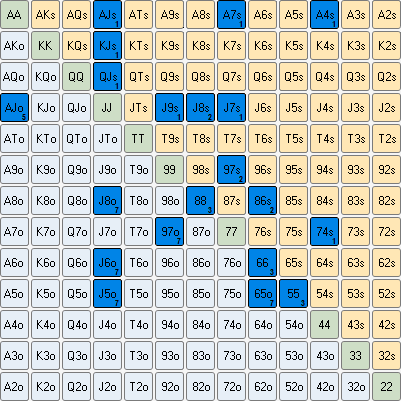
He continues with the straight, every set, some two pair, every J with a flushdraw, and 5 combinations of AJo (just hedging again). Given the result, I think more two pair actually fold, but trying to be not results oriented.
Now I made a major simplification and just assumed that we're always getting in another 300 on the River (because this makes it way easier to calculate). In fact I think we're getting significantly less money in on average, which means this is an overestimate in terms of EV, but I also think we can fold sometimes (which isn't included now), which is an underestimate in terms of EV. I think they roughly balance each other out.
We won't find a lot of folds because after the Turn raise, the Pot is 740 and the effective stack is 438 (because 800-20-22-320=438), so SPR is 0.6. Hard to fold now. Still, if the flush comes in and this player jams into us, you could probably fold (god help us if he ever does it as a bluff, but he probably doesn't). And that's probably it; I think if the board pairs and he jams, I'm not folding the straight, and I'm not even sure you should. Conversely, there should be a lot of cards where he folds the River even with the SPR.
So overall getting some extra money in at the cost of missing out on some clutch folds seems a pretty fair tradeoff. If anyone thinks this substantially under- or overestimates EV, let me know. Fwiw I'd guess this way of calculating gets slightly higher EV than jamming all-in right away (no one ever said how much they wanted to 3bet) because if you jam, then you're folding out a lot more hands than I did here, so P(V calls) gets a lot smaller.
Alright so given this simplification, we can now calculate the EV like this:

where P(V calls)= 63/124 (about 51%) `p` is the probability that we win against this range by the River, which is 82.1%. And it's 720 because we win 100+320+300, and -620 because we're not "losing" the 100 dead money on the Flop. This comes out at 352, so the +EV of 3betting is about 352€, and the 3bet is better iff the EV of flatting is < 352€.
The Call Line
Spoiler
Alright so this one is much harder because we need to model an entire street. There are 46 possible River cards and 124 possible hands for Villain, which makes 5704 combinations, so we have to simplify.
The only practical way I could think of was to categorize the River card and Villain's hand strength and write it as a decision tree:
(Again for convenience, the board is 6♦J♥5♣ ((8♣)) Pot=100 (340), and my hand is 9♥7♦)
How to read/Notes:
Spoiler
- If I say CARD= , it's a statement about the River card. Otherwise it's a statement about what opponent has. So "JJ" means he has two Jacks, boat means he has a full house, etc.
- Each option precludes all later options on the same level. So the very first one looks at opponent having the 5-9 straight (regardless of River card), which means that in all subsequent options, opponent does not have the 5-9 straight.
- The number behind the case is the EV, so the first line means that we score 50€ if opponent has the straight (because we chop the 100€😉, and the next line says that I'm expecting to lose another 160 if opponent has quads and the board is both paired & has a flush possible.
- I'm mostly grouping by (category of) River card, and then for each, I group by Villain hand strength.
- Because we start the calculation at the Turn where the Pot is already 100 and we called 120 on the Turn, each outcome where I win has 100+120+the River bet, and each that I lose has -120-the River Bet. Chop is +50. To make this easier to read I've added the +220 or -120 in () rather than calculating them into the result.
- Otherwise I hope at least the idea for each estimate is understandable, e.g., I lose less against a boat when there's a flush possible because now it's easier to fold, and consequnetly Villain bets less. In a lot of cases I'd bet the same but +EV changes because V is more likely to call with a stronger holding.
- Idk if I have to say this, but obviously anyone else doing this would have different estimates on all of these, but that only matters if they're consistently off in one direction. If you have 20 more here, 30 less there, 40 more here, 10 less there, 20 less there, you'd end up with a very similar result. It's only a major issue if you think I've consistently estimated something wrong in the same direction.
- It's not good analysis to be confident about anything so I've hedged a ton again and e.g. given small +EV in spots where I probably won't get called, because every once in a while Villain will make a hero call or bluff.
Decision Tree:
Spoiler
- 5-9 straight: +50 # i.e., we chop 100% of the time
- CARD=6c or Jc # in general, this makes it easier to fold to aggression because a bet from him into a paired board & possible flush looks extremely strong
- quads: -160 (-120)
- boat: -150 (-120)
- flush: -140 (-120) # I expect him to bet just slightly differently with these, and I expect that a larger bet is more -EV because he'll generally bet too small, so I'm usually calling. If he does bet much larger, I'd probably find a fold.
- weaker straight: +150 (+220)
- trips: +130 (+220)
- other: +50 # includes the pairs
- quads: -160 (-120)
- CARD=other club # now board is unpaired
- flush: -220
- 2pair: +150 (+220)
- JJ: +80 (+220)
- other: +25 (+220)
- flush: -220
(no more flushes from here)
(Board Reminder for convenience: 6♦J♥5♣ ((8♣)) Pot=100 (340), and my hand is 9♥7♦)
- CARD=J
- boat: -250 (-120)
- weaker straight: +350 (+220)
- trips: +250 (+220)
- other: +30 (+220)
- boat: -250 (-120)
- CARD=5 or 6 or 8
- quads: -250 (-120)
- boat: -230 (-120)
- JJ: +130 (+220)
- other: +45 (+220)
- quads: -250 (-120)
(board is now not paired)
- CARD=7 or 9 or 4 # action killer (also T9/T7 is a better straight but V doesn't have it in his range)
- JJ: +90 (+220) # I'd bet ~120 and small chance V folds
- other: +25 (+220)
- JJ: +90 (+220) # I'd bet ~120 and small chance V folds
(I now have the nuts (CARD=Q/T would allow T9/Q9 straight but again V doesn't have those))
- weaker straight: +580 (+220) # V leads, I jam, he almost always calls. Note that 630 would be max (but nothing is 100%)
- set: +550 (+220)
- CARD=A,K,Q
- 2pair: +290 (+220) # decent chance he folds to a jam (I could have better 2pair), also he might not lead
- JJ: +180 (+220)
- other: +30 (+220)
- 2pair: +290 (+220) # decent chance he folds to a jam (I could have better 2pair), also he might not lead
- CARD=other # blank River -> highest payouts
- 2pair: +340 (+220)
- JJ: +180 (+220) # I'd probably bet 200, and it would probably get through
- other: +55 (+220)
- 2pair: +340 (+220)
How to Evaluate: Theoretically, each one of these has a fixed probability, and we could just add them all together. Practically this is a nightmare, way too many cases, virtually guaranteed that I'd make a mistake. So instead I created a python script that implements the decision tree and then just goes through all combinations & adds them together.
Results:
Spoiler
I'm not including the result into this post before we can discuss the assumptions, that would go against the entire "don't post results" philosophy. If you're someone who was arguing about this, I sincerely hope you didn't click on this Spoiler before deciding what you think about the model!
I haven't run it myself yet, either. Maybe it will show that the 3bet is better, I don't know. There's no point in trying to do a proper calculation if you allow yourself to tweak it after seeing the result.
Will include code together with results.
I feel like the debate over call/raise turn is kinda pointless, both plays are fine
river is a more interesting spot, looks to me he had a hand like 86 or 85 more often than not guven quick check, when we bet we can easily rep a bunch of busted draws but we are technically trying to make him fold his airball when bluffing those
given we want something like K high or Q high to fold river, maybe the occasional 57 or something, we don’t need to bet particularly big but also not too small either given your perceived bluffing range is kinda obvious, so yeah I’d bet anywhere between 60% and 100% and expect to get looked up by anything that has showdown value a decent chunk of the time
I think the part I like least about this hand is the very small turn bet fwiw
I feel like the debate over call/raise turn is kinda pointless, both plays are fine
river is a more interesting spot, looks to me he had a hand like 86 or 85 more often than not guven quick check, when we bet we can easily rep a bunch of busted draws but we are technically trying to make him fold his airball when bluffing those
I also thought that River was more interesting than Turn when I posted the hand (because I didn't think the Turn decision was very close), but I think the chance that I get called by a 6 or 8 here is very low, so regardless of how likely you think he is to have trips, I think you should bet the River as if you knew he had trips (because otherwise you're not getting paid anyway).
I get that theoretically he could think I have a busted draw and hero call me with a pair, but given the player and that it was against me and that he doesn't know me, it's just never gonna happen. A 6 or 8 is folding to any bet above 100.
I mean from experience I can tell you most people live wouldn’t fold a pair against this line, unless they face an overbet, recs have a tendency to only overbet for value so that’s usually how they perceive it as well, it’s very obvious even from a bad player’s pov that you can have a hand like T9 or QT or Q9 by the river and they just decide to hero it
wouldn’t bet river as I knew he had trips because that really is not what he’s representing when he raises turn and quickly checks river
I mean from experience I can tell you most people live wouldn’t fold a pair against this line, unless they face an overbet, recs have a tendency to only overbet for value so that’s usually how they perceive it as well, it’s very obvious even from a bad player’s pov that you can have a hand like T9 or QT or Q9 by the river and they just decide to hero itw
It's not that I don't believe you, I'm just telling you that they don't do it against me. People who don't know me approximately never hero call me. Everyone thinks I'm nitty and too much of a coward to bluff, so they overfold. It would be silly for me to pretend like this adjustment doesn't exist. (Result is an example of this; he folded trips, and never even suggested that I could be bluffing, and it never occurred to him that I could have a hand as weak as 97, he immediately said "better Jack or set".)
If he'd played with me a bunch it would be different. Sometimes people who know me well (& see that I in fact bluff all the time) flip to the reverse behavior and start calling me down crazy wide, especially if they have ego problems. But someone who doesn't know me is never gonna put me on a bluff when I have plausible value hands.
The range analysis exercise and your subsequent posts all seem like you're still trying to defend your decision-making in-game.
It's pointless if you're unable or unwilling to accept the obvious truth that low-stakes recs are very rarely bluffing when they check-raise the turn, and what few bluffs they have tend to be super high-equity draws.
You could have gotten stacks in on the turn if you sized up on your bet, and then 3B-jammed over his x/r. Instead of winning 800, you won 162. You left 638 on the table.
If you watch how high-stakes crushers play, they don't slow-play nutted hands when their opponents show aggression, making it clear they like their hands. The crushers just get their money in whenever they have the best of it.
The range analysis exercise and your subsequent posts all seem like you're still trying to defend your decision-making in-game. It's pointless if you're unable or unwilling to accept the obvious truth that low-stakes recs are very rarely bluffing when they check-raise the turn, and what few bluffs they have tend to be super high-equity draws.You could have gotten stacks in on t
Please critique the model if you think it's wrong, rather than just repeating your conclusion. The entire point of doing it was so that if you think I'm making a mistake, you can now tell me specifically which part of my thinking is wrong. If there is nothing wrong with it and the calculation shows that the calling line is higher EV -- which I still don't know -- then calling is better. If there is nothing wrong and 3betting is higher EV, then 3betting is better. We don't have to argue on a high level anymore.
You mentioned that he won't raise as a bluff except rarely with very high equity draws, but that's exactly what the model assumes. I've only given him I think 4 combinations of bluffs total, all others are top pair or better.
Please critique the model if you think it's wrong, rather than just repeating your conclusion. The entire point of doing it was so that if you think I'm making a mistake, you can now tell me specifically which part of my thinking is wrong. If there is nothing wrong with it and the calculation shows that the calling line is higher EV -- which I still don't know -- then calling
1. It's not *MY* conclusion. It's the unanimous consensus of everyone who responded to your OP.
2. I'm not critiquing the model, because it either supports what everyone's told you, in which case, looking at it is pointless (as I said), or it's the result of you torturing the parameters to get it to support *YOUR* conclusion, in which case looking at is is even more pointless.
The entire point of doing it appears to be assuring yourself you didn't make a mistake. We've already told you multiple times and at length which part of your thinking is wrong (the part where you think he folds to a 3B after check-raising the turn). You don't need to do complex equity calculations.
The simple fact that you apparently think he has a lot of JX combos that didn't pick up equity on the turn ignores the more glaring fact that V donked turn with TPTK in an earlier hand.
When he donked TPTK, it was more than likely because he didn't want the turn to check through. When he check-raises this hand, it should be clear that he's not worried about the turn checking through, and felt confident raising when you bet, because he picked up equity on the 8c. For whatever reason, he LOVED that card.
With two clubs and three to a straight on board, it seems very likely that the 8c either made him a straight with 97 or 74, a set with 88, 2P with some 8x combo, or gave him some sort of high-equity draw, likely either a combo-draw or pair + draw, very often TP + draw.
I suspect part of your problem analyzing this hand is that you got excited turning the nuts, which leads to overlooking what the rest of your range looks like, especially to a loose-passive low-stakes rec.
In their minds, you're going to have all the over-pairs and a ton of AX here. When they check-raise your turn barrel, they're telling you they don't mind gambling with you, even if you have an over-pair.
Your thinking appears to be limited to, "I have the nuts, and I don't want him to fold." But he's not x/r-folding. He was willing to go broke if you 3B-jammed on the turn.
It reminds me of a hand I saw last night - girl limps in with 32cc and calls a raise from a guy with KK. Flop comes 6d4d2s. She check-calls his c-bet, check-raises his turn barrel when she makes trips on the turn 2h, and of course snaps off his 3B jam. I had to concentrate to keep from laughing my balls off when the river was another K, making him top boat.
Of course she has trips when she x/r's the turn. Of course he has an over-pair when he jams. She was counting on it. Why else would she get involved with a garbage hand like 32s and call the c-bet if she's not going to try to get stacks in when she makes trips?
If he turned over 66 or 44 that flopped a set and turned a boat, she'd just call it a cooler. He's going to have so many more over-pairs than combos of 66 or 44.
She probably thought she out-played him, and just got coolered by the river K, instead of realizing she shouldn't be limp-calling raises with 32s, much less calling his c-bet with bottom pair.
Out of curiosity, if V bet big on the river, say, a PSB or an over-bet, were you calling? What if he bet small? Would you raise, or flat call?
What if the river is a club and he bets? You calling? What if he checks on a club? You betting? What size?
What if it's another 6, 5, or 8? He bets, you call? He checks, you bet? What size?
Judging by some of your statements, I suspect you'd struggle to find the correct line on a lot of run-outs, which is to be expected when we're making sub-optimal plays on earlier streets.
The fact you weren't sure what size to bet on the river, and that you chose too big a size points to a mistake on an earlier street.
2. I'm not critiquing the model, because it either supports what everyone's told you, in which case, looking at it is pointless (as I said), or it's the result of you torturing the parameters to get it to support *YOUR* conclusion, in which case looking at is is even more pointless.
No; I can't have tweaked the parameters to get the conclusion I want because I have not run the calculation yet, so I don't know what the conclusion will be.
If you're confident that you're right, you should be excited to have the calculation, because it will show that 3bet line is better! I'm going out of my way to make my position falsifiable here. I'm handing you the opportunity to prove that I was wrong on a silver platter. just to be extra clear: I'm going to accept whatever the calculation shows. If it says the 3bet is better, not only will I admit that the 3bet is better, but I'll even post a shoutout to everyone who said it was. If it says the call line is better, I'll assume my initial position was right and the call line is better.
BTW, if I were going to go by authority/what others tell me then I'd think the call line is better because I discussed this hand with my coach in my weekly hand review, and he immediately said call, which I'm weighting moderately higher than online feedback. (I don't mean this in an exaggerated way, I assume most people commenting are probably winning live players as well, so I take both seriously; in fact mean moderately higher.) But it doesn't matter because I'm not going by authority, I'll trust an explicit calculation over high-level intuition. People can make mistakes in estimating low-level stuff like ranges or whether someone will call, but generally people will make more mistakes on high level judgments (like just black box intuition) because it takes more parameters into account). That's why a calculation beats just using the gut.
(Won't respond to any of the high-level arguments/psychoanalzying, there's no reason when we have a the calculation right there.)
Fair enough, though as I was thinking about this tonight, I think your reads that he doesn't bluff and donks with TPTK would lead us to think he has a very narrow range that check-raises the turn.
And by very narrow, I think we can probably narrow it down to J9cc, J7cc, and 76cc, plus maybe occasionally J4cc, if we think he's defending his straddle that wide.
I know I and others said that his x/r range is going to be weighted towards 2P and sets for value, but as I thought about it more, the prior hand where he donked turn with TPTK makes me think he'd be more likely to donk turn with 2P or a set.
When he checks, he's letting you take a free card. When you bet and he raises, he's almost certainly doing it as a merge bet, to protect some modicum of showdown value, while hoping / anticipating to improve to a nutted hand in the event you call the x/r with a hand that's better than his.
I don't think it's wise to try to narrow any opponent down so far that we zero in on just a few possible holdings, and as such, in-game, I'd be happy to range him as I and others have in prior posts - straights, 2P, sets, pair + draw, and combo draws.
If that's the range we're giving him in our minds, then that's the range I'd give him if you're going to do an equity calculation.
All that said, before we know what the equity calculation reveals, I do think it's imperative to keep in mind that A) V isn't likely to range us very well, and is more thank likely going to think we're weighted towards over-pairs or NFD's if we 3B-jam, and B) we're going to have a hard time extracting max value on a lot of rivers if we just flat call, not just due to bad run-outs, but because of how nutted we look when we flat his turn x/r.
I think the danger in letting the solver confirm our turn decision is that the solver may assume he over-folds to our 3B or that he's going to pay us off on the river, when neither seems super-likely, much less certain.
(very reasonable reply overall; appreciate it!!)
I think the danger in letting the solver confirm our turn decision is that the solver may assume he over-folds to our 3B or that he's going to pay us off on the river, when neither seems super-likely, much less certain.
I didn't use a solver, I made all these ranges by hand. The only programs I used are Equilab to visualize and compute equity for ranges, and Claude to write code.
All that said, before we know what the equity calculation reveals, I do think it's imperative to keep in mind that A) V isn't likely to range us very well, and is more thank likely going to think we're weighted towards over-pairs or NFD's if we 3B-jam, and B) we're going to have a hard time extracting max value on a lot of rivers if we just flat call, not just due to bad run-ou
Well, you can see exactly how much value I expect to get for each specific River card in the decision tree, so again if you think I misestimated any spot, you can be specific in where you think I should lower/raise the number.
I generally don't think flatting the x/r looks nutted; imE most people fast-play their nutted hands on the Turn, so I think the Turn 3bet looks more nutted. I think we'd get paid from some hands that wouldn't call the 3bet, though of course it really depends on the River card. My payouts in the decision tree are way higher for dud Rivers than they are for e.g. clubs, and middling for non-club A/K/Q.
---
Gonna wait another 2 days in case anyone wants to comment or critique before I post the results. (Also haven't actually finished writing the program yet so will take a bit and I play the next few days.)

