Who really has the range advantage here ?
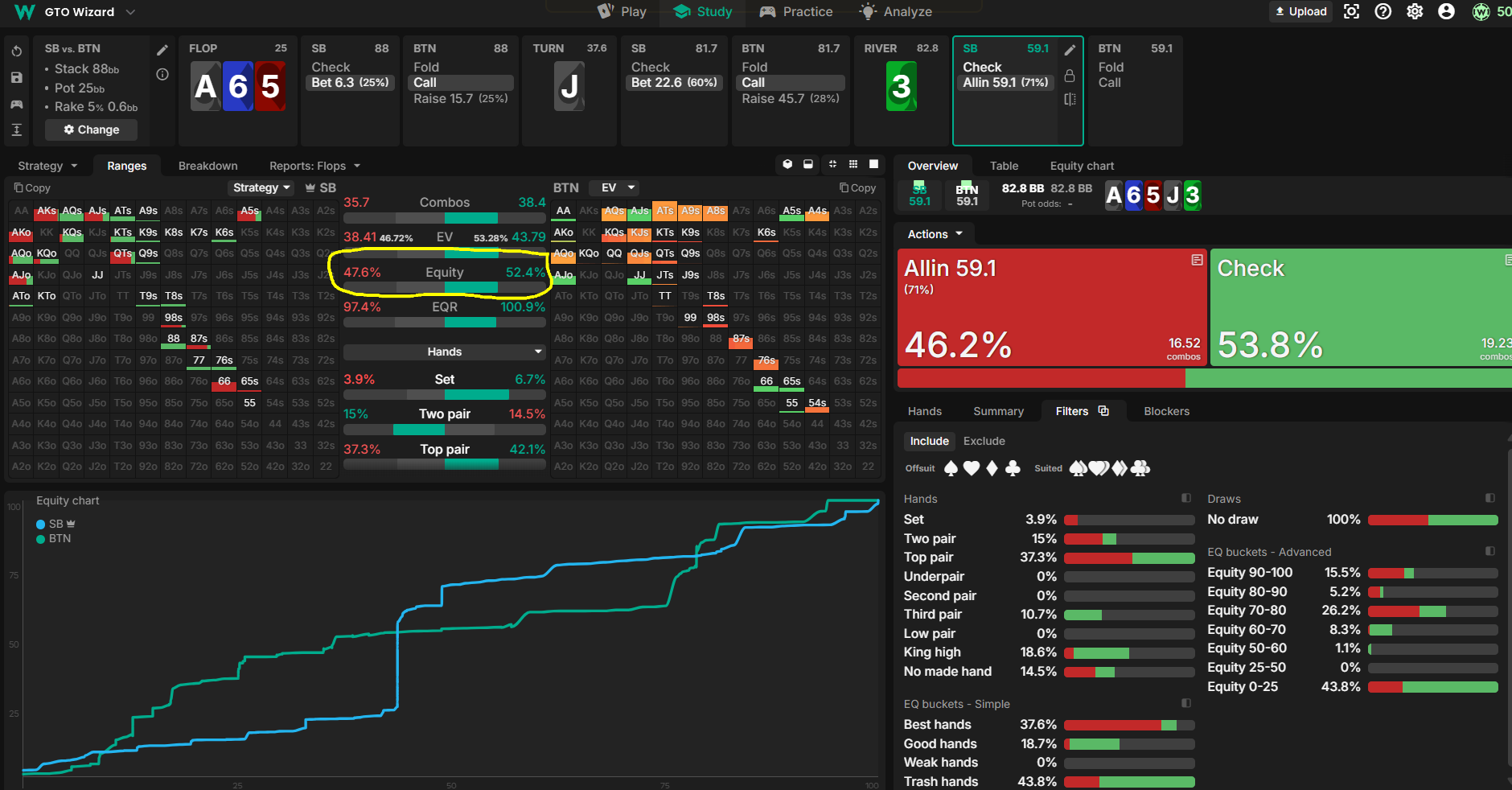
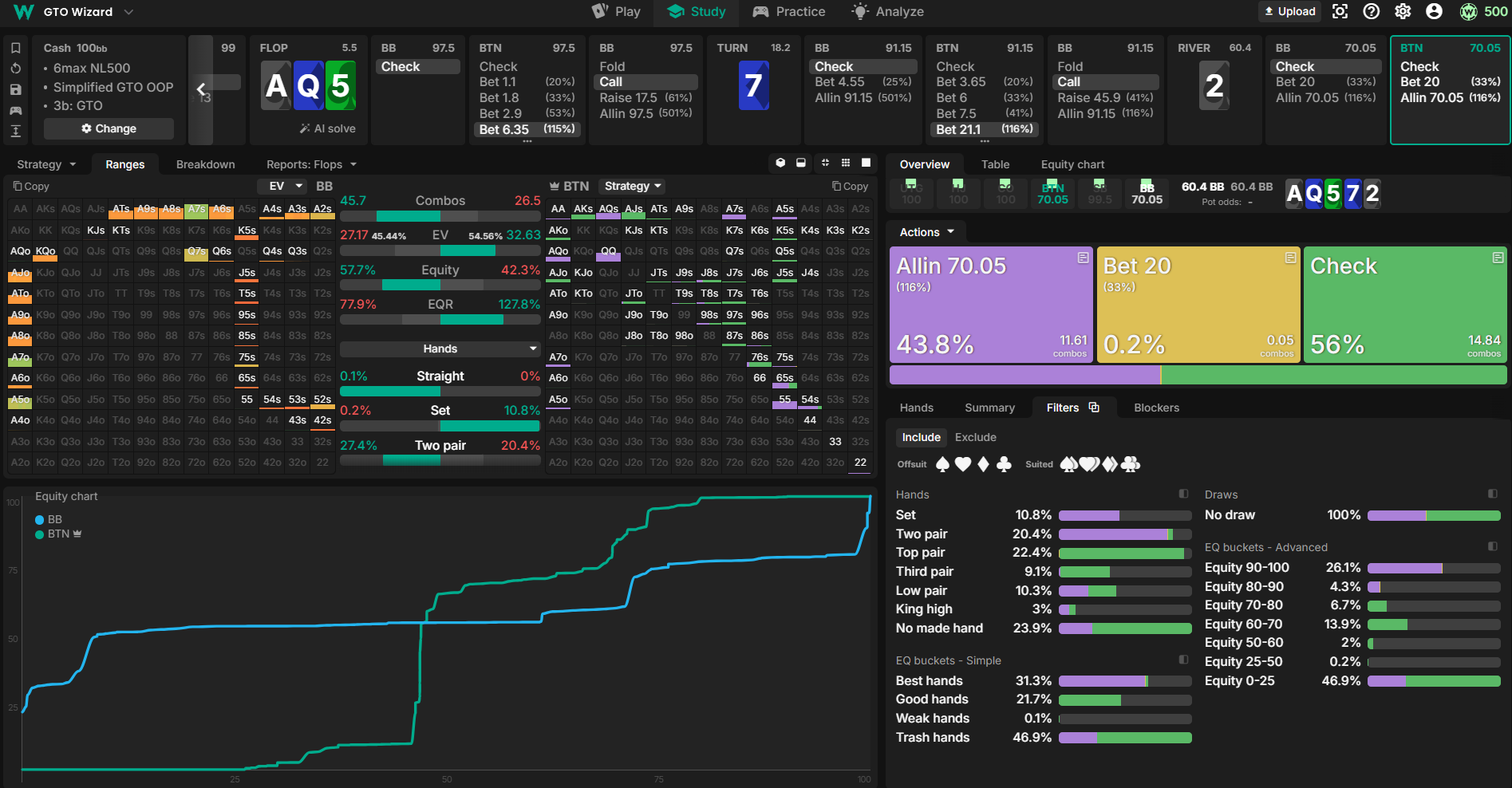
I got into these two situations. Both of them are triple barrel lines so I was looking for heuristics in how to bluff OTR and one thing I remembered was that my bluffing frequency should be higher if the River brings a card that improves my range giving me the " range advantage " something like a triple broadway runout for example. Howver, on bricks I wasnt sure who has the range advantage. I know the aggressor prob has the nut advantage and some stronger hands than the defender in a triple barrel but villian has called a double barrel so he has narrowed his range by the River giving him a range advantage ( this is my thought process but could be wrong, lmk ). The Equity buckets in both shows that the defenders range has more equity so do this means, he has a range advantage ? I will put two examples here: one is SB vs BTN 3BP and the other SRP IP PFR
6 Replies

The term "range advantage" can be a little vague. They have the range advantage in the sense that their range has overall more equity, because their range lacks the bluffs that you have in your range. However, you have the "nut advantage" of the strongest overall hands, which in a sense gives you the advantage as it enables you to bet with a polarized range of strong value hands and bluffs.
Generally on a blank river you're going to want to continue betting with some of your bluffs, but also have some that give up.
If you're making pot sized bets generally you can support 2 bluffs for 1 value hand on the flop, 1 bluff for 1 value hand on the turn and 1 bluff for every 2 value hands on the river.
That's assuming you're perfectly polarized and that your bluffs have no equity, but in real poker it's not quite that straightforward. You will have hands that have some characteristics of both a value hand and a bluff.
Also in the two examples you gave, sometimes humans will over fold on the turn and arrive with a stronger hand on average on the river. Sometimes they can become so tilted towards stronger hands like Ax+ that on the river it might make sense not to bluff at all.

Equity alone doesn't determine which player should be the aggressor. Take the nuts and air vs bluff-catcher toy game: imagine the board is 22223 and OOP has exactly KK while IP has 1 combo of AA and 99 combos of QQ-. OOP has 99% equity and yet has no incentive to bet: IP would simply fold all their QQ and OOP will have value owned themselves against the 1 combo of AA. IP, on the other hand, is incentivized to shove no matter how deep stacks are, and the prevalence of bluffs just means they have to bet QQ- at a lower frequency.
Note that the second picture you posted is a prototypical "diagonal figure-8" shaped graph you will see in these polar vs condensed range situations.

This is why I believe range advantage is a myth.
I ran a bunch of similar regression analyses a while back, and I have to say I agree.
Unfortunately I did this on an old machine and can't find the results, but going off memory I ran analyses by several different combinations of size, frequency and size*frequency against equity, EQR, and EV, and I remember that basically any correlation I could find had issues of causality. For example, the highest correlation I found was something like size and realization, which begs the question: Does that mean whenever you're in a spot with good equity realization you should bet large, or does betting large improve your equity realization (by maximizing value with your nut range and denying the most equity with your air and vulnerable hands)?
Before reading into your post beyond the headers and graphics, I have the same question of causality with your findings.
To offer a more affirmative theory on betting size and frequency, the distribution of equities across your respective ranges is going to be the single strongest determining factor, at least for end-of-action decisions. Something like the distance between the lines at both the high-end of the distribution and the low end of the distribution is determinative of the size and the prevalence of hands in the top-right of the graphs you posted (what percentage of your range is ahead of their range at each respective percentile) will determine the frequency you can bet.
The first half of that sentence often gets described as "nut advantage" and the second half as "range advantage", but we have to get a lot more precise with our terminology. Instead of nut advantage, it might be more like "polar differential" because:
1) I believe it's the distance between the lines that matters for sizing in particular whereas prevalence matters more for frequency (again, think of the toy game example from my last post) and
2) the distance matters at both the top and bottom of the distribution.
The concept of "range advantage" needs to be scrapped almost entirely due to what Tombos and I have demonstrated. Even just "value advantage" would be an improvement, or better yet "value concentration."
I didn't feel comfortable addressing spots with cards left to come because things like protection, geometric sizing, etc complicates this all a bit.
Unfortunately, this isn't information you will find in most aggregated reports from solvers, as they don't list equities on a per-hand basis. The very graphs you posted from GTOw's dashboard have the best predictive power of any data visualization I've seen.
There's a concept in poker that is relevant, but I haven't heard it defined well. I will call it "equity elasticity."
Certain hands perform almost as well against the top of our opponents range as they do against the bottom, so they have "inelastic equity." This means as more money goes into the pot they will generally over perform (think nut flush draw on the flop).
Other hands might have decent overall equity vs our opponent's entire range, but poor equity against the top of our opponent's range, so they have "elastic equity." In this case the hands will generally under realize their equity (think bottom pair like T9o on an AKT flush draw flop).
Intuitively this explains the strong correlation between cbet percentage and equity realization that tombos demonstrated through his link. Hands with "inelastic equity" can take the heat of repeated bets and will tend to have high equity realization.
Hands with "elastic equity" have strong equity against our opponents air hands but poor equity against their value hands. In this case the threat of additional bets will force them to fold early and they will have poor equity realization.


