My journey from a beginner to an advanced player
Hi guys,
I'm starting this thread to document my progress as a new backgammon player. I will post analysis, questions, an
After your move 18/13, you're hit on 15/36 rolls:- Any 1 (11 rolls)- 6-4 (2 rolls)- 6-2 (2 rolls)After 11/6, you're hit on 17/36 rolls:- Any 6 (11 rolls)- 5-1 (2 rolls)- 4-2 (2 rolls)- 2-2 and 3-3 (2 rolls)So that's only 2 more rolls. Yes, every roll counts, but what do you gain with 11/6?- 1 blot secured.- An extra builder to attack on your 1-pt: now 6-5 can point on your oppo
Well I’m no expert either but I think you hit on the main points of the position. Cleaning up the blot is good and giving yourself a builder is good too. I think focusing on black’s “prime” is also a mistake. Block doesn’t really have a prime; he has a 5 point board. It’s functionally similar to a prime in that you have to roll a 6 to escape,
Thank you both for the comments! Now that I look at the position again, it is not as scary as it first seemed, since indeed black has a lot of work to do even if he hits my blot.
I guess the blot on the 18-point is also producing a difficult decision for all his rolls with 6s, as he has to choose between hitting or escaping (as opposed to a blot on the 13-point).
Thank you both for the comments! Now that I look at the position again, it is not as scary as it first seemed, since indeed black has a lot of work to do even if he hits my blot.
I guess the blot on the 18-point is also producing a difficult decision for all his rolls with 6s, as he has to choose between hitting or escaping (as opposed to a blot on the 13-point).
Hey, you are making progress! The duplication of sixes is a good point that I did not really even consider. That’s probably why 11/6 comes out just a bit better than 11/8 18/16 which also safeties the blot.
I agree with stremba70, very astute observation! I hadn't thought either of the duplicated 6s.
Hey, you are making progress! The duplication of sixes is a good point that I did not really even consider. That’s probably why 11/6 comes out just a bit better than 11/8 18/16 which also safeties the blot.
That and the fact that 11/8 doesn't provide an extra attacker for the ace point.
diceroll,
This is just a general comment about what I think I have seen from the positions you post. It seems to me that you are playing to avoid being hit as a general rule. In many, if not most, positions this is probably not a bad rule of thumb. I’ve played against high level bots and humans where you get hit once in a seemingly unthreatening position and before you know it your sitting there with three of your checkers on the bar against a closed board and you lose gammon.
The idea of playing safe, though is not a good one for every position though. I think many of the positions you posted are ones where you made mistakes because playing safe was the wrong idea. Don’t get discouraged; it is tough to learn when taking the risk is worthwhile. I went through a period where I went through the same thing until I learned that more aggressive play can be better. Unfortunately I took it too far the other way and started taking unwarranted risks. I still have a tendency to play overly aggresively at times. It really is a tough aspect of the game to get right.
diceroll, This is just a general comment about what I think I have seen from the positions you post. It seems to me that you are playing to avoid being hit as a general rule. In many, if not most, positions this is probably not a bad rule of thumb. I’ve played against high level bots and humans where you get hit once in a seemingly unthreatening position and before you know it
I think you're right, especially in late-game positions I probably play too safe. In early game phases, I've learned to take more risks when the opponent doesn't yet have a developed home board (this I learned mostly by observing how aggressively XG plays). One of the things that seemed counterintuitive at first was hitting loose on 5-point or 4-point, leaving a blot there in early game. Through repetition, I've managed to improve in those situations. Late game positions don't repeat as often so will take longer to improve.
One more interesting situation from previous games:
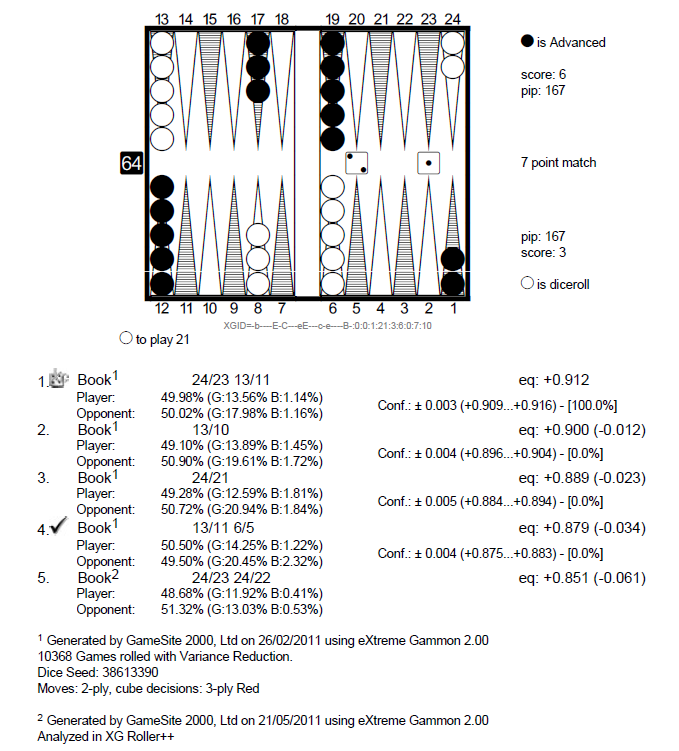
This time it's about an opening move. Notice the match score and that this is post-Crawford. When the match score is 0-0, the difference between 13/11 6/5 and 24/23 13/11 is minimal. However, with match score 3-6, 13/11 6/5 is actually a pretty big error.
I played with this position and different match scores in XG, and here's a brief summary of what I found:
- Match score 2-6 or 4-6: 13/11 6/5 is the best move, everything else is an error.
- Match score 1-6, 3-6 or 5-6: 13/11 6/5 is an error, 24/23 13/11 is the best move.
I suppose this is because of cube strategy so that when the difference in match score is an even number it's a different situation than when it's an odd number, correct? But can you walk me through how this works? 13/11 6/5 produces me more gammon wins, so I would think that it is preferred when the opponent is 1-away with a clear lead in the match. But this is not the case here. Why is that?
It's a bit baffling to me also, because at this score where gammons have no value for the opponent, I would eagerly play 13/11 6/5.
https://bkgm.com/articles/GOL/Aug99/five...
See the part : "4-3 (1 away, 2 away) Post-Crawford"
It's about cube effect.
Well explained in the article above.
But honestly don't be to rude with yourself, it's very rare and you are not going to loose a lot of equity with these situations.
From Kit Woolsey himself (https://bkgm.com/articles/GOL/Aug99/five...)
"4-3 (1 away, 2 away) Post-Crawford
At first glance, this looks very simple. Obviously the trailer will double at his first legal opportunity, since he has everything to gain and nothing to lose. After the leader takes the winner of the game will win the match, so in essence it is double match point.
It is true that once the cube has been turned and accepted both players should play as though they are playing at double match point, but the leader is not required to accept the double. Let's see how it looks from his point of view:
If he takes, he is playing the game for the match.
If he drops the score is 4-4 (1 away, 1 away), and he has 50% equity.
It is clear that the leader should accept the double only when he is the favorite. If he is the underdog, he should refuse the double. This is what is called the free drop for the leader, since he can drop the double without giving up anything.
Does this affect the play of the opening roll? If the leader wins the opening it won't matter. The trailer will double however the leader plays, and the leader will take unless he feels he is the underdog (which he might be on some of the weaker opening rolls -- that is not clear). However if the trailer wins the opening roll his play can make a significant difference. The reason is that the trailer can't double immediately. He has to wait for the leader to roll and play, and the leader can now examine the position and see who is the favorite.
For example, let's consider the opening roll of 2-1. Normally both the splitting play of 24/23, 13/11 and the slotting play of 13/11, 6/5 are reasonable, and the choice of play is largely a matter of personal preference. At this score, however, it isn't close. It is mandatory to avoid the slotting play.
Suppose the trailer plays 13/11, 6/5. If the leader hits the blot (or rolls a good doubles such as 1-1, 3-3, or 6-6) he is the clear favorite and will happily accept the double. Otherwise he is the underdog, and will decline the double. Consequently slotting the five point won't work, since the trailer will not have the opportunity to cover the blot -- we will be playing a new game. Therefore he should play 24/23, 13/11. Now most of the leader's rolls do not lead to a decisive advantage for one player, which is what the trailer would prefer.
It may seem obvious that the trailer should always double at his first opportunity, but that is not clear. Suppose we have the best possible start for the trailer -- he rolls 3-1 and the leader rolls 6-2 (playing 24/18, 13/11 let us say). Obviously if the trailer doubles the leader should drop. But perhaps the trailer should play on for a gammon! It is quite unlikely that the leader will roll well enough on the next exchange to take the advantage. If in the future the leader threatens to gain the advantage the trailer can always double and move on to the next game, but if things continue to go the trailer's way he can continue to play on for the gammon. It should be noted that you should not do this unless you are sure that your opponent understands the free drop concept. If there is some chance that he will just take the initial double, it would be foolish not to double."
From Kit Woolsey himself (https://bkgm.com/articles/GOL/Aug99/five...)"4-3 (1 away, 2 away) Post-CrawfordAt first glance, this looks very simple. Obviously the trailer will double at his first legal opportunity, since he has everything to gain and nothing to lose. After the leader takes the winner of the game will win the match, so in essence it is double match point.It is
Very nice find, thank you!
It's interesting that 13/11 6/5 is apparently too volatile to go for the gammon approach. Whereas when rolling 3-1, you gain such an advantage immediately that you should try going for a gammon (although with 3-1, the first move is clear so the same dilemma is not present).
After a week-long break, I've played again a lot of matches against XG. I feel like something has clicked, and my avg. PR has been going down fast. Below is a chart including all of the competitive matches I've played against XG:
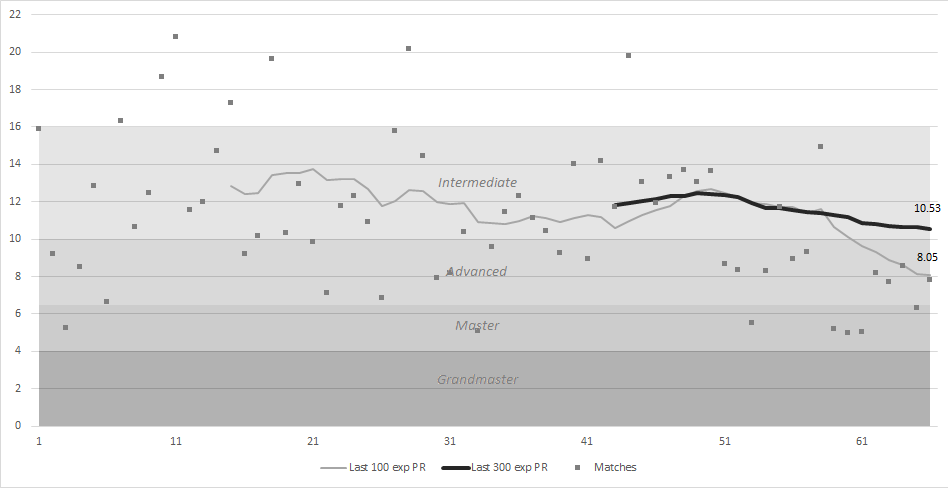
Most of the last 15 matches are in the advanced territory. The 100 XP moving average is currently 8.05.
It seems that I have fixed some of the tendencies I had earlier because my blunder analysis shows less emphasis around certain topics, i.e. the errors are more random.
I'm very happy about this progress. Once the 300 XP moving average goes below 10.0, I consider my goal achieved. This still requires focused effort because a few bad matches can obviously increase the avg. PR by a lot.
In general, I've noticed that there is a huge difference between playing relaxed and focused vs. playing when your mind is not 100% in the game. I've noticed this in poker and chess as well. All of these games are very unforgiving in a way that they don't allow even a moment of distraction.
Very nice find, thank you!
It's interesting that 13/11 6/5 is apparently too volatile to go for the gammon approach. Whereas when rolling 3-1, you gain such an advantage immediately that you should try going for a gammon (although with 3-1, the first move is clear so the same dilemma is not present).
Yes that was a very interesting position you posted. I would have looked at the match score, realized it was a gammon go score (one where gammons have a higher than normal value - in this case 4 points for a doubles gammon wins the match so the increased value is obvious) and gladly slotted the five point. The linked article makes sense though. Slotting is a risk/reward play. You risk getting hit in order to grab the five point early. The problem is that you take the risk but never get the reward. If it works out well, he just uses the free drop.
The article talks about 1 away, 2 away, but the position posted is 1 away, 4 away.
Nonetheless, the same principles apply.
Here is a position from a recent match:
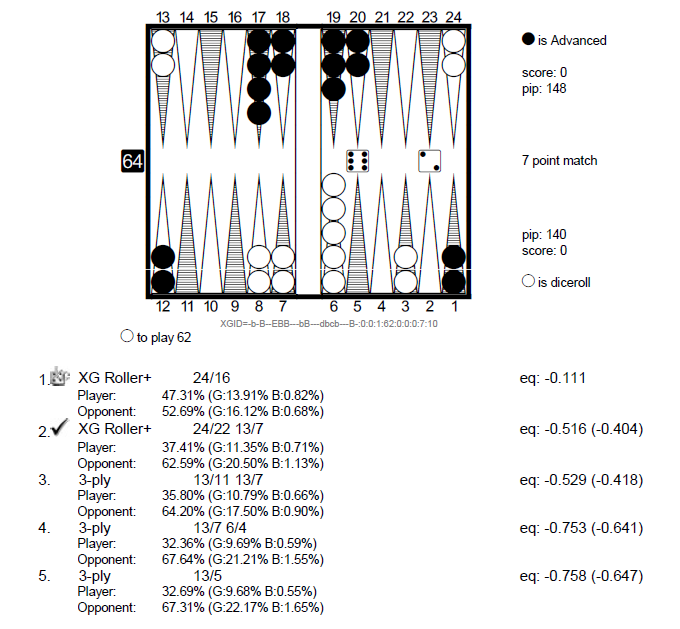
As you can see, my move 24/22 13/7 was a gigantic blunder. XG wanted to just run with a back checker. All other moves are huge blunders.
My thinking is, I want to split the back checkers but also bring down a builder to the 7-point. Opponent's prime is starting to look scary, but we would still have one left there even if we managed to escape with the other (which is uncertain).
What I'm most confused about is how much equity I lose (-0.404). Is it because of future cube action (opponent has good doubling opportunities)? The opponent also has two checkers back and I can build my prime as well. Is keeping the 13-point the important thing here? 
I would possibly have played 13/11 13/7 over the board, because I wouldn't have thought that splitting the back men was a good idea at this moment.
But when you think about it, you're ahead in the race (although slightly), so running with a back man makes sense.
And yes, your 13-pt (called midpoint) is important, it connects your back men to your other checkers, like some sort of bridge. So in hindsight, I think preserving the midpoint is important in the equation.
Also note that after 24-16, if your opponent was to hit you with a 4, he would have to break his own midpoint to do so, which is also a factor I guess.
I played around with the position in XG, and the doubling cube didn't seem to affect the decision much (when I hold the cube I should still clearly play 24/16). The dice distributions after 24/16 and 24/22 13/7 are below:
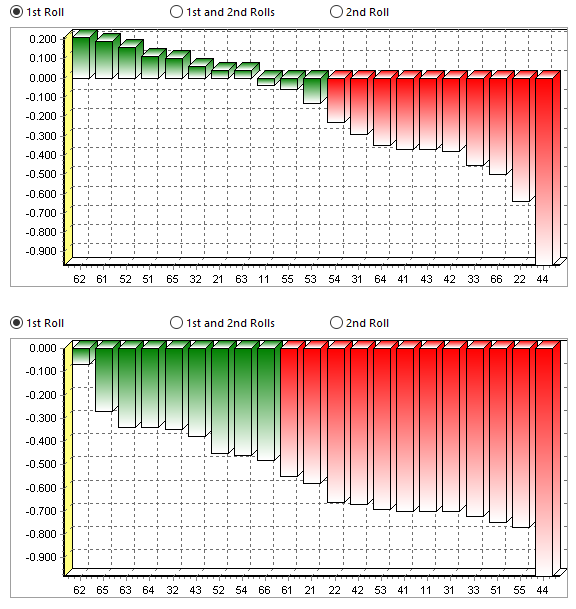
After running (24/16), a lot of the opponent's rolls miss, whereas after splitting the back checkers and bringing one down to the 7-point, almost all of the opponent's rolls are bad for me.
When you post these I try to figure out what I think the best move is before looking at the XG analysis. When I did so this time I honestly didnÂ’t see anything other than 24/16 that made any sense to me. Your point about there being many more bad rolls after 13/7 than after 24/16 is undoubtedly valid, but my main focus on this position was on how it likely will develop over the next 4-5 turns. It is shaping up to likely become a priming battle. Timing is crucial in priming battles - the player forced to break their prime first will most likely lose. We arenÂ’t quite there yet; both players have some work to do, but thatÂ’s the way itÂ’s heading unless something changes.
How do we maintain timing? First, if nothing changes, you are at a slight timing disadvantage here. Your prime is a point further advanced than blackÂ’s. This indicates a need to rectify it. Timing comes from having spare checkers that have escaped the enemy prime but are not advanced to your own front position. In that is outfield checkers. Having more outfield checkers and fewer trapped ones gives you a timing edge that usually will win you the game once primes are formed. With that in mind, 24/16 obviously does better. Even if your blot on the 16 gets hit you are no worse off in terms of timing than before. If a blot on the 7 is hot, thatÂ’s a third trapped checker.
ThereÂ’s also a more immediate consideration. Look at where blacks spare checkers are. There is a big stack on the 8 point he wants to unload. Stepping up to the 22 gives him exactly what he wants - the opportunity to unstack by attacking your back checkers. Rolls like 51 and 31 are obviously bad as black will hit two. Even a 41 though is bad for you since hitting the 13 point blot will allow black to split his back men more safely. HeÂ’s in a similar position to you regarding splitting. You really want him to step up to the 4 or 5 point so you can hit loose and unstack your 6 point. (That does risk getting another checker sent back but for the reward of strengthening your prime if missed; something that leaving a blot on the 13 doesnÂ’t offer). If youÂ’re on the bar, rolls like 61, 62, 51 or 52 no longer allow you to hit loose.
If you donÂ’t run there just isnÂ’t any good 6 to play. You donÂ’t want to break your midpoint and leave a blot there as already discussed. You donÂ’t want to dump checkers to low home board points (ie 24/22 8/2). You only lose more timing whether you cover the blot on the 2 or it gets hit - neither one helps you. By elimination the best 6 is 22/16.
Very well analyzed @stremba70!
When you post these I try to figure out what I think the best move is before looking at the XG analysis. When I did so this time I honestly didnÂ’t see anything other than 24/16 that made any sense to me. Your point about there being many more bad rolls after 13/7 than after 24/16 is undoubtedly valid, but my main focus on this position was on how it likely will develop over th
Thanks for the insightful analysis! Everything you say here makes sense, 24/16 now seems much more clear to me. I think I have not yet understood how important running is in some situations. Often I'm so focused on building a prime in early game phases that I overlook other aspects.
Yes, don't forget that backgammon is essentially a race.
With many obstacles, but a race nonetheless.
I, too, often forget this.
Progress update:
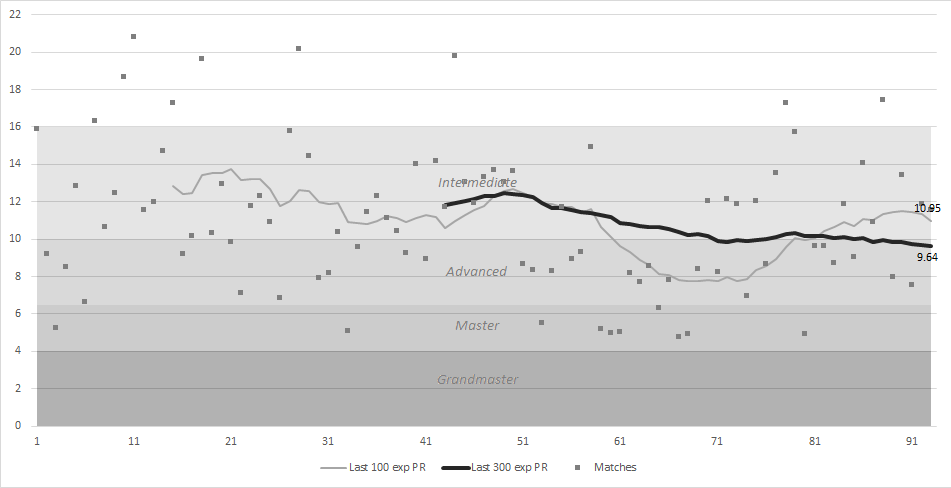
I've played quite a lot of matches against XG over the last couple of weeks. The 300 exp. average PR is now in the advanced territory (9.64), so I guess I can now call myself an advanced player? 😀
However, the most recent matches haven't gone too well, and this is reflected in the 100 exp. avg. PR. I believe this is because I've not been as focused lately. Based on blunder analysis, I seem to be making more easy mistakes than a while back. The good thing is, these should also be easy to fix.
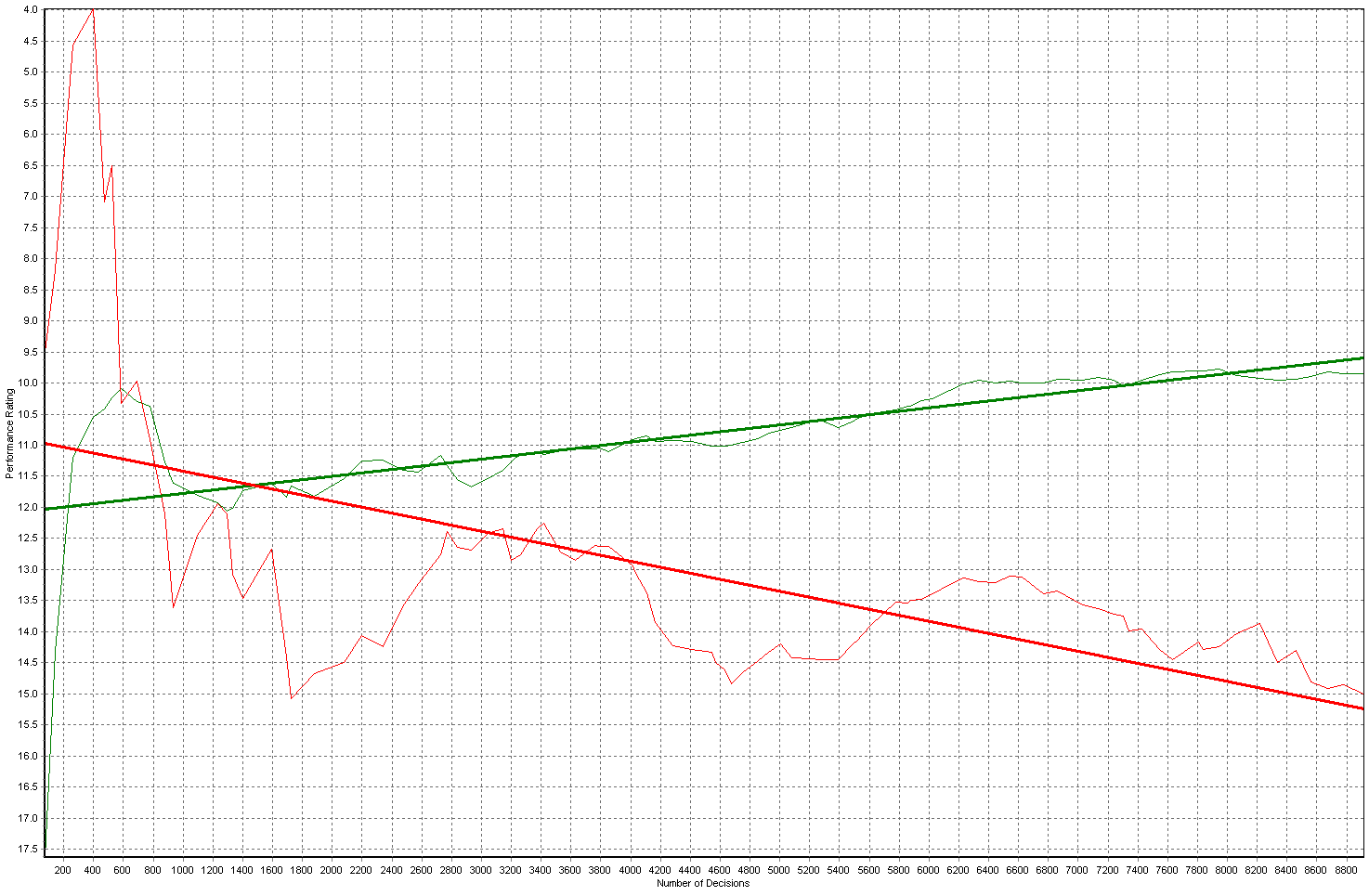
This is the progress graph directly from XG, separately for checker play (green) and cube play (red). I've been improving in checker play, whereas cube play hasn't shown any progress - it's actually gone downhill (the graph is a bit misleading though, because the earlier values are based on very few decisions).
I still think my understanding of cube action is better now, since I'm aware of concepts I wasn't aware of before. Maybe the decisions lately have just been tougher, I'm not sure. In any case, cube play is starting to weigh my progress down, so I'll try to focus more on it in the future.
In blunder analysis, a couple of things stand out to me:
- Doubling too weak
- Playing too safe (especially in mid/late game situations and when there is opportunity to blitz)
Funny how these tendencies were quite clear already a while back, but I still keep making the same types of mistakes. In general though, I think the errors have been getting more random, so I guess I'm adjusting gradually.
You are playing matches against XG. If you have not already done so, you should try reading up on cube play in matches. It is quite a bit different from cube play in money games. If what you have learned about cube play came from sources discussing money games that is likely to be misleading you and studying match play cube handling might improve your cube handling.
You are playing matches against XG. If you have not already done so, you should try reading up on cube play in matches. It is quite a bit different from cube play in money games. If what you have learned about cube play came from sources discussing money games that is likely to be misleading you and studying match play cube handling might improve your cube handling.
Yes, I should definitely read more about cube play. For example, I'm aware that there are reference positions but I haven't studied them at all. In some situations, my gut feeling about winning chances is way off and I make bad cube plays. E.g. sometimes I estimate to be 70-30 favorite when in reality it's 55-45 or something like that.
Absolutely study those reference positions and get a better understanding of how to estimate your winning and gammon probabilities. That absolutely is critical to learning how to handle the cube. In addition though (and probably after you have gotten better with these estimates) you should learn the differences in how doubling and taking work at different match scores. Different match scores can make this enormously different. There are scores where you can double as an underdog (for example, trailing 5-3 in a 7 point match when you have significant gammon probability) and there are scores where you should not double even if you have winning chances of 80% or more. These are mostly when weÂ’ll ahead in a match, especially if you only need 2 points to win. If you double your opponent can immediately take and redouble, giving them a chance to catch up quickly. If you are leading 5-0 in a 7 point match and you double, your opponent could redouble, win a gammon and win the match this game. You must be much more conservative when you double in this situation as a result.
A couple of interesting positions:
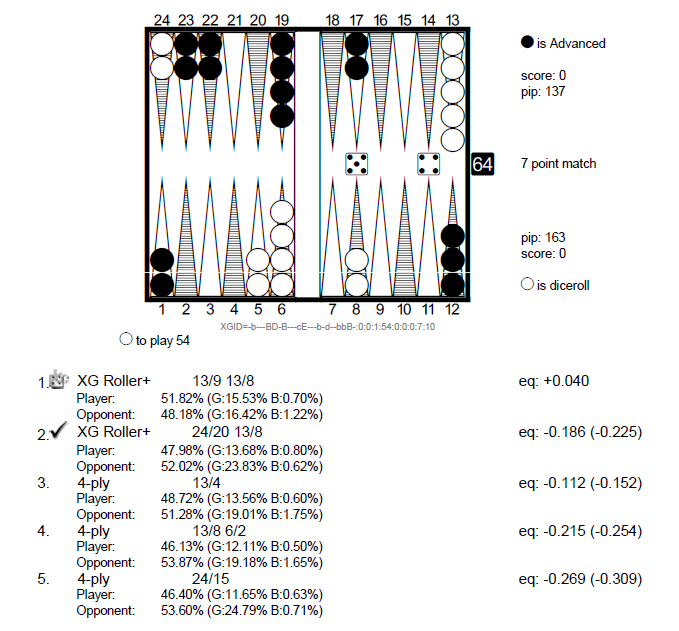
In this one, I thought it would be good to diversify by bringing a builder down but also splitting the back checkers. There is of course a chance of getting blitzed, but the opponent has spare checkers only on the 6-point. I don't detest XG's preferred move, but what I'm confused about is how all the other moves are such big blunders. I would expect 13/9 13/8 to be somewhat close to 24/20 13/8 in equity, but this is not the case. Why?
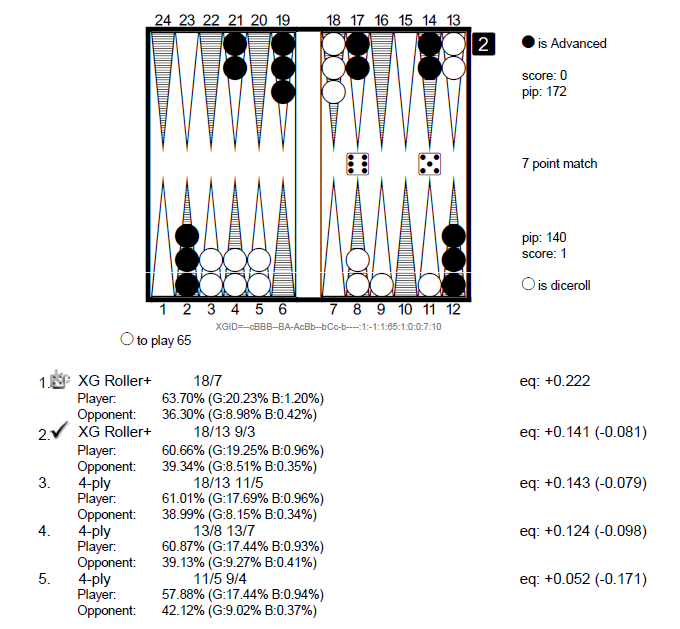
Here's an example where I play too safe again. XG apparently wants to build the prime, but it leaves 3 blots. Why take such a big risk? We are massively ahead in the race - shouldn't one play safe in that case? If we leave 3 blots, the opponent has a high chance of hitting one, and then might hit another one after that.

