Buying extra ammo whilst shot taking?

*serious thread
QUESTION:
Would it be sensible/profitable to play lower stakes concurrently while taking a shot at higher stakes, and then using any winnings from that process directly to further 'fund' the shot? i.e. effectively extending the number of shot buy-ins available to lose (potentially indefinitely) before moving back down.
LOGIC:
I realise this could work both ways and any negative variance at the lower stake will decrease your bankroll. But in this system any decrease in bankroll from the lower stake would just count as decreases to your lower stake bankroll, not the shot fund itself. So the shot fund can only ever gain and the worst outcome is you maintain the originally allocated five buy-ins (until busto).
EXAMPLE:
Fred beats 50nl successfully over a large sample and has enough bankroll for a 5 buy-in shot at 100nl. To ease himself in he plays 100nl cash games exclusively at peak hours versus fish to maximise his chances of success. However, as this process is more time consuming and stressful he also continues to grind 50nlz as his day job. And as Fred is currently upswinging the stacks are still pouring in. He made another 8 buy-ins today which he now puts directly into his shot fund, allowing him a 9 buy-in shot in totality, rather than the original 5.
Logical? Win/win? I think this is a nice untapped way to maximise shot taking success/efficiency if you are confident in your play and can follow the rules objectively. Any further lower stake buy-ins are only ever going to be fed back into the next shot anyways so why not keep yer foot on the gas at a stake you already know you've mastered while the 'maximally efficient' (but more laborious/demanding/slave to variance) shot take process continues. 🤷
Worst possible outcome i guess is you hit some freak downswing that obliterates the lower stake bankroll to the extent the entire shot-take is unviable. But the chances of that seem ultra slim if you have a proven sample of success.

When I saw the title of this thread I thought: "Oho, Ceres got drunk and wants to buy extra ammo. Things are not looking good."
As for the thread itself, as always, I don't understand a thing 😀
Isn't this roughly what people do anyway? A lot of people have a strategy of playing 50nl until they have their, say, 60 buyins of 50nl plus 5 buyins of 100nl to shot take with. Then, they play more 50nl if they lose their 5 buyin shot take.
Well, you're basically just playing some of those extra hands of 50nl early. I think the only extra thing you'd need to take into account is dropping down to 25nl at the appropriate time if you somehow manage to downswing hard in both. Seems to me like it's the exact same amount of risk of having to do that as if you'd done purely the shot take then dropped back and downswing at 50nl after. Possibly it's even less risky if you're willing to forget the shot take if your 50nl downswing is bad enough.
In practice, I play mixed sessions of my shot and whatever my main stake is, and so do many others. I think in that case we're already doing what you're describing more or less.
In practice, I play mixed sessions of my shot and whatever my main stake is, and so do many others. I think in that case we're already doing what you're describing more or less.
Thanks. I'd never heard or read it articulated before so I wasn't sure if I was missing something. Never understood multi-stake play before now either but in this context, and coupled with solid WR expectations, I've finally understood!
Plus I guess the value of this kind of flexible system increases as you move up and the risk of ruin expands and it takes longer to build rolls. Clearly the dream would be poker client monitoring auto-software that you can pre program and just switch off from mentally.
Until then: flexi-shot funds ftw.
Ceres, how much ammo do you hold in your clip and what caliber ?
And how many ducks did you shoot recently with your super high accuracy (win rate) ?
Yeah you're not going to believe me so whatever, but the god's honest truth is I'm actually a lapsed billionaire. An original financial GOAT who flew too close to the dollar sign sun and realised, meh, it wasn't worth the hassle after all.
Instead of my luxury lifestyle i decided to drop down and play microstakes for 7 years in a small cupboard. Call it a learning experience if you will. The path to true personal suffering and wisdom? Idfk.
FTR I have an ~80bb/100 WR currently. But I don't shoot ducks; I shoot.. losers.
pwng pwng
Awesome. Great things can be achieved even on micro stakes. And sometimes the path to success requires just keeping playing and the desired moment might become reality almost by itself. You never know when you'll get that one time chance, so it's good to be ready.
Whatever stakes you play, remember to always fold 23 suited, it's the most deceptive of all hands. It looks ok, but plays like trash.
Er, if we never play 32s then we never have the nuts on A♥5♠4♦ boards and villain can bluff with impunity.
I appreciate the top tier advice deuces but I've heard a rumour you haven't played any actual poker since Windows 7 launched, so colour me skeptical aye.
I appreciate the top tier advice deuces but I've heard a rumour you haven't played any actual poker since Windows 7 launched, so colour me skeptical aye.
Rumor confirmed. But... poker isn't only about the money. Take for example tournaments where you win tickets to the next round. You win a ticket that can connect you to the money, but you don't win any money when you win a ticket.
To the topic of this thread - I think it's good to switch to higher stakes when you're on a downswing and you're losing a lot. Someone could say - "To lose even more ?". No, to quickly replenish your bankroll by playing in a completely different mode. A mode that can psychologically easily end the downswing spiral which can go endlessly.
You only need to set the exact amount of $ you're ready to risk BEFORE switching to higher stakes.
For example you lost $1300 during the last 18 hours and you can't stop losing. So you take $600 and go to higher stakes. If you lose - you end the whole session and save your time and nerves. If you win, you can come back to lower stakes with good mood.
Good luck !

Worst possible outcome i guess is you hit some freak downswing that obliterates the lower stake bankroll to the extent the entire shot-take is unviable. But the chances of that seem ultra slim if you have a proven sample of success.
In theory there is some 'optimal stake' for your bankroll and risk tolerance. As your BR increases so does your optimal buy-in. However poker sites only offer discrete stakes.
Mixing stakes is sort of equivalent to playing something between those two stakes. Lets say your optimal stake for your current role is NL75. You can mix NL50 and NL100 tables to achieve your desired level of risk.
This begs the question: how do you calculate your "optimal stake"? Well that leads into stuff like the kelly criterion which I've covered here:

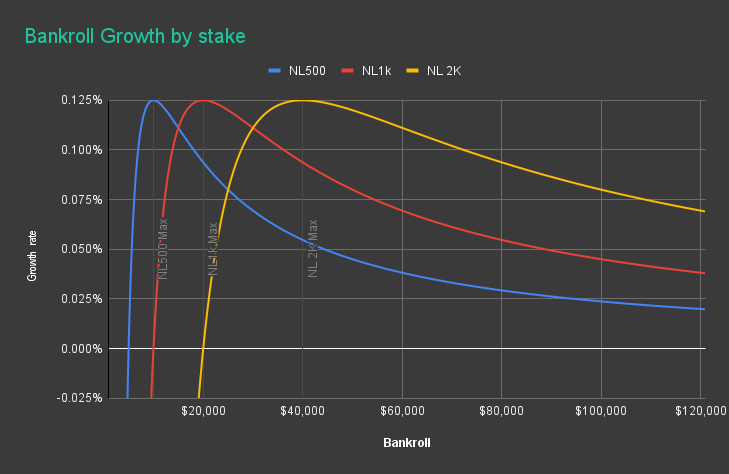
Cheers tombos, for your serious and erudite answer. I like the 'in-between stake' analogy a lot because it's something my ape brain can comprehend.
(RE: article, I still haven't cleared up my (mis)understanding of the gambler's fallacy being somehow 'disproven' by the law of large numbers. Apols in advance for harping on about it but doesn't it just.. ultimately, confirm that it's not actually a fallacy ??? i.e. Luck does (always) even out, really, truthfully, even if it's not sentient or predictable in the short term?
(may need to start a new thread on this, but if I can be corrected abruptly by all means))
For example you lost $1300 during the last 18 hours and you can't stop losing. So you take $600 and go to higher stakes. If you lose - you end the whole session and save your time and nerves. If you win, you can come back to lower stakes with good mood.
But what if lady luck was hiding.. three or four buy-ins down the road in a dumpster? a.k.a. way behind the three or four buy-ins you just spewed into the high stakes meat grinder? What now coach? Play the lower stake alllllll over again where lady luck was ruined originally for no less than triple the amount of work?
Yikes. And that's IF one finds luck again. Shaking one's fist and cursing the logic that took you too high too soon, like Icarus, cursing his poor adhesive choices and dire understanding of coastal weather patterns.
Good luck !
No kidding.

Cheers tombos, for your serious and erudite answer. I like the 'in-between stake' analogy a lot because it's something my ape brain can comprehend. (RE: article, I still haven't cleared up my (mis)understanding of the gambler's fallacy being somehow 'disproven' by the law of large numbers. Apols in advance for harping on about it but doesn't it just.. ultimately, confirm that i
Results will converge to expected results on a percentage basis, but not on an absolute basis.
If you flip a fair coin 10 times and the results are 9 heads and 1 tails, and then flip 1,000 more times with the results being 500/500, the results will have converged to near 50%, but all you have done is break even on the last 1,000 flips. You are still in the hole from the first10. There is no expectation that you will make up prior loses. Only that you will have a fair result going forward.
If you flip a fair coin 10 times and the results are 9 heads and 1 tails, and then flip 1,000 more times with the results being 500/500, the results will have converged to near 50%, but all you have done is break even on the last 1,000 flips.
I don't really understand the last bit. If the % of flips evens out, then how is it mathematically incorrect to say that after the first 10 flips it is likely (a.k.a. there is a measurable/predictable/provable % chance of it being true) that future flips will tend towards tails?
There is no expectation that you will make up prior loses. Only that you will have a fair result going forward.
Those two sentences are logically incompatible. If probability doesn't even out eventually, nobody would/could reliably play poker profitably. I have to expect my yellow and green lines to converge eventually in order to continue playing during a downswing (and they do, reliably).
And therein lies the gambler's fallacy.
You make a coin flip bet. Tails you win, heads you lose. You get off to a bad start and lose the first 5 flips. What is the expected value if you keep flipping?
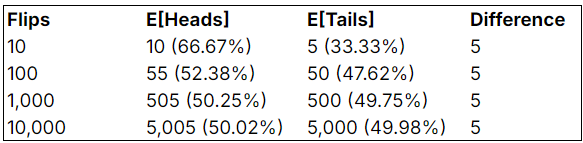
As you can see, we expect the coin to converge on percentage basis (trend towards 50% - 50%), but not on an absolute basis (your expectation is to remain behind 5 flips, it just looks smaller from the perspective of 10k flips). That's the law of large numbers.
I don't really understand the last bit. If the % of flips evens out, then how is it mathematically incorrect to say that after the first 10 flips it is likely (a.k.a. there is a measurable/predictable/provable % chance of it being true) that future flips will tend towards tails?
Let's start over.
This time, we start with a virtual 100 heads lead. You whisper to the coin, "listen mr, we're far behind so you better start flipping tails or no one will believe you're a fair coin!". You're lying to the poor coin of course, the 100-point lead is made up. But the coin doesn't care because it has no ears. Even if it could hear you, it has no agency, and cannot alter its probability of landing heads or tails. Each flip is of course independent, and at no point will the poor inanimate coin alter its trajectory to try and bring karmic justice to the world.
Those two sentences are logically incompatible. If probability doesn't even out eventually, nobody would/could reliably play poker profitably. I have to expect my yellow and green lines to converge eventually in order to continue playing during a downswing (and they do, reliably).
In absolute numbers (not percentages) at what point do you expect the results of a fair coin to be even? Do you expect it to stay that way? What is the mechanism?

And standard deviation actually increases with the number of hands played in absolute terms, but decreases relative to EV.
Because EV scales linearly with the number of hands played, while standard deviation scales with the square root of the number of hands.
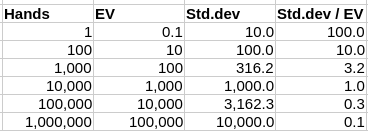
And this shows why anything less than 10 000 hands is basically noise, a ripple on the ocean.
I don't really understand the last bit. If the % of flips evens out, then how is it mathematically incorrect to say that after the first 10 flips it is likely (a.k.a. there is a measurable/predictable/provable % chance of it being true) that future flips will tend towards tails? Those two sentences are logically incompatible. If probability doesn't even out eventually, nobody w
The probability of flipping heads or tails is 0.5 (=50%). Mathematically, it is possible, and you will eventually if you get a big enough sample, get 9 heads in a row. The probability that your next 9 flips come all heads is 0.5^9=0.001953 (=0.1953%). Still, each launch has the exact same probability, 0.5. Coins have no memory of the previous events, just as cards have no memory. The convergence over the long run has nothing to do with magic, it's just the 0.5 probability, and mathematics, working its way.
Assume you are a 10 bb/100 sure winner at your games. Idk the exact numbers, but let's say you figured out you have a 3% chance that your next 1k hands will be a loss of 5 buy-ins (wild guess, just putting it here to help showing my point). You lose 5 buy-ins in a 1k hand session. Does this affect the probability that your next session will also be a losing one (-5 buy-ins to be precise)? The answer is no. Then, what guarantees things will ever even out in the long run, assuming we know for sure that you're the 10 bb/100 winner?
The probability of experiencing 2 -5 buy-in losing sessions in sequence is 0.03^2=0.0009 (=0.09%). 3 -5 buy-in losing sessions should happen 0.03^3=0.000027 (=0.0027%). And it goes on. The number keeps getting smaller and smaller trending towards zero, but it won't be zero. Technically, you may go broke with a 100 buy-ins bankroll just by experience -5 buy-in sessions in sequence. What guarantees that this won't happen in your lifetime is how the function works, how it keeps getting smaller and smaller converging to zero just by adding one more session. Plus the obvious fact that, same way as you may lose, you may also win, at a designated probability.
I think the confusion arises out of mixed definitions.
For example, if the Gambler's Fallacy is defined as: 'A punter is playing roulette and after ten REDS they start doubling their bets on BLACK because BLACK is 'due''.... then yeah, that's a fallacy; the odds of it being RED/BLACK are ofc identical for every sequence up to a point almost certainly exceeding that of the gambler's capacity to keep playing.
However, if we define it more loosely (which the vast majority of the youtube videos I watched do), then I don't think it's a 'fallacy' at all.
Take the wiki definition for example:
The gambler's fallacy, also known as the Monte Carlo fallacy or the fallacy of the maturity of chances, is the belief that, if an event (whose occurrences are independent and identically distriputed) has occurred less frequently than expected, it is more likely to happen again in the future (or vice versa).
Which to a poker player's mind is antithetical to the core idea of probability itself (i.e. that odds have to equalise over time because that is literally how probability works).
In this sense the GF is not a 'fallacy' at all. It's more like a paradox: both things are true depending on the context. Sure there is no increased probability technically speaking on the very next flip, but you'd bet your life roll on a billion flips equaling out to ~50/50.
Therefore, from a meta, zoomed out perspective, accommodating the entire sequence of events, it IS mathematically correct to say that as N approaches infinity each subsequent flip is probabilisticaly more likely in either direction. Variance always plays out. So I think it's wrong and misleading to lump that interpretation in the same bracket as a 'fallacy'.
If that's a fallacy then poker isn't long term profitable, and yet here we all are. Fallacying. 🤷
And therein lies the gambler's fallacy. You make a coin flip bet. Tails you win, heads you lose. You get off to a bad start and lose the first 5 flips. What is the expected value if you keep flipping? As you can see, we expect the coin to converge on percentage basis (trend towards 50% - 50%), but not on an absolute basis (your expectation is to remain behind 5 flips, it jus
What about a million flips. Or a trillion? Are you still betting that the difference will remain indefinitely?


