Can hero call this river jam after the turn checks through?

Hi all,
Had this hand last week - it's the second level of a €350 buy-in live tournament. Not many reads on any of the players, other than their Hendon Mob cashes - villain has about $30k (not that that means much exactly - other than he's certainly an experienced live player). Hero doubled up starting stack a couple of orbits earlier. Table is 9-handed and most players other than hero have close to starting stack, but villain is short and only has 35bbs starting the hand.
PREFLOP
Folds to hero (500bbs) in the lojack with T♥T♣; hero opens to 2.5bbs. Folds to villain in the BB, who calls.
FLOP (6.5bbs)
K♠5♦4♦
Checks to hero who bets 2bbs. Villain raises to 5bbs. Sigh. But the price is just too good here, and hero decides to defend vs the various semi-bluffs that the BB can have (in addition to value hands). Hero calls, in the knowledge that folding is probably fine.
TURN (16.5bbs)
K♠5♦4♦2♦
Villain checks, hero checks. I just want to get to showdown as cheaply as possible.
RIVER (16.5bbs)
K♠5♦4♦2♦Q♣
Villain jams. Hero...?

I don't see any reason why we need to look at calling here. We've invested 8bbs and the board is just an absolute disaster. We've played it fine on every street, and the right play is just a fold.
I don't see any reason why we need to look at calling here. We've invested 8bbs and the board is just an absolute disaster. We've played it fine on every street, and the right play is just a fold.
Yeah as a general rule I would agree with you and fold here. But something really smelt off in how villain has played this hand. If he check-raised with the flush draw, surely he's going to bet turn too? The only other obvious draw he might check raise is the 76 OESD, and that missed. Once he effectively caps his range with the turn check, how can he repolarise and bet so large on this river? The only hand that came to mind that might play this way is KQ. Are flopped two pairs/sets really going to play this way, and jam river once they get the green light that hero apparently doesn't have a flush after checking back the turn? It just didn't feel right to me.

I'm guessing if you looked at a solver you would probably prefer to call with hands that include a diamond. TdTx would likely be a preferable combo to call with over your exact hand.
On this particular hand I likely fold. Not that I haven't called in spots like this based off of a read that a player was over bluffing.
However the 2d turn is a particularly bad card for how it connects with our opponent's range. In addition to the obvious flushes, it also makes a straight for several rather intuitive flop check raises (A3, 63s).
I have no doubt that they will show up with some bluffs here (87,76, A2 all make sense, maybe some random 3x or something that decided to raise the flop for whatever reason).
The main problem is that the big blind just calls with so many suited combos that they have a lot of potential flush combos to support any potential bluff combos. A solver will probably find some additional unintuitive bluffs to remain balanced, but I feel like most players are probably under bluffing here with so many flop bluffs getting there. They can also show up with some thinner value jams like sets, 2 pair, maybe even something like KJ?

We called the flop c/r because we suspect villain can be semi-bluffing (in addition to having Kx). Well the semi-bluffs got there for the most part. And KQ got there too.
If villain turned a flush they will sometimes check because we are likely to fold, even with Kx hands.
The other thing to consider is that Villain checked back the turn with 27.5bb's. With 16bb's in the pot a standard bet would be like 8 and 12 bb's. Which would be over 30% effective stack size and be virtually pot committing. So Villain could have bet like 5 bb's again which is somewhat weakish and would likely be called by better hands. Or Villain could check with a made hand in order to jam the river which would be polarizing.
The other thing I consider is that an OOP c/r of 2.5x is ridiculously small. Its as if they want to be called. So I think it is done a lot with 55/44/K5s/K4s/54 type hands that want it all in by the end. And maybe Villain got scared by the diamond on the turn and wanted to see if you bet like you had a flush.
So in the end I fold with here with TT.
I'm guessing if you looked at a solver you would probably prefer to call with hands that include a diamond. TdTx would likely be a preferable combo to call with over your exact hand.On this particular hand I likely fold. Not that I haven't called in spots like this based off of a read that a player was over bluffing. However the 2d turn is a particularly bad card for how it con
Yeah, I agree with pretty much everything you said, and this was my train of thinking in the hand for the most part. The turn is absolutely smashing his range, and once the flush draw completes he arrives at the river with far fewer bluffs that he would usually. That said, something really didn't smell right about his river bet...
We called the flop c/r because we suspect villain can be semi-bluffing (in addition to having Kx). Well the semi-bluffs got there for the most part. And KQ got there too.If villain turned a flush they will sometimes check because we are likely to fold, even with Kx hands. The other thing to consider is that Villain checked back the turn with 27.5bb's. With 16bb's in the po
Agreed, many of the semi bluffs, and QK, got there on this runout - so it's fine for me to fold more of my bluff catchers.
Yes it's certainly polarising when he jams the river, but the odd thing about it is that he apparently caps his range with the check on the turn, and the river should really not change much for that capped range (with the exception of the KQ combos). This is what really stuck out to me in this hand and felt off.
Yes the flop check-raise size is very small, and usually I simply take this as begging for action and being afraid of making the other player fold. I also felt that he might have been scared of the flush coming in, and if my hand had been a bit weaker I might have started bluffing as a result, but the TT I just wanted to get to showdown.
Yeah as a general rule I would agree with you and fold here. But something really smelt off in how villain has played this hand. If he check-raised with the flush draw, surely he's going to bet turn too? The only other obvious draw he might check raise is the 76 OESD, and that missed. Once he effectively caps his range with the turn check, how can he repolarise and bet so large
Because he did not cap his range. Nut flush checks to you here a majority of the time. If you do not have a flush it hitting scares you and makes you less likely to call a turn bet. If you do have a flush he does not need to bet the turn to get it all in.

Because he did not cap his range. Nut flush checks to you here a majority of the time. If you do not have a flush it hitting scares you and makes you less likely to call a turn bet. If you do have a flush he does not need to bet the turn to get it all in.
Without the Ad on board, hero will have more combos of flushes and the nut flush than otherwise. But I still think I'd expect some kind of bet from villain with a flush-- you can get it in if the turn goes check/check, but mostly like villain did, by jamming 170% pot on the river.
Because he did not cap his range. Nut flush checks to you here a majority of the time. If you do not have a flush it hitting scares you and makes you less likely to call a turn bet. If you do have a flush he does not need to bet the turn to get it all in.
Sure there is some truth to this, but I still think most villains will bet with flushes. Hero has called flop, so he must have something or other, and other than the turn completing the flush, not much else has changed - if hero had AK for example, he's going to continue to call, and betting turn and river is more likely to win villain more chips than checking turn and then overbet jamming river, as the former keeps hero's range wider. There are also many hands that will call then turn but give up on the river, so villain misses value if he decides to slow play.
Without the Ad on board, hero will have more combos of flushes and the nut flush than otherwise. But I still think I'd expect some kind of bet from villain with a flush-- you can get it in if the turn goes check/check, but mostly like villain did, by jamming 170% pot on the river.
Yes, I agree - but as mentioned above, villain does himself out of significant value if he decides to slow play turn and jam river, as opposed to betting "normal" sizes on each street instead.
***REVEAL***
Well, my curiosity got the better of me this time, and I flipped in the call. Hero showed K♣T♠, which makes sense in various ways. The small check raise on the flop was him going for 'tentative' value. The check on the turn was him being scared of the flush coming in. The overbet jam on the river - I guess - was him going for pretty thin value. I'm not sure I like the river jam at all - I think betting smaller and keeping villain's calling range wider was the way to go with his hand here.
Another unusual thing that happened this hand was that after I called, hero demanded to see my hand, and the table/dealer affirmed that I had to show. I didn't think that this was normal on the river, after calling an all-in - it certainly isn't the case online.
In hindsight, I consider it a bad call with the flush having come in and villain's range clearly lacking bluffs.
Yes, I agree - but as mentioned above, villain does himself out of significant value if he decides to slow play turn and jam river, as opposed to betting "normal" sizes on each street instead.
I should have been more clear; I actually agree with that; I think villain is betting a turn flush far more often than checking and then jamming.
River is a fold. You beat bluffs, but pool doesn’t overbluff these spots after flop XR + turn check.
So I decided to roughly run this spot in GTO+. I'm trying to do some additional solver study so my game doesn't stagnate. Anyway I used standard solver ranges for the LJ open and BB defend. Most of the hand was modeled pretty closely to as played with the exception that the flop raise from your opponent was to a bigger 10 BB sizing (I used saved bet size parameters tailored more to cash games).
Given the above GTO+ had TT as a pure fold on the river with all combos. JJ was mixing but it was actually the opposite of what I expected. JJ without a diamond was a pure call and JJ with a diamond was mixing folds. I'm guessing maybe the jack of diamonds blocks more bluffs than flushes?
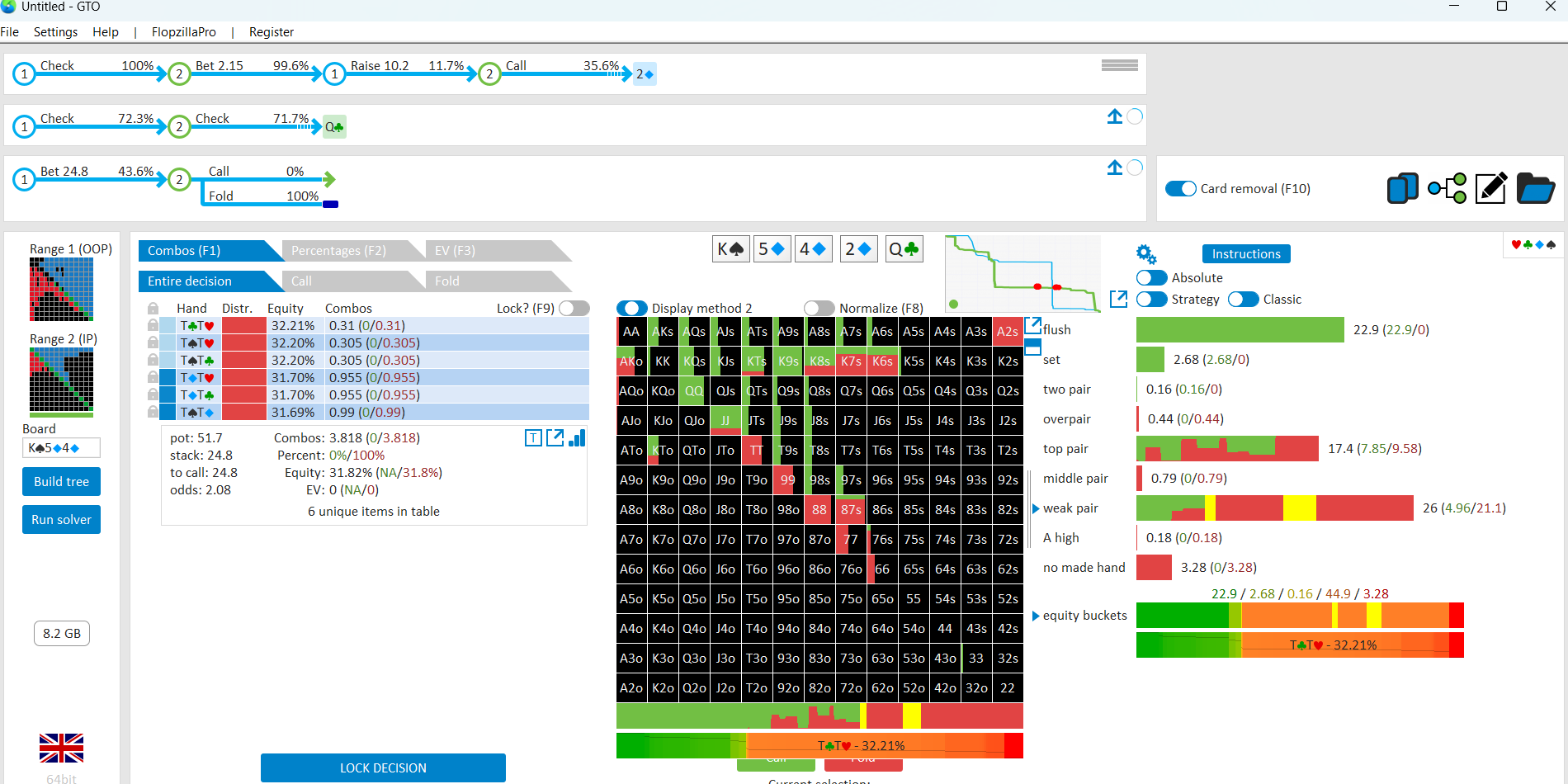
A couple takeaways...
1. BB was actually not check raise bluffing the flop with very many flush draws compared to how many they had in their range. I guess it makes sense that they don't want to get blown off of that much equity if you re-raise. Their FD raises were mainly just some nut flush draws and combo straight/flush draws that could presumably all get it in if re-raised.
2. BB is supposed to check turn with all of their flushes and you are supposed to check back with all of yours after the 2d hits. This part might be skewed by the larger flop raise size as the SPR is lower and it's easier to get the money in on the river without a massive overbet.
3. You should actually arrive at the river with a fair amount of flushes after this line. As a result you don't have to hero call much even against an optimal GTO opponent. Solver is calling with flushes and some Kx (mainly K9+) along with QQ and most JJ but is folding some Kx and all pocket pairs
It’s a fold to the flop XR. It’s a pot size bet on the turn after he checks. It’s a fold to the river jam.
He’s a short stacked, experienced player and it’s the second level of a $410 tournament. He had exactly what he advertised and he must’ve known you’d overthink and crycall. It didn’t smell right because you were sniffing for steak au poivre in a McDonalds.
And your price on the flop wasn’t 45-1.
Probably should just check the flop - not much that can call the flop bet, maybe he stabs the turn fairly wide. The problem with calling the flop x/r is he can bet the turn and we have to fold - people are rarely x/r and then just going check check. I'd fold to the flop x/r.
The flop play was fine. We have a big range advantage opening in the LJ and even the solver is betting small with range. He should be calling with many hands we're ahead of such as 5x, 4x, flush draws, straight draws, many ace high and backdoor draws, plus we don't want to give a free card to hands like QJo. The BB defense range is wide and it makes sense to attack all the trashy combos with a small bet.
When he raises small we're getting a great price and are still ahead of all the draws, even against a relatively straight forward player. If our opponent is straight-forward it's fine to just call the small raise and then fold to additional aggression.
When we call the flop raise we're going to have tons of Kx and flush draws along with some weaker hands like TT, but it's not like our opponent can just attack with impunity. We're going to be able to realize our equity fairly well with TT because our range is protected by our stronger hands.
We're supposed to have some hands that can call down and some hands that will call the flop raise and fold to additional aggression, especially after the flush and straight draws come in. TT fits in that latter category perfectly. That's just good range construction. The only mistake was getting overly curious and paying off on the end.
I will now typically fold to this small of a flop c/r without top pair or better and no draw. It is almost always a player with a really good hand that isn't a semi-bluff. Its like they want us to continue and not fold. The c/r sizing in this spot that represents semi bluffs and strong hands are typically at least 3x and often 4x (my sizing HU) or 3.5x.
Where I will call or re-raise is if the player is in Position and makes a 2.5x or smaller min raise. On the flop it is usually because they are trying to get to the river without having to pay a decent sized turn bet (on the turn they usually check it back unless they improve). Similarly on the turn if the min raise is in position it looks to me like they want to get to showdown cheap (where they check back the river unless they improve).
If I have a read that the player could have a bluff then I will call. I have basically seen that happen like once or twice in all the years I have played. Whereas the in position min raises are semi bluffs a lot of the time.
River is a fold. You beat bluffs, but pool doesn’t overbluff these spots after flop XR + turn check.
Sure, I pretty much agree and I'm folding TT here 95% of the time.
So I decided to roughly run this spot in GTO+. I'm trying to do some additional solver study so my game doesn't stagnate. Anyway I used standard solver ranges for the LJ open and BB defend. Most of the hand was modeled pretty closely to as played with the exception that the flop raise from your opponent was to a bigger 10 BB sizing (I used saved bet size parameters tailored mor
Really interesting, thanks for doing this analysis. I'm actually surprised that TT is a fold 100% of the time, but far be it from me to disagree with our silicon overlords. I guess hero has enough stronger hands to call down with that TT can just go in the muck. Yes it's possible that the jack of diamonds blocks more bluffs than flushes, like you suggested - but sometimes the logic of solvers can be hard to figure out, and I think that's a case of that.
Yeah I think check-rasing with some NFDs, combo/straight flush draws and check-calling others is pretty standard. So I guess that means that when the 2♦ comes in on the turn that villain is even more value-heavy.
Sure, it makes more sense that I can fold TT if I arrive at the river with a decent amount of flushes. I agree that vs a human one can certainly overfold in comparison to vs the general player pool. I just smelt a bluff in the air, but this time I was wrong.
What do you think of his river jam? He went for some pretty thin value - why not a smaller bet?
It's a fold to the flop XR. It's a pot size bet on the turn after he checks. It's a fold to the river jam.He's a short stacked, experienced player and it's the second level of a $410 tournament. He had exactly what he advertised and he must've known you'd overthink and crycall. It didn't smell right because you were sniffing for steak au poivre in a McDonalds.And your price on
The price is insanely good to call on the flop. If we start folding too much then we're gonna get obliterated by bluffy opponents. If he raises a bit larger then of course I'm folding TT.
He didn't have exactly what he advertised at all. Nobody in the thread put him on a middling top pair.
Why would I pet the pot on the turn after he checks? You want to turn TT into a bluff? I'd argue it has too much showdown value for that and just wants to check down.
Yes, I agree the river should mostly be a fold - almost always, in fact.
I honestly wonder what worse hand he was hoping to get called by with the river jam. It's way too thin in my opinion, for the betsize used. It's almost an "I don't know what do so so I'll jam" kind of bet. I think check-calling with his hand would be perfectly fine or, if he's going to value bet it, use a smaller size so he can get called wider.
It didn't smell right because if he has a flush he is usually betting the turn, and if he doesn't have a flush then what can he jam the river with that a) expects to get called by worse and b) doesn't value bet the turn?
The flop play was fine. We have a big range advantage opening in the LJ and even the solver is betting small with range. He should be calling with many hands we're ahead of such as 5x, 4x, flush draws, straight draws, many ace high and backdoor draws, plus we don't want to give a free card to hands like QJo. The BB defense range is wide and it makes sense to attack all the tras
Yes, agreed. I'm range betting this flop most of the time, with the exception of a few specific combos. TT needs a lot of protection vs the various overcard hands, as you indicated.
I was totally ready to fold to a reasonably sized turn bet. The turn checking through contributed significantly to my decision to call the river.
Agreed that our range is protected with many stronger hands, and TT can hope to showdown in bluffcatching mode - assuming the obvious draws don't come in, of course (or, if they do, that villain doesn't do some fishy stuff that piques my curiosity, lol).
What do you think of his river jam? He went for some pretty thin value - why not a smaller bet?
Yeah it's likely just bad, although sometimes it's funny how a play that a fish would make at low stakes can circle back to being a sick merge bet from a high stakes crusher. I think you could make an argument for it with the right set of assumptions (that you are always betting turn with your stronger hands when checked to, that you're generally sticky and prone to making hero calls, etc). That's a stretch though and his river jam was probably just bad.

