Hitting a wall during solver study
Hi, everyone. I'm playing NL50-100 6max. I felt the need to improve my game(have huge swings now), bought numerous GTO Wizard subscriptions. Was trying to study using solvers, but it doesn't feel like I improved at all.
Also watched maybe all of the cash related GTO Wizard YouTube videos + a few from their private library on the website, about how to use it correctly. Didn't help😞
Can you please share what is your studying framework and approach? Besides "try to understand why solver does this and that." Heard it a lot of times, but can't find the exact way on how to do it.
10 Replies

Post a hand/spot you'd like to improve or better understand first and then I can explain how to use a solver to better understand that spot and improve your technical skill and understanding.

I would take up that offer OP..
My approach:
1. META
Break the game down into manageable chunks ( SRP IP v OOP, OOP v IP, 3BP same) and start with easier solutions first like 3b pots which have narrower ranges and are thus easier to study.
eg. SB 3b BU, which happens regularly. Ask yourself questions like: what boards can we cbet? Every A high flop? What are good turns to barrel? etc
2. MICRO
Play hand, study off-table with infinite time to think. Don't just replay your exact combo, break down your range roughly, their range, and what you think a solver would do with value/bluffs and folds.
Truth: there are no shortcuts here. But the point of doing the META work is that you should now at least have some assumptions that will/won't match up to the reality. Be patient. Gradually patterns will emerge. Post hands, ask questions of better players, or get a coach. No substitutions for this afaik.
3. Improve theory
Learn node-locking. At least the basics. You don't need to do much of it to get the general idea. This is the real 'a-ha' moment. When you get a sense of how the solver adjusts to sub-optimal play you are now starting to think like a solver, and that is the secret, if there is one, to getting gud/competent. When you understand how to manipulate EV you can start implementing shortcuts. Now you don't need to do as much 1 or 2 as well.
**************
Look. Unless you're Stephen Hawking incarnate the brutal reality is solver study can be infuriatingly difficult and opaque to begin with. It's too big of a subject to give good broad advice about without it sounding slightly bland and unhelpful. I don't have a GTOw sub but I doubt there's any video sites better content wise for breaking it all down on that front.
To add...
The real 'goal ' of solver work for me is #1 to alleviate stress when playing. When you realise at a subconscious level how close half the decisions you make actually are in EV terms the game becomes more enjoyable and relaxing. Which leads to better play/less moodswings etc etc. You can put the brain energy where it's needed like improvisation.
In that sense we're not trying to learn what a solver would do in every spot at all. It's much more akin to learning something incalculable like quantum physics or 'police work'. You just keep coming at it with ignorance until you have enough to get by and do your job. But you start from zero like everyone.

Solver work tends to have an accelerative curve, in the sense that your first 10 hours of study, you get very little. The longer I have studied the more I can quickly learn something new.
I think this is because you are looking at so many data points without knowing how they connect to the whole. I would compare it to making a 1000 piece jigsaw. Similar to what Ceres said you have to allow your brain to catch up - It usually in game where you have an "aha" moment as to why solver does something.
I would recommend trying the drills and switching between "study this spot" and "practice this spot". This not only helps you internalise the information, it lets you follow interesting rabbit holes.
For instance if I land on the river in the drill and am not sure what my range should look like - I will make some estimations on what I think makes sense, then click "study this spot" to bring up the solver output. From there I might even specifically drill that river spot for 2 minutes.
Also 1 tip would be to constantly ask would be "can a human make this play?". So if most of the solvers calling range is very awkward and unnatural hands then it is likely the spot will be overfolded. And if the solvers bluffs look difficult to find then the spot is likely underbluffed.
In addition to what others have said, I've found having someone on your level or better to talk about hands, strat, theory etc. 1-on-1 really helpful. I've found that some larger study groups can become kind of like 20 chefs cooking the same soup, and arguing about the very basics of cooking while forgetting the big picture.
If you're for an example both working on let's say 3bp SB vs IP at the same time, and notice something that seems like pattern, then you can ask if they've noticed the same thing and work on it together and ask each other questions. Then you can chat about for an example 'hey I really doubt the population raises here with under pairs or anything really as much as this solution wants, could it be that if we node lock that tendency into a solver, we could actually get away with range betting this board because of that?'. Bam, you both just learned something new that probably would've taken more time and work to figure out by studying alone.
Like Ceres said, seeing how much (a **** ton) solver adjusts both pre and post by node locking different imbalances makes one realize that the vast majority of even decently studied players aren't exploiting others nearly as much as they could, not even close, myself included. It helps to understand equilibrium solutions as well when you force yourself to try to find some logic behind max exploitative solutions and compare them to Nash equilibrium.
In addition to what others have said, I've found having someone on your level or better to talk about hands, strat, theory etc. 1-on-1 really helpful. I've found that some larger study groups can become kind of like 20 chefs cooking the same soup, and arguing about the very basics of cooking while forgetting the big picture.
If you're for an example both working on let's say 3bp SB vs IP at the same time, and notice something that seems like pattern, then you can ask if they've noticed the same thing and work on it together and ask each other questions. Then you can chat about for an example 'hey I really doubt the population raises here with under pairs or anything really as much as this solution wants, could it be that if we node lock that tendency into a solver, we could actually get away with range betting this board because of that?'. Bam, you both just learned something new that probably would've taken more time and work to figure out by studying alone.
Like Ceres said, seeing how much (a **** ton) solver adjusts both pre and post by node locking different imbalances makes one realize that the vast majority of even decently studied players aren't exploiting others nearly as much as they could, not even close, myself included. It helps to understand equilibrium solutions as well when you force yourself to try to find some logic behind max exploitative solutions and compare them to Nash equilibrium.
Thanks a lot guys for all your replies. I appreciate your help
Post a hand/spot you'd like to improve or better understand first and then I can explain how to use a solver to better understand that spot and improve your technical skill and understanding.
Special thanks to you man😀
[image]aFjpSMX.png[/im
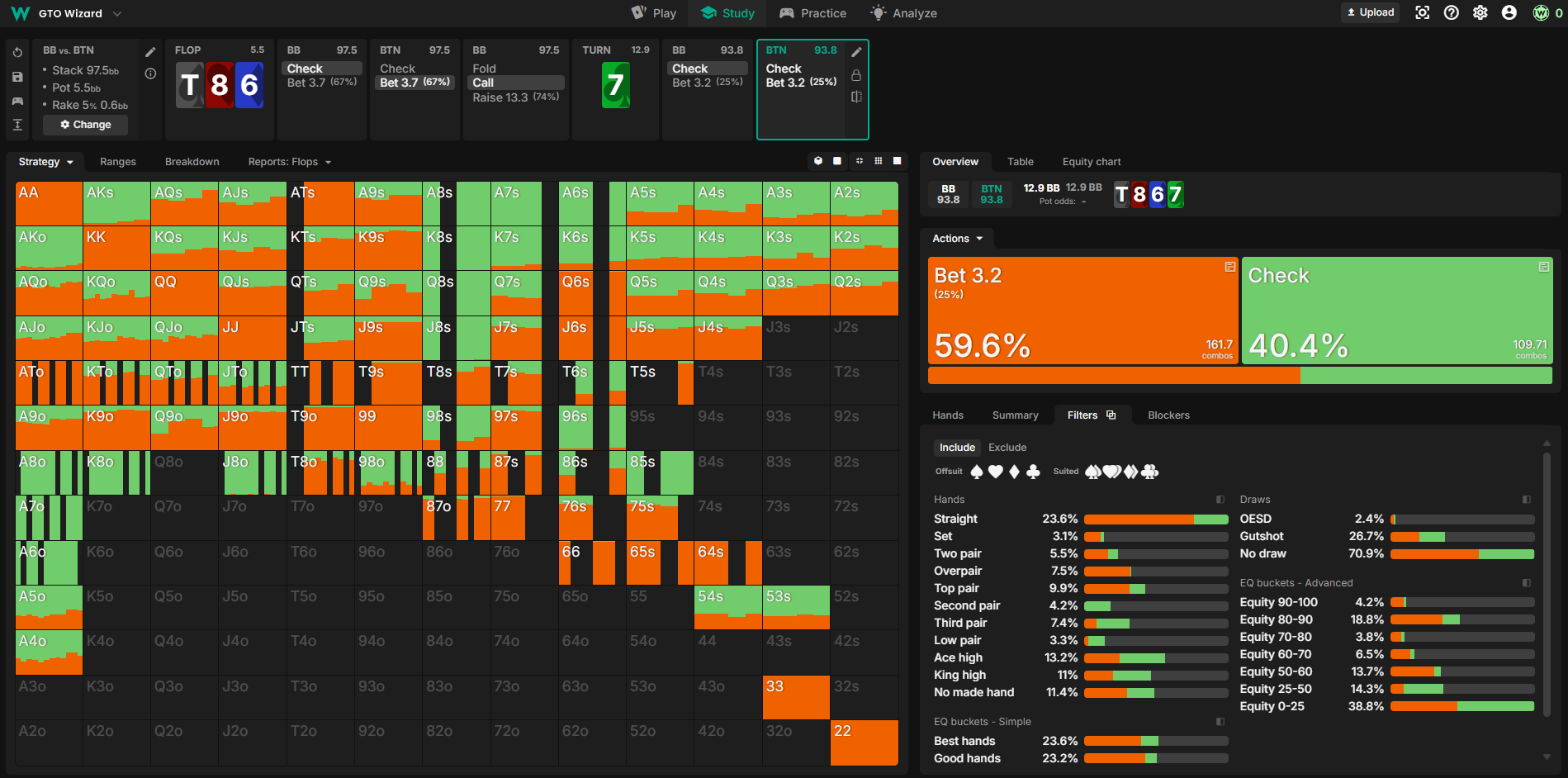 Why would we bet for such a small size, we have 45 vs 55 equity disadvantage here. Not trying to receive the answer here specifically, but rather to learn how to discover it myself.
To add...
The real 'goal ' of solver work for me is #1 to alleviate stress when playing. When you realise at a subconscious level how close half the decisions you make actually are in EV terms the game becomes more enjoyable and relaxing. Which leads to better play/less moodswings etc etc. You can put the brain energy where it's needed like improvisation.
This one really reasonated with me. I like playing, but any somewhat serious mistake makes me feel bad during session. After that, I just stop enjoying the process.
Solver work tends to have an accelerative curve, in the sense that your first 10 hours of study, you get very little. The longer I have studied the more I can quickly learn something new.I think this is because you are looking at so many data points without knowing how they connect to the whole. I would compare it to making a 1000 piece jigsaw. Similar to what Ceres said you ha
Noted
In addition to what others have said, I've found having someone on your level or better to talk about hands, strat, theory etc. 1-on-1 really helpful. I've found that some larger study groups can become kind of like 20 chefs cooking the same soup, and arguing about the very basics of cooking while forgetting the big picture.
Other coach also recommended to find someone to study with, I tried, but didn't like it at all. Is every regular in some kind of study group?
Also how do you track the ranges, while playing a hand? For example, I somewhat know how to play K83r as BTN my exact combo. But when I'm at BB vs BTN, and have to estimate whole villian's range, it gets much harder for me.
Why would we bet for such a small size, we have 45 vs 55 equity disadvantage here. Not trying to receive the answer here specifically, but rather to learn how to discover it myself.
I think this is because if you bet very big, your opponent can defend with straights only, without making a mistake, because he has enough straights in his Range. The more nuts your opponent has in his range, the more you want to bet small. Thats why you want to overbet on blank turns as a 2nd barrel but size down on a three flush turn. One card straight, that is likely in your opponents range, is the best example for betting small.
imagine you open raise BU 2.5bb, SB fold, BB calls,
Flop (5,5bb) is: KQJr,
BB checks, BU bets 33% ps, BB calls
Turn (9,13bb) is: Tr
BB checks, BU goes AI for 95bb
BB can now just call with straights and you gain zero value. He also has enough straights to make your bluffs indifferent or in this case even -EV.
There is no easy way to figure it out yourself. You need logic.
Thanks a lot guys for all your replies. I appreciate your helpSpecial thanks to you man😀[image]aFjpSMX.png[/im
Why would we bet for such a small size, we have 45 vs 55 equity disadvantage here. Not trying to receive the answer here specifically, but rather to learn how to discover it myself.Well, you'd want to look at the response vs the bet and see what hands are call/fold/raising. Generally speaking a smaller size allows one to bet with a wider range, so if IP sizes up too much here I imagine they'd only be able to value bet for 2 pair or better or maybe just sets which would allow oop to realize enough equity such that the smaller bet size is superior to a larger one. I imagine the difference is really small, though.
You would really want to play around with different allowed sizes and look at all the responses to get granular enough to really answer your question to a satisfactory level. As an overall statement I wouldn't get too caught up with analyzing sizes too much—at least not prior to the river. The importance of sizing is significantly less important than execution. Sizing just more or less dictates the strategy.


