To hero or not to hero? That is the question...

This hand was played in the 6th level of an $11 mystery bounty turbo tourney on Stars. 78 players remain from 130, late

you gotta call zero
unftly you haven't posted villain's strat in your solver outputs, so Ill guess: even if we call turn and solver says maybe call river with A3, we'll have an easy snapfold on river too.
with reads on weird activity from opp - it's a call.

Sure, I understand that betting keeps our range uncapped and retains the betting initiative. If the opponent folds, it's a great outcome - but what if they raise?When we bet the flop with this hand, it's as a bluff, right? What should we do with this hand if villain calls and the turn is a blank?Yes I do see what you mean with regard to the benefit of us betting flop and being
The idea that we bet only for value or as a bluff is some seriously old school poker thinking. I mean it’s useful at a basic level but falls down in situations like this. This thread in live cash from 2015 or so is worth a read if you have time https://forumserver.twoplustwo.com/170/l...
If we get check raised we fold the hand, easy. We have a pair of threes and are drawing to five outs.
OK so far?

The idea that we bet only for value or as a bluff is some seriously old school poker thinking. I mean it’s useful at a basic level but falls down in situations like this.
I'll add, protection / equity denial are important reasons too, to reiterate:
And, as we've discussed, keeping the betting lead is actually the more effective way to exercise pot control at this stack depth.
The idea that we bet only for value or as a bluff is some seriously old school poker thinking. I mean it’s useful at a basic level but falls down in situations like this. This thread in live cash from 2015 or so is worth a read if you have time https://forumserver.twoplustwo.com/170/l...If we get check raised we fold the hand,
Interesting link, had a read through it, thanks.
Can you explain your reasoning for betting the flop with this hand then?
One thing I should've clarified before... This is a mystery bounty but typically the bounties don't start until you're in the money, so I'm assuming no bounties are in play? Anyway I decided to look at this hand in more depth. I didn't account for any bounties or ICM but we're still pretty fair from the bubble so ICM effects should be minimal (again I'm assuming bounties aren't
Your classification of players doesn't make any sense.
Post #2, 3 (yours), 9, 24, 45 all explicity reveal 1st instinct folds or very strongly imply it
Only post #5 and 50 imply 1st instinct calls.
I guarantee you're not defending wide enough. I have data that's credible enough to gamble on that you're not.
So, I got news for you--it's not the people running justifiable exploits here who are the "inexperienced" ones.
It's the "regs" in this scenario who are not doing their jobs.
Okay interesting, thanks. I would honestly love to hear this "essay" that you mentioned on checking back A3 on the flop,
Try to visualize as many paths through the tree as possible.
Be rigid with setting up a strategy profile in your mind. Pretend you're Pee-oh.
You check and things start branching off--well I mean xb with AA is stupid, right? KK even more so--they need more protection. AJ Nah, too strong, and needs protection.
You can bet 1bb and scoop this thing often "enough" to be unexploitable--basically always.
I doubt you can have more than 1bb/100 extracted from you exploitatively if you fire 100% cbet. Min sizing.
How can 7h5s call A 7 isn't the nuts...
How can 7h5s raise You have lots of 7s you're snap folding (blockers), and a 7 isn't the nuts.
Assess the xf frequency here. Be precise. Visualize the 13x13 grid--where are the folds Be PIO.
But like--what about 99 Why might they prefer to check compared to A3
I do believe there's buckets of combos in this spot where you're miscomputing flop strategy.
I think you have the right idea for others, like how you mentioned your jacks in post #15.
Are 77 really higher EV than Ah3h Do 77 need more or less protection
So you start to compute high-level highest frequency lines; for the most part there's really only a couple paths through the tree here, here are some examples:
x-x-Probe(ModeratelyLarge)-c-Barrel(Large)(All In)
This is where you are.
x-cbet(1bb)-f
x-cbet(1bb)-xr(Small)-c-Barrel(Large)(All-in)
x-cbet(1bb)-xr(Small)-c-Barrel(Smallish)-c. Who says you can't play SPR<1/2 pots? Nothin' in the rules that says you can't.
x-cbet(1bb)-c-x-Barrel(Moderate)-c-x-Triple(ModeratelyLarge)(All In)
x-cbet(1bb)-c-x-x . This is where we could have been.
And what about that line where you cbet(1bb), he calls; turn checks through. Why might you expect his river probe strategy to be "kaleidoscopic"
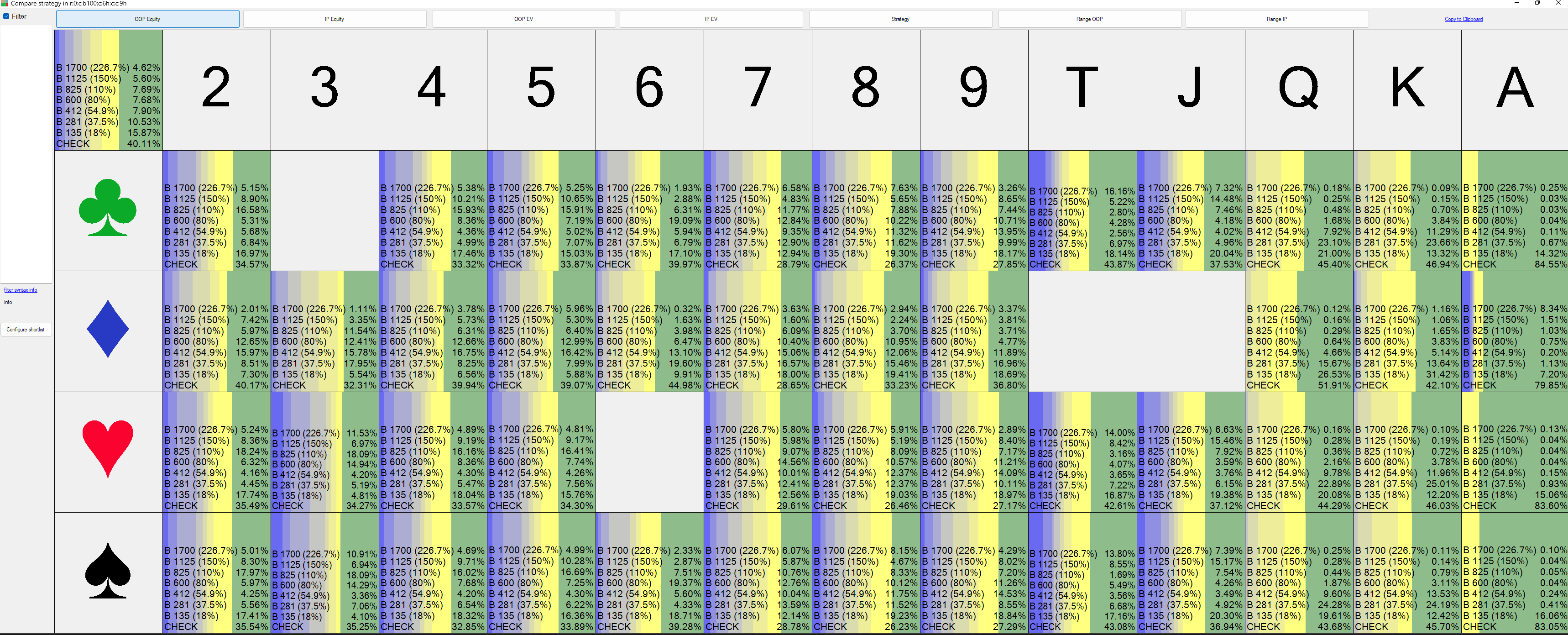
So for A3 in particular:
- It's higher EV than you think just on it's own merits; I mean it's beating more than half his range, almost sure of that.
- It needs protection like a mother****er
- Exercise: contrast its strategy with 77-99
- Exercise: contrast its strategy with J5
I think it's pretty clear that the x-cbet(1bb)-c-x-x (OOP river probe Opportunity node of the tree) is much better "pot control" (whatever that means). It's the difference between 1bb going in on the flop and, very frequently 0-2bb on the rivers; vs very often ALL of the chips going in by the end--that's the x-x-Probe(ModeratelyLarge)-c-Barrel(Large)(AI) node.
And it'll be frequented materially often in this spot so it's worth studying. People can find exploits here and if they're using the right tools--which you are--then some of them will eventually figure out how to actually USE them.
After all, a tool's only as good as the mechanic using it.
as per posts so far -
Get to choose smaller sizing
Uncap range
Retain betting initiative
Deny equity / get folds from random overcard
Make decisions more simple for turn river / narrow opponents turn range
Edit: and you have more Kx Ax than V so it’s less likely he will have any high card SDV to check down with - so your check down strat has a problem

Your classification of players doesn't make any sense.Post #2, 3 (yours), 9, 24, 45 all explicity reveal 1st instinct folds or very strongly imply itOnly post #5 and 50 imply 1st instinct calls.I guarantee you're not defending wide enough. I have data that's credible enough to gamble on that you're not.So, I got news for you--it's not the people running justifiable exploits her
I'm not quite following what you're trying to say here. When you say you have data that I'm not defending wide enough, what data are you referring to?
Also what exploits are you referring to? Are you saying over bluffing turn and river would be profitable after the PFR checks back? If so are you saying with any two cards or just increasing the bluff frequency slightly?
Try to visualize as many paths through the tree as possible.You can bet 1bb and scoop this thing often "enough" to be unexploitable--basically always. I doubt you can have more than 1bb/100 extracted from you exploitatively if you fire 100% cbet. Min sizing.Assess the xf frequency here.But like--what about 99 Why might they prefer to check compared to A3I do believe there's buc
If you "fire 100% cbet," aren't you going to get exploited when players start adjusting?
Sure, I agree that villain is likely going to check-fold at a higher frequency than he should.
99 needs less protection than A3 I guess.
For which buckets of combos do you belileve I'm miscomputing the flop strategy?
I believe 77 is higher EV than A3 and needs less protection. But I also believe that just because a hand is vulnerable does not mean it should be bet.
I agree that betting flop, checking back turn and calling river is better pot control than checking back flop. However, villain does have more options than just calling the bet, he can and will check raise at some frequency, especially vs the wide button range, and that's a disaster for A3.
Anyway thanks for the detailed analysis, I appreciate it a lot.
as per posts so far -
Get to choose smaller sizing
Uncap range
Retain betting initiative
Deny equity / get folds from random overcard
Make decisions more simple for turn river / narrow opponents turn range
Edit: and you have more Kx Ax than V so it’s less likely he will have any high card SDV to check down with - so your check down strat has a problem
Sure, these all sound like good reasons.
Another question: why doesn't the solver play as you suggset? IIRC it is mixing between betting and checking with A3.
Sure, these all sound like good reasons.
Another question: why doesn't the solver play as you suggset? IIRC it is mixing between betting and checking with A3.
It's mostly betting though (~83% for A3 without a flush draw vs 70% for overall range). One reason the solver often mixes is for board coverage on various run-outs. If you bet 100% of your 3x then your opponent would know you never have trips when a 3 hits on the turn.
If you "fire 100% cbet," aren't you going to get exploited when players start adjusting?
Sure, I agree that villain is likely going to check-fold at a higher frequency than he should.
Great reason to bet, if he's folding at a higher frequency than he should. Make him adjust, don't pre-adjust for him.
Yeah, it doesn't have any in-between cards you have to worry about hitting a pair. A3 also has more outs against Jx/Tx when you bet and are called. (Same reason you'll often see solvers defending the BB x/c A3 on a board like this where they might x/f 88-44 and even 99, because you're still ahead of bluffs, you have more outs when you're not, and if villain is betting AQ/AK you might cooler them if an ace hits.
I agree that betting flop, checking back turn and calling river is better pot control than checking back flop. However, villain does have more options than just calling the bet, he can and will check raise at some frequency, especially vs the wide button range, and that's a disaster for A3.
But how frequently is he doing that, and with which hands? You need to tailor your strategy to the frequencies of outcomes, not just avoiding the one outcome you're worried about. (As someone who still struggles with this sometimes, I understand how it happens.)
I don't know if anyone ran the x/r range here - I tried running it on Octopi but we're supposed to open jam A3s from the button at cEV according to them. Even so, villain's x/r range is mostly top pair, with some gutshots, and some combo flush draws (Qd3d, 8d7d, for example). They're almost all slightly ahead / way behind hands, and even when you call the flop x/r, on that turn, all the bluffs that didn't improve give up, and all the hands that continue have at worst 8x with outs by then. So if he check-raises flop, you call, and he continues on the turn, you can pretty safely fold.
Sorry OP: assessing facing xr here as a "disaster" is such a massively histrionic and quite frankly just plain wrong computation.
It'e an exceptionally exploitable computation.
I agree that betting flop, checking back turn and calling river is better pot control than checking back flop. However, villain does have more options than just calling the bet, he can and will check raise at some frequency, especially vs the wide button range, and that's a disaster for A3.
.
bf flop is not a disaster, far from it. Sometimes we’re simply behind on the flop and the cheaper we find out the better.
whether to call river on various runouts is worthy of a more detailed review
Great reason to bet, if he's folding at a higher frequency than he should. Make him adjust, don't pre-adjust for him.Yeah, it doesn't have any in-between cards you have to worry about hitting a pair. A3 also has more outs against Jx/Tx when you bet and are called. (Same reason you'll often see solvers defending the BB x/c A3 on a board like this where they might x/f 88-44 and e
Sure, it's a good reason to bet, but - at least as I initially saw it it - there are also good reasons to check here.
I imagine in this setup BTN vs BB the BB is meant to check-raise at a relatively high frequency - perhaps 10% or more - but I'm just guessing.
Are you sure that all the check raise bluffs that don't hit the turn are just going to give up?
Sure, it's a good reason to bet, but - at least as I initially saw it it - there are also good reasons to check here.
I think the reasons for betting are more robust, but hopefully, the explanations of how a few of us are thinking about this spot will expand your own thinking on the game.
I imagine in this setup BTN vs BB the BB is meant to check-raise at a relatively high frequency - perhaps 10% or more - but I'm just guessing.
I don't know. At this depth I think a lot of the strongest jacks may rejam preflop, or things like KQo and suited Ax, so their range may be missing some of their highest-equity hands here-- which would also have to reduce the number of bluffs to stay balanced, so a lower frequency overall. I'm not at my computer, so I can't check the sim again - I may be overstating it, or not.
(On another note: even for something you consider pretty high frequency, your main concern is something that, by your own evaluation, doesn't happen 90% of the time, or nearly so.)
Are you sure that all the check raise bluffs that don't hit the turn are just going to give up?
On that turn? Yeah. I'd have to look at the sim again, but IIRC a lot of the bluffs were things like Q4o with a diamond. The stronger-equity check-raises that aren't Jx or better all improve on an 8 turn (things like 8d7d).
I think the reasons for betting are more robust, but hopefully, the explanations of how a few of us are thinking about this spot will expand your own thinking on the game.I don't know. At this depth I think a lot of the strongest jacks may rejam preflop, or things like KQo and suited Ax, so their range may be missing some of their highest-equity hands here-- which would also ha
Yes, I have definitely learned several things in this thread.
Sure, they only checkraise 10% of the time. But we have to snapfold when they do. They call perhaps 50% of the time, and we've bloated the pot with bottom pair. So 60% of the time our decision to bet does not work out that well - this is the problem I have with betting bottom pair. But I do see some of the merits now too.
I don't think that many in the player pool are simply giving up after check raising flop - but I could be wrong.
We don't have to snap-fold-- A3s isn't in our range according to the sim because we're supposed to shove it pre, but A3o always calls the standard check-raise. I know I mentioned that already.
Here's how the solver responds as BB, chipEV 20bb deep, button open, BB defend, button b25:
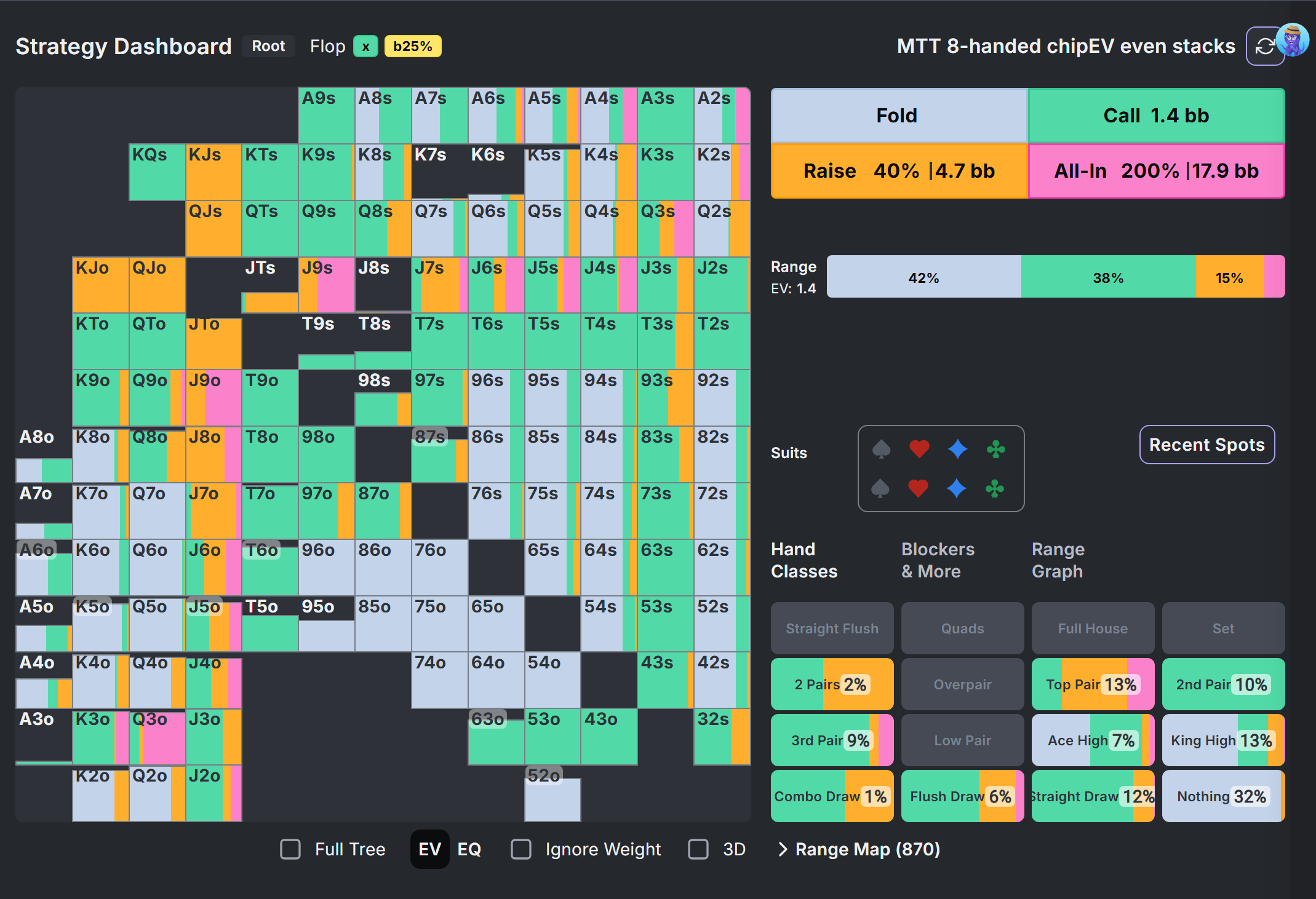
You can see, there's a lot of top pair in the range and some vulnerable combo draws, but also junk that blocks some of our continues. (Kd4x / Kd2x, and Qd4x / Qd2x, for example-- they block KJ/QJ and our stronger flush draws.)
Look, to me it seems like your thinking about this hand comes down to "getting check-raised with bottom pair is the absolute worst thing that could happen and I need to avoid it at all costs." That's neither true in and of itself, nor is it an approach that considers villain's entire range to maximize our EV, instead of just trying to avoid the one outcome we don't like.
We don't have to snap-fold-- A3s isn't in our range according to the sim because we're supposed to shove it pre, but A3o always calls the standard check-raise. I know I mentioned that already.Here's how the solver responds as BB, chipEV 20bb deep, button open, BB defend, button b25: You can see, there's a lot of top pair in the range and some vulnerable combo draws, but also j
Sure, but others have commented on the thread that we should simply fold if we get check raised.
As I indicated above, we might get check raised 10% of the time, and villain might just call 50% of the time. Neither of those are good outcomes after betting the flop with bottom pair.
flop checkraise we call of course.
Qd4 doesn't often give up on turn, since it turned a gutshot.
Kd4 or Ad2 do give up, and 87 or K8 with a diamond check as well with the pair.
he has bluffs that give up, but his overall range slows down and checks turn 30% of time. we're fine folding turn if he barrels.
imo one-street checkraise-bluffs are much more prevelant than doublebarrel potsize bluffs into ambiguous ranges. here more or less for sure and probably at higher stakes too.
you're better off having a clear idea of what you're certainly folding out, which will be trash for villain if he raises flop. but if he starts bluffing after you check back, he has neither a clear idea of your range in that moment, but also of your range development on future streets. he doesn't know what you have or what you're going to fold, and if you're going to fold anything at all. he's left in the dark and so are you.
our small flop cbet will be raised a staggering 20% of time by solver. but Im much happier to call that flopraise, than his turnbomb after our checkback. we can think more clearly of what he might be doing in first case, while in the latter we're left guessing about that particular player's strat, who may be at the one or other extreme or some infinite point inbetween, and best we can do is work with vague estimations about population's tendencies.
even if we think he's a brazil dude who's playing more aggressive than average, we'll be able to work much better with that idea in case of a raise of our flop cbet. because that's what he'll likely be doing then (being more aggressive vs our cbet), but if we check, maybe once in a blue moon we'll be up vs a brazil opponent who'll also go for more aggression in that particular line/situation.
Sure, but others have commented on the thread that we should simply fold if we get check raised.
As I indicated above, we might get check raised 10% of the time, and villain might just call 50% of the time. Neither of those are good outcomes after betting the flop with bottom pair.
Who says those people are right?
Who says the were actuallt contemplating the existence of a small xr sizing strat?
You sure were folding when he clicks it to 3bb? This the hill you wanna die on?
Says who its not a good outcome?
The Nash equilibrium says youre dead flat out wrong
Youve got 70+ posts to work with. Why dont you give something back: node lock a tree in various way and try to find oop response bs small cbet where A3 is max ev as a pure xb.
Go ahead and try. It will not be a sensical strat to assume. I guarantee it.
Be a scientist here.
The max exploitative start assuming oop xf flop too often and xr too seldom says you are WAY WAY WAY wrong.
Basically--youre computations are all wrong here. Sorry! Happens to all of us.


