[2-4]: all-in or fold?
UTG straddles (to 8). UTG is a pro who I've seen straddle for the second time in over a year, he's not going to overdefend.
UTG+1 limps. UTG+1 is also a pro but one who starts doing things he knows are stupid when he's running badly. I've seen him limp first in a few times -- maybe 5 times so far, not sure -- and it was never premium.
UTG+2 bets 30. UTG+2 is a guy I don't know well but he didn't seem to have particularly tight ranges, and it was late in the day so most of the table was loosening up.
HJ flats 30.
CO flats 30.
Hero is in the SB with K♠Q♥ and a stack of about 480€. UTG+1 has about 280€. UTG+2 covers. I think HJ and CO also cover but I'm not sure. UTG definitely covers. The casino has no rake for preflop pots.
So what now? Flatting this and entering a 4+ way pot in worst position with a 2€ discount for a 30€ raise seems like torching money. Raising less than all-in seems like a bad idea as well (the SPR would be too low to fold to a 4bet). So I think it's jam or fold? Folding is odd because we're probably ahead of everyone's ranges and there's so much dead money, but jamming also seems odd because our stack is so large; would be much easier if we had 250€ or something. Every option here seems super awkward.
Agree that neither flatting nor rasing less than all-in are viable options.
With a stack of ~480, you are ~60x effective, so not that deep after all.
In theory, only UTG+2 may call a shove, the rest is dead money.
Shoving is most probably +EV, but I can get behind folding if you want keep variance at bay.
Easy fold?
I think we should have tighter shoving ranges than kqo. (maybe jj+/AQs+/ako+ or even tighter)
+1 limper can have some premiums occasionally.
The callers can have jj~qq/aq~ak sometimes
Initial raiser range is uncapped.
Also I rather squeeze to 120 than shove.
We can still play poker postflop if we make it 120. We can also squeeze lighter(99+/AJs+/AQo+) than shoving range.
Anyhow, kqo is like bottom of squeezing range, oop can fold easily.
I rather squeeze kj ip than kq oop vs so many ppl.

Just fold.

Just eyeballing it, I think the raiser needs at least 25% raising range for jam to be good here (but I'm not great at these depths).
I wouldn't put an unknown player ISOing in UTG+2 on that wide of a range.
Just eyeballing it, I think the raiser needs at least 25% raising range for jam to be good here (but I'm not great at these depths).
I wouldn't put an unknown player raising 7.5bbs in UTG+2 to be that wide.
This probably assumes that the raiser calls appropriately wide? E.g., AQ would dominate KQ if it calls but most people probably fold AQ there, and even AK... probably calls but I wouldn't be shocked if it folds.

two pros up front, an ep opens for 6x and two flats IP and you want to rip KQo?
might as well write your credit card info down on the cards so the other players can withdraw more easily when your hand hits the muck
two pros up front, an ep opens for 6x and two flats IP and you want to rip KQo?
might as well write your credit card info down on the cards so the other players can withdraw more easily when your hand hits the muck
30 is a 3.75x raise, which is quite small after a straddle and a flat. Most people open 26 or 28 when there's a straddle without a flat.
And the straddle being a pro makes the jam better, not worse, since he won't do anything dumb.
two pros up front, an ep opens for 6x and two flats IP and you want to rip KQo?
might as well write your credit card info down on the cards so the other players can withdraw more easily when your hand hits the muck
It's only 3.75bb w/straddle
I thought you're fan of aggro plays, lol.
I've shipped in similar spots with super light range and get snapped by tt/aa/aa and some more similar hands. I've learned to tighten up in such spots.
Just eyeballing it, I think the raiser needs at least 25% raising range for jam to be good here (but I'm not great at these depths).I wouldn't put an unknown player raising 7.5bbs in UTG+2 to be that wide.
This probably assumes that the raiser calls appropriately wide? E.g., AQ would dominate KQ if it calls but most people probably fold AQ there, and even AK... probably calls bu
It wouldn't assume perfect play from a fundamental theorem of poker standpoint like that, no.
It assumes they don't overfold relative to MDF considerations. If their combined fold frequency is high enough you can ship napkins, but I really don't think that's the case here.
Sorry about getting the raise size wrong, I'll edit that.
Alright let's see, so let's say we give UTG+2 this opening range (w/ card removal from my KQo)
Spoiler
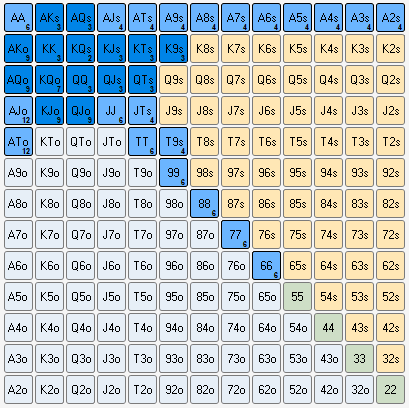
which is 186 combinations, and this calling range
Spoiler
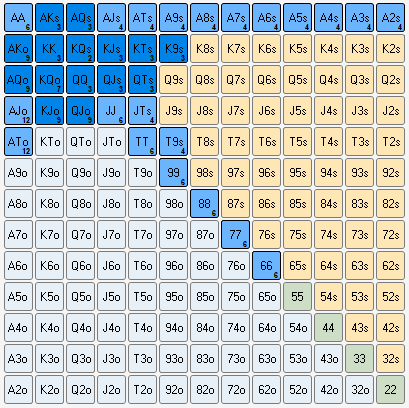
which is 36 combinations. Our equity against the calling range is 0.283. Then
EV < P(UTG+2 folds) * deadmoney + P(UTG+2 calls) * 0.283 * 560 - P(UTG+2 calls) * 0.717 * 478 (not = because other people can have a hand too and there's rake, so we'd need this to be significantly above 0 to call). That comes out to 30. So with this range, jamming would be about +30 EV given this range and the assumption that no one else ever has a hand (and no rake if you get called and win). That probably makes it pretty close to 0 if you give a few % of other people having a range. Here's what it looks like if you just plug in a few different values for getting called into the same formula (original one is just under 0.2) (not exactly correct since then the ranges when you do get called are also different, but whatefs):
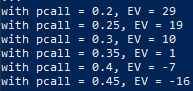
So probably the shove is unnecessary but not awful
KQ suited might jam, KQo not so much. Against multiple flats, you’re often dominated. Easy fold, even if it feels nitty.

Reveal:
I shoved, UTG+1 had limped KK and called. Which I believe is the first time he limped a premium, so this has pretty much no impact on how I view the hand in retrospect (and wasn't why I posted). UTG+2 folded quickly.
This post has confused me.
KQ is low on my list of poker hands.
You pull up range charts, combos, etc and this is a situation where I fold quickly without a second thought. I’m not being critical, it’s just something I would never dream of doing.
If stacks were smaller, a shove might work. But with 480€, you risk too much for the reward. Easy fold.
Seems like a pretty standard fold.
Alright let's see, so let's say we give UTG+2 this opening range (w/ card removal from my KQo)
Spoiler
which is 186 combinations, and this calling range
Spoiler
which is 36 combinations. Our equity against the calling range is 0.283. Then EV < P(UTG+2 folds) * deadmoney + P(UTG+2 calls) * 0.283 * 560 - P(UTG+2 calls) * 0.717 * 478 (not = because other people can have a hand too and there's r
As always, I appreciate you're actually doing the work.
So 81% just happens to be the threshold at which this is profitable even if you just open muck every time they call. Since even 72o will scoop $1k+ vs AA 12% of the time you GII (and 32% against AKo), this is gonna lead to some extraordinary conclusions.
So this can be the limitation of this approach: that you have to assume the very things that you should really be setting out to prove.
I actually feel like a 10-20x jam over a bunch of limpers and callers is a common enough spot in LLSNL that we could have good data on it if there were good collection methods, but you personally need to know what that data is at the time of the decision point for that to do you any good. Theoretical constraints are helpful bounds to the conversation when we're out in the unknown, and then you can adjust from there based on any information you have in equal measure to your confidence in that information.
I mean, I think a lot of people use the theoretical assumptions as an excuse to be lazy and not check it against real world math (probably myself included), so it's easy to get lazy using one method or the other. The person who prints is the one who does the hard work to come at it from both sides and find the best statistical inference that lies somewhere in-between.
In any case, here's my feedback on the inputs:
The initial range you gave UTG+2 to be about a 17.5% raising range, which seems a bit wider for an EP ISO for someone who seems basically unknown--your speculations of why they might be wider notwithstanding. (I sense your natural motivation is toward finding reasoning that others/yourself are/should be wider, so I'll start from a position of skepticism of those sorts of speculations and you should too. I speak from first-hand experience as someone who resists the same temptations.)
FWIW, I think you accidentally posted the same screenshot twice, but based on combos I assume you're putting UTG+2's continuing range at something like TT+/AK. This range varies quite a bit, but what I'll say is that a big raise from the blinds over a bunch of dead money is a tactic most people have seen before, and I think it looks a lot more to people like AK/AJs/88 making a play than a premium and IME it's something that activates competitiveness/defensiveness in people. I have bluffy vibes, so YMMV depending on what you find people's preconceptions of you tend to be.
Which is a good segue to the other villains. I know you accounted for them, but the adjustment seemed arbitrary and off-handed. I think they're too important of inputs to not account for directly.
As I suggested above, I think you're going to run into stochastic defensiveness / gamble-gamble, so I think the continuing frequency of each player is going to be less elastic than it should be. I agree the original raiser will tend to not pull their MDF weight, but the others' call frequency will hew closer to the main villain's call frequency than it should, which will pick up the slack to some degree (not sure to what degree without doing math of my own.)
Finally, while I agree you shouldn't let results weigh too much on you, I'll note that while limp trapping premiums is rare overall, a limp slightly increases the odds of them having a premium rather than reducing it. People show up with a top 2.5% hand about 4-5% of the time that they limp. (This is for all players, can't speak for described player specifically.)
Then, of course, there is the fully unweighted range of UTG.
FWIW, I think you accidentally posted the same screenshot twice, but based on combos I assume you're putting UTG+2's continuing range at something like TT+/AK.
Oops. But yes, it was exactly TT+/AK.
(I sense your natural motivation is toward finding reasoning that others/yourself are/should be wider, so I'll start from a position of skepticism of those sorts of speculations and you should too. I speak from first-hand experience as someone who resists the same temptations.)
Hmm well I sat on this for a while before responding and still don't know if I agree that I have this tendency or not. Well, realistically I probably do. Either way I'll keep it in mind.
No disagreements with anything else you said, and agree that it looks like folding was better overall. (Though the move was narrow enough I'll already that I'll be lazy and won't try to extend the calculation by accounting for other villains directly.) Thanks for being patient with me! :3
yah idk if its breakeven vs utg2's range rakeless i pretty sure its losing moderate amount because u still have bb / straddle / limper / hj / co who can all occasionally call
i could see myself jamming in game but given its straddle / large open, their ranges are probably stronger than usual (opener / flatters)
with all that being said. gtowizard has 60 bb ranges with 3x open / no rake, and i see it mixing squeeze small with kqo. a bit different here bc 3.8x and more dead but is at least a line to consider. fairly substantial ev difference between flat / small 3b and jam there fwiw but if bigger would change things enough to just never play small 3b. when i look at shallower configs mostly leans toward 3b jam and kqo just becomes a fold. the calling ranges look extremely intuitive for everyone in the sim im looking at.
Reveal:
I shoved, UTG+1 had limped KK and called. Which I believe is the first time he limped a premium, so this has pretty much no impact on how I view the hand in retrospect (and wasn't why I posted). UTG+2 folded quickly.
I don't get the part in bold. Are you saying there's nothing to learn from the hand? Does that mean you like your shove with KQo?
Your shove has to get through 5 people, including two blinds, an EP limper who is apparently running bad and possibly tilted, and the original raiser. It seems optimistic to think that none of them has a hand that will call, and that when we get called, we'll ever be better than flipping against a hand like JJ or TT, and we could be dominated by AK/AQ.
When you say, "folding is odd because we're probably ahead of everyone's ranges," it seems to me like you have a hard time folding hands that look pretty but are actually pretty marginal in spots like this.
What makes you think we're ahead of everyone's range? Everyone's ranges here are likely to include PP's and some AX type combos. Have you never seen anyone flat a raise with better than KQo?
Put yourself in your opponents' positions, and ask what worse hands you'd call with. You probably wouldn't call with any worse hands.
You might occasionally fold some better hands, like middling pairs or some trashy AX combos, but it's not like this is a tournament, where people are more cognizant of protecting their stack and will over-fold. Just the opposite - I've seen low stakes recs call off in spots like this with some low PP's and trashy AXo combos. If they lose, they just re-load.
If the UTG1 guy is ever limping to induce so he can re-raise, either of the blinds wakes up with a real hand, or the original raiser isn't FOS, we're cooked.
Lastly, FWIW, I notice you'll do these equity analyses in threads you post, wherein you assign opponents a range that you think is reasonable, and otherwise would seem to support your in-game decisions, yet without really taking into account live low-stakes player tendencies, which can and often will skew more unreasonable (which is why I think you get called here more often than you apparently think).
To echo the points Raise Announced has made - while it's good that you're thinking about the game and willing to put in time with equity calc's, you seem resistant to developing useful heuristics which adhere to how the player pool in your games actually plays.
Like, for instance, your jam seems to assume UTG1 never limps with premiums, and HJ / CO never flat call the raise with a hand that will call your 3B. While the assumption about UTG1 may be a reasonable inference based on the past hands you've seen him limp, we can't assume his open-limping range never has premiums. And it's shocking to me how often I see low-stakes recs limp, over-limp, or flat call a raise, then flat call or over-call a big 3B, with all sorts of hands, including some that have KQo in rough shape.
I don't get the part in bold. Are you saying there's nothing to learn from the hand? Does that mean you like your shove with KQo?Your shove has to get through 5 people, including two blinds, an EP limper who is apparently running bad and possibly tilted, and the original raiser. It seems optimistic to think that none of them has a hand that will call, and that when we get calle
I don't know who you think you're arguing against. I said twice already that I don't like the shove in retrospect. The bolded part just says that the reasoning for this conclusion doesn't depend on UTG+1 having limped KK. The reasoning you just gave in this post also didn't depend on this, so I don't get why you found the bolded part objectionable.
It's odd because I think this has happened several times by now where people make replies that essentially accuse me of rationalizing my own decision, but always in threads where I had already explicitly disavowed my own decision.
to add fuel to the fire. if KQo is close whats the range we are actually jamming? are we intending to play flats here at all?
i think something like a5ss, 88+, AQo+, AJss+, KJss+ as a starting point? with no flats. can see argument for small 3b range too centered around top
What do we think HJ & CO are cold calling 30 with?
And how do you know the first two are pros?


