Most profitable way to play a flopped set
Never quite sure how to proceed in the following scenario.
Game is 5 10
Villain is UTG + 1 and raises to 35 - tight aggressive player
Hero has pocket 55s and calls 25 more in the big blind
Flop 2 5 9 rainbow
Hero checks, initial raiser bets 45
Do I raise here which is basically announcing that i have a set and can beat an over pair to board or do i wait until the turn before getting more money in?
If i just call and he has overpair he will most likely fire again where i can then check raise - again giving my hand away or if he has AK he may just check back,
How can i maximise these spots when you finally hit your set and get paid off?
19 Replies
On this specific board I'd prob just x/c and then maybe x/r turn.
Ever thought about leading flop? If he has an OP and you donk he may raise your flop bet and you could get more money in that way?
Considered leading the flop but what hands is he putting me on that are behind an over pair? A 2 or A 5 suited maybe?

I call flop and x/r turn. If turn checks through, lead river.
I'd rather x/raise flop on a non-rainbow board or if the board were more connected up top.
Leading flop isn't bad, but I wouldn't go too big. Maybe $30-$40.
It all kind of depends on your image, too.

It depends on villain, especially in this game where there's a pretty wide range of "TAGs" from TINOs to legit good players to people who have listened to just enough HungryHorse to be a danger to themself and others. If they're very aggressive, capable of airballing, capable of using huge sizes against capped ranges on dry runouts, etc, then 55 is a good candidate to slowplay here. As compared to, say, 99, you unblock the marginal value hands of 9x that might payoff lighter when you're underrepped, and 55 is a little more at risk of being on the wrong side of a cooler when stacks go in fast.
If they're just a TINO then whatever, pot's prolly not gonna get huge regardless, might as well build the pot / take it down now. Never hurts to get a little protection and WWoSD with the more aggressive line to keep them guessing and maybe loosen them up a little eventually.
But other than that, this is more about how you play the rest of your range than it is about 55.
Are you finding the raises with K8s/QTs w BDFD and the like that make villain have a pit in their stomach when they have an OP here?
Not even like you need to be too creative here, since there are plenty of GSSDs on this board.

This.
Are you finding the raises with K8s/QTs w BDFD and the like that make villain have a pit in their stomach when they have an OP here
Hmm, not this. Solver pure folds K8s and mostly folds QTs (vs. b50 flop).
Not even like you need to be too creative here, since there are plenty of GSSDs on this board.
But, this again ... solver loves A4s/A3s/86s/64s/63s and is also quite happy with A8s/A7s/A6s/87s/76s/43s.
Pretty much pure raising 22/95s/52s, but only 50% of 99/55.
I would probably call more often that solver with 55, mainly because I doubt I'm raising as much with the other stuff.
I believe we agree on the highest level point: if there's a flop where you don't think your sets will get paid off because there aren't enough of the type of hands you usually raise, that's an indication that you need to find more hands to raise on that particular flop.
Whether that applies to this flop is questionable because, as you and I agree, there are plenty of 4-out frontdoor draws to choose from. Just x/ring them all will probably produce similar frequencies as a solver's more mixed and varied approach, with the board coverage weaknesses causing less problems in the real world than against clairvoyant bots.
As for the bit I'm quoting: I guess it's my fault for naming specific combos, but this isn't a super useful form of solver analysis IMO. I could say my solver shows raises for plenty of the types of hands I'm talking about (see below), but that would miss the same, more important point in equal and opposite direction.
And that point is this: The exact combos that make up the edges of a strategy are going to be extremely sensitive to the specifics of the scenario (which far outnumber our brain's computing power), the specific abstractions and inputs (which will change with something as simple as rake structure or preflop raise size), or just the quirks of the programming of the different software how far down it's solved, etc.
I think a much better takeaway of the below in range explorer view is "PIO is raising some double backdoors+overs" and not quibble over the combo selection. (Though the combo selection conversation can be interesting and does lead to some useful heuristics, like "the only single-overcard hands that continue are A-high", which makes in particular the A8dd vs K8dd distinction useful, but then there's raises from K4dd and the like, so...)
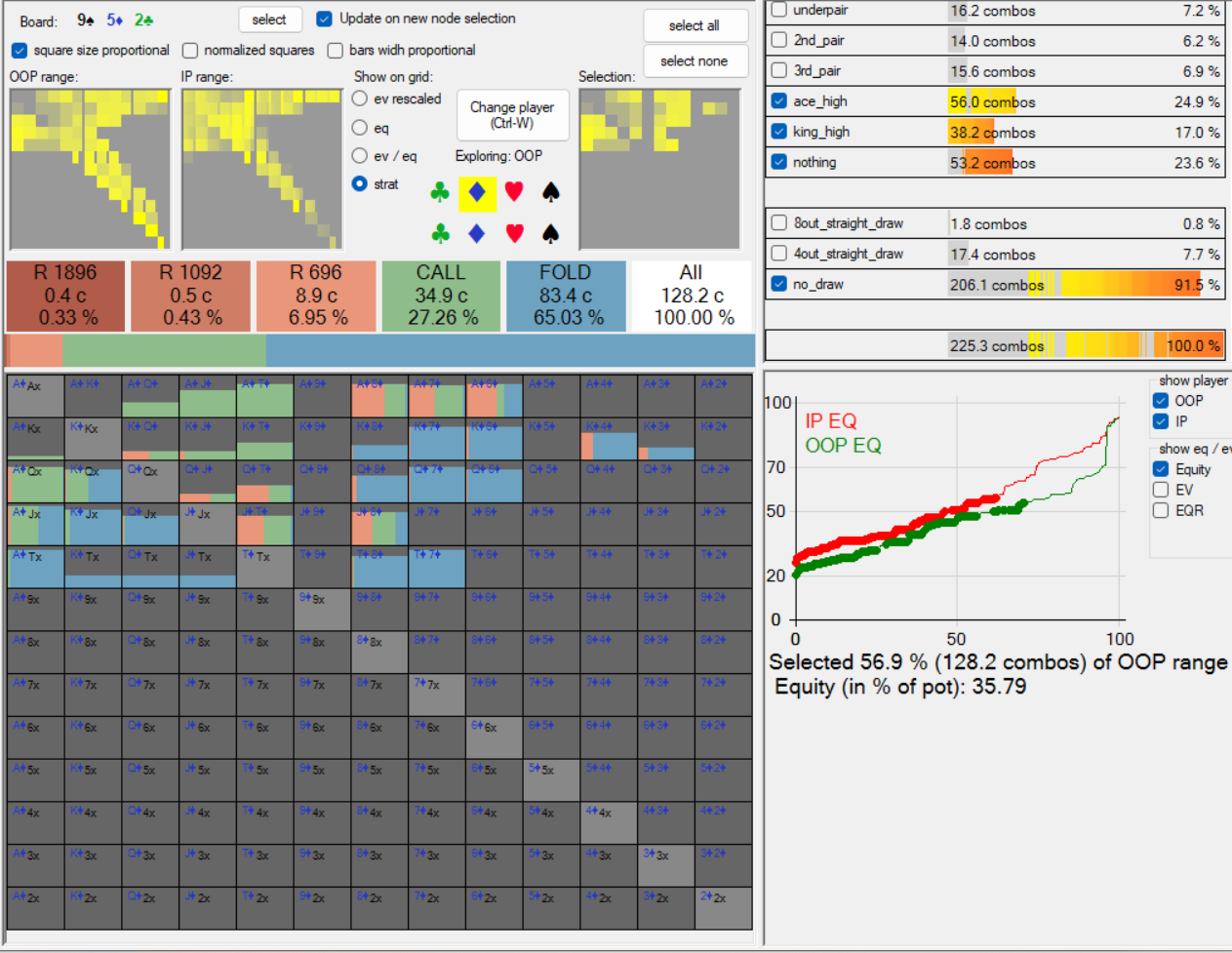
All of this to say nothing of what poker is actually about: exploiting our opponent's deviations from equilibrium without fear of them clairvoyantly and instantaneously counteracting that exploit. If you find people overfold to your raises, then by all means pull some of the best pure folds out of the muck and raise with them, which means maybe you just flat a lot of the hands that are good enough to call.
To be fair, I wouldn't actually do this against an EP player B60ing on 952r specifically, but this would be my advice to anyone concerned about not getting paid often enough here.

Probably x/r the turn, although it looks very strong. You need to try to get in 4 bets postflop. Even decent players have trouble folding over pairs. If villain folds an over pair, it may be because villain doesn't think you are bluffing often. You don't need to be balanced in this particular spot, but need to appear to be balanced.
Welcome to the wonderful wide world of playing hands out of position. I see you chose the "versus a TAG" upgrade to go along with your season pass at 5/10. Sometimes you're gonna flop big and get minimum value vs a strong range and thats just the way it is.
All options are on the table. We should probably at least check the flop to get max value from his entire range instead of trying to funnel him into exclusively overpairs at this moment.
AJs is like the new JJ for me on the bubble… looks too good to fold until you bust and regret it �� honestly I just fold it now unless I’m covering the table.
Check raise the flop smallish. $145.
Bet the turn medium, $200.
Jam river (If remaining stack is a little more than pot-sized or less).

vs. an UTG+1 range its best to just c/c this board and hope he double barrels.
Check raise the flop smallish. $145.
Bet the turn medium, $200.
Jam river (If remaining stack is a little more than pot-sized or less).
considering he likely missed this board, if you cr flop he folds almost all the time.
a lot of players will also fold overpairs if they perceive you as a nit if you cr flop small and then bomb the turn.
obv this means you should cr flop more as a bluff as an exploit. so on this board it would mean CRIng anything w/o showdown value.
How deep are we? That matters a lot in this situation.
The easy answer is that our goal is to get all the money in the pot. V probably didn't connect with this board, and if he did we're dead because V maybe has 99 here and its a real struggle to come up with too many other hands he has that interact if our read of TAG is anywhere close to right.
So a couple of dynamics from a theoretical sense: V is supposed to be checking back this board roughly 50% of the time. TAGs aren't, they are betting close to 100%.
When we x/r to $130, V is supposed to call 50% of the time and raise 10% of the time. That isn't happening. V isn't continuing with KQ, QJ, JT, AQ, AJ, A5, A4 against a x/r and they are 3! bluffing somewhere close to 0.00001% of the time. Against a x/r in this spot, Vs are going to become very honest, I'd say maybe A5 or AK with a BDFD is about as wide as you're going to get called and close to nobody is going to try to turn those hands into a bluff against the x/r that as you put it announces H has a set. These hands are calling, hoping that you shut it down on the turn and they pick up some equity.
So I'd assert that Vs are over c-betting and when faced against a x/r are overfolding and under bluffing. As a result the exploit is to over x/r as a bluff. I'd contend that works even against very good players who are well studied with GTO because even if they identify that they "should" be c-betting less and they "should" continue wider, they aren't actually doing it. It's one of my favorite spots to bluff because it is so unnatural to play anything close to "correct" for the IP player and its pretty rare when the IP player is forced into such an uncomfortable spot.
So if Vs are over c-betting and under continuing vs a x/r, then it follows that with our value, we don't want to x/r. We want V to catch-up or continue barrelling. If V has a lot more suited Ax and broadways than should have c-bet the flop, it means that there are a ton of cards that could improve them OTT to a pair, FD or SD. And if they are aggressive, when they pick up equity OTT, they are going to bet it frequently since H's range includes a ton of 9x and 5x. We can then x/evaluate OTT to determine if V seems to like their hand enough to gii. If they xb turn then they probably don't have a super strong hand and we're only getting one more street of value anyway. OTR, I'd be tempted to look to x/r if something like an A or K peels off and bet bricks small.
But all this is academic if we're shallow enough that JJ-AA is simply never folding, then gii. If we're deep, our best chance to gii is to allow V to catch up with his broadway holdings, or get the confidence that his overpair is good and only x/r when the price we're offering is so good that overpairs just can't get away.
If you’re deep, I like the check-call flop, check-raise turn line. It keeps ranges wide and looks a lot more like you’re protecting a pair or semibluffing.
If you’re deep, I like the check-call flop, check-raise turn line. It keeps ranges wide and looks a lot more like you’re protecting a pair or semibluffing.
I can assure you nothing looks stronger than check raising the turn, other than perhaps raising the river. The turn is like the final frontier for nutted hands that are expecting rivers to get checked through with SDV. But like I said there's not much you can do other than hope villain cant let go of AA or decides to jump off a bridge with a hail mary bluff.
I almost wonder if triple donk overbet might get looked up the lightest of all.
I can assure you nothing looks stronger than check raising the turn, other than perhaps raising the river. The turn is like the final frontier for nutted hands that are expecting rivers to get checked through with SDV. But like I said there's not much you can do other than hope villain cant let go of AA or decides to jump off a bridge with a hail mary bluff. I almost wonder if
So are we saying that any check raise on any street is going to essentially be announcing me as having a set - (given the board texture) Therefore sounds to me unless the board is very draw heavy there is little value trying to hit sets to bust over pairs ? Triple donk seems to me to be just as obvious. Jury still out for me here...
You had it right up until the “therefore.” The real conclusion is everything illiterati and I discussed.
You’re trying to perform an impossible task. There’s no way to force an observant villain that you have a hand you never have when playing for stacks. Probably the fancier and more sophisticated your line the more apparent it’ll be that you have one of the 9 combos you’re ever playing for stacks here.
The problem isn’t that they’re not paying off your sets. The problem is that it’s correct to not pay off your sets.
The answer is very dependent on Villain of curse. If we don`t have any specifc history/information of the villain then we want to ask ourself how is the average tight aggro regular in your games deviating from a optimal game and ask how we should exploit it.
If the average villain in your games is not capable of cbetting turns and rivers aggro enough and also big enough (using overbets) on turns and even some all ins shoves on rivers if spr small enough then we should just build the pot ourself.
Also in theory we would also like to check raise not to polarised so having also 9x etc in the range therefore using a smaller check raise size and repping 9x makes sense like this we also keep more overcards hands like QJ etc in villains range.
On most turns we would need then to polarize and start overbetting so we get all the money in normaly we want to use a geometric sizing which means we try to use the same turn and river size like this we maximise the ev vs villains bluffcatchers.
If we deviate from that we need very solid evidence that villain is never calling down worser for example tank folding multiple times or comments on you running hot etc. (out of ego). We need to be careful that our decision making is not guided by fear and stays rational for example you assuming him directly seeing a set when facing a xr can be based in fear of him folding and missing out of value or also we like to mirror our own perception of reality into other people so if you are seeing only nuts when facing a xr here then you UNCONCIOUSLY assume that villain thinks the same.
If you have such a strong assumption that villain is overfolding to xr b b so hard then you should adjust by over bluffing that line for example a hand like 9x blocking villains most likely set becomes a xr b b pretty fast if villain is not bluff catching are you doing this currently ?
Alternativly you can experiment with more creative lines to see how players react for example donking small on flop he raises then you donk again small turn he raises river donk small villain raises this line can work well vs ,,GTO`` players you can spot them by comments like this is not a thing, you getting upset when someone makes a theoretical bad call etc.
When you take unusual lines vs this players so lines that make no sense theoreticly then you can trigger anger/ aggression in them so to aggressive reactions because most of us where conditioned with the believe that mistakes deserver punishment.
Raise flop people have a hard time folding overpairs.
If you think he's always folding an overpair eventually I think I still like a flop raise, maybe get tricky with a turn check and then bomb river for 1.5-2X pot.
The answer to your question at the end is this though:
If people are giving you tons of credit for having the goods you need to start bluffing hands like 67 and 78 suited in this position.
If you're never bluffing the better players can make a lot of big folds to you which I imagine is much more common at 5/10. At lower stakes I see many players who never bluff and still almost always get paid off.


