Getting tricky with AA
Just wondering if anyone would play AA like this.
Game is 2/5 with most players having between $400 - $1000
Very active pl

Agree with this being a near-mandatory backraise.
Hero should in theory have a semi-balanced backraise range, which is not overly difficult to construct vs. overly agressive player, and Hero 4! range will be way ahead of villain. This is a great exploit spot as Hero can 4! very light profitably.

Honestly, this is enough for me to flat (but then I 4bet): will regularly try and isolate or try and take it down pre flop if there is perceived dead money in the pot.
But how much is any V 3!ing from the BB If we say he is 3!ing 50% of hands, then 50% of the time we're going to the flop with a $30 pot. That's a disaster for AA, and that's assuming BB is a nut 3!ing 50% of hands. AA is a hand that performs well in pots with small SPRs. As SPRs get larger, AA starts trending toward being a hand that loses big pots and wins little ones. In a $3
Playing a single raised pot in position with AA is not exactly the disaster you think it is. If the CO had limped and we had raised with AA you would not bat an eyelash at any postflop scenario that came up.
So by that logic it’s clear that the concern is missing value. If we have a chance to get a 4bet in, that chance is disproportionately worth more than the value of getting the 3bet in. We want to play a 4bet pot exponentially more than we want to play a 3bet pot.
i think the line is fine assuming reads are accurate
Playing a single raised pot in position with AA is not exactly the disaster you think it is. If the CO had limped and we had raised with AA you would not bat an eyelash at any postflop scenario that came up.So by that logic it’s clear that the concern is missing value. If we have a chance to get a 4bet in, that chance is disproportionately worth more than the value of getting t
I think this may be a case that you guys broadly agree and it's just terminology at this point. It's highly +EV to play a 3bet pot IP with AA and even more highly +EV to put in a 4bet instead of flatting. Whether or not we prefer to label the lost EV a 'disaster' is fine either way IMO.
I think this may be a case that you guys broadly agree and it's just terminology at this point. It's highly +EV to play a 3bet pot IP with AA and even more highly +EV to put in a 4bet instead of flatting. Whether or not we prefer to label the lost EV a 'disaster' is fine either way IMO.
It’s not just terminology. The post I was responding to was specifically saying that we need to induce a 3bet more than 50% of the time in order to make the backraise play worth it. I do not think this is true and I think the percentage of the time we have to induce is way lower because of how much more value we get from 4betting instead of 3betting. Part of the reason is the disproportionate bet sizes that go in but the other part is that whenever we don’t induce there is still probably a good deal of value to be had from playing postflop.

I would think you need close to 50% 3!s. The 4! isn't going to be seen as usually AA, but it does look stronger than a 3!, which is a disadvantage.
i think its harder to quantify the ev then it seems.
sure like if u take a look at 3x open sims the ev difference between 3b and flat aa is about 2 bb. but idk man oop is supposed to be 4betting 17-25% of the time depending on rake and sizing etc. that isnt happening, its probably closer to like 7-10%. i dont know how to quantify that difference in ev but my guess is in general people put in way too little money in most nodes, esp as the defender. if thats the case and you have a 3rd player willingly putting in way too high of betting volume id imagine that some kind of strategy shift to allow him in could also be fine - v likely he can make much more than 2bb of mistakes and also co may inappropriately range us both in srps and facing a sqz from bb (he may flat or 4b stuff that he cannot if we have traps)
am open to backraising but i think described v is going to be signif more likely to lose money with initiative as the 3bettor as opposed to either calling off jam light or 5bing over small 4b
is generally painful watching people who dont do math / study / calcs start randomly guessing numbers with no justification behind them. again am not picking on anybody, but ok why do you think the number he needs to 3b is 50%? what does 50% of hands look like? is anyone actually 3betting that range? what is bb supposed to squeeze at equilibrium?
id still probably 3bet the first time around but i just dont think people understand how to valuate mistakes or even really compare lines so it just becomes NO THIS IS THE WORST PLAYER EVER I DISAGREE and then triple down into that
even if you do all of this and you decide flatting aa is not great here i think it opens the line up to other things to think about. ie do we need need a btn flatting range if people are not putting in enough 4bets or to a lesser extent, money in postflop. can we go wider than equilibrium suggests to 3b? what do we do about sizing vs inelastic opponents?

i think its harder to quantify the ev then it seems.sure like if u take a look at 3x open sims the ev difference between 3b and flat aa is about 2 bb. but idk man oop is supposed to be 4betting 17-25% of the time depending on rake and sizing etc. that isnt happening, its probably closer to like 7%. i dont know how to quantify that difference in ev but my guess is in general peo
Not sure if you were referencing me with the 50% comment, but I made it clear I was just spit balling (see my original comment below). I think it's definitely hard to quantify, but it's almost always a mistake to call with AA closing the action at deeper stack depths. This is proven by just about any solver spot you look at plus it's common sense. You can always create a balanced raising range and if you expect your opponent to overfold then the solution is to raise more with junkier combos to balance your range and force them to defend, not to flat AA.
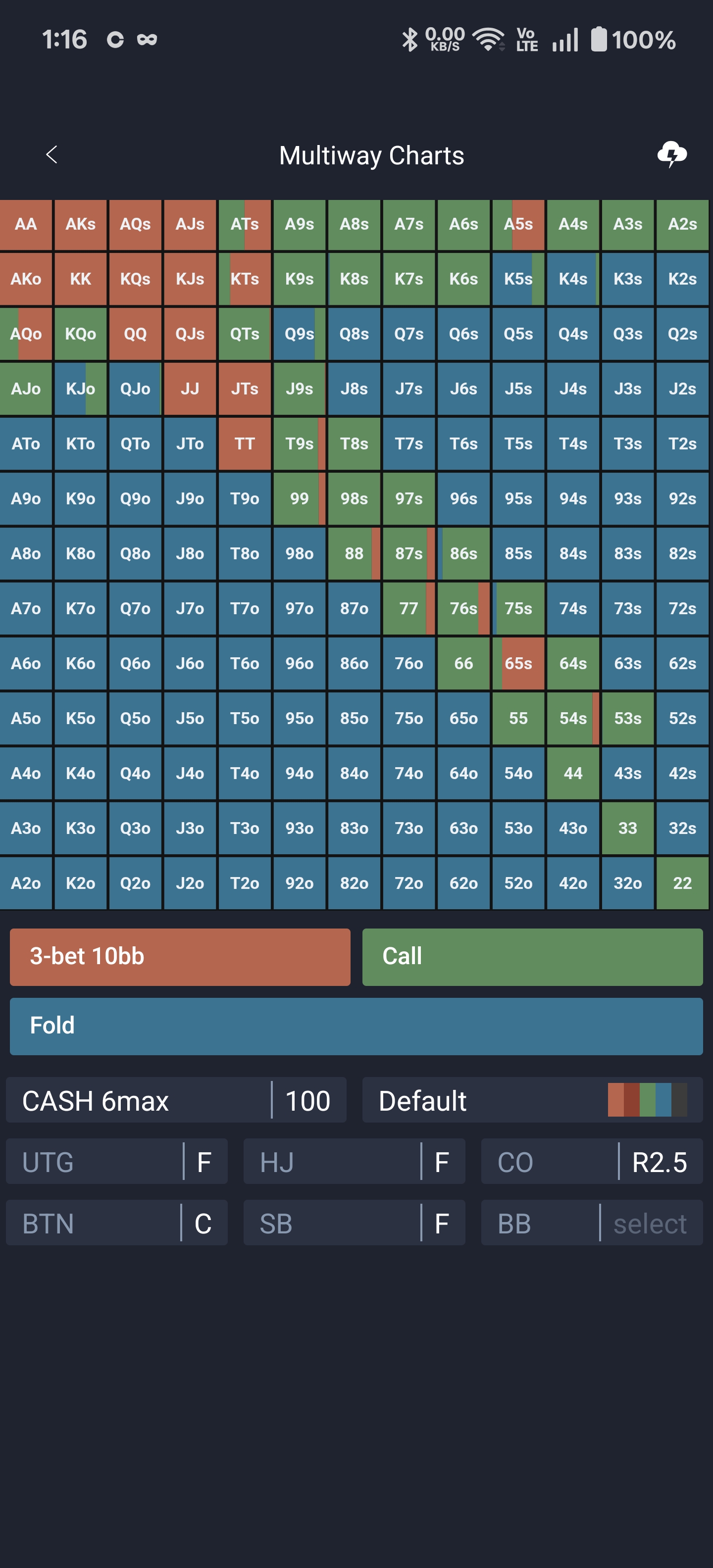
Here's what the BB is "supposed to be squeezing" facing a CO raise and button call. This is a 6-max 100 BB chart but the results should be pretty close to equilibrium of the OP's spot. As you can see they're really not raising that much:
[image]q8r0NVY.jpg[/im
..]
The raising range is fairly snug, like maybe 10%. That's what my original point was. Even an extremely aggressive villain isn't raising THAT much, and I'm not sure that BB raising 20% or something is enough of a reason to flat AA.
My original post:
I wish posters would stop questioning an OP's reads on his Villains. Newbie gave a read for a reason, and he was right (imagine that). Just move on.Maybe a 3bet is better, regardless, but that doesn't change Newbie's read. Yes, he should have 4bet...
I'm not sure why this bothers you. Speaking for myself I wasn't even questioning his read, just questioning whether the read is en
i think its harder to quantify the ev then it seems.sure like if u take a look at 3x open sims the ev difference between 3b and flat aa is about 2 bb. but idk man oop is supposed to be 4betting 17-25% of the time depending on rake and sizing etc. that isnt happening, its probably closer to like 7-10%. i dont know how to quantify that difference in ev but my guess is in general
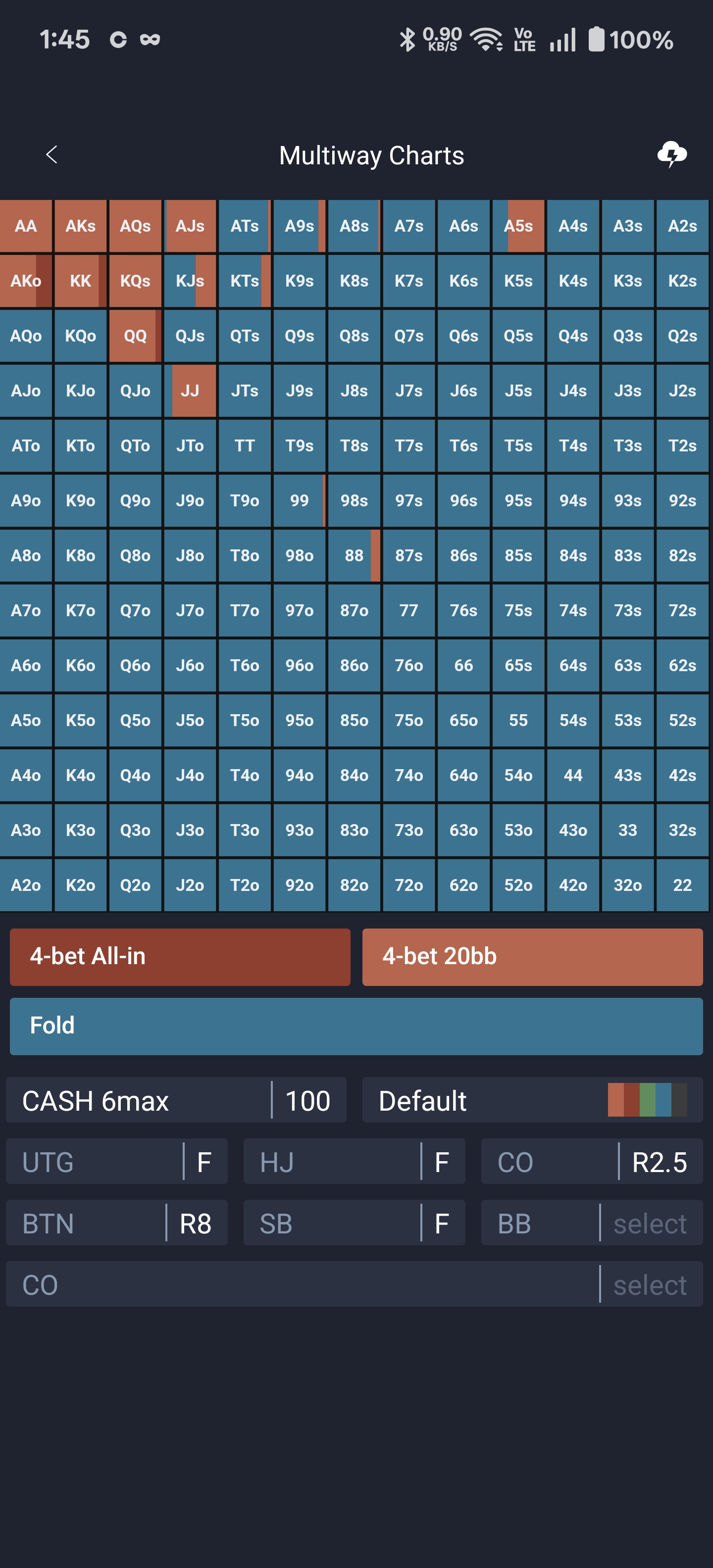
Also not sure what you're talking about saying they're supposed to be 4-betting 17-25%? No they're not. BB solver range vs CO raise and Button 3-bet:
And let's not forget two major factors:
1: BB will 4! some portion of his range.
2: CO is continuing with a tighter range when we flat and BB 3!s than if we 3! and BB flats or folds because he is closing the action. As it is CO is in a spot where calling is pretty bad with atc.
If our theory is that BB is 3!ing too light, then when we 4! he is folding a ton. Whereas CO could have a hand like AQ/AJ/KQ that might put in a bunch post flop, but facing a squeeze as monkey in the middle folds. That's why squeezing works, because the original raiser can't continue with a lot of moderately strong hands.
With AA we want to build a pot, not just steal the light $55 3!. We have weaker hands that are thrilled to 4! and get a fold against a weak 3! range.
Playing a single raised pot in position with AA is not exactly the disaster you think it is. If the CO had limped and we had raised with AA you would not bat an eyelash at any postflop scenario that came up.So by that logic it’s clear that the concern is missing value. If we have a chance to get a 4bet in, that chance is disproportionately worth more than the value of getting t
To play devil's advocate, wouldn't it also be true that we want to play a 3BP exponentially more than a SRP?
Understanding that you also advocated for the 4B, the debate among many here appears to be over the EV of 3B'ing versus the EV of call-4B'ing, when we can 3B 100% of the time and don't know how often we'll get to 4B if we flat. I think Yami's point was that the frequency of being able to 4B matters a lot when deciding if we want to make this play, because we lose a ton of value when we flat and don't get to 4B.
What struck me about the OP wasn't that his read turned out to be right, it was that his logic for flatting apparently wasn't to 4B, as we all seemed to assume, but rather to induce the BB to 3B, so that OP could continue the deception by flatting again, not 4B'ing.
So, while we can debate the merits of 3B'ing versus flatting to back raise, at the risk of not getting the chance, back raising doesn't appear to have ever been under consideration by OP. And so maybe we really ought to be debating the merits of 3B'ing versus double-flatting for deception at the risk of losing value when the BB doesn't 3B and we end up playing a SRP.
My point is if we're never going to back raise, the flat call hoping to induce a 3B warrants some scrutiny, because we risk losing value when we play a SRP, and we're never going to add EV by playing a 4B pot if we're planning to double flat for deception.
That would seem to make the initial flat really bad.
It’s not just terminology. The post I was responding to was specifically saying that we need to induce a 3bet more than 50% of the time in order to make the backraise play worth it. I do not think this is true and I think the percentage of the time we have to induce is way lower because of how much more value we get from 4betting instead of 3betting. Part of the reason is the d
Oh OK, understand.

I agree with this a lot, and if you are going to do this random call instead of 3bet line then 2-5 is way better than 1-2 ... but honestly not sure how much the GTO numbers can be trusted here even for 2-5.
sure like if u take a look at 3x open sims the ev difference between 3b and flat aa is about 2 bb.
Yeh, esp. live I just doubt that's ever true. People are way more likely to incorrectly call 3bets live, people are more likely to stack off with overpairs in 3bet pots, even though the 4bet range is going to be smaller people are more likely to decide to decide AKo is the nuts.
But very few people are 4betting, so the call/4bet line can give off major warning signs.
On the other side I see a lot of people who flat AA pre. and then don't fold it post, or make it obvious they have something when they aren't bluffing enough ... so you get huge errors in the other direction.
Then there's lots of "live read" stuff that changes the numbers a lot because people will randomly decide you can't have AA when you 3bet because you 3bet a couple of times in the last hour ... or you always have AK/QQ+ because this is your first 3bet in a couple of hours. Or 3bet guy could decide you are randomly fighting back vs. his perceived wide 3bet when he has QQ now ... so ships it.
but idk man oop is supposed to be 4betting 17-25% of the time depending on rake and sizing etc. that isnt happening, its probably closer to like 7-10%.
Assume you mean the original raiser is supposed to be 4betting 17-25% of his open range, vs. our 3bet?
You probably could have worded that differently, to be clearer.
i just dont think people understand how to valuate mistakes or even really compare lines
One problem here is that we are seeing just one hand, and a small explanation. Like if you 3bet AA here 100% it's fine, and if you get tricky 10% of the time it's probably still fine (maybe even better) ... but if you decide to get tricky 50%+ of the time I'd assume that's going to go worse for you in the long run.
If some known online pro. was like "well my randomizer was bottom 10% both times, so I just called" then I'd just shrug and move on ... but my experience live is that if people ever call AA then they do it way too much (and assume a bunch of other posters have that same "read").
tl;dr Would mostly go with simpler lines and have H 3bet or 4bet to exploit the too high VPIP mistakes when we know we have the best hand. #ezgame
I am not sure you could determine the math of call/4! versus 3! with a solver. Not sure how you can quantify that the 4! looks stronger than a 3! and how that effects BB's play. Can you quantify the expected win a single raised, 3!, 4!, and 5! pot. How often does he fold to a 4! and how often does he 5!? It is obvious you need to get the 4! in a lot to compensate for the single raised pots. I am not sure you can get that information from a solver.
You have someone 3bettimg 50% of hands oop. Even if you can model that, it is unlikely he plays anything like gto postflop.
When I threw out the 50% number, it was meant to illustrate an absurd number where even a 50% 3! rate it isn't immediately obvious that flatting is seriously worth considering. If it isn't immediately obvious at 50%, then do we really need to try to calculate if it's better at 25% or 15%?
If someone wants to run the math with some super aggressive 3! range, I'll read it. But it's kind of like trying to prove that open limping UTG with 95s is good. Some plays are obviously inferior and you can justify them however you want, you can even do it once and double up, but it's still a bad play. And it's bad enough I don't see the necessity of trying to calc it out.

To play devil's advocate, wouldn't it also be true that we want to play a 3BP exponentially more than a SRP?Understanding that you also advocated for the 4B, the debate among many here appears to be over the EV of 3B'ing versus the EV of call-4B'ing, when we can 3B 100% of the time and don't know how often we'll get to 4B if we flat. I think Yami's point was that the frequency
+1
How deep are we with BB? If he and we both have $1000, the ability to 4-bet preflop looks awfully tempting, because we can better get stacks in.
If he only has the $400, though, then it makes the double-flat not just understandable, but perhaps even bordering on preferable if he's game to continue stacking off postflop when he might otherwise lolfold whatever trash he thought he was bullying CO with.
I wasn't even thinking about the stack depth as a factor here. But I suppose there may be some combo of depth and live read that would make this a good line. I just don't know what that combo is, and I question what our plan is for pot flop.
Like, what combos of board texture and opponents' actions call for a raise, when do we fold, and when do we just keep calling?
We're at most $1000. If we 3! to $65, and one V calls, you have $140ish in the pot OTF. So 6.6x SPR.
Seems like an SPR that can gii without going too crazy.
($140) 935 behind b40 $60 into $140
($260) 875 behind. b75 $200
($660) 675 behind. Reasonable jam.
That works on a lot of runouts, and on certain runouts maybe we can overbet turn to make it easier.
If original raiser calls too (I think far more likely in 3! bb flats line than call, bb squeezes line), we're going to the flop with $190 and two Vs. Should be smooth.
If we were like $2k deep, I think this idea has more legs, but is bb more likely to call a 3! and flop enough to stack off vs folding to a 4! with almost everything except what he might have 4! himself (or would be super sticky post flop in a 3! line anyway).
The question is, what does V's 4! calling range look like vs the range he 4!s himself? I don't think there are that many combos of difference. Which the implied assumption seems to be that V is never 4!ing, but if he is never 4!ing, how much is he calling a 4!?
And I find it very hard to believe that someone who we observed is 3!ing more than we believe is reasonable, is also the kind of person who will never 4! unless V has simply observed we are nitty and is disrespectfully folding.
Say I'm V and am aggressively targeting CO. Maybe I am 3!ing this spot 100% because I see H on the btn as a nit who is going to fold to my squeeze too much and I don't have any respect for CO and am happy to play a pot vs him OOP. If that's my mindset, then when H 4!s, I'm folding QQ and I'm probably going to feel sick about KK because I feel like I'm against AA almost always. I'm certainly not calling a 4! with speculative stuff. My 4! calling range is going to be tighter than my cold 4! range. And I think that's true for most less passive players. And someone 3!ing that frequently isn't passive?
And if V is just a maniac who loves to bloat pots, then we shouldn't have a problem getting a bloated pot from that player type without getting fancy play syndrome. Because is he suddenly nitting it up on the flop?
We're at most $1000. If we 3! to $65, and one V calls, you have $140ish in the pot OTF. So 6.6x SPR.
Seems like an SPR that can gii without going too crazy.
($140) 935 behind b40 $60 into $140
($260) 875 behind. b75 $200
($660) 675 behind. Reasonable jam.
That works on a lot of runouts, and on certain runouts maybe we can overbet turn to make it easier.
If original raiser calls too (I think far more likely in 3! bb flats line than call, bb squeezes line), we're going to the flop with $190 and two Vs. Should be smooth.
If we were like $2k deep, I think this idea has more legs, but is bb more likely to call a 3! and flop enough to stack off vs folding to a 4! with almost everything except what he might have 4! himself (or would be super sticky post flop in a 3! line anyway).
The question is, what does V's 4! calling range look like vs the range he 4!s himself? I don't think there are that many combos of difference. Which the implied assumption seems to be that V is never 4!ing, but if he is never 4!ing, how much is he calling a 4!?
And I find it very hard to believe that someone who we observed is 3!ing more than we believe is reasonable, is also the kind of person who will never 4! unless V has simply observed we are nitty and is disrespectfully folding.
Say I'm V and am aggressively targeting CO. Maybe I am 3!ing this spot 100% because I see H on the btn as a nit who is going to fold to my squeeze too much and I don't have any respect for CO and am happy to play a pot vs him OOP. If that's my mindset, then when H 4!s, I'm folding QQ and I'm probably going to feel sick about KK because I feel like I'm against AA almost always. I'm certainly not calling a 4! with speculative stuff. My 4! calling range is going to be tighter than my cold 4! range. And I think that's true for most less passive players. And someone 3!ing that frequently isn't passive?
And if V is just a maniac who loves to bloat pots, then we shouldn't have a problem getting a bloated pot from that player type without getting fancy play syndrome. Because is he suddenly nitting it up on the flop?


