Subject: Challenging GTO: A White Paper & 64k-Hand Trial of an Exploitative AI
Hi 2+2 Community,
For the past several years, my colleague and I (under our research name, Spiderdime Systems) have been working on a poker AI project.
We've long been fascinated by the "solved" myth in poker. The consensus has been that the path to victory is being unexploitable (the 'shield'). Our project was conceived to test the contrary hypothesis: that in a real-world, human-centric environment, a maximally exploitative strategy (the 'sword') is more effective.
We built an AI named Patrick on this "exploitative" philosophy. Its architecture is not built for unexploitable self-play but is instead a purpose-built engine for identifying and attacking the flawed, psychological, and often irrational nature of human opponents.
The Trial
We ran a formal trial against human opponents in a real-money environment. To ensure the integrity of the data (and for ethical reasons, to minimize impact), this was conducted at 1¢/2¢ fast-fold tables.
• Hands Played: 64,267
• Unique Opponents: 7,159
• Final Net Win Rate (Bank Balance): +3.7 BB/100
• Post-Rake, Pre-Rakeback Win Rate (Green Line): +3.0 BB/100
• Rake Incurred: 10.8 BB/100
We've documented the entire project, architecture (including our 'Ranges' module and 'Search and Destroy' module), and our full results in a formal White Paper.
We are posting this here because we genuinely seek this community's expert feedback and analysis.
We are making all of our data public for independent review:
1. The Full White Paper (PDF):
https://spiderdime.com/the-research/#The...
2. The Complete Hand Histories:
https://spiderdime.com/the-research/#The...
3. Video Analysis (16-Hand Sample):
https://spiderdime.com/the-research/#The...
We welcome all critique and discussion.
Thank you,
The Spiderdime Systems Team

We've long been fascinated by the "solved" myth in poker. The consensus has been that the path to victory is being unexploitable
I don't think either of these two statements is accurate.
Hi Didace,
That's a very fair point, and we appreciate the feedback. You're right, our opening line could have been more precise.
When we use the term "solved myth," we're referencing the public discourse and the dominance of GTO solvers, not suggesting that top-tier professionals literally believe the game is 100% solved.
You're also correct about "consensus." The true consensus among pros is indeed more nuanced (e.g., "learn GTO as a baseline, then deviate to exploit").
Our project is an exploration of a different architectural philosophy: what happens if you build a system from the ground up to be maximally exploitative (our 'sword'), rather than starting with a GTO framework (the 'shield') and then adding exploitative layers?
It's this "sword vs. shield" approach we're testing, and the architecture is detailed in the White Paper. We'd be very interested in your thoughts on the methodology itself.
Thanks for the post.

Very interesting work. I look forward to diving into the white paper and hh.
Quick question - what's the baseline strategy if you don't have info on the opponent? It's not GTO I guess. How much of your success would you attribute to the strength of the baseline, as opposed to the exploitative adjustments?
what happens if you build a system from the ground up to be maximally exploitative
How do you know the system is maximally exploitative at the beginning?
Alright, I spent an hour analyzing the hands. Here's what I found:
Win Rate
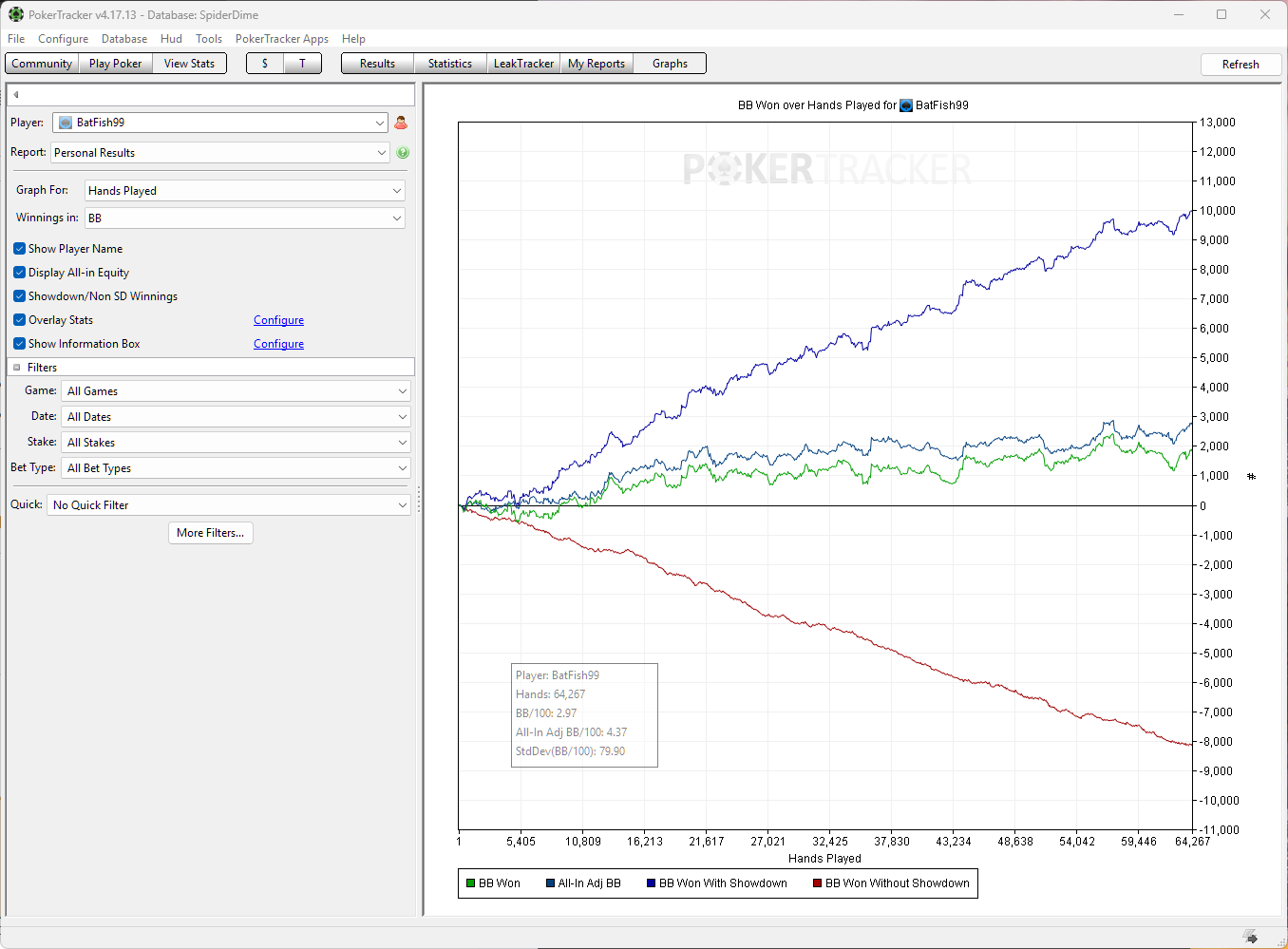
Win rate = 2.97
All-in adj. win rate = 4.37
Std deviation = 79.9
I would market it as having a win rate of 4.4 bb/100. All-in adj. win rates are considered standard in poker, as they converge faster and are closer to the truth.
Sample size is a bit small, but a Bayesian estimate puts the win rate at 2.3 bb/100, with a 95% CI of -0.6 to 5.3 bb/10.
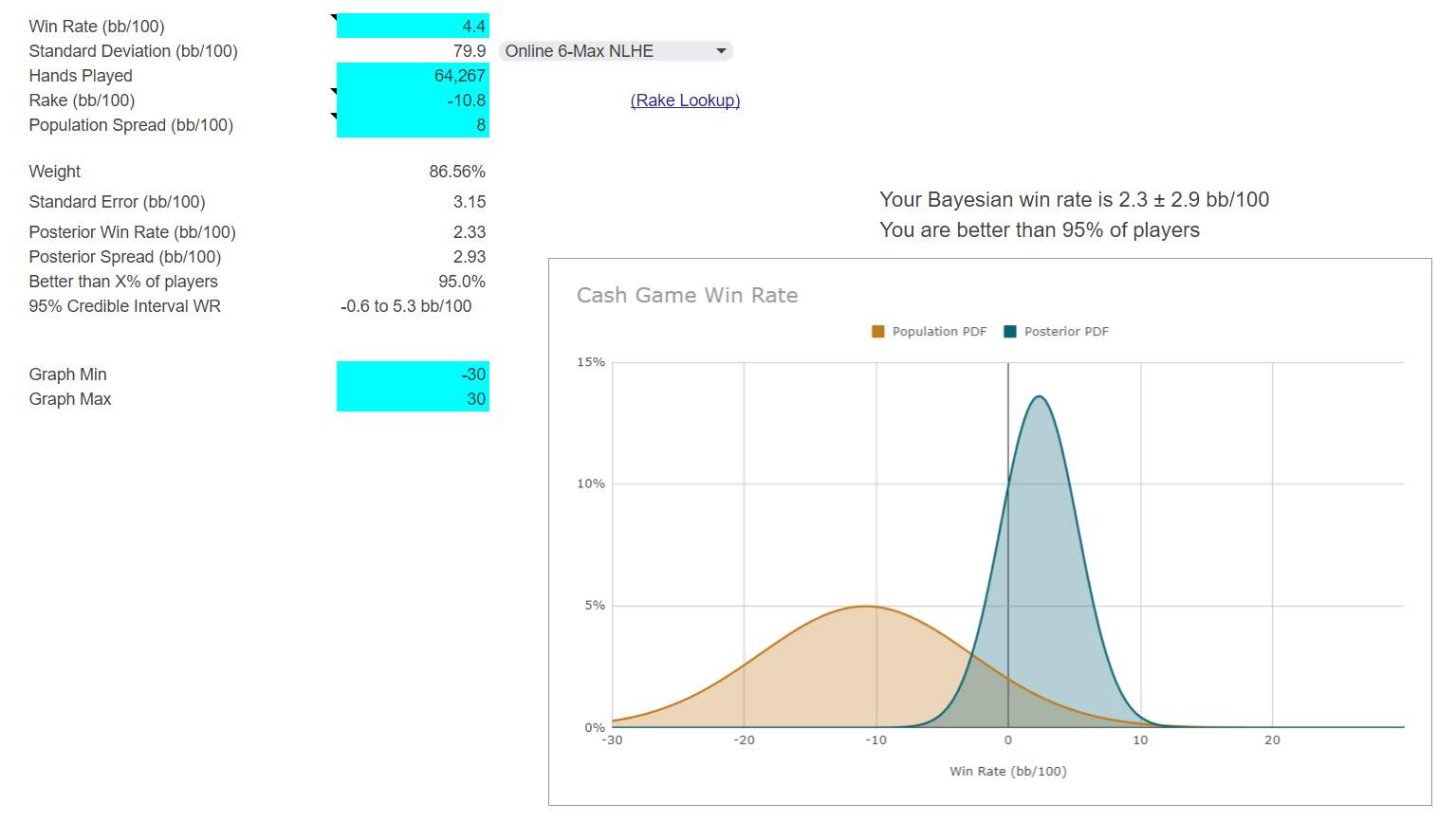
So yes, overall I'd put this bot in the top 95% of 2NL players. Top of the beginner class. Hard to say how well it would perform at higher stakes though.
Play Style
Overall style appears to be very nitty and nut-peddly, which makes sense at 2NL.
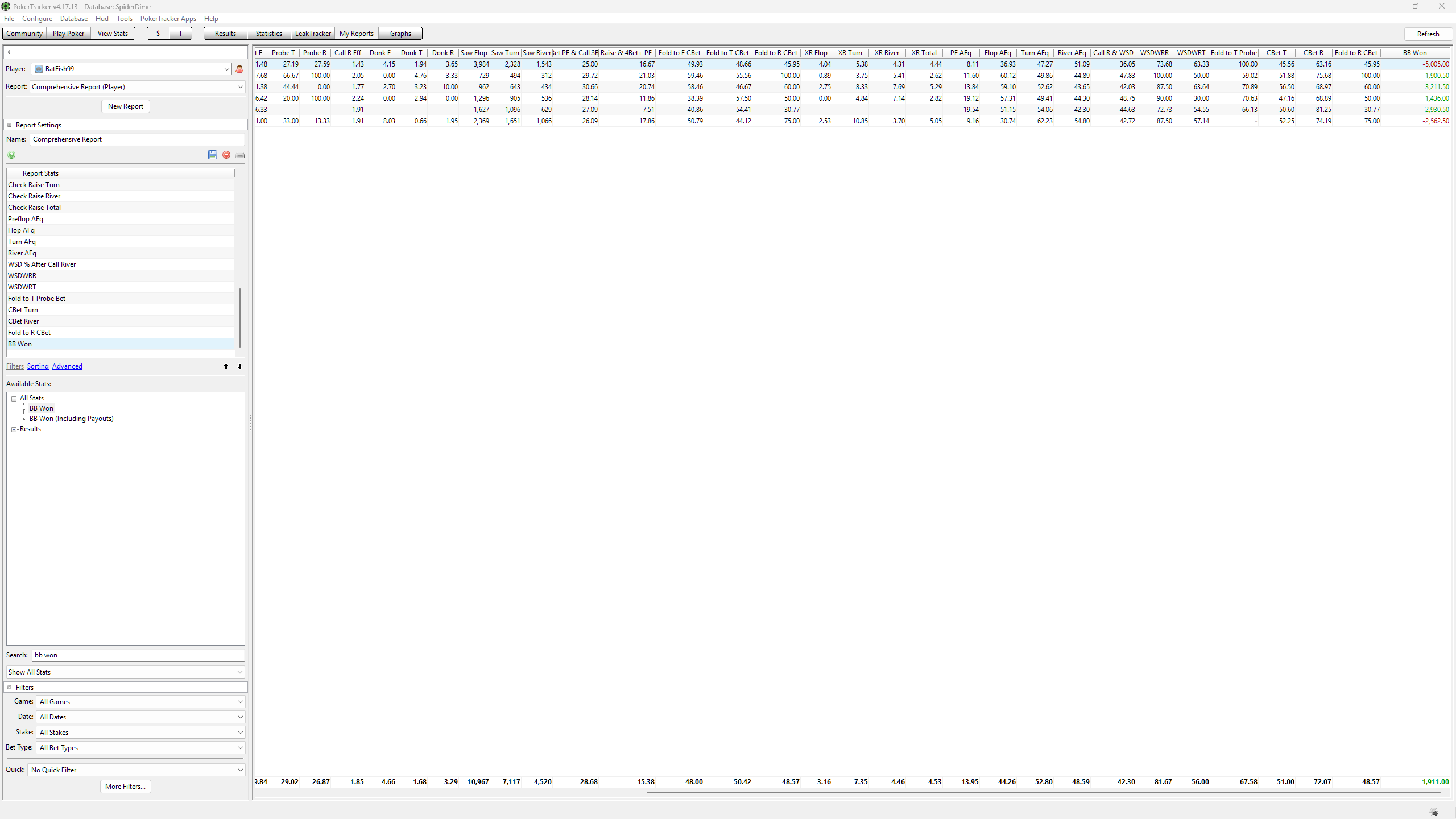
Some relevant stats:
- VPIP/PFR/3B = 20.4 / 13.6 / 4.4
- Call R Eff = 1.85
- WSD = 55.7%
- XR Flop = 3.16%
- Cbet Flop = 49.9%
- Fold to Turn Probe = 67.6%
- Won SD when raised river = 82%
- It's opening only 11.5% of hands from UTG and 35.6% of hands in the BTN
It's very tight, over-folding and under-bluffing from every position. Slow plays flop a lot.
Hands
One weird part about the data is that all the hands seem to be from Jan-Feb of 2023, indicating these hands are almost 3 years old. I wonder, did it take that long to launch, or were the timestamps changed?
Almost every 100bb+ pot in the database is a big hand. It's hard to find spots where it bluffed all in. There are a few bluffs here and there, but it picks its spots carefully.
Ethics
Ok so someone is going to point out that botting is a serious offense. You cheated, took money from people who did not consent to play against a machine. Botting violates ToS and degrades trust in online poker.
Granted, you only took $38 from the player pool, but in any case you should inform 888 of the situation. We also don't know if you used this on other sites under different aliases.
Verdict
This bot is a textbook nit. But that's probably a great strategy at 2NL!
The real question is, would it scale? I don't think this nitty strategy will beat mid stakes. But idk if the bot is capable of adjusting to a different meta. I guess it depends how the baseline was trained.
Very interesting work. I look forward to diving into the white paper and hh.
Quick question - what's the baseline strategy if you don't have info on the opponent? It's not GTO I guess. How much of your success would you attribute to the strength of the baseline, as opposed to the exploitative adjustments?
Hi tombos21,
Thank you, and you are correct, the baseline is not GTO.
Even when we have zero specific stats on a new opponent, the system simultaneously engages three distinct modules: the General Algorithm (our primary heuristic engine), the Ranges module (which assigns a default profile), and The Lawnmower (our deception engine).
We describe this default mode as playing like Johnny Moss. It acts with certainty to play "street poker" from Hand #1—using logical heuristics rather than heavy math, making standard assumptions about micro-stakes players, and employing deceptive timing (like deliberate stutters or "Hollywood" pauses) to induce the specific action we're seeking.
Regarding your second question on attribution: We estimate that of the +16.0 BB/100 performance delta, somewhere between 8 to 12 BB/100 comes from this aggressive "Johnny Moss" baseline alone.
The specific "Search and Destroy" exploits are the final layer that targets specific leaks, but the core engine is designed to be exploitative by default, rather than a GTO safety net.
Hi Didace,
That is a fair challenge on the terminology, but we would argue the system is maximally exploitative from Hand 1. It is just that the target of that exploitation is different.
At Hand 1, the "maximum" exploitation possible is bounded by the lack of specific data. Therefore, the system targets the Population Average (the "Unknown Micro-Stakes Player" archetype).
Our architecture assumes a new player will exhibit standard human patterns and imbalances (in bet sizing, timing, or range construction) rather than GTO perfection. It attacks that profile immediately using the baseline logic.
As specific data accumulates, the target shifts from the "Population" to the "Individual," and the ceiling for "maximum exploitation" rises. But the architectural intent to exploit is constant from the first card dealt.
Alright, I spent an hour analyzing the hands. Here's what I found:Win RateWin rate = 2.97All-in adj. win rate = 4.37 Std deviation = 79.9I would market it as having a win rate of 4.4 bb/100. All-in adj. win rates are considered standard in poker, as they converge faster and are closer to the truth. Sample size is a bit small, but a Bayesian estimate puts the win rate at 2.3 bb/
Hi tombos21,
Thanks for the independent audit. It is valuable to have a third party verify the data and calculations. Regarding the win rate, you are correct regarding the All-in Adj calculation (4.37 bb/100). However, our decision to claim the Bank Balance figure (+3.7 bb/100) as the final result wasn't just about conservatism. As we argue in the White Paper, we believe the Yellow Line is too often used to mask poor results or claim moral victories. We take the stance that the only undeniable ground truth in poker is the actual change in the bank balance.
You are also correct that his stats (20/13/4) reflect a tight approach. However, Patrick isn't hard-coded to be a nit. This Tight-Medium Aggressive (TMAG) style was an emergent property of his logic interacting with this specific player pool. The system identified a general population tendency toward stickiness and over-calling. Against a field that calls too wide, the math of our General Algorithm dictates that pure bluffs lose value, while thin value bets gain value. Consequently, the system naturally converged on a strategy of tightening up and nut peddling.
If we moved him to a mid-stakes game where the meta might be to over-fold, the logic would invert, and you would likely see those aggression stats rise. However, actually executing that move was out of the question for this project. As detailed in the Ethical Considerations section of the White Paper, causing significant financial losses to human opponents would break the core principles of our study.
This created a difficult juxtaposition for us. From a scientific perspective, we were keen to move up the levels to stress-test the architecture against tougher opponents. However, we were bound by our ethical framework. Taking a $2 stack for research is one thing; systematically draining bankrolls at higher stakes would have crossed the line from research to predation. We chose to prioritize that ethical constraint over our scientific curiosity.
Finally, on the timeline, yes, the hands are from early 2023. The delay was simply due to the operational workload required to finalize the analysis, write the White Paper, build the website, and produce the 17-video series alongside our other professional commitments. Everything took much longer than anticipated. No timestamps were changed; you can verify this by correlating the hand history timestamps with the actual gameplay footage in our Trial Data videos here: https://www.youtube.com/watch?v=VRZ1nzBy...
Thank you again for the deep dive. This kind of honest peer review and feedback is exactly what we were hoping for.
I'm curious what your plans are? Will Patrick evolve into a commercial application or is it meant to stay in the realm of academia?
I'm curious what your plans are? Will Patrick evolve into a commercial application or is it meant to stay in the realm of academia?
Hi tombos21,
To answer your question directly: it is staying in the realm of research.
Regarding a commercial release of the full agent, the answer is a definitive no. Patrick is too dangerous to be released into the wild. The results of this limited trial were encouraging, but what the final numbers don't show is the trajectory; because of the machine learning protocols, Patrick was continuing to improve with every hand played. Releasing a tool that learns to exploit humans would be predatory and damaging to the poker ecosystem, which goes against our ethical framework.
We may, at some point, consider spinning off specific modules—like the Ranges visualization or the Relative Strengths Matrix—as standalone coaching tools. These could help human players visualise how ranges morph in real-time.
Our immediate focus is simply getting the rest of the project out the door. We are heads-down completing the commentary and production on the remaining 15 videos in the 'Easy Game' series. Unlike the raw 'Trial Data' footage already released for analysis, these are designed to entertain and drive wider engagement, and we will be releasing them every two weeks .
Beyond that, our goal is to take this architecture and test if the sword philosophy applies to General AI problems outside of poker.

If this isn't some kind of fake thing where this is actually human play then it's pretty funny that the issues the ai runs into while trying to exploit other players are almost the same issues a very beginner would run into. This strategy looks like what someone who doesn't have much of a clue would think is maximally exploitative at nl2.
Hi Didace,That is a fair challenge on the terminology, but we would argue the system is maximally exploitative from Hand 1. It is just that the target of that exploitation is different.At Hand 1, the "maximum" exploitation possible is bounded by the lack of specific data. Therefore, the system targets the Population Average (the "Unknown Micro-Stakes Player" archetype).Our arch
Do you have a control? What would that control be based on?
How do you define "maximally"? Maybe you are not exploitive at all? Prove me wrong.
If this isn't some kind of fake thing where this is actually human play then it's pretty funny that the issues the ai runs into while trying to exploit other players are almost the same issues a very beginner would run into. This strategy looks like what someone who doesn't have much of a clue would think is maximally exploitative at nl2.
Hi aner0,
Thanks for the comment. Regarding authenticity, the strongest evidence is in the video series itself. If you watch the footage, you can see the Ranges module calculating in real-time; visually narrowing down the villain's likely holdings based on their actions (you can also see the ranges Patrick selected to play). If you look closely at the footage, the speed and precision of the visualization leaves no doubt that it is a machine playing.
To your point about the strategy looking like a beginner's intuition: we agree that in many spots, the output looks identical. But we would argue the process is different.
A beginner plays simply because they lack the tools to do otherwise. Patrick often played simply because the architecture calculated that complex lines were lower EV against this specific 2NL population. However, when the situation called for it, the AI executed lines that are distinctly non-beginner.
Two specific examples from the video series might demonstrate this best:
Hand 14 (Turning Value to Bluff): On the Turn, Patrick bets for value. When the River kills his hand/equity, he instantly pivots and turns his hand into a pure bluff to fold out better holdings. A beginner rarely possesses the discipline to turn a made hand into a zero-equity bluff based on a board run-out. https://www.youtube.com/watch?v=DWGs_9pd...
Hand 15 (Adaptive Check-Raise): Here, Patrick initially C-Bets the flop to isolate a Calling Station in a 3-way pot. When the Station folds and a Tight Reg calls, the AI instantly recalculates the dynamic. On the Turn, it switches gears to a check-raise semi-bluff, correctly predicting the Tight Reg would bet when checked to but would fold to significant pressure. https://www.youtube.com/watch?v=G3D17uwj...
We would welcome your expert critique on the logic applied in these specific spots.
Hi aner0,Thanks for the comment. Regarding authenticity, the strongest evidence is in the video series itself. If you watch the footage, you can see the Ranges module calculating in real-time; visually narrowing down the villain's likely holdings based on their actions (you can also see the ranges Patrick selected to play). If you look closely at the footage, the speed and prec
in hand 14 you have 8 high on river though?
hand 15 i don't think looks very non human either.
again, i don't deny that it's pretty impressive, i'm just happy that whatever the ai comes up with as the best exploit is still comparable to a really mediocre human player
i skimmed through other hands and it also makes silly plays like donking a straight BB vs CO on KQ9. Some of these off-beat creative plays are just plain losing
Do you have a control? What would that control be based on?
How do you define "maximally"? Maybe you are not exploitive at all? Prove me wrong.
Hi Didace,
Thank you for the questions.
In a live field trial, a perfect control is impossible. However, the Field Average serves as the effective control group. The Null Hypothesis would be that the AI performs in line with the population average. The control, being the Field Average, was minus 13.0 BB/100 while the Variable, Patrick, was plus 3.0 BB/100. The performance delta of plus 16.0 BB/100 suggests the strategy successfully differentiated itself from the control group.
We use the term maximally exploitative to describe the architectural goal, not a claim of having achieved a mathematical limit. In a strict Game Theory sense, calculating the Max Exploit against a complex, unknown human strategy is impossible as you cannot compute a perfect counter-strategy to a strategy you cannot see. However, we define it by Directional Intent. The GTO goal is to move toward equilibrium to minimise exploitability. Patrick's goal is to move away from equilibrium to maximise expected value against a specific opponent profile.
You asked if we are exploitative at all. The proof of exploitation is Strategic Deviation. If the AI were not exploitative, it would attempt to play a static, balanced frequency. Instead, it deviates massively based on the opponent. For example, in Hand 3 (Exploiting a Calling Station), the AI identifies a passive opponent and deviates to make thin value bets with a weak pair, a line that may be questionable against a balanced player. https://www.youtube.com/watch?v=Qr33dPrk...
Conversely, in Hand 12, it identifies opponents with high Fold to Steal statistics and opens with Q3 offsuit, a hand that should never be in a standard opening range. https://www.youtube.com/watch?v=qd_PP3fL...
It identified a specific leak and warped its strategy to attack it. If it was not exploitative, it would have folded the Q3 and checked back the weak pair. We hope that clarifies our definitions. We aren't claiming to have solved the game. We are claiming to have built a machine that successfully hunts for leaks rather than hiding behind a shield.

in hand 14 you have 8 high on river though?hand 15 i don't think looks very non human either.again, i don't deny that it's pretty impressive, i'm just happy that whatever the ai comes up with as the best exploit is still comparable to a really mediocre human playeri skimmed through other hands and it also makes silly plays like donking a straight BB vs CO on KQ9. Some of these
Hi aner0,
Thank you for looking at the other hands, we really appreciate you taking the time.
Regarding Hand 14, you are right that having 8-high means we have zero showdown value, so betting is the only way to win. The distinction we draw is that a typical beginner often lacks the commitment to fire that extra barrel when their hand turns into 8-high on the river, preferring to check-fold and save the money. Patrick recognized that the only way to win the pot was to fire, and he pulled the trigger.
You mentioned the play of donking the straight on the KQ9 board in Hand 10. This is a spot where we freely admit the AI might have been over-zealous. Conventional wisdom suggests checking to the pre-flop aggressor to protect your checking range. It appears the architecture calculated that the Medium Reg opponent likely held a strong hand but might check back the flop for pot control. By leading out, Patrick guaranteed money went into the pot immediately. It was a greedy play designed to extract maximum value, but we agree it is highly debatable whether this deviation was optimal or simply an over-adjustment.
Regarding the comparison to a mediocre human, we accept that characterisation for this specific stake level. It appears the AI determined that a simplified, ABC style was the most efficient way to extract value from this population. It prioritised the most profitable line over the most complex one, even if that resulted in a strategy that looks unsophisticated to a coach.
We suspect if we dropped him into a higher-stakes game, those greedy, controversial leads would get punished, and the system would be forced to evolve or die. Proving that this sword-based philosophy can generalise to other complex human environments is the hypothesis we intend to test next.
I would suggest that +3bb/100 at .01/.02 is bad. Your control group is self-selecting to be worse than normal - kind of a reverse survivorship bias. But, I guess a one-eyed man in the land of the blind is king.
ETA: Also, your control should be some other "GTO" bot. You are already down the ethically challenged hole of using a bot so using another should not keep you awake at night.

Yeah, playing 20/14 and opening 35% from the BTN seems like the kind of strategy a very mediocre reg would come up with. That's how I played 20 years ago when I first learned to beat microstakes.
I haven't read the white paper, but opening 35% from the BTN seems to suggest a low-level kind of exploit: "They under fold preflop, therefore I should open tighter!"
To be fair to SpiderDime, their bot's win rate is at least two standard deviations above the mean. It's definitely a top microstakes player.
888 2NL rake is ridiculous; 6.25% basically uncapped. Bot lost 10.8 bb/100 to rake, population lost 13.0 bb/100 to rake. That's a deep canyon to climb.
Now obviously that doesn't make it a top player, just top of the beginner class. Hard to say if their training methods would scale to more challenging stakes.
Trying to reduce the white paper's conclusion and discussion of limitations to a summary with meaningful takeaways...
1. Exploitative (attacking sword) play generally works better against humans who aren't playing GTO (defensive shield).
2. Patrick the AI is generally better than most humans when it comes to finding the highest EV exploits versus any opponent.
3. The lower the stakes, the farther from GTO humans tend to play, and the higher the EV of exploitative play. As you move up in stakes, the player pool tends to play more fundamentally sound, and we'd expect to see a smaller delta between GTO and a max exploitative style.
If that's a fair summary, my first thought is that none of the above should be all that surprising to anyone paying attention to the evolution of the game.
My second thought is that rather than viewing Patrick as an argument against GTO and for exploitative play style, at any stakes, Patrick could evolve to be useful as a training tool for players at all stakes.
It's easy to envision how Patrick could help players develop better heuristics with a higher degree of confidence in their validity, effectively "flattening the learning curve" by enabling players to quickly deploy exploits after shorter periods of observation.
It wouldn't shock me if Patrick were to present some radical new insights. But I suspect the more likely outcome is that Patrick would be able to quantifiably validate what was previously only intuitive and otherwise impossible for a solver to demonstrate, for example, ideas related to tilt or demographic tendencies.
Fully expecting someone at some point to notice Patrick has started to skew sexist or racist in his exploits. It's only a matter of time.
this bot is not good ay exploiting nl2, please mr chatgpt, don’t strawman my argument. the reason it’s not good has nothing to do with unsophisticated play, but with making plays that lose.Not from a theoretical standpoint, from a play that loses standpoint
Very interesting work indeed. Congrats on putting this together and thanks for providing all those details. Truly good study material.
I see the famous Tombos is of course eager to know if you are going to commercialize this work! Normal, this could threaten the legacy solver he works for.
Don’t get spooked by critics, I think your work is fantastic, and I understand your dilemma to test in a real setting with the minimal financial impact to players. If anything, I believe some of them would have benefited from playing against your AI and maybe learned a thing or two along the way. I like in particular the hands you shared on YouTube. If you’re curious, I also shared some interesting hands history on Reddit PokerSolvers sub.
Some questions:
- Did you spot check a sample of the played hand against a modern solver? And against an old generation solver? Did you spot any flagrant mistake? Or identified spots where solvers and your AI diverged massively?
- Do you have a subset of hands that are particularly interesting and complex to « solve » ? Multiway, donk bets,…
- Does your AI compute and account for key metrics on each street, such as pot odds, SPR, # of outs for hero, villain(s) combined range, equity required to call, and many others …?
On hand 15, hero with 86s, I reviewed it using various player profiles for villain, from NIT, GTO, and TAG. I get to the same conclusion: a vast majority of check/fold, not check raise.
I couldn’t find the check-raise semi bluff on the turn to be anything else than -EV. Yes in this particular instance your AI won, but 9 times out of 10 it should not (well, maybe not 90%, but you see my point)
Villain’s turn betting range gets stronger:
• Preflop: he cold-calls CO open on the button so he’s already fairly tight.
• Flop: 7♣ 5♥ J♦, he calls your c-bet multiway so he has mostly Jx, strong 7x/5x, pocket pairs, good draws.
• Turn: 2♣, you check, he bets big (~75% pot) so this is usually value-heavy and good draws, not air.
Hero: 8♦6♦ on 7♣ 5♥ J♦ 2♣
• We have an open-ended straight draw: 4s and 9s so 8 outs so 17% maximum equity with one card to come. (Assuming no other players folded a 4 or a 8 which could definitely be possible). But 2 outs are « dirty » if they come as ♣, bringing the backdoor flush draw. So maybe 6 outs …12% equity, maybe less.
• No flush draw, no overcards, no pair.
• If he has overpairs, Jx, two pair, or a set, ….
• therefore with 10-12% equity we will miss the river most of the time. (See, I was not far off with my 9 out of 10 times you lose)
For a check-raise to be good, we need villain to folds enough of his betting range, and when called, we are not completely crushed, or we must at least have a strong combo draw equity.
Here, villain betting range is quite strong: Jx+, good pockets, strong club draws, maybe some straights and sets. A tight reg is not folding Jx or better very often to one raise, especially deep.
In GTO land, on this line, the turn check-raise bluffs usually come from combo draws (straight + flush draw) or pair + draw hands. None of that here.
Unless the AI had a specific read on villain (which read?), Check-raising should not fold enough weak stuff in villain range, and when called we are in bad shape and out of position.
So here, with the pot odds and out-of-position penalty, the “fold when beaten” rule should kicks in.
So I would give maybe a 2 or a 3 out of ten ranking note for this play, due to it’s creativity and « agressive » exploitative style, but quite weak in terms of EV and « optimal » play.

There's no bot in the world that has its own money that it can spend, so a really good bot isn't the one who just wins, but a bot who can also hero call you, hero bluff you or hero fold.

