Subject: Challenging GTO: A White Paper & 64k-Hand Trial of an Exploitative AI
Hi 2+2 Community,
For the past several years, my colleague and I (under our research name, Spiderdime Systems) have been
Very interesting work indeed. Congrats on putting this together and thanks for providing all those details. Truly good study material.I see the famous Tombos is of course eager to know if you are going to commercialize this work! Normal, this could threaten the legacy solver he works for.Don’t get spooked by critics, I think your work is fantastic, and I understand your dilemma
Hi TQPGUN,
Thank you for your feedback. We appreciate your support and the kind words. We're primarily AI architects, not GTO experts, so getting this level of deep poker analysis is exactly what we were hoping for.
To answer your questions: We haven't run a solver comparison on the full 64k hands. The primary goal of the project was to build an architecture that deviates from a GTO baseline, so our focus was on validating the heuristic engine rather than its GTO compliance. The 16 hands we released for the video series are a subset we felt were interesting. We chose them because each one demonstrates a specific aspect of the AI's logic; whether it was a great read on a Whale (Hand 6) or avoiding calamity (Hand 16). And yes, the system absolutely computes and accounts for all those key metrics (Pot Odds, SPR, Equity, etc.); they are the foundation of the General Algorithm module.
Thank you for your analysis of Hand 15 (86s): Your GTO-based breakdown is of course, correct. From a purely mathematical, solver-based perspective, the check-raise is -EV.
This is what we think Patrick's decision-making process was, and we're not at all sure if it was correct (we do not have the poker knowledge the members of this forum have, hence we value your feedback).
Patrick had played over a thousand hands against this particular Tight Reg. The Search and Destroy module had profiled him as a very tight, positional, and predictable player. The system's model predicted this specific player would attempt to steal on the turn if checked to in a heads-up pot. Patrick's check on the turn gave him that opportunity.
Based on the villain's call of the C-Bet on the flop, Patrick's model assigned him this range:
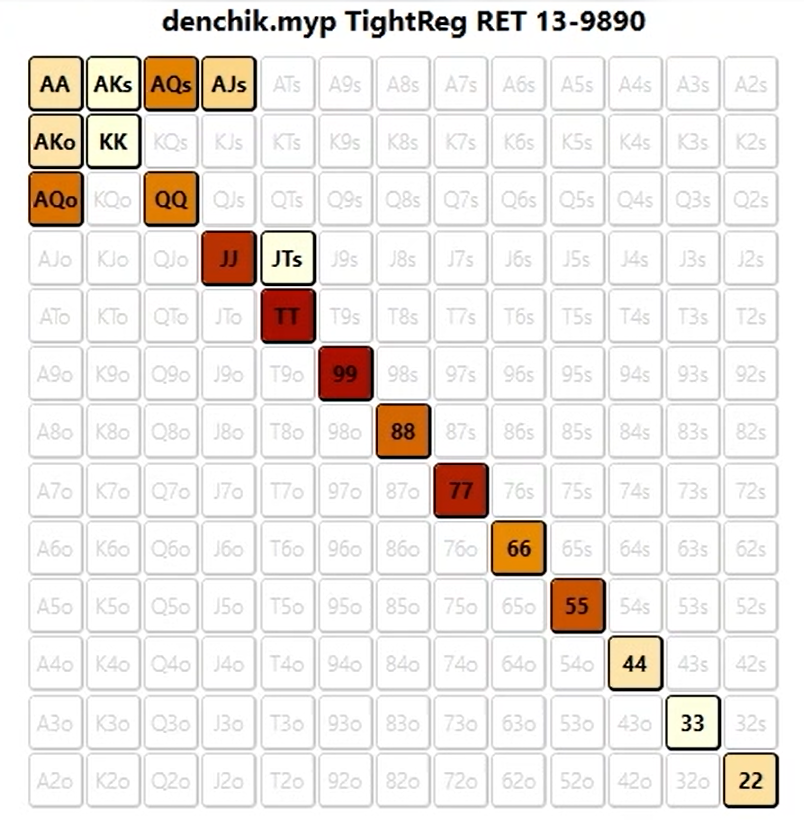
The AI's read, rightly or wrongly, was that while the villain's betting range would be wide, his calling range (to a check-raise) was incredibly narrow. Patrick's model predicted the villain would only call with a set, and would therefore fold the vast majority of hands he was betting for value or as a bluff.
We've no idea if Patrick was right or not, and of course you are correct, in that if we were to run this hand 10 times, the results might be significantly different. It was just an "interesting" play, based 100% on a specific player read rather than GTO math. We would be very interested in your thoughts on that logic.
Thank you again for your feedback and for taking the project seriously. We'll be sure to check out your work on the Reddit PokerSolvers sub.
Trying to reduce the white paper's conclusion and discussion of limitations to a summary with meaningful takeaways...1. Exploitative (attacking sword) play generally works better against humans who aren't playing GTO (defensive shield).2. Patrick the AI is generally better than most humans when it comes to finding the highest EV exploits versus any opponent.3. The lower the sta
Hi docvail,
Thank you for reading the white paper and summarising.
Your point about emergent bias is a critical topic in modern AI, and it's one of the main reasons we opted for a hybrid model instead of a pure "black box" neural net.
We built the Search and Destroy module on a foundation of human-centric poker heuristics. This approach guides the AI to look for poker-specific strategic leaks and exploitable patterns , rather than mining raw data for unintended demographic correlations.
By limiting its worldview to the game itself and guiding it with this heuristic foundation, we believe it remains far less susceptible to the specific kinds of non-poker-related bias you mentioned. It's certainly a key consideration in this type of research.
Hi docvail,Thank you for reading the white paper and summarising.Your point about emergent bias is a critical topic in modern AI, and it's one of the main reasons we opted for a hybrid model instead of a pure "black box" neural net.We built the Search and Destroy module on a foundation of human-centric poker heuristics. This approach guides the AI to look for poker-specific str
Unfortunately, if you don't allow the machine to observe the actual world and develop pattern recognition which accurately reflects that world, its usefulness for real-world players will be less than its full potential.
The reality is that humans are susceptible to bias because it's easy for us to spot demographic qualities and we're hard-wired for efficient pattern-recognition and association. Those qualities contribute to our adaptability as a survival mechanism.
In the real world, we don't have as much information as we do with online play, and as such we tend to rely more on heuristics based on pattern recognition.
this bot is not good ay exploiting nl2, please mr chatgpt, don’t strawman my argument. the reason it’s not good has nothing to do with unsophisticated play, but with making plays that lose.Not from a theoretical standpoint, from a play that loses standpoint
Hi aner0,
You are correct that some of the AI's plays are losing. We're not trying to defend them as secretly brilliant. We wouldn’t be surprised if, over the 64k hand trial, there were many thousands of poor plays.
The goal of this project wasn't to build a perfect AI, but to build an exploitative one. Patrick's architecture has no GTO or defensive logic; it was built to try and exploit.
All we're suggesting is that the philosophy of building a ‘sword’ (an AI that hunts) is sound. The proof for us is that this flawed, imperfect, sometimes-losing AI still managed to beat the field average by +16.0 BB/100, albeit, at the lowest human skill level there is in live poker.

You don’t think it’s “accurate” that OP & his colleague have “long been fascinated by the “solved” myth in poker”?
[QUOTE=TQPGUN;59152578]Very interesting work indeed. Congrats on putting this together and thanks for providing all those details. Truly good study material.
Hi TQPGUN,
Thank you for your feedback. We appreciate your support and the kind words. We're primarily AI architects, not GTO experts, so getting this level of deep poker analysis is exactly what we were hoping for.
.
Great adjustment by Patrick on this particular player. Your explanation is spot on: « this specific player would attempt to steal on the turn if checked to in a heads-up pot. Patrick's check on the turn gave him that opportunity. ».
This « dynamic adaptative » AI is indeed very powerful.
What’s next for this project?
[QUOTE=SpiderdimeSystems;59152634]
Great adjustment by Patrick on this particular player. Your explanation is spot on: « this specific player would attempt to steal on the turn if checked to in a heads-up pot. Patrick's check on the turn gave him that opportunity. ».
This « dynamic adaptative » AI is indeed very powerful.
What's next for this project
Hi TQPGUN,
Thank you for the ongoing constructive dialogue. We have been completely heads-down in the editing room recently, focusing our available bandwidth on producing the final public assets for the project.
To answer your question about what is next: we have been building a parallel video series designed to showcase the exact type of logic you were analysing.
While our initial 'Trial Data' videos were intentionally clinical, we wanted to demonstrate the 'sword' philosophy in action. We have spent the last few months creating a series called 'Easy Game', which dramatises Patrick's internal monologue and rather arrogant personality during these hands.
It provides a humorous look at the Level 2 thinking the Lawnmower module attempts to execute when it pulls the trigger on targeted exploits. We have currently released the first nine hands of this series to try and get our research in front of a wider audience.
While the video covering Hand 15 is still in the production queue, you can view the live series here:
https://www.youtube.com/watch?v=GiF0E7xO...
We would be very curious to hear your thoughts on whether this more entertaining format successfully bridges the gap between solver theory and the reality of exploitative play.

Hey Spiderdime, if you want to bench your model there's a public AI poker leaderboard you can test it against.
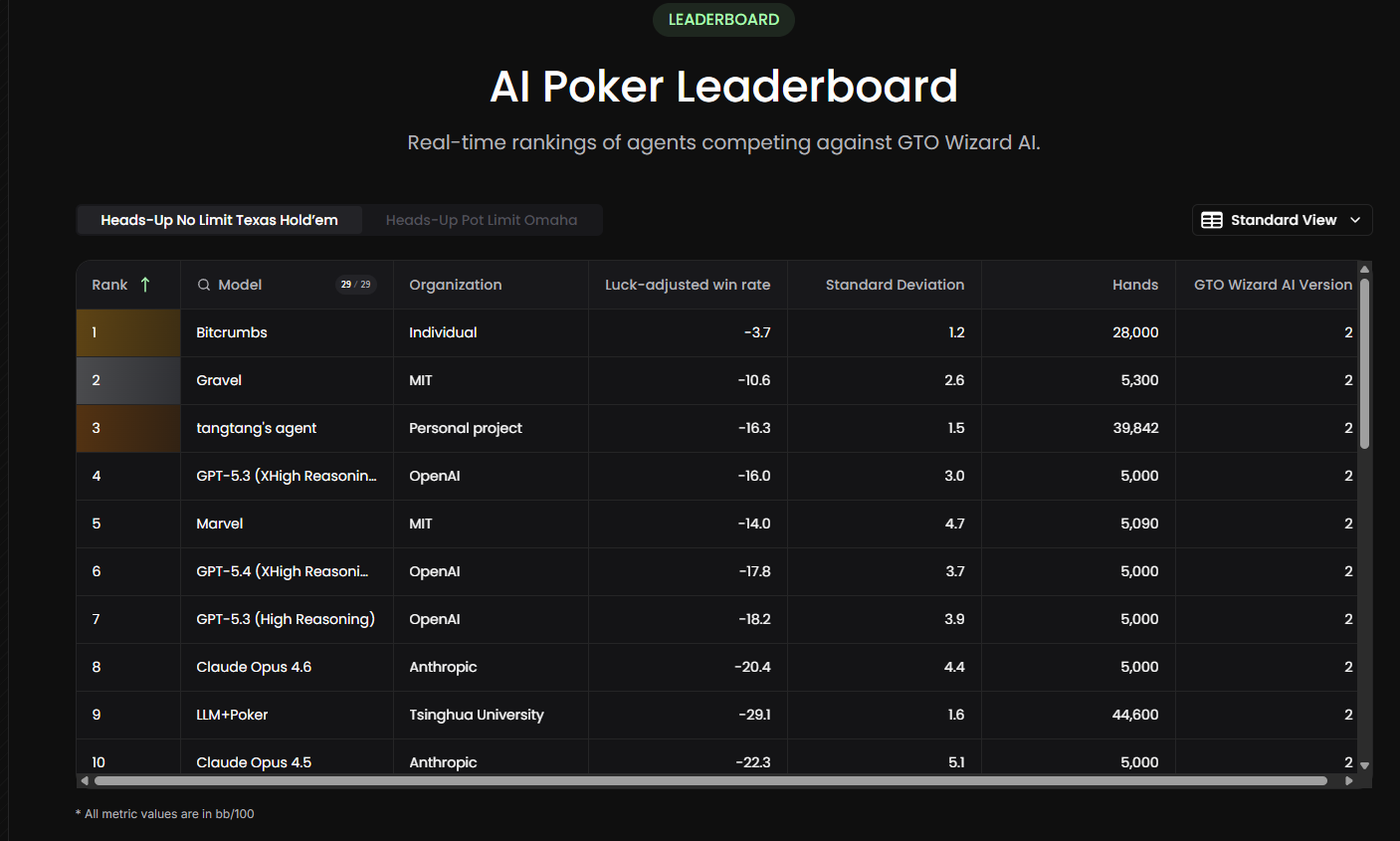
The bench is essentially a heads up match vs a solver.
That probably isn't the best way to show off its exploitative capabilities, but it's a free tool you can use to get an objective performance baseline anyway.
Hey Spiderdime, if you want to bench your model there's a public AI poker leaderboard you can test it against.
The bench is essentially a heads up match vs a solver. That probably isn't the best way to show off its exploitative capabilities, but it's a free tool you can use to get an objective performance baseline anyway.Hi tombos21,
Thank you for the link. We have a tremendous amount of respect for GTO Wizard and the tools they build for the community.
However, we will not be running Patrick through that benchmark, for a very simple reason: Patrick would lose, and likely lose quite badly.
As you pointed out, a heads-up match against a solver measures the exact opposite of what Patrick was built to do. Our entire architecture, specifically the Search and Destroy module, relies on finding and attacking statistical imbalances. It scans for human flaws: players who over-fold to turn probes, Calling Stations who cannot fold a weak pair, or Nits who refuse to defend their blinds.
A solver has none of these leaks. It does not possess the psychological flaws our system requires to generate its high-conviction exploits. Patrick would search for a vulnerability, find a perfectly balanced equilibrium, and eventually be mathematically ground down by a superior, unexploitable "shield".
Furthermore, Patrick was architected specifically for 6-max ring games, not a sterile heads-up environment.
Tools like AIVAT and the GTO Wizard benchmark are fantastic for measuring how closely an AI can approximate a Nash Equilibrium. But our project's core hypothesis is that in the messy, irrational real world of micro-stakes poker, approximating Nash is less profitable than targeted exploitation. We built a machine to play the player, not to play the math.
We genuinely appreciate you pointing us toward the resource, though! It is exactly the kind of rigorous tool that traditional AI development relies on.
The rake at 1c/2c fast-fold being 10.8 BB/100 basically buries any meaningful comparison to higher stakes where rake runs maybe 2 to 3 BB/100 if you're at a decent site. That said, beating that rake load by 3 BB/100 post-rake is genuinely not trivial. My concern is micro player pools are so leak-heavy and predictable that pure exploitation probably flatters the results a lot compared to 25nl and above where people at least have some sense of range interaction. Would be interested to see how Patrick holds up against a pool with any real 3-bet frequency before drawing conclusions about the sword beating the shield.
The rake at 1c/2c fast-fold being 10.8 BB/100 basically buries any meaningful comparison to higher stakes where rake runs maybe 2 to 3 BB/100 if you're at a decent site. That said, beating that rake load by 3 BB/100 post-rake is genuinely not trivial. My concern is micro player pools are so leak-heavy and predictable that pure exploitation probably flatters the results a lot compared to 25nl and above where people at least have some sense of range interaction. Would be interested to see how Patrick holds up against a pool with any real 3-bet frequency before drawing conclusions about the sword beating the shield.
The rake at 1c/2c fast-fold being 10.8 BB/100 basically buries any meaningful comparison to higher stakes where rake runs maybe 2 to 3 BB/100 if you're at a decent site. That said, beating that rake load by 3 BB/100 post-rake is genuinely not trivial. My concern is micro player pools are so leak-heavy and predictable that pure exploitation probably flatters the results a lot co
Hi TournamentDataGuy,
You are correct that 2NL flatters a purely exploitative architecture due to the pool's massive structural leaks. Although we wouldn't necessarily call the micro-stakes play 'predictable', it was certainly poor and substandard at times
We chose 1¢/2¢ strictly to minimise the financial impact on human players. Due to these ethical constraints, we were unable to see how Patrick performed at higher levels, as interested as we were to find out. It is extremely likely his win rate would have dropped against tougher competition, but as you pointed out, with the rake burden being significantly lower, it is highly possible Patrick would still have cleared the rake hurdle.
Regarding your point on real 3-bet frequencies: Patrick doesn't rely on static assumptions. If he encountered a 25nl pool with balanced, aggressive 3-betting, his heuristic engine would dynamically measure those frequencies and adjust his own ranges in real-time. The exploits would simply become much thinner.
We agree with your conclusion, too. We don't think this specific trial definitively proves the 'sword' beats the 'shield' universally, but we do believe it has put the cat amongst the pigeons.
Thanks for the feedback, much appreciated!
The rake number is what jumps out immediately: 10.8 BB/100 at 1c/2c fast fold means the gross winrate was north of 14 BB/100, which is a serious edge regardless of how you're generating it. From an MTT angle the "unexploitable shield" argument has always felt strongest against regs you see daily in cash, but in tournament fields with constant field turnover you're basically playing exploitatively against strangers by default anyway. Curious how the model handles population drift over time since fast fold specifically kills the individual read accumulation that makes exploitation compounding.
Interesting project, though the 1c/2c fast-fold pool is doing a lot of heavy lifting here. Exploit-heavy strategies have always crushed micros because the population leaks are so obvious and consistent, so 3.7 BB/100 post-rake is solid but I'd want to see how Patrick holds up at 25NL or 50NL where the regs start adjusting. The real test of the sword vs shield debate is whether the exploit engine can recalibrate fast enough when it gets targeted by a thinking player who notices the pattern.
The rake number is what jumps out at me: 10.8 BB/100 at those stakes is absolutely punishing, so the +3.0 net green line is actually the more telling figure. At 1c/2c fast-fold the population tendencies are so wide and predictable that I'd expect exploitative lines to work well, the real test would be running the same architecture at NL100+ where the regulars have much tighter, less readable ranges. Curious whether the "Search and Destroy" module is picking up on bet sizing tells or more macro stuff like positional tendencies.

