‘Big, Beautiful Bill’ potentially very bad for poker (players) in the US + STAY ON TOPIC!!

This makes Black Friday look like a children’s birthday party.
There’s no chance this passes right? It would

I've been posting about this on X, and most people are angry at me because I'm not riding the outrage and doom-and-gloom train.
It's much easier to join the screaming crowd and post, "OMG!! EXISENTIAL THREAT TO PRO POKER AND SPORTSBETTING!! UNFAIR!!! NO GOOD!! THIS MUST BE REPEALED!! CALL YOUR CONGRESSMAN!! COME ON EVERYONE LET'S FIGHT!!!"
Posts like that mean nothing, and accomplish nothing.
Here's some realities, whether you like them or not. I can speak these realities from 25+ years involvement in the poker / sportsbetting / casino advantage play communities. As a disclaimer, note that I am NOT advocating you cheat on your taxes, but rather am discussing what I've observed in the gambling communities for the past 25 or so years. As a second disclaimer, I am not a tax professional and this is not tax advice. It's just the observations of an idiot on a forum.
1) Dina Titus' FAIR Act to negate this change is a nice bill, but it's not going anywhere. Titus has zero influence. Everything she tries fails. You don't get an A for effort in Congress. The best bill in the world is useless if it doesn't pass. She is not going to rescue you. This new tax law is going to take effect on 1/1/26 whether you like it or not.
2) This will not end professional gambling as we know it. In fact, the gambling/poker/sportsbetting landscape will look very similar a year from today, compared to right now. Go ahead and screenshot this post, and show it to me on 12/4/26 if you want to rub it in my face that I'm wrong, but I'm reasonably sure I'll be right.
3) This only affects a small percentage of players. If you don't itemize, you're not affected. If your total net losing SESSIONS (note the word sessions) are 11% or more greater than your total net winning sessions, this will not affect you.
4) Playing offshore online poker is not going to save you. This is because you are expected to pay income tax on ALL income, not just US-derived income. Sure, some people don't declare offshore income, but that's cheating on your taxes. And if you're going to cheat on your taxes like that, then you'd also likely be willing to simply pad 11% fake losses onto your actual number, which would negate this law. It is bizarre how people clutch pearls and say "OMG I WOULD NEVER DECLARE FAKE LOSSES", yet claim they'll play offshore to dodge this law. It's like saying you wouldn't ever shoplift because you're a good person, so instead you're going to run email phishing scams.
5) Casino advantage players will definitely not be affected. There is no reliable tracking of their wins and losses, as they typically play on multiple players cards (many not in their own names), as well as often with no card at all. Their wins/losses on their taxes are completely self-reported and unverifiable beyond a very rough number. I can assure you that very few casino APs report their actual winnings to the IRS. Most report a number they feel they can get away with defending if audited. So these people will just tack on another 11% of losses, and the new law will be negated. There will be no proof they did this, in most cases.
6) Live cash poker players are similar. You can pretend we live in a perfect world where live cash poker players accurately report their winnings to the IRS, but most don't. Again, they will simply tack on another 11% of "losses" and nobody will be the wiser.
7) Sessions matter, and most people don't understand them. The 90% loss deduction limit only matters for losing sessions against winning sessions, NOT within the same session. If you're in the same session, you can deduct 100% of losses. For example, if you win $100k in a tournament, and then walk over to the blackjack table and donk it all off, you have broken even. You would have any tax liability for this day, because it's all the same session. The IRS has never defined a "session" with specifics, so players can define their own sessions by whatever is most advantageous for them, and as long as it's somewhat reasonable (you can't say the year is one long session), then it will typically pass an audit. This will be a huge legal tool to combat this new law.
8) The law on the books is one thing, and enforcement is another. I have serious doubts that the IRS is going to come after breakeven players who declare zero gambling income, even if the law states they owe taxes for nonexistent wins. Remember, this is all self-reported, and very few gamblers have historically been audited. In fact, there's gamblers I've known over the years whom I was sure would get audited (like one guy who made millions in cash games and didn't file a return for 5 years straight), but somehow they never did. So the enforcement might be very light, if at all.
9) People will probably start creating phony losses to negate this, if necessary. For example, the tournament-only player might start claiming he's also playing live cash and losing a bunch of money, and include those fake "losing sessions" in his losses calculation, until it brings down his total liability 11% (and negates the new law). This will be tough for the IRS to prove. Typically the way they prove tax evasion is showing that you have far more wealth/assets/deposits/cash than your returns claim you should have. For example, if I claim to have made no more than $100k per year for the past 20 years, and I buy a $10m house in cash today, that would be very suspicious to the IRS. They might haul me in and ask how I had $10m cash to buy this house, if my returns show I haven't made anywhere near $10m lifetime. But the tournament player claiming additional cash losses that offset his overall tournament winnings probably wouldn't be questioned. Again, I am not advocating doing things like this, and I always file my own taxes legally. I'm just saying it's going to happen, and therefore these people will keep playing despite all of their claims that it makes their career unviable.
10) Take #9 and apply it to pretty much any other form of gambling (sportsbetting, for example), and you'll see that a lot of people are going to keep on with their pro gambling careers, and just adjust what they claim to the IRS. You're not going to have a mass quitting of pros who go work regular jobs, nor are you going to have many people actually sending money to the IRS to pay taxes on a breakeven or slightly losing year.
When I point stuff out like the above, I get a lot of pearl-clutching and stupid responses:
"OMG how can you advocate tax cheating? I thought you're the anti-fraud guy!" ---- I'm not advocating this, but I know my fellow gamblers, and I'm telling you what many are going to do.
"Why are you defending this new law? Stop it! Join our fight instead of telling us it's not a big deal!" ---- I'm not defending the new law. It sucks, and I hate it. But this is not going to have the gigantic impact on the game that people think it will.
"Sessions don't matter! You can only deduct 90% of losses from winnings! Period!" --- Nope, you're wrong.
"There's a cap of 90% deduction from winnings. You don't know what you're talking about!" --- Nope, there is no cap in the new law. The only change involves taking your total losing sessions and multiplying that number by 0.9 before subtracting it from winnings, for tax calculations.
"The IRS is going to see everything from now on and send me a big tax bill!" --- Nope, this is self-reported. You will only have to defend your numbers when you get audited, so keep that in mind no matter what you choose to do.
ANY QUESTIONS?

Growing calls by gamblers, gaming industry to change tax laws before 2026
Fox 5 Las Vegas video with Toney Dunst and Russell Fox.


I've been posting about this on X, and most people are angry at me because I'm not riding the outrage and doom-and-gloom train.
Couldn't agree more. I said virtually the same exact thing (in a much, much short form lol) right when this first came out. We are not talking about a bunch of accountants and do-good type of people that this affects. Those affected by this feel this is an unjust and unfair law, and will adjust accordingly to minimize its impact. Argue morality all you want, but this is precisely what is going to happen.

dan, you're ignoring online winnings
yes, majority of my stuff is via kiosks and pph - but i'll still occasionally hit a legal online for about 20k until i'm limited to pennies and given how thin the edges are it'll be treated as upwards of 60k in income - it absolutely devastates anything online
dan, you're ignoring online winnings
yes, majority of my stuff is via kiosks and pph - but i'll still occasionally hit a legal online for about 20k until i'm limited to pennies and given how thin the edges are it'll be treated as upwards of 60k in income - it absolutely devastates anything online
What I wrote pretty much covers everything, if you just apply it a bit differently.
For example, wsop.com is not going to send a report to the IRS for each player regarding what they "won" and "lost", and then the high volume grinder who won $10m worth of pots but lost $9.8m in all of his other hands ends up getting a mammoth tax bill based upon the taxable income calculation of $1,118,000, when in reality he only won $200k.
That's the scare scenario being presented on X and elsewhere, but not reality.
Here's what is really going to happen:
The IRS will be informed about your cashouts and deposits on wsop.com for 2026, as they already are.
When you file your taxes for 2026 in April 2027, you will state yourself what you believe your "winnings" and "losses" to be, and you will multiply the losses by 0.9 before substracting them from the winnings. If that number seems to reasonably correlate with the cashouts/deposits WSOP.com indicated to them, it is extremely unlikely anything will be questioned.
If you claim that, in addition to the online results, you lost $50k in cash games (which of course, $45k of which is deductible), that also brings down your liability, and once again it's just on your word.
Furthermore, as I mentioned before, there's the matter of enforcement.
I've been thinking about something. WHY was this law passed? WHY were they limiting 90% of losses against wins? How did anyone think this was fair?
We will likely never know the answer to this, but I'm guessing the discussion went something like, "Those professional gamblers, they've been getting away with underpaying their taxes for decades. They self-report and all of them are shaving off winnings! It's not fair to the rest of American taxpayers!" Then someone responded, "I know! Since all of them have to be cheating by at least 10%, let's just chop 10% off whatever losses they want to deduct! That will make it more equitable!"
Then these dummies didn't think about all of the negative side effects to this, most importantly the "phantom income" problem.
What's my point?
The IRS is never going to haul in a high volume grinder who clearly made no more than $200k in poker, and demand he pay taxes on a fake income of $1.18m, thus making his tax rate something like 300%. This would be a horrible look, and an embarrassment to the IRS and its top brass, and the media would eat it up.
I cannot see a realistic scenario where such a grinder would be brought into an audit and told to pay $600k taxes on $200k income, even if the law technically allows for that to happen. Much like they could be auditing the gambling community like crazy (and indeed would catch a lot of tax cheats), but they have been barely auditing gamblers at all, going back decades.
No part of the gambling industry will be devastated by this new law, except perhaps the high roller tournaments, as that involves a small group of people, and if enough of them decide the risk isn't worth it, I could see some of those falling apart.
But hey... if the damage is limited to having $250k buyin tournaments go less often, then we will not have lost very much. And for 99.99% of us, we aren't affected by high roller events anyway.

What I wrote pretty much covers everything, if you just apply it a bit differently.For example, wsop.com is not going to send a report to the IRS for each player regarding what they "won" and "lost", and then the high volume grinder who won $10m worth of pots but lost $9.8m in all of his other hands ends up getting a mammoth tax bill based upon the taxable income calculation of
Perhaps, but you can't be certain that "everyone" is going to evade/ignore the law. Also, we don't know if auditing practices stay the same or not
If regulators show this law has teeth, then what you are saying will not be true. It's entirely possible in this scenario that it results in more people complying with tax law, as I've been hearing people say "lol taxes" for the better part of two decades when it comes to reporting income. Those people may be in for a rude awakening (years and years of evasion and clearly improper reporting...)
Perhaps, but you can't be certain that "everyone" is going to evade/ignore the law. Also, we don't know if auditing practices stay the same or notIf regulators show this law has teeth, then what you are saying will not be true. It's entirely possible in this scenario that it results in more people complying with tax law, as I've been hearing people say "lol taxes" for the bette
I'm not psychic and not guaranteeing that my predictions will come true. I just think they're likely.
What I am almost certain about is that no breakeven player is going to be compelled to pay taxes on winnings that didn't exist, regardless of what the law says.
I believe this new law will more be used as a tool to negate underreporting of gambling income, and not to torture the breakeven or small-win players with a giant tax bill.
And, as I said, this might just be ignored by the IRS entirely.
I also don't believe that we are going to have a mass quitting on 1/1/26. What are these pro gamblers going to do? Go get a job after all these years? Fat chance.
And for those who are going to move online play offshore, they're especially stupid. Failing to report offshore wins is a greater offense than inflating your losses to negate a new tax law which otherwise skews your income incorrectly.
i obviously don't know jack about how it'll happen, but online sportsbook statements are a lot more detailed than deposits and withdrawals
i obviously don't know jack about how it'll happen, but online sportsbook statements are a lot more detailed than deposits and withdrawals
That's not what they're going to send to the IRS.
They're basically supposed to inform the IRS about money in and money out -- not what happens in between.
The IRS could subpoena those records, and the online books would hand them over, but they're not going to get a report on your heavy action and expect you to pay big taxes despite breaking even for 2026.
That's not what they're going to send to the IRS.
They're basically supposed to inform the IRS about money in and money out -- not what happens in between.
The IRS could subpoena those records, and the online books would hand them over, but they're not going to get a report on your heavy action and expect you to pay big taxes despite breaking even for 2026.
Great Posts. You're anti-fraud? I'm not aware of your background.
What if I'm playing poker online and let's say I had 1M in wins, and 900K in losses, you're not worried about applying the new law?
Sessions being considered as daily total wins / losses.
This would be a pretty big tax difference due to the high volume.
900 * .9 = 840
1,000,000 - 840,000 = 160K taxable vs 100K actually earned
Report this straight up since the IRS can get access to those online records possibly? And adjust elsewhere?
As for enforcement, I'm not sure if I trust IRS agents to necessarily have enough common sense to not enforce something like this. Why are you confident that we won't possibly get an agent who would apply strictly these laws?
My concern would be the online sites since the IRS could possibly those exact records and possibly apply that. I've been playing online a lot lately and I netted a fairly high amount. I would like to just report the net online winnings if at all possible next year. Maybe I can adjust with live play to get to the 11% number? Or you like the idea of just reporting the net online?
Great Posts. You're anti-fraud? I'm not aware of your background.What if I'm playing poker online and let's say I had 1M in wins, and 900K in losses, you're not worried about applying the new law?Sessions being considered as daily total wins / losses.This would be a pretty big tax difference due to the high volume. 900 * .9 = 840 1,000,000 - 840,000 = 160K taxable vs 100K act
The IRS can get access, yes. But they're not going to be sent these numbers. They're going to be sent what you withdrew, and maybe also what you deposited.
It is not very likely the IRS will demand the full details of your daily wins/losses, unless they feel there is something else suspicious about your return.
FYI, you are never just supposed to report "net winnings". Even prior to 2026, you were supposed to report total wins, total losses, and then the difference between the two was your gambling income (minus expenses, which we will ignore for this discussion).
The difference this year is having to multiply the total losses by 0.9. That's it. There's no other difference.
I was posting that some players will probably pad the total losses to negate that difference, such as claiming fake losses in other gambling venues. That's how I'm assuming a lot of people are going to get around it. Others will creatively define sessions.
I'm not advising anyone to cheat on their taxes, but rather stating what I'm assuming most will do, given the behavior I've witnessed in the gambling community for the past 25 years.
The IRS can get access, yes. But they're not going to be sent these numbers. They're going to be sent what you withdrew, and maybe also what you deposited.
I'm not advising anyone to cheat on their taxes, but rather stating what I'm assuming most will do, given the behavior I've witnessed in the gambling community for the past 25 years.
I agree with most of what you wrote. I'm somewhat concerned / skeptical about some agents would be stricter than we might expect.
And I don't what recourse they would have if they got in trouble.
I'm very well aware that we need to provide wins and losses. And I'm aware of how significant the effects are for online players especially. It's not uncommon to see a few million in wins, a few million in losses online in sessions with thin margins from online poker or sports bets.
I also doubt that the majority of people are reporting gambling wins and losses from online sports or online poker correctly or have idea of the effects.
It seems like a session could be stretched out for a full day or a day and a half possibly.
I had question about the sweepstakes poker model for you (Global or WPT Gold for example):
What if we consider the deposits as "losses" or costs / expenses (taking 90%)
And the Cashouts as Wins -
I agree with most of what you wrote. I'm somewhat concerned / skeptical about some agents would be stricter than we might expect.And I don't what recourse they would have if they got in trouble. I'm very well aware that we need to provide wins and losses. And I'm aware of how significant the effects are for online players especially. It's not uncommon to see a few million i
I'll make you feel a bit better.
The IRS is absolutely swamped recently. They are super behind on everything, and extremely slow on any correspondence you have with them.
It's not a matter of strict agents. Your return is unlikely to be viewed by a human being.
If they do find issue with your return, regarding this new law, they aren't going to haul you off to prison. They are going to send you a letter and say, "Hey, we see you're reporting X amount of gambling losses, can you justify this?", and then you'll be expected to write back and justify it. And by "justify", I don't mean 100% ironclad proof. You'll just be asked to explain where these losses came from, how much in each place, etc.
As I said before, it is unlikely they are going to expect any breakeven players to pay taxes on nonexistent wins, nor is it likely they will ask winning gamblers to pay more than 100%+ of their income in taxes. What the law says and what the IRS expects/enforces are two different things.
There is more (sort of) good news I have to share, which I will explain in the next post.
This is a rumor reported by VitalVegas (Scott Roeben), who tends to be pretty good regarding accuracy. People bring him rumors and he reports them, and from what I've seen, most of the time they turn out to be true.
So what does this mean? Are the gambling CEOs, politicians, and IRS meeting so they can repeal this new law?
Sadly, no. "Resolution" does not equal "repeal". Resolution in this case means "clarification".
There are TWO gambling related tax issues which remain unresolved for 2026, and we are now less than 4 weeks away from the start of that year.
Issue #1 is the 90% loss deduction limit, as we've been discussing here. While the law is fairly clear, there remain lots of scary and unanswered questions. First, will they expect taxes to be paid on gambling "winnings" if the gambler loses or breaks even, but the 90% thing causes a phantom income for tax purposes? Second, what will the IRS expect of a gambling winner with high volume, to where the new law would induce a tax liability greater than their income? Third, what is defined as a session, for the purposes of this law?
Issue #2 is the new $2000 W2-G reporting threshold, which is getting relatively little attention. A law was changed to bring that threshold from $1200 (set in 1977, and still in effect in 2025) to $2000. The attempt was to make it $5000, but $2000 was the compromise. However, these dummies changed the wrong statute, so now we have it to where one says $2000 and the other says $1200.
Specifically, they changed the $600 threshold for general payments to $2000 (such as whether I have to give you a tax form if you buy a piece of me in the WSOP, and I pay you $1000 from my winnnigs). That's known as Section 6041(a). However, the $1200 W2-G law for casino machines (slots/video poker) was Section 3402(q), and that remains $1200.
The idiots meant to change 3402(q), and accidentally changed 6041(a). LOL!
So now there's a lot of confusion on the part of casinos, whether they issue W2-G forms for $1200 machine jackpots, or if they start at $2000 when January 1st arrives.
This gathering that VitalVegas is describing is a meeting where the IRS will be pressed to come up with specific guidance for both of the issues above, so people understand what the hell to expect for 2026.
Why is this good news?
It is very possible that the IRS will greatly soften the new 90% deduction of losses law. For example, they might issue guidance that those without a net win for the year still have $0 tax liability for their gambling. They might also issue guidance that there's a percentage cap for taxation of gambling income, regardless of the 90% loss limit. For example, they might state that you will never owe more than 35% of your net gambling winnings in taxes, no matter what taxable income number the 90% loss ends up generating. I'm just making these things up off the top of my head, so don't get too excited, but basically there might be more concrete guidance on all of this, even if the law itself is not repealed.
Of course, because X is full of morons, virtue signalers, and ignoramuses, nobody is paying attention to this important meeting (except VitalVegas, apparently), and everyone instead continues to clutch pearls.
"There is more (sort of) good news I have to share, which I will explain in the next post."
Interesting!
I'm projecting to make about 250K plus next year net from gambling winnings. I'm hoping I can just pay taxes on 250K only.
Lately, I'm playing online.
I was also curious, what do the live sports books and poker rooms report to the IRS, or even for table games. Only if you cash out for more than 10K? They don't keep up with your net wins and losses at the Casinos is that correct?
Looking forward to the updates after the new year's starts.
I'm a seasoned sports analyst and oddsmaker with a proven track record at several top European betting firms. For years, I was on the other side of the counter—the one setting the lines and understanding exactly how the sportsbook works. Now, I use that insider experience and my extensive network in the sports world to offer premium, professional advisory services.
I specialize in soccer and American sports, using a deep analytical approach to spot value and opportunities that others often overlook. My goal is simple: to turn my expertise into a real financial edge for my clients. I give them the high-quality, data-driven insights they need to make smart decisions and win consistently.
Make sure to check out my website where I drop one free pick every single day. Sometimes, you can even score a 100% free lock—that's your ticket to risk-free cash!
v i c t o r y p i c k s . e u
Today I'm handing out a 100% locked-in, guaranteed winner for a college basketball game (NCAAB) to anyone who wants it. Here's all you gotta do:
1.Just send me a message [c o n t a c t @ v i c t o r y p i c k s . e u]
2.Please type "FIX" in the subject line of your message.
That's it. You'll receive your free lock within the next 60 minutes at the latest.
*Heads up, some email services automatically filter my messages into the spam folder, so I recommend checking there.
What I wrote pretty much covers everything, if you just apply it a bit differently.For example, wsop.com is not going to send a report to the IRS for each player regarding what they "won" and "lost", and then the high volume grinder who won $10m worth of pots but lost $9.8m in all of his other hands ends up getting a mammoth tax bill based upon the taxable income calculation of
I agree with most of what you said. However I'd be shocked if within a couple of years these sites poker and sports betting aren't required to report everything to the IRS. If that happens then this bill becomes a real problem.
I do think people acting like this is gloom and doom for cash players and sports bettors are being silly for the reasons you mentioned .
It's definitely an issue for tournament full timers especially high rollers.
Let's Go!
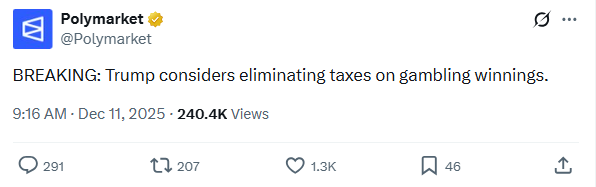
C'mon now ...
This is going to throw lefties for a loop.

maybe instead of fixing the bill for losses, he just removes all tax on winnings. degeneracy would go through the roof.

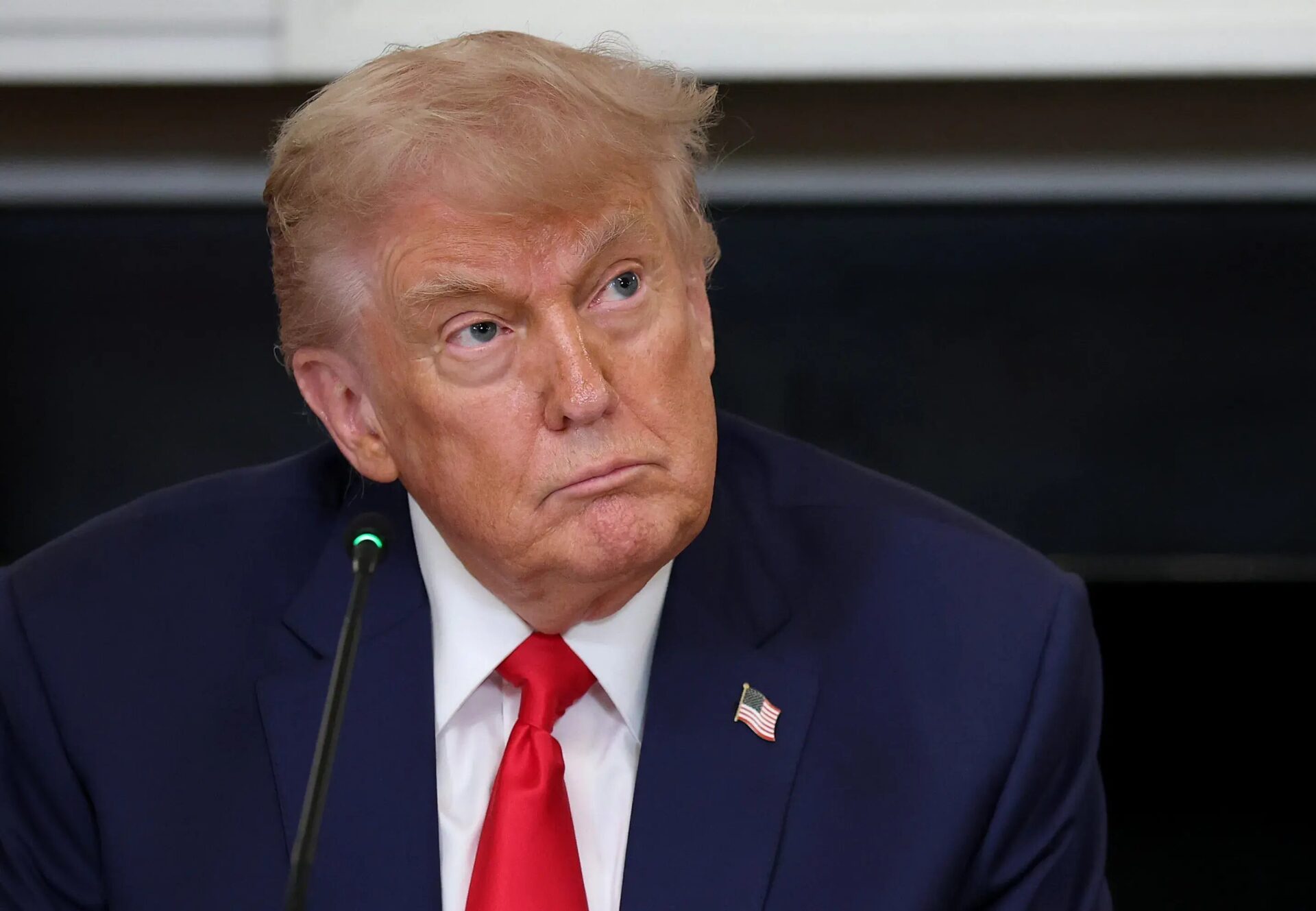
Owner of Circa
https://x.com/DerekJStevens/status/19992...
Meanwhile I think I saw on Polymarket or Kalshi it has a 4% chance to get repealed in 2025.


