[5-5]: Flopping the nuts, but how do we get paid?
LJ Hero 600€
SB Villain 700€
UTG+1 V2 250€
Villain in this hand is a middle-aged white guy whom I don't know well but seems
I guess since I already spoiled my action now I can as well just post
Continuation
Hero bets 25. Villain calls.
I got no reveal, so the hand is consistent with him calling three times wth Ace high, but it also doesn't rule out him having hit something strong.
Ace high???
How does he call with ace high? Why can't he have any pair?
If he calls the small turn bet and river barrel with ace high, is he really folding any pair to a large turn bet?
We left money on the table.
Specifically to this, yes. If V is going to raise all 8x 100% of the time, then I think your sizing is just fine in isolation (ignoring balance).
It's probably massively pool dependent, so your Euro 5/5 pool is likely quite different, but where I play it generally takes a stronger message than a same-pot more-chips bet to make a fish afraid they are losing out on value, especially from a "middling" hand like trips. My fish will just assume that Hero is going to b/b/b for a "reasonable" size and think they got "enough" value just calling three streets.
Reality might be in the middle, but choosing the large size to guarantee the value from 8x has a significant gain and I just don't think a player with "no bluffs" is ever that aggressive. Anyone who always raises a spot like that is going to figure out that people fold too much and the idea of bluffing will occur to them.
As played, he probably just didn't have a hand and we weren't getting paid anyway. Happens. But personally I could see even something like 98 or 86 playing this way, afraid that aggression is just getting called by better 8x.


Short answers:
1) Yes, don't rely on passive players to do the value betting for you. They will disappoint you repeatedly in increasingly baffling ways. Even if they raise your underbet, they often just 3x--it which is R33--and you show up on the river in an identical spot as if you'd just B75 OTT except in a place where it looks WAY less likely that you just have whiffed overs that are throwing a tantrum that the board whiffed you so bad.
2) No, 99-JJ aren't insignificant parts of their range. It's almost as many combos as 8x and draws, depending on how many offsuit 8x hands they play pre.
Bigger picture answer (which I'll caveat later):
I think at the most fundamental level when analyzing your play you should make sure your strategy as a whole is maximally exploiting their strategy as a whole. Given that:
1) They're showing up OTT with too wide of a range. You want to skew toward maximal aggression against someone with this leak because they're (as a whole) both overfolding AND calling too light. In this scenario, the wider the range and the larger the bet size they're making this mistake against, the more you print (if they're overcalling larger sizes, you get more value; if they manage to overfold even to large sizes, then you get enormous equity denial, which is the case, eg, if they fold NFDs to overbets here.) (The same goes for betting increasingly marginal hands because they deny more equity than they should.)
I can show you some tools offline if you'd like that calculates the EV of both your bluffs and value for different bet sizes facing different range widths and calling frequencies. TL;DR, they both go up for larger sizes at wider range widths.
2) They're passive. The more passive someone is, the more face up you should play your hand. Bet big for big value value, bet small with razor thin value, bet small with air, bet big with big draws, check SDV, etc. Deception matters much more for aggressive players who will do the betting and raising for you and who will attack any perceived imbalances in your play.
3) And of course everyone's #1 leak (including regs) is inelasticity, so the bigger you make your bets with the nuts, the more likely they are to exploit themselves by not adjusting their fold frequency. The smaller you make your bets with clear value, the more likely you are to exploit yourself because you're adjusting the frequency that they should fold to the amount they're actually folding, whereas exploitation happens in the other direction.
Given all this, and that you have the effective nuts and unblock the coolers and it only takes a slight overbet OTT to set up a pot-sized jam on the river, you cannot possibly go wrong with getting stacks in yourself.
Caveated answer:
"You cannot possibly go wrong" isn't the same as it being optimal. Exceptions exist obviously, and the appeal of villain raising the hands we cooler and/or chasing a dead draw aren't lost on me. But my caveats to the caveat are:
1) I think most of the alternatives are just *other* ways of exploiting villain's tendencies by forcing them to face big aggression. If you bet $60 on the turn so that you can jam $500 in their face when a diamond hits, then sure, I can't really argue with that. If you underbet to induce a raise then, a) even if they raise you'll probably still have to do most the heavy lifting yourself (see above), and b) if they don't take the bait the first time with every draw to a 5-card hand in poker threatening their hand, you have to say "Fuck it, I'll just have to do it myself then" and bet some very large amount OTR (though jamming may be too ambitious at that point).
For this reason, I think it's extremely unlikely giving them a good price at every opportunity in the hand is a good idea unless you cripple the deck. Betting smaller just so more hands will call isn't generally the correct exploit*; you're just pandering to the weakness of their range/strat.
*Unless you are ahead of <80% of their range, in which case you're exploiting by vbetting thinner than you should be able to get away with.
2) IME people who find excuses not to overbet or range merge or bet air or other forms of abusive aggression in one spot tend to find a lot of excuses in a lot of places and never end up overbetting/range merging/betting air and so (objectively speaking) simply aren't aggressive. There's a sort of aggression's paradox that can be like trying to find an entry-level job during a recession: You can't get a job until you get experience and you can't get experience until you get a job.
You don't want your first big show of aggression to be when you're nutted because your image is too clean, you don't want it to be when you have air because they haven't yet showed they have a fold button, you don't want it to be when you're merged because you're just value owning yourself because your image is too clean to get called light. So you just wait for a better spot and wait for a better spot until you look at your watch and see it's 2026, no limit solvers have been on the market for over a decade and you still haven't implemented any of the lessons into your game against the players who are bleeding the most EV to them. (Not talking about OP specifically, or any one person, really, just talking about the dangers of this approach in general.) In order for your second or third overbet/triple barrel/4b/etc to go in at a time when the gameflow is favorable to you, there needs to be a first and second time you stuck it in without being totally sure exactly how villain will react just knowing that it's favorable for you either way.
Case and point: The fact that people are talking about him folding draws and overpairs suggest that people actually think villain is OVERfolding versus B150 (before even accounting for their range being too wide to begin with). So are y'all ripping it with air here against someone whose read is "wide calling ranges" on a card that improved one of their most likely made hands?
Prolly not. Villain has Schrödinger's range. It rolls over and dies anytime we have value, but it also claws us to death anytime we so much as go for tummy rubs with air.
This is something that's hard with 25-hand-per-hour poker because I don't think you should conclude you're playing poorly when you take one underbetting value line in the one hand you had the nuts against a passive player in your last 200 hands. It might have been a perfectly fine exception. It's easier when you can look back at your last 5k hands, or whatever, and be like "Man, I should be owning x player type with y strategy but I'm hardly ever doing it."
Okay there's a lot here.
And actually there's something I feel compelled to bring up, which is that you've given me the general "betting bigger with value is probably better" advice before (not exactly like here, but similar enough), and I haven't really implemented it. (I have implemented other things you've told me though!) I think I was too shy/conflict averse to ever bring it up, so I just kinda forgot about it. But yea the main thing I disagree with that stopped me from implementing it is this:
3) And of course everyone's #1 leak (including regs) is inelasticity, so the bigger you make your bets with the nuts, the more likely they are to exploit themselves by not adjusting their fold frequency. The smaller you make your bets with clear value, the more likely you are to exploit yourself because you're adjusting the frequency that they should fold to the amount they're
This doesn't seem true to me. I would agree that people are inelastic with draws specifically (though idk if you need the concept of elaisticity there, you can also just say that people pay too much with draws). But it doesn't seem true for made hands. In fact it seems to me like a lot of people have a pretty fixed way they play their marginal hands, which is to always call small and medium bets and usually fold to huge bets. And this playstyle is too elastic, rather than too inelastic. It means almost never folding to B50 but usually folding to B125, which amounts to a much bigger difference than between 33% and 56%.
I specifically remember betting 70% pot on the Turn a few times because of the statistically overfolded thing, but it hasn't worked well, and I remember thinking something along the lines of "what am I doing, if I just bet bigger there he'd have folded". So I stopped doing it and mostly returned to the "bet huge if you bluff, bet normal if you want value" algorithm that I'd been running before.
I have no data for this, which is I think why I felt shy about saying it, but I guess I'm just claiming that either the statistics don't apply to me because of my image, or it's just different live than online. Or both? It's probably both. It's so hard for me to ever get an overbet called -- and I have tried! I can only remember one hand in the past... two months I think? ... where I got a value overbet through, and it was (... digs up transcript ...) on A♦K♥8♥9♠9♦ where every Ace chops. And even there I just went slightly over Pot rather than jamming all-in because I was afraid he might still find a fold if I do that (I had a full house).
But (bringing me to this part)...
2) IME people who find excuses not to overbet or range merge or bet air or other forms of abusive aggression in one spot tend to find a lot of excuses in a lot of places and never end up overbetting/range merging/betting air and so (objectively speaking) simply aren't aggressive. There's a sort of aggression's paradox that can be like trying to find an entry-level job during a
Idk about other people, but as for me -- well, I don't merge ranges against most of the field. But I do the other two things (overbetting and betting air) pretty often. The overbet is just usually a bluff. So about this:
So are y'all ripping it with air here against someone whose read is "wide calling ranges" on a card that improved one of their most likely made hands? [Probably not.]
Actually, yeah. If I had Q♠J♠ on 3♦7♦8♥ I would probably bet 20 on the Flop, and if the Turn is an 8♠ and he checks, I could very much see myself betting 135. Maybe the chances that I would go for it are less than 50%, but not much less. I wouldn't quite go B150, but I would probably overbet if I tried to bluff. I think I do something like this about once per session, and I often feel like I should be doing it more often, maybe 3 times per session.
Other stuff:
Even if they raise your underbet, they often just 3x--it which is R33--and you show up on the river in an identical spot as if you'd just B75 OTT except in a place where it looks WAY less likely that you just have whiffed overs that are throwing a tantrum that the board whiffed you so bad.
Yes, I completely agree with that, it's pretty rare to see someone raise in relation to the Pot size rather than the bet size. Actually I know I'm mostly pushing back in this reply, but I still have huge uncertainty around the best play in spots like this, wouldn't shock me if the large bet is still better for mostly this reason.
Separate from this hand (since most of your comment was more general anyway).
The more passive someone is, the more face up you should play your hand. Bet big for big value value, bet small with razor thin value, bet small with air, bet big with big draws, check SDV, etc. Deception matters much more for aggressive players who will do the betting and raising for you and who will attack any perceived imbalances in your play.
I can show you some tools offline if you'd like that calculates the EV of both your bluffs and value for different bet sizes facing different range widths and calling frequencies. TL;DR, they both go up for larger sizes at wider range widths.
I'd say among these, I'm at "already do that" for checking SDV, betting small with air [on boards where people will fold regardless of bet size], and betting big with big draws, and at "starting to do that recently" for betting small with thin value and using larger RFI sizes preflop. Which yea I guess that just leaves the betting big with big value hands thing.
This has no bearing on anything but I counted hands for 2 weeks once and it averaged 37 hands per hour (but I constantly hear people cite the 25 number even in my casino, idk where everyone got it from but it clearly stuck). At my casino, I think 25 is about how many you play in tournaments, but cash is much faster.
(As always, thanks for the reply and for being patient with me ♦)
I can tell this conversation is gonna be a response onion because there's so much to say on all of the only-semi-related things I brought up in my post lol.
This doesn't seem true to me. I would agree that people are inelastic with draws specifically (though idk if you need the concept of elaisticity there, you can also just say that people pay too much with draws). But it doesn't seem true for made hands. In fact it seems to me like a lot of people have a pretty fixed way they play their marginal hands, which is to always call sma
So I agree with a lot of this with the important caveat that we're talking about a relatively narrow band of bet sizes over the course of one street.
In our conversation about B75 being overfolded I actually clarified that was someone else's suggestion and my own research suggests B75 is the *least* overfolded size lol. It makes sense to me that B50 would have very similar fold frequency as B75 (and so the former is more overfolded) because they're both "normal" bet sizes, whereas you get undue credit for "overbetting" if you just go like B120 even though the alpha isn't as different as the discrepancy in fold frequency might be.
Where you'll see the real inelasticities is comparing like B10 to B40 or B120 to B300+ where the differences in alpha can be FAR bigger than the amount people are meaningfully changing their fold range.
While I'm personally a little bearish on making small changes in bet sizes on early streets, I think you could build a solid framework where you underbet, overbet or normal bet most your hands but go with (eg) a "big" normal bet for value (say: B80) and "small" normal bet as a bluff (say: B50). (At least against passive fish whose only route for exploiting you is calling more, and we've established they won't adjust properly.)
(A lot of what I'm saying probably needs to be translated in live terms where not everyone's counting the pot, so it's more like 1.5-3x you previous street's bet size is "normal" and below that is "small" and above that is "big", or maybe it's even more absolute terms and it's just bigger or smaller than $100, etc).
That probably calls into question suggesting B150, since that's a "small" overbet all things considered. To that I'd say:
1) B150 is already 3 times bigger than B50 and 6 times bigger than what you went with, so it is still more meaningful than (eg) the difference between B120 and B80.
2) For early (or I guess in this case, middle) street bet sizing, geometric sizes have an outsized impact. Even comparing to (eg) B100, going B150 OTT -> B100 OTR gets an additional 1.5 times the turn pot compared to B100->B100. And if people are inelastic facing a bet size in a vacuum, they are DEFINITELY too inelastic adjusting future street calling ranges to previous street bet sizes. (Like, this is literally one of my own leaks that I need to constantly remind myself because if you don't find it challenging to always make space in your flow to remember and account for all of the sizes on all of the streets properly adapt your range width, then you are better at poker than me.) If we were even deeper, the differences that overbetting unlocked would be even more stark.
For this reason, I don't personally go bigger than B150 until the river because (eg) B150->B300 is enough to get 12 times the turn pot in the middle, and beyond that I feel like I'm narrowing their range down so much I'd like to think they would throw a raise in themselves at some point.
In any case, I think it's literally impossible for humans to tell the difference between opponents folding 60% vs B125 (overfold) as opposed to 50% vs B125 (overcall), or folding 30% vs B50 (overcall) as opposed to 35% vs B50 (overfold) without tools, including at the very least pen and paper. (Making further concerns about sample size and causality wholly redundant AFAICT.)
What I think is more likely to happen is you receive more negative reinforcement when you bet big (ie: they fold more) or (maybe [IDK, I'm not a neurologist or psychometrician or whatever]) humans are able to intuit whether something "works" a bare majority/minority of the time, neither of which will lead you to infer the right lessons from experience.
I'm obviously making no suggestions about YOUR personal intelligence or thought process, talking about human nature. I hate sizing up as an adjustment against someone I know is ALREADY overfolding to smaller sizes that guarantees the bad thing will happen most the time, shit is genuinely frustrating for me lol.
Idk about other people, but as for me -- well, I don't merge ranges against most of the field. But I do the other two things (overbetting and betting air) pretty often. The overbet is just usually a bluff. So about this:
So obviously this part of the post I wasn't specifically directed at you, but it does at least obliquely affect you if you're getting advice with internally inconsistent logic.
Also, maybe I shouldn't have said "people" at all because I'm kind of talking about decision flows and justifications as much as anything. I think the biggest impact on your game and winrate are going to happen at the macro level and reorder your decision flow and fundamentally change your default play so that it informs what you do even when you're on a part of the gametree you haven't studied (which, let's be real, is 90%+ of the tree for all of us 😃 ) or you're too lazy/tired/win-tilted to consider everything, etc.
I'm trying to get at the same thing I got at with my bluff defaultist vs bluff exceptionalist thing. What is important is that you are in general exploiting people whose weakness is having too wide of ranges is to force them to face a maximal amount of aggression. Even when correctly identifying exceptions to that principle, I personally find it helpful to outright clock it as such ("I'm ONLY doing it with this part of my range 'cause...", "I'm only doing it for this ONE street, but then...", "that's the ONE card I'm not...", etc).
In any case, to address the question of whether you should overbet bluff this spot, I personally think smaller bet sizes are better for paired and dry ace-high boards. A paired board makes it harder for them to have a made hand at all (making it very challenging to any size), but it's easier for them to have a hand they're loathe to fold to any size (ie: trips), and it's also more likely they get suspicious with 2nd pair- (they'd be right to be skeptical that most players would overbet an overpair here [because most people would be worried about value owning themselves] or even a boat [for the reason others have justified not betting big with in this HH]). For that reason, I think the more you narrow the range, the closer their strategy converges to the correct one.
In our conversation about B75 being overfolded I actually clarified that was someone else's suggestion and my own research suggests B75 is the *least* overfolded size lol.
WHAT REALLY? Oh no! So sorry for misquoting you 🤐. This wasn't something you've ever explicitly advised or anything, it's just something I happened to remember, but apparently I remembered it wrong. Well, dang.
... but also, that makes so much more sense to me. The B70 thing has been bugging me ever since because it feels like a bad bluffing size, and in fact it's a size I use for value a lot. It being the least overfolded makes so much more sense.
So I agree with a lot of this with the important caveat that we're talking about a relatively narrow band of bet sizes over the course of one street. [...] Where you'll see the real inelasticities is comparing like B10 to B40 or B120 to B300+ where the differences in alpha can be FAR bigger than the amount people are meaningfully changing their fold range.
Okay. Great. So let me try to put this under a different framework. I mean "elastic" and "inelastic" are just abstractions to talk about the difference between two curves anyway. What's actually going on is that there's a "correct" fold % corresponding to MDF (bet size / (bet size + pot size)), and then there's the % that people actually fold, and most of the time the second one moves too slowly relative to the first one, but at some spots it moves too quickly. And then the question is which points are which. And also the second line is above the first one almost the entire time (almost every spot is overfolded) except maybe for really huge bets where it could plausibly dip below?
So it's something like this? Maybe, kind of? (where blue one is 1-MDF and red one is empirical, which in this case means drawn by hand by me right now)
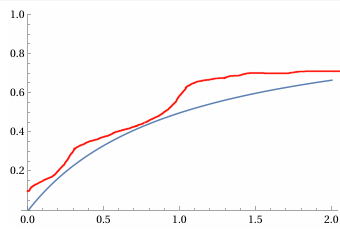
But either way, figuring out how this graph looks would be the more granular way to talk about the topic.
In any case, to address the question of whether you should overbet bluff this spot, I personally think smaller bet sizes are better for paired and dry ace-high boards. A paired board makes it harder for them to have a made hand at all (making it very challenging to any size), but it's easier for them to have a hand they're loathe to fold to any size (ie: trips), and it's also m
Hm. I mean I definitely agree on dry A-high boards, I'm never overbet-bluffing those. The reason I like it for paired boards is that I think a board being paired (especially one of the relevant cards being paired) makes it so (a) people are less likely to have hit it, and (b) people are less likely to believe you have hit it, and (c) people are less enthused about chasing straights and flushes. So if you bet small on 3♦7♦8♥ 8♠, I feel like someone with 6♦6♥ is gonna go "well the 8 paired so this makes it less likely I'm beat, let's call". And someone with 6♦5♥ is gonna go whatsmallbetwellIhaveadrawsoIcallokayRiverplease. Whereas if you overbet, they'll just fold everything other than trips. They're never folding trips, but they don't have to; they don't have trips well over 55% of the time.
I can see the small size to fold out air, so it's probably profitable as well. I mean again if we bring it back to the graph, there can be more than one spot where there's a big delta between both curves, but yea I think the overbet on paired boards has a lot of merit? Of course not based on data as always.
In our conversation about B75 being overfolded I actually clarified that was someone else's suggestion and my own research suggests B75 is the *least* overfolded size lol.
WHAT REALLY? Oh no! So sorry for misquoting you 🤐. This wasn't something you've ever explicitly advised or anything, it's just something I happened to remember, but apparently I remembered it wrong. Well, dang.
Haha, it's all good. You didn't misquote me at all. It's something I've said and it's a strategy I've used; it's just that when I went to verify it myself, it wasn't true for my field.
Okay. Great. So let me try to put this under a different framework. I mean "elastic" and "inelastic" are just abstractions to talk about the difference between two curves anyway. What's actually going on is that there's a "correct" fold % corresponding to MDF (bet size / (bet size + pot size)), and then there's the % that people actually fold, and most of the time the second on
This is precisely how I would look at it, at least in theory.
In the real world, you'll never truly know where the redline is, and your own actions can influence and all that, but yes, that's my basic perspective.
Double checking the hands they'd need to call an OB with here (before even accounting that they're arriving at this node wider than they should be), I agree it's clear you'll be printing regardless.
But other considerations will be how much fold equity and actual equity dry overs will have on future streets when they call with the hands you're citing. Overbetting a paired board tends to be a one-and-done strategy where once you've isolated yourself against their favorite part of their range, you're probably just losing the hand. Maybe you post-oak on a blank to see if they ever fold a whiffed draw, but it's pretty grim.
It can be a matter of personal taste at a certain point. I'm somewhat allergic to checking back the river with Q-high, so any flow that forces me to do that is probably gonna disfavored regardless of EV (though I do think there's a good EV-based case here).
But other considerations will be how much fold equity and actual equity dry overs will have on future streets when they call with the hands you're citing. Overbetting a paired board tends to be a one-and-done strategy where once you've isolated yourself against their favorite part of their range, you're probably just losing the hand. Maybe you post-oak on a blank to see if they
Yes; if my overbet gets called on the Turn, I'm giving up basically every time.
I like the way you played it until the river.
I used to think I was an over-thinker until I met you guys.
I understand difficulty in getting big bets called and you did get called, but I would have bet more. You can bet 75 and it’s not even a half pot bet, and maybe looks a little bluffy with the rest of your line.
I like giving villain a decision!!!!!
There was no decision, everyone is going to throw in a quarter here.
I struggle with this exact thing and usually get pissed at myself when villain folds - wishing I went smaller. But you can talk until you’re blue in the face and never predict hero calls.
Still, after going small the entire way and getting called, I like pushing a little for one street.

