[5-5]: Pocket Pair Against Passive Whale
BB Villain 800€
BN Hero 900€
Villain is a maybe 40yo guy I've seen for the first time today, but have played with for maybe two hours already. In the second half he played probably over 80% of hands, usually limp-calling, sometimes raising 15 or 20. (I don't think he's limp-folded a single hand, so his range is very wide.) He also calls pretty wide on the Flop, though not excessively so, and on later streets he's folded a lot. I guess he was passive-ish, but he has bluffed a few times when other people seemed weak.
I've played a few hands with him, this was the biggest and most recent one, maybe one orbit ago:
Spoiler
Villain limps in LJ, one more limper, Hero raises 35 with K♥T♣ from the BB, only Villain calls. Flop comes J♦J♥A♣. Hero bets 20 and Villain calls. Turn comes Q♥. Hero checks, Villain bets 50, Hero calls. Hero checks in the dark. River comes 7♣. Villain bets 100, Hero raises 250, Villain calls, shows J♣T♠.
Hero is dealt 2♠2♣. HJ limps. Hero raises 20. Villain (BB) calls. HJ folds.
Flop (50€): T♠T♣6♥
Villain checks. Hero checks.
I think cbetting the Flop is probably the default play (for I guess thin value or equity protection), but, idk, seems marginal and I decided to check this time.
Turn (50€): 7♥
Villain bets 20. Hero ???
13 Replies
I think this spot can really go either way - raise or fold. Raising to say 60 should be enough to fold out any bluffs without the FD, and if he does have a FD he probably calls and checks river if he misses and some rare times we're good. But we have 22, V has a minimum of 12 outs if he isn't paired already, so I don't think folding is ever wrong.
I think calling is a pretty big mistake.
Villain appears to be a player that stabs if you show weakness, so I don’t think the turn bet has a lot of meaning.
While he might be looking for value with a ten, I think it’s more likely he picked up a flush draw or maybe paired the seven.
I don’t like checking behind the flop. Honestly, I almost didn’t respond, because I fold ducks most of the time. But I could have done this - raising in position. However, once I jump in (been accused of mis-using aggression at times) I’m fighting for the pot.
In fact, I would pot the flop and try to take the dead money down. Villains pov I might have a ten. Point is, I don’t want to get deep into this hand, maybe playing for stacks with a pair of twos. Playing fast and finding out.
When you get in there with ducks, it’s a bluff. If you’re not willing to use maximum pressure and fold equity, you should probably fold them like I do most of the time.
When you get in there with ducks, it’s a bluff. If you’re not willing to use maximum pressure and fold equity, you should probably fold them like I do most of the time.
Just for clarification, we're just slightly behind on this Flop (I have Villain defend top 90% of hands, uncapped because I've seen him not 3bet premiums before).

Similar on the Turn (modulo updating his range based on the bet, of course)

To elaborate, I mean there's three reasons to bet in poker. Bluffing, meaning getting stronger hands to fold, value betting, meaning getting weaker hands to call, and equity denial, meaning getting hands to fold that are weaker right now but could become stronger on future streets.
Since we have 22, the only hands stronger than us are pairs, and TT6r looks to me like one of the worst possible flops to get a pair to fold. So I don't think betting as a bluff is applicable. If we bet the Flop, the reasons would have to be value and/or equity denial.
I’m hearing you prim, but I think it’s hard to get to the river and win with 22.
So, call it equity denial, but the point is with early aggression you can win with 22.
I think raising the turn is going to generate more folds than betting flop. Hands like 88, KJ, Ax are probably floating the flop frequently, and are we just going to barrel turn when called?
It's very natural to check back Tx on this flop and then look to raise when the FD comes in. Raising turn is probably only be called by pair+ and FD and V should be discouraged from any bluffs on the river because we do have strong inelastic hands in this line. So river checks a ton unless V has a monster.
We will face a tricky decision on whether to bluff river, but if V 3!s or leads river it's an easy fold.
(I think raising the Turn has merit, but didn't do it in the hand.)
Continuation:
Hero calls.
River (90€): 7♠
Villain bets 30, Hero ???
Well, Continuation
Hero tries to bet 140, Villain folds before the chips go in
To elaborate, I mean there's three reasons to bet in poker. Bluffing, meaning getting stronger hands to fold, value betting, meaning getting weaker hands to call, and equity denial, meaning getting hands to fold that are weaker right now but could become stronger on future streets.Since we have 22, the only hands stronger than us are pairs, and TT6r looks to me like one of the
idk i not sure that necessarily applies otf. also folding even something like 54o on this board is a large win with your hand.
i think you're probably isoing too wide in both hands tbh
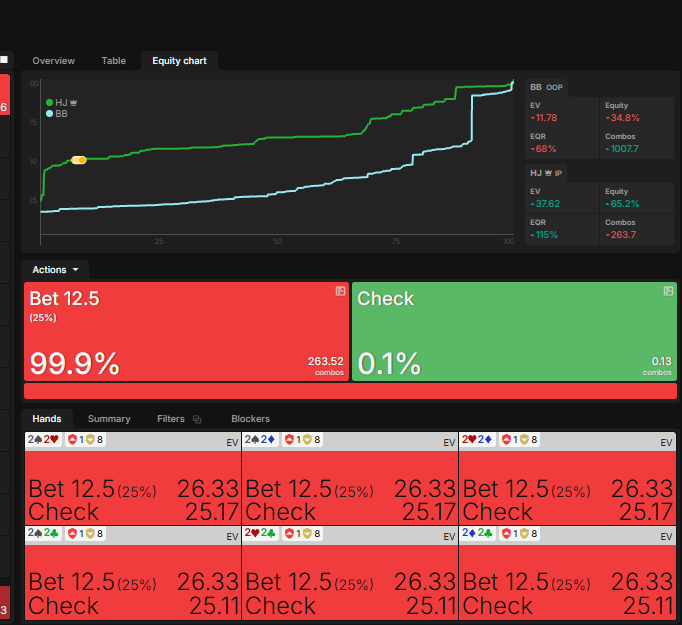
fyi hj vs bb and i have bb defending ~85% without the top 6% or whatever
i dont really see a compelling reason to deviate from that with 22 in particular. something like AK or KQ where u can cooler him if u check back and he hits or even just something like AA that needs less protection and does a better job bluff catching would be different imo
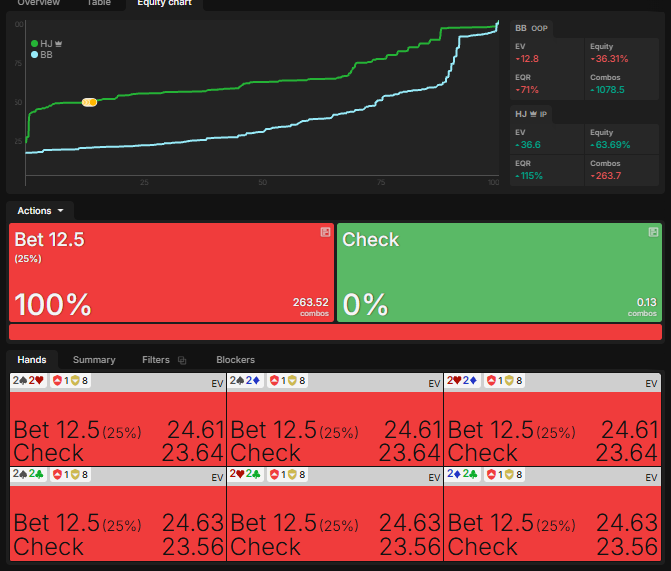
vs top 92% since u said he doesnt 3b premiums. is same thing he just too wide to be able to deal with small cbet effectively and you have a hand that really benefits from him folding anything
yea fair enough, I should have cbet the flop.
Thought about it more, and actually this is pretty cool because the hand inadvertently demonstrates the value of equity protection. Like, all pairs benefit from equity protection a little because all the hands that currently behind have 3 outs per overcard (so either 0 or 3 or 6). But of all the pairs, 22 benefits the most because the largest number of hands-that-are-currently-behind have all 6 outs (all except the X2 hands). Specifically if I make a board of 3 random disconnected cards, like K♠8♣3♦, then any random hand that completely misses the board (like J♥4♠) still has around 26% equity against 2♣2♠ (and the hands with backdoor straight+flush equity go up to 34%). And then if I also make the board paired instead, like the one we have here, it jumps to at least 37% because all hands gain additional outs to counterfeit my pair (which is in fact what happened).
So yeah this board + my hand happens to be just about perfectly optimized to maximize the value of equity protection. Like it's gonna be super rare that a hand is ahead of most of the opponent's range, but doesn't beat anything by more than 63% (other than exactly the X2 hands), as is the case here. Which is something I should definitely recognize in the future.
You all know better than me and though I’ve missed out on some big scores, I think I’ve saved money folding deuces most of the time.
However, from the button, I likely do exactly what you did pre-flop. Maybe this is wrong, but my next move would be to pot the flop and take it down now or be done with it.
I can’t fault what you did, mostly keeping the pot small before running him off on the river.
Also my take when villain checks flop and comes out small on the turn:
Yes it looks like the way a fish would play a ten here, but no, it won’t be most of the time.
A reminder perhaps to always bet the flop if you have a ten, don’t wait.
Most of the time what happens:
You didn’t bet, so I’ll take a stab at it.
I got a little bit and maybe you’ll fold.
You didn’t fold, so I’m done.


