TPTK in 3bp facing likely river give-up
I have looked at a solve of this, but mostly curious inclinations around exploitative adjustments and what to do in this
The thing I don't like about the 10% pot bet here is that it's 1/2. V is likely checking with SDV to check-call, not check-fold, nor check-raise. He'll be happy if we just check it back. He's most likely just going to flat call a 10% PSB. He's unlikely to spaz-raise just because we bet small.
Whereas more experienced players may be more familiar with the line, and may be capable of finding a check-raise bluff on the river, low stakes recs just aren't going to turn SDV into a bluff on the river at a high enough frequency to make 10% pot better than just betting large.
The low stakes player pool isn't taking this line with AA/KK and then checking river to trap on a total brick. They're mostly going to just barrel off and jam. When they 3B pre, c-bet the flop, and check the river, it's just going to be some SDV that can't beat TPTK but can beat a lot of hands we'd check back.
I don't think it matters that we have AQ of clubs, blocking some of his AXcc combos. Low stakes players aren't finding enough c-bets with enough BDFD AXcc combos for us to worry about our suits.
He's not trapping with AA/KK hoping we'll bluff with missed backdoor clubs. We're not going to bluff enough on the river after he bets 80% pot on the turn.
His line is indicative of TT, JJ, and KQs, and not much else. The most obvious draw on the flop is JT, which bricks. He might fold to a 70% pot jam, but he's not folding to a 1/2 pot bet in this line.
His line is indicative of TT, JJ, and KQs, and not much else. The most obvious draw on the flop is JT, which bricks. He might fold to a 70% pot jam, but he's not folding to a 1/2 pot bet in this line.
I think that's the meat of his range. I do think sometimes V has KK/AQ that got nervous - if we're behind, I'd bet that's the hand we lose to. Also add bluffs like AK/AJ/maybe JT?
Is V calling $100-$150 with JJ/TT? If so it's a slam dunk bet. If not then we're only getting value from KQ.
$25 is called by almost anything, maybe as weak as AJ and the off chance to induce a spaz.
I don't know if it's better, but we can bet call because as you point out, V probably doesn't have anything better that would jam.
If V might call larger, then larger is better, but we checked in the apparent belief V wouldn't call a normal size. Betting something and giving ourselves a chance is better than checking if Vs range is as weak as we all apparently agree on.
I think that's the meat of his range. I do think sometimes V has KK/AQ that got nervous - if we're behind, I'd bet that's the hand we lose to. Also add bluffs like AK/AJ/maybe JTIs V calling $100-$150 with JJ/TT If so it's a slam dunk bet. If not then we're only getting value from KQ.$25 is called by almost anything, maybe as weak as AJ and the off chance to induce a spaz. I do
This is nuanced, and of course there are always players who are the exception, but when low stakes players take this line, it's usually some sort of SDV. It's not usually ace-high. Sometimes it's just a busted draw, but I wouldn't expect that here.
The reason it isn't usually ace-high is that when they 3B pre, they feel self-imposed pressure to rep big PP's by running it. It certainly seems credible when they 3B pre and go bet-bet-jam. They end up being balanced by accident, taking the same line with AA/KK and AK.
When they have AK, they may understand the value of having blockers to the big pairs that might snap them off, even though we might have 4B AA/KK pre, and so we probably don't have AA/KK too often anyway. To a lesser extent, they may apply the same logic to AJ - they block AA and JJ, so if we don't have QX, then the best hand we're likely to have is TT, which won't like it if they jam. Maybe they mentally go down the rabbit hole of how they block our AQ and QJ combos.
The reason it isn't JT here is that they don't often 3B JT from the SB pre. If they do, they'll often jam turn with JTcc that picks up the BDFD. Otherwise, they size down with their turn bet to save some ammo for the river. They don't want to over-commit with just a draw and only leave themselves 2/3 pot behind. They want the option of blasting the river if they brick.
The bet sizes here are also a clue. He's using somewhat chunky sizing on flop and turn. He has a hand he likes, but apparently doesn't love after we call two decent sized bets. So he shuts it down to play his hand like a bluff catcher and avoid value-owning himself on the river.
Just because we called twice doesn't mean he's ready to fold if we bet. He's turning his hand into a bluff catcher. He wants us to check it back, so he's not going to turn his hand into a bluff by check raising if we bet small. He's just going to call. Maybe he won't call a 70% pot jam, but he'll struggle to fold if we bet $150-$175.
I don't think your node locks are reasonable assumptions. Even after seeing the showdown of JJ I doubt he is betting JJ and TT every time. More likely it's just a random spaz bet where he didn't think it through this time.I think there's more downside to betting tiny and calling a raise than you're acknowledging. This is a 3-bet pot and live players tend to have very strong 3-b
instead of arguing with me and trying to be right, just read my posts. if you want to look at the node locks as a spectrum that might be easier. to me there is very little downside to betting small and calling a raise here as at most i lose .65 of a psb with a hand that can shove for value at equilibrium and is indifferent leaning towards call when facing a jam. i think this is a reasonable place to bet small which was confirmed by solver before reads even enter the picture. this isn't really a spot people check overpairs oop and the op who is the only one who has played with villain told you he isn't doing that. instead we get direct evidence of what hes doing wrong (putting in too much money early with weak hands / wrong sizing / depolar), which op says people in his pool do, and you are saying no he isn't doing that. you can keep tripling down or whatever but its exhausting dealing with you every time.
i gave multiple examples of hands of nosebleed pros doing this via youtube (which im sure none of you looked at) and i showed u a solve supporting what im saying, and then subsequent solves of what would lead us to be more inclined to do this / change the strategy. if you're unwilling to look at any of that, or read any of what im saying with an open mind i dont really know what to tell you.

I think you guys are being results oriented. I don't see how we include JJ and TT as the bulk of their range here, after they barreled relatively big on the flop and turn. Even recreational players know to slow down betting when overcards to their pocket pair come on the flop. I acknowledge he did have JJ here, but I would think the combined flop and turn lines should make that relatively unlikely. Ask yourselves honestly: if you hadn't seen the reveal would you really be expecting to see JJ and TT here?
Your node locks are cherry picked to support you POV. If you have any links to high stakes crushers betting 10% pot in position on the river please post a link as I would love to take a look.
You posted this hand:
cannot try to find it now but theres youtube clip of phil galfond vs odd oddsen i think playing nl live where phil 3bs him ip with AK. and the board is like idk 643r it goes xx turn is a brick 7 and phil b/c AK because the idea is why would oop ever check a value hand twice and the x/r is ultra polar. thats a more extreme example and its pre river so equities are weird and they
This hand is completely different because the action occurred on the turn. Yeah betting small on the turn in position can be a very reasonable play at high stakes. The idea is to squeeze out a bit of value with the intention of checking back river. Occasionally you can also bet tiny with the nuts to protect your small bet range.
Once you're check raised you have a bluff catcher with AK and can call or fold as appropriate. I'm sure Galfond concluded his opponent was over bluffing and called. That's all very reasonable. I have not seen Galfond make that kind of tiny bet in position on the river though.
yes call if u b10 and he jams for what would have been 2/3 psb
the video is coinpoker featuring frank smith and lukabrate and the hand in question starts around 19 min in with jasamgale having a8 vs kevin paque (taxhere). if you care enough you'll be able to find it
fwiw ak will call 10% here ime
so like this one?
the sim where it mixes 10% isn't node locked, i just gave it the option of b10 and jam otr but otherwise is equilibrium with pre ranges but adjusted spr. when i start nodelocking it stops using the 10% size because oop is much more capped / dense w weaker made hands and AQ becomes worth more
i dont really want to keep going back and forth about nothing so is probably my last response towards u :(
you really are absolutely brutal, you don't even understand or read the sims and posts you're arguing against.
yes call if u b10 and he jams for what would have been 2/3 psbthe video is coinpoker featuring frank smith and lukabrate and the hand in question starts around 19 min in with jasamgale having a8 vs kevin paque (taxhere). if you care enough you'll be able to find itfwiw ak will call 10% here ime
so like this one?the sim where it mixes 10% isn't node locked, i just gave it the opt
I'm going to need a link or at least a street by street breakdown of the hand if you want me to respond to it. It's probably a waste of time anyway. I acknowledged in my very first post there are some very specific assumptions that, if true, could make a small river bet reasonable.
The disagreement I am having (with several of you) is more about assumptions.
Given that villain bet more than half pot on the flop and more than 2/3 pot on the turn (after 3 betting pre), I don't think it's a reasonable assumption to conclude that their range is JJ, TT, KQ, AQ or whatever and that they'll call b10 and not a bigger bet.
If that is what you all are thinking, I can acknowledge that given your assumptions your bet would likely be fine. We would just have to agree to disagree about the assumptions.
Also: You did see where the OP said he checked the hand in a solver and AQ was checking back at equilibrium? Rhetorical question you don't need to respond. So the burden is sort of on you to justify deviating. I just see us getting value owned occasionally when he chicken checks AA, KK and then feels confident enough to jam after we bet tiny. That is versus us squeezing out a tiny bit of value from AK, JJ, TT. The problem is when we're ahead we only get B10 and when we're behind we potentially lose our entire remaining stack.
I'm going to need a link or at least a street by street breakdown of the hand if you want me to respond to it. It's probably a waste of time anyway. I acknowledged in my very first post there are some very specific assumptions that, if true, could make a small river bet reasonable.The disagreement I am having (with several of you) is more about assumptions.Given that villain be
i dont really care if u respond to it. you demanded proof of a hand like that existing, i gave u instructions to where you could find the hand and a ~10 min breakdown of the hand and his approach that would take u 15 seconds to find. if you're unwilling to do that then thats ok too. i thought the video was eye opening because its not something i had ever done / thought about doing and it was the first thing i thought about in this thread.
i dont think villain has JJ when i see the hh, i think he is extremely weighted towards ace high type hands. what i was saying (and what the node locks support) is the more med str hands you think he has (also the less he checks his good hands otr), the more important it is for us to size up with AQ compared to b10. i have no idea what op looked at but i posted the river ss of the solve from gtowizardai.
if you are convinced he checks overpairs enough here (honestly at all) given spr and the run out then theres not really any way i can argue that. experience doesnt really dictate that for me, op says that isnt happening in his pool, and solver also doesn't do that. so its kind of hard for me to really buy into that theory on a brick 6.
again we just kind of seem to be going in a circle
Solver also doesn't play JJ this way.
Anyway it's pretty ridiculous for you to expect any of us to go on some search for a random video with X players at 19 minutes in. If you had something like the title of the video or better yet a link maybe we could find the spot in less than an hour.
Anyway I understand the general configuration of capped range vs capped range but with some small possibility of traps that you can occasionally make some tiny bets in position in very specific scenarios. I think it's generally a play better left to the high stakes crushers though as it's really easy to screw up and shoot yourself in the foot. If your screen name is llinuslove I will admit defeat. 😂
Also just as a demonstration of good will, I do agree with the other conclusion you reached through your solves. That the more medium strength hands he checks and the less traps and or better hands checking for no good reason the more we should want to go for a bigger bet on the river. I just would expect the big turn bet especially to be more polarizing in most cases.
I think you guys are being results oriented. I don't see how we include JJ and TT as the bulk of their range here, after they barreled relatively big on the flop and turn. Even recreational players know to slow down betting when overcards to their pocket pair come on the flop. I acknowledge he did have JJ here, but I would think the combined flop and turn lines should make that
Yes. I expected exactly JJ and TT, before the reveal...
Grunch:Everything seems fine overall. I might consider raising turn when we pick up the BDFD to go with our TPTK. Don't want him getting away on a club river.I'd think he'd barrel off with better than AQ, and he might sigh-call a half-pot bet with JJ or TT. So I might bet $150-$175. I might also just jam, if we have the right table image.Solvers and good players check river in
He c-bet 1/2 pot as the PFR because low stakes recs think they're always supposed to c-bet the flop. And there are hands he can target for value - 9x, 88, 77, AK, JT, etc.
He sized up and bet 80% pot on the turn because a lot of our range is going to be made up of worse hands he can target for value. We could have 9x, a straight draw, a BDFD, etc. He has JJ, so he can also target TT.
He did know to slow down betting when there's an over-card to his PP on the board. He slowed down by checking the river, when all the potential draws in our range brick, and we might bluff if he checks, but we'll just fold all those hands if he bets again, and we'll just snap him off with QX.
If you think JJ / TT are unlikely, what is likely?
AA / KK? If we think he's supposed to slow down with JJ / TT, we shouldn't expect him to slow down with AA / KK.
QQ? Would he risk us checking back with JJ / TT, 9x, or a busted draw if he had QQ? Ditto for 99, if he even 3B's 99 pre.
AK? If he was going to slow down, he might just check the flop or turn. Maybe he's giving up on the river, and we can get a crying call by betting 10% pot, but what's the likelihood that he's going to 3B pre, c-bet 1/2 pot on the flop, bet 80% on the turn, only leaving himself 2/3 pot for the river, and he's now going to give up?
KQs? Is he checking to check-fold?
He can have all 12 combos of JJ / TT. He can have 9 combos of AA / KK. 1 combo of QQ. 2 combos of KQs. 12 combos of AK.
So there are 14 combos of JJ / TT / KQs we can target for value by betting 1/2 pot or jamming. And I think he plays all of them this way, all the time.
There are 10 combos of AA / KK / QQ that he probably doesn't have. There are 12 combos of AK that we can target with a 10% pot bet, but I'm not sure he takes this line with all of them, all the time.
I'd weight his range heavily towards JJ / TT/ KQs that is checking to bluff-catch. That's the portion of his range I'd be targeting for value by betting 1/2 pot to all in on the river.
I don't know. There seems to be a consensus here from a lot of you guys, so maybe you all are right. I may be somewhat out of touch with how these low stakes games are playing. I'm playing mostly MTTs and when I play cash it's typically 2/5 or 5/10.
It's just so drilled into my head that pocket pairs 1-2 cards below the top board card are the highest frequency checks. If you have any checking range at all they're some of the first hands you check with on flop and turn. I was assuming this heuristic had filtered down, even to lower stakes fish.
For the record, if you do put him on a range you can profitably value bet against, I much prefer your sizing of 1/2 pot or even jam. There's just more upside this way to reopen the action compared to a B10.
I don't know. There seems to be a consensus here from a lot of you guys, so maybe you all are right. I may be somewhat out of touch with how these low stakes games are playing. I'm playing mostly MTTs and when I play cash it's typically 2/5 or 5/10.It's just so drilled into my head that pocket pairs 1-2 cards below the top board card are the highest frequency checks. If you hav
Respectfully, you're making a common mistake, by projecting your play style onto opponents.
When I was playing MTT's frequently, I felt like it made me a better cash game player, because, like you, I learned to play less aggro, more conservatively, in order to protect my stack. Opponents in MTT's are more likely to check this flop and turn with JJ / TT.
Low stakes cash games just play differently. We can reload and top off whenever we want. There's less risk in opening larger and 3B'ing wider. There's no ICM pressure. The player pool tends to be more driven by fear and greed.
Likewise, as you move up in stakes, the player pool tends to get incrementally better, less impatient, more able to make big folds, more able to lay traps, more capable of finding less intuitive lines, etc.
I do agree with Submersible that AK will call a 10% pot bet here. I just don't think very many low stakes recs with AK are getting to the river this way.
They don't always 3B AK out of the blinds pre. They don't necessarily c-bet. They don't always barrel turn, but if they do, they tend to over-bet for max fold equity. They don't always take their foot off the gas by checking river. Sometimes, they just run it, because they don't think they have any showdown value, and are afraid of getting bluffed by JT.
IMO, checking this back or betting 10% pot is borderline criminal. I'd be slightly more likely to bet 1/2 pot only because I think V is going to be somewhat price sensitive, and a 1/2 pot bet looks more bluffy than an all-in bet. Low stakes players just tend to have it more when they jam here.
I'd be more likely to jam if I think V is emotional / tilted, or if I just have a FOS image (as I often do).
Reading a few more posts, more closely, it seems to me like there's a combination of risk-aversion and good-player projection happening here.
I said in my first post that a solver / good player checks back here because at equilibrium, V could be trapping, so we shouldn't bet thin for value or bluff. If we bet, we should have it, and so they're checking to check-fold.
But this is 1/2. The pool isn't checking river to trap with AA/KK, or QQ/99. Those hands bet 80% pot on the turn so they can jam brick rivers.
They're not checking to check-fold. JT bricked. BD clubs bricked. The only hand that "gets there" is T8cc. But we'd have to first raise pre, then call V's 3B, continue on the flop with just a gutter and a BDFD, and continue on the turn when V bets 80% pot.
Are we really doing all that with T8cc? Even if we are, it's one combo. Talk about MUBsy.
The only other hands AA/KK need to worry about are sets and 2P, and a lot of low stakes players are going to raise turn with those hands, when the BDFD appears. Hell, I said I might raise turn with AQcc, so he doesn't get away on a club river.
If we called flop and turn thinking our hand was good, V's check shouldn't be a reason to doubt it. Not going for thin value here, or betting 10% to induce a spaz raise that isn't coming is just killing our win rate.
Respectfully, you're making a common mistake, by projecting your play style onto opponents. When I was playing MTT's frequently, I felt like it made me a better cash game player, because, like you, I learned to play less aggro, more conservatively, in order to protect my stack. Opponents in MTT's are more likely to check this flop and turn with JJ / TT.Low stakes cash games jus
i mean it can't be borderline criminal, solver is indifferent between the options which ive rarely seen for tiny
ignoring all the slop in this thread, when you bet 10% they need to basically call ~range. a good thought exercise is if u get here with jt / kt would u ever b10 lol. when you b65 they need to defend uh ~60% of their range i think. believe the ev is similar here because they aren't capped (checking aq / few combos overall) but not entirely sure re that. the idea that random at 1/2 is a) going to predict you're doing this and adjust ranges or b) playing a default game designed around or accidentally punishing that is a bit much to me.
am sort of trying to deescalate the convo so ill leave it at that and ignore the 2/5 mtt comment
think its a good q of how thin we want to bet the river as a function of how capped we assume they are
i mean it can't be borderline criminal, solver is indifferent between the options which ive rarely seen for tinyignoring all the slop in this thread, when you bet 10% they need to basically call ~range. a good thought exercise is if u get here with jt / kt would u ever b10 lol. when you b65 they need to defend uh ~60% of their range i think. believe the ev is similar here becau
I think this is where you and I will inevitably be at odds. While I understand and appreciate that there is intrinsic value in understanding equilibrium strategy, I'll always view it as a baseline from which to deviate based on specific opponent reads or population tendencies.
The b10 line works in theory, because in theory our opponents have some better hands that check here from OOP, and some worse hands that just check-fold, and I would assume no hands that check-call when we bet 1/2 pot.
I don't know if the solver is ever taking this line with JJ and TT on the flop and turn. But I would guess if we node-lock to force it to play those hands this way, it's checking to check-fold.
But you've repeatedly expressed exasperation at how little solver use there is among forum members who post here. We're supposedly the "good" players. The vast majority of low-stakes recs aren't using solvers, have never looked at any solver outputs, and may not even be aware of them.
They're playing exploitably. I would expect you to argue that in live games we don't have enough observation data to deviate from GTO in order to exploit them, but I'd argue that we do. The player pool in the aggregate displays consistent leaks. It's not hard to identify specific opponent leaks if we're paying attention.
To whatever extent you're able to internalize and apply theory in-game, I'm sure you'll be able to find the theoretically correct play in most situations. I'm sure that as long as I'm playing exploitably, I'll often make plays that turn out to be incorrect, both in theory, and in terms of the results.
But I believe that we can increase our win rate by being better at exploiting our opponents. I don't need to be right every time. I just need to be right more often than I'm wrong.
I think this is where you and I will inevitably be at odds. While I understand and appreciate that there is intrinsic value in understanding equilibrium strategy, I'll always view it as a baseline from which to deviate based on specific opponent reads or population tendencies.The b10 line works in theory, because in theory our opponents have some better hands that check here fr
yeah idk man ive never said not to exploit. i think alot of the specifics in this paragraph are incorrect. the entire convo in this thread about something thats obviously exploitative lol
if you dont use a solver how can u deviate
Just to clear some things I think are being attributed to me as OP -
On the solve, I usually solve locally in GTO+ with manually constructed ranges and a somewhat restrictive tree, so my solves are probably not quite as high-quality as GTOW (but I'm a cheapskate in paying for solvers). No one in LLS really plays GTO ranges though, so I don't think hand-wavy starting ranges are necessarily terrible. I probably suffer more from not always providing quite as rich a tree as I think GTOW implicitly does.
This thread has been interesting enough I should play around more with my solve and I'll pull it up at some point, but from memory the actual equilibrium here has V taking a large turn size with a much more polar range (think KK+ and draws) and checking river with a very slightly protected range of mostly busted draws (it was fairly close to a pure x/f). I did not bother trying to force b10 into the tree for Hero on the river, and so with check or shove as the choices, the solver for Hero is shoving its own missed draws that called two streets (e.g. JTs) along with top of range (mostly sets) and weaker one pair hands and checking Qx.
In equilibrium, I expect b10 (if offered) fails as a strategy because solver Villain isn't getting to the river like this with many elastic combos. KTcc or whatever that got here as a turn bluff and give-up isn't calling any size. Simply getting to the river on this line with combos that don't have a strong preference for either stacking off (or triple-barreling as a bluff) or giving up is itself a mistake in equilibrium, and kind of why there exists the heuristic that "regs check to check-fold". The equilibrium river check is fairly close to an unprotected give-up and a substantial fraction of range is, in effect, just open-folding the river after failing to either have Hero fold turn or V spike the river.
The idea of b10 occurred to me because it's been suggested in as an exploitative play here and especially because V did show up with JJ. Hands like KQ/JJ/TT and even AK are too middling to "supposed" to be in range after the large turn bet, so it's pointless to target them unless V is playing non-optimally. I think it makes sense as a bet size to target that range in a typical value sense, and I do specifically think that you want the size that maybe AK or TT will shrug call.
There are many fish who "check to check-call" here and are more likely to have QJ-AA on this line, but my read was that V was not that kind of player. Perhaps also worth noting that I really doubt the player type to checks river with KK/AA here is super likely to raise a small river bet, as the whole point of their check was because they're afraid of losing. Their check is a prayer to see the cheapest possible showdown, even if they are likely to crying call our shove anyway. And also, yes I have seen players fail to value bet KK/AA here, but far far more often IME low-stakes fish wildly overplay KK/AA like it's the stone nuts unless there's a 3-flush, one-liner, or board pair. The number of times I'm watching others in a hand and have the suddenly aggressive fish on surely a set or at least two pair and then they turn over a cracked AA is just insane.
I agree with sub's earlier statement that Hero should be nearly 100% to either win or chop (AQ seems believable from V) and it's really a question of value extraction versus the chance that somehow the hand read is wrong or V is doing something totally crazy (which is always a higher % chance than I think humans can account for).
Also for reference the jasamgale hand is here and seems a little bit of a stretch to apply to LLS since the level of play is so much higher but it's definitely an interesting discussion of the place of this strategy in general and does feature a polarizing bet followed by a seeming give-up. I'll transcribe here with jasamgale as "Hero" although the cast shows it from Villain's perspective.
50/100 NLH 6-max (or 10k NL I guess, I don't play online)
Hero in BN with $20,350
Villain in BB with $10,000
Folds to Hero, who picks up (won't spoil the video if you want to watch)
Spoiler
As Qh
Hero bets $250, V calls. Heads-up to the flop:
Flop ($550): 8h 7c 4h
Check, check.
Turn ($550): 8h 7c 4h Ac
Villain bets $1,100. Hero calls.
River ($2,750): 8h 7c 4h Ac Qd
Villain checks. Hero bets $250. Villain raises to $8,650 all-in. Hero calls.
Villain shows
Spoiler
Ah 8c
Also for reference the jasamgale hand is here and seems a little bit of a stretch to apply to LLS since the level of play is so much higher but it's definitely an interesting discussion of the place of this strategy in general and does feature a polarizing bet followed by a seeming give-up. I'll transcribe here with jasamgale as "Hero" although the cast shows it from Villain's
Thanks for finding that hand.
It's a pretty interesting spot, but very different than the spot in this thread.
I think the IP player is thinking that when OOP checks it's mostly bricked draws that are checking to give up (after the polar turn sizing). I kind of like the tiny bet with AQ to try to induce a raise, given the right dynamic.
You can also make the tiny bets with your own air to try to fold out K high or something when you have T high, and potentially make some ultra thin value bets. I really like it better though with the parts of your range that are inducing or bluffing.
The problem with B10 IP on the river with thin value is just the risk of reopening the action and getting raised, which is why I don't like doing it with the hand in this thread.
Anyway back to the streamed hand...
I hate the check raise AI with A8. As the commentators were saying it's probably too thin that deep. I also agree with their idea that almost no one is bluff raising all in there. Check raising to a smaller size would probably be better as you can more credibly rep bluffs.
That being said I don't like the check raise at all after you 2x overbet the turn. You've just got to expect bare Ax to check back every time and you miss out on a ton of value.
I would have preferred betting something like 2/3 pot with the A8 on the river. You can get called a lot, even by hands worse than Ax because you can also be bluffing your air there. At that sizing you also leave him enough rope to potentially bluff raise all in.
In this case the AQ quite likely would have just called a 2/3 pot bet (since they're losing to all sets). The player with A8 likely would have lost less in this exact scenario by just betting 2/3 pot on the river, but the main advantage is just getting max value from IP's Ax.
Thanks for finding that hand.It's a pretty interesting spot, but very different than the spot in this thread.I think the IP player is thinking that when OOP checks it's mostly bricked draws that are checking to give up (after the polar turn sizing). I kind of like the tiny bet with AQ to try to induce a raise, given the right dynamic. You can also make the tiny bets with your o
lol. you get these guys are like top 20 in the world right? i dont think you really understand what's going on in the hand
aq would mix but lean towards jam over 2/3. gtowizard at least wants to split b150 and all in otr but theyre using wider ranges than the presets i have and probably not much ev loss between b100 and b150, would expect b67 to not make much sense (there arent really hands here that are worth 2/3 psb that arent worth more. the biggest thing i think youre missing is ip is not checking back Ax here when he is using b10 as his river size. a8 will jam over that, frank's argument in the video is he expects jasamgale to overfold vs the xjam, im not really sure about that since the b/c range is 2pair.
the argument for b10 in the thread is oop isn't checking hands that you need to fear reopening the action against, which pretty much everyone except you is in agreement about. once we accept that its just a question of how much he's actually going to defend vs different sizes, i expect you see a large overfold vs jam because i dont really expect him to have many pairs given line and turn sizing in conjunction with river check. hand is also not necessarily a check back in solver and i think its indicative of the forum that 50 posts in, literally no one except me has run a solve on their own to test this. and that no one understands how to read the solver outputs i posted in here (yet everyone is a huge winner in their unverifiable pools)
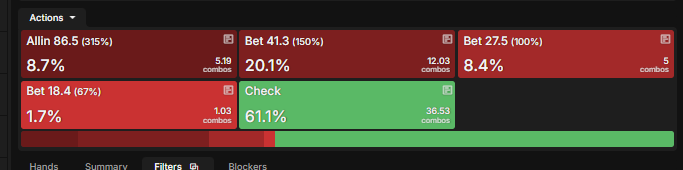
river strat as oop in the a8 hand. it never checks a8. what i can get it to do is range check as oop if i nodelock ip to b10 otr w range (he is supposed to b10 with ~75% of range if i eliminate any other sizing option) so maybe thats a driving incentive here. im not really sure, its a really weird hand and i think borderline impossible to try to evaluate without understanding jasamgale's strategy overall
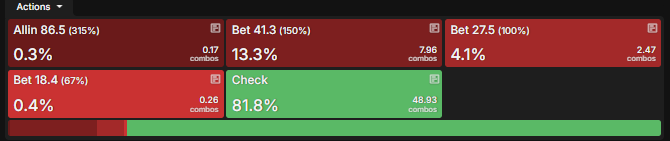
river strat as oop when i change the node lock from betting 100% as ip to 90% (so still overstabbing). given that paque is incredibly good would think this is very likely to be what's going on. a8 will pure xjam when it checks. you're looking at ip betting the river from a normal sizing context but the driver for betting 10% is that he gets to bet any ax.
its really interesting approach to the situation in general - oop hyper polar and weighted towards giveups. oop supposed to be almost pure calling jack highs facing the b10
That doesn't mean they don't still make mistakes in game. It's sort of intuitive to check OOP when you have a strong hand and every draw misses, but in that exact situation it was a poor decision. I'm fairly certain that if you went over the hand with the player who made that river check raise he would be willing to admit that himself.
The problem is that when you bet 2x pot on the turn your range is effective nuts and air. When you check river, IP is not value betting thin and not putting in a big bet as a bluff.
It's a clearly lower EV line than just value betting yourself on the river.

