Developing a heuristic for 4-Broadway boards.
The most recent video posted by Bart Hanson made me realize I don't have a good heuristic for playing 4-Broadway boards, so I'm hoping to crowd-source some help developing one.
To start my thinking, I looked at the existing heuristics which I think serve as building blocks:
1. Ace-high boards tend to be under-bluffed.
I think the reasoning is that both the PFR and caller's ranges have a lot of AX that makes top pair or aces up.
2. Two-Broadway boards tend to be over-bluffed.
I think the reasoning is that both PFR and caller's ranges have a lot of two-Broadway combos that are bricked straight draws, but can credibly rep top 2P. As a result, these boards tend to be fairly easy to play when we have top 2P or a set.
3. Three-Broadway boards tend to be under-bluffed.
I think the reasoning is related to the above - both ranges have a lot of combos that make Broadway, or 2P+. As a result, these boards can be more difficult to play when we have 2P or a set.
What about 4-Broadway boards, where there's a one-liner to Broadway?
It seems like the range advantage on these boards tends to distinctly shift from one player to the other. These would seem to be the most difficult boards to play when we have 2P or a set, especially from OOP.
Building off the above, this is what I have so far:
4a. Four-Broadway boards tend to be under-bluffed by the OOP player, and over-bluffed by the IP player.
4b. When the one card that makes Broadway is the T, J, or Q, these boards tend to favor for the pre-flop caller, especially when that player is IP.
4c. When the one card that makes Broadway is the A or K, these boards tend to favor the pre-flop raiser, especially when that player is OOP.
4d. These boards tend to be under-bluffed by whichever player started with the range advantage, and over-bluffed by whichever player ends with the range advantage.
My initial reasoning for 4a is it's harder for the OOP player to rep the straight if they don't actually have it, and they don't have an incentive to turn 2P / sets into a bluff using polar sizing. The OOP player has more incentive to block-bet or check with their entire range.
The IP player has more incentive to bluff when the OOP player block-bets or checks. When the OOP player checks, the IP player can put max pressure on the OOP player with their entire range. They can bet their straights for value, turn 2P into a bluff, and check back or go for thin value with their sets.
For 4b & 4c - the IP pre-flop caller is likely to have a wider range, so they can more often credibly rep the 1 card that completes the straight, having more combos of TX, JX, and QX in their pre-flop opening or calling range, whereas the OOP PFR is going to have fewer of those combos, and more AX and KX combos.
For 4d - When the range advantage shifts, the player who started out with a strong hand tends to slow down, opening the door for his opponent to begin bluffing more.
Obviously, this is just a starting point, not a finished product. I would think there may be some nuance in SRP vs 3BP's, and the ranges may shift based on the positions.
Thoughts?
Thinking about this some more, I think we may be able to simplify by ignoring 4b and 4c, and instead just combining 4a and 4d:
Four Broadway boards tend to be under-bluffed by the OOP player or the player who started with the range advantage on the flop, and over-bluffed by the IP player or the player who ended with the range advantage on the river.
My thinking is that 4b and 4c may be true, but 4a and 4d over-ride them by being more important and easier to understand and remember.

I appreciate the write up you made here. I think you have a lot of good insight. You made me realize I should put some more time in studying how to respond when a fourth Broadway card hits.
It often feels like a guessing game as to how likely it is for your opponent to have a straight.
Like I was just looking at an AQJ flop in a solver. The preflop configuration was CO open, BB 3-bet, CO call. Then BB followed through with a cbet and CO called.
Here is the turn report for the BB:
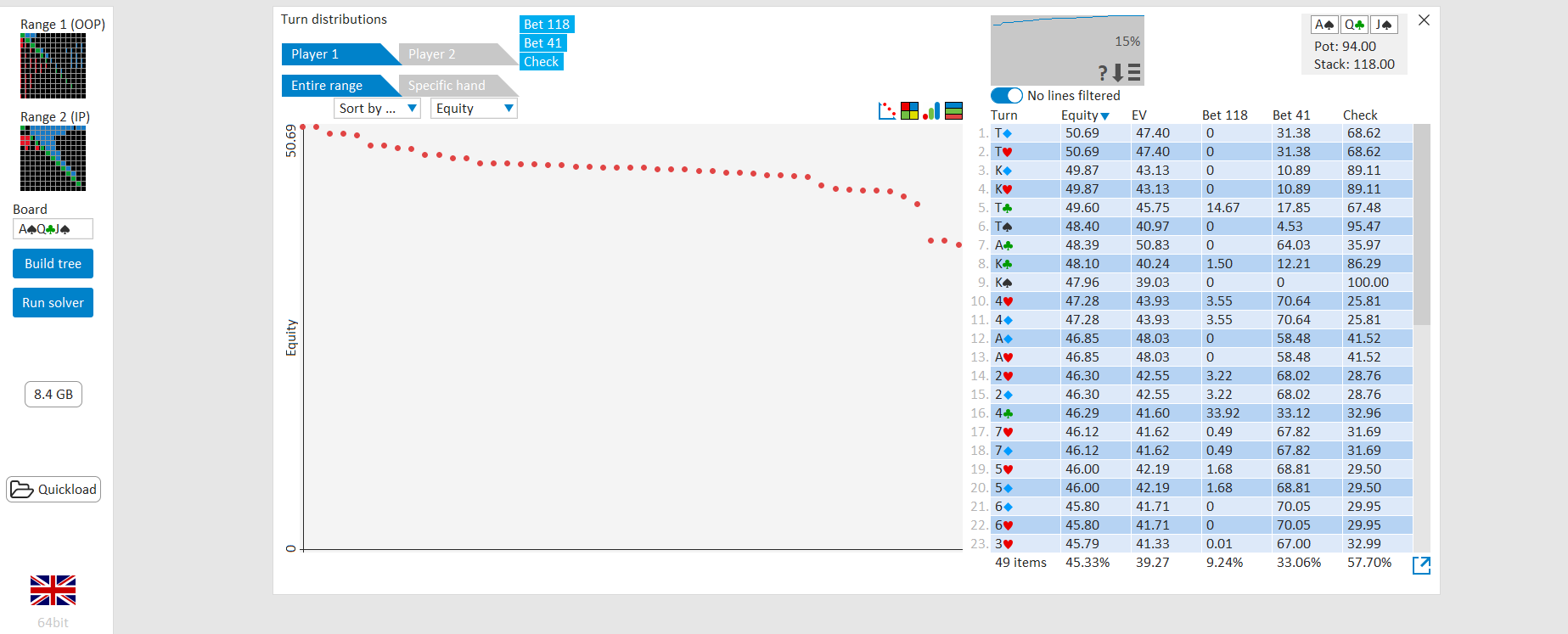
The K and T 4-Broadway turns are some of the best cards in the deck for the aggressor. That being said the preflop aggressor still only has ~50% equity on those cards range vs range. So it really is a guessing game.
Looking at different betting scenarios the GTO lines are complex and unintuitive. The OOP player is betting small or checking turn. The betting range includes lots of straights, which are rather intuitive bets. However they are also betting with lots of weakish single pair hands, presumably as a bluff. Some two pair hands are betting too, presumably as a sort of block bet. However sets are checking every time.
I think I would agree with your heuristic that the OOP player tends to under bluff these spots, but I think there are likely outlier players that massively overbluff, seeing the 4-straight as a good bluffing opportunity.
Anyway one additional note. I would say to beware of overgeneralizing and relying too much on these sorts of "rules." You still need to look at each situation individually.
Like for example, your heuristic for A high boards can be true in some scenarios, but not in others. You said ace high boards tend to be underbluffed.
However here's a counterexample. When a player opens in late position, BB defends and the flop comes something like A54. The preflop aggressor should be playing something like 15% checks, but most players are still range betting. That might not be the best counterexample, but it's the first one that came to mind.
My overall point is that your heuristics may be true in some specific scenarios, but not in others. Also there's a large variation in how individual players approach spots vs how the population as a whole plays.
Still I think what you're doing here is very smart. When you're in a close spot and your decision could go either way it's good to have some heuristics to fall back on. Like you may have a hand that's a borderline continue vs a bet, but if the spot is generally underbluffed it may be better to fold. That kind of heuristic can be very helpful.
FWIW, the first three heuristics weren't of my own invention. I picked them up from others.
Overall I agree that all heuristics are short cuts to good starting points or might be tie-breakers in close decisions where we're simply unsure. Generally I think they're good for what they are, true enough often enough, as far as they go, etc.
The four Broadway boards are unusual and would seem to be challenging to navigate, hence the search for a reasonably useful heuristic.
I appreciate the write up you made here. I think you have a lot of good insight. You made me realize I should put some more time in studying how to respond when a fourth Broadway card hits.It often feels like a guessing game as to how likely it is for your opponent to have a straight. Like I was just looking at an AQJ flop in a solver. The preflop configuration was CO open, BB
I appreciate your input. It doesn't seem like anyone else wants to contribute. Don't feel obligated to continue discussing it, but since you did respond...
Among the reasons I wanted to develop this heuristic is that these situations are such a guessing game, much like the trips-on-board and four-flush boards, where it's very easy for any player in the pot to have the one card that makes the nuts in their hand, and all other hands that previously looked strong are now reduced to bluff-catchers.
That last part seems key to me - when we don't have the nuts, we're bluff-catching, and so my working heuristic is focused on which player has the most incentive or opportunity to bluff.
It just occurs to me that maybe it's not correct to use the terms over- and under-bluffing to describe what's happening. It may be that one player is supposed to bluff at a very low frequency, and his opponent is supposed to bluff at a very high frequency. Maybe we should just be trying to understand who is who and why that is.
I suspect that the incentives here are extreme, such that one player is supposed to bluff a lot and the other hardly at all. I think this would be because one player would be capped, and struggle to turn enough showdown value into a bluff, and the player who is over-bluffing knows this about his opponent.
To your point that some players will end up over-bluffing, even OOP, I wonder if that stems from most not intuitively finding the right lines on the turn, or if this stems from having too tight / too wide a raising / 3B'ing range pre, and c-betting too many / not enough hands on the flop.
Like, if the turn betting range when the straight comes in on the turn is lots of straights, some weak 1P, and some 2P, but no sets, how many humans are able to correctly structure their betting range and checking range such that they don't end up over-bluffing? What happens if they get to the turn and river with too many or too few hands? Do they just end up running it?
I further suspect that it's harder for the player with the betting lead to rep the straight when it comes in on the river, because their flop c-bet and turn barrel range would have to include a lot of those weakish single pair hands that also have a draw. Like, how many people are c-betting the flop with KQ or AT on AKJ, and then barreling turn on a brick?
More likely, the flop c-bet / turn barrel range on AKJX is going to mostly be 2P+ and stronger TP's, like AA, KK, AK, AJ and AQ. On the T river, the only hand in that player's range that is loving it is AQ. The rest of their range getting to the river hates it, and will struggle to find the right line.
Thoughts?
My thinking is that it's next to impossible to balance appropriately in these 4 Broadway spots. So I would expect most players to be out of balance in one way or another.
It does make sense that the IP player would be more likely to bluff after the OOP aggressor checks. The check signals that OOP likely doesn't have a straight and sort of gives the IP player free reign to bluff.
That being said, I'm not sure the IP player is generally over bluffing either. I think a lot of lower stakes opponents especially probably under bluff in both positions. The reason I say that is because, after looking at the solver output, a lot of the bluffs are supposed to come from hands that include a pair. Like on the AQJT example board I used before, many of the bluffs were like Jx, Tx, and I think even some Qx were bluffing.
Especially IP on the river a lot of players will just check these back thinking that they have showdown value. In reality if they thought it through more they would realize the OOP player should have a ton of Ax, sets and 2 pair, so a hand like Jx really has little to no showdown value and they would be better off turning it into a bluff.
IME people often tend to underbluff in spots where the preferred bluffs could also be perceived to have showdown value.
My point about there being outliers who massively over bluff is because it is difficult to control your frequencies if you do know you're supposed to turn pairs into bluffs. While the majority likely under bluff and try to get to showdown, you will run into players who bluff EVERY time that they have 1 pair or worse (admittedly this is still more likely coming from the IP player).
So when you're facing a big bet on these 4 Broadway boards maybe the best question to ask yourself is how likely is your particular opponent to turn weak showdown value hands into a bluff? It is a guessing game but I do feel like I have a pretty good intuition for it and can "guess" right more often than not. It's about recognizing your opponent's tendencies.
Regarding this:
I further suspect that it's harder for the player with the betting lead to rep the straight when it comes in on the river, because their flop c-bet and turn barrel range would have to include a lot of those weakish single pair hands that also have a draw. Like, how many people are c-betting the flop with KQ or AT on AKJ, and then barreling turn on a brick?More likely, the flop
This is another example of what I was getting at above... People often tend to underbluff when the preferred bluffs can also be perceived to have showdown value.
In theory the 4-straight completing cards should be good for the aggressor's range, especially on a rainbow board. That's because the aggressor has a lot of very strong hands on a 3-broadway board, and gutshot straight draws are some of the only natural bluffs. So when a 4-straight comes in some of their relatively few natural bluffs (in comparison to the large number of value combos) improve to straights and they're left with a range that is almost pure value combined with hands that were value but have now been downgraded. They will have very few natural bluffs left in their range.
Again though this is assuming that the aggressor is making the appropriate semibluffs with hands that include something like a pair + gutshot. A lot of players will still just take passive lines with those types of hands that should be bluffing, again because they're thinking they have showdown value when really there is little to none.
In practice I think you're likely right that most pre flop aggressors who are OOP and double barrel will have ranges skewed towards hands like strong Ax and 2 pair plus. A lot of these people likely end up checking flop or turn with some of the hands that should be bluffing, such as pair + gutshot.
Anyway the more I think about these spots the more interesting they are. Really they're pretty challenging to play. This is especially true in a spot like the example I used in my first post, where you have a BB 3-bet vs CO call.
The BB pre flop 3-bet range is supposed to be polarized with very strong hands combined with small frequencies of weak stuff like offsuit Jx and Qx. These weak 1 pair hands end up turning into preferred postflop bluffs too per the solver. Really though how many players are actually finding these weak 3-bets out of the BB? Even if they do sometimes find these low frequency bluffs, how are they controlling the frequencies?
Pretty much everyone is going to be unbalanced in one way or another. The only exception might be the absolute best high stakes online crushers, who presumably could have developed a system to randomize with a RNG or something.

My thinking is that it's next to impossible to balance appropriately in these 4 Broadway spots. So I would expect most players to be out of balance in one way or another.
To add another voice to this somewhat complicated but easy thread... Yeh, I think mostly below 2-5 you can just x/f bottom two or worse on 4 broadway boards to river bets. Sometimes you are good, but calling with 10% equity so you'll be happy 1 in 10 times isn't great long term. Some people will overvalue top two or sometimes bluff something, so sets become the tipping point, but so often someone betting means they just have the missing broadway card.
On 3 broadway boards, below 2-5, you can get massive value because people will bet and/or don't fold A7 on AQJ anywhere near correctly ... evaluating it like A82 even though it's completely different. They'll also call a lot of money with KQ/KJ, and pretty often go broke with QJ, so roughly default to piling money in with value.
Obv. somewhat player dependant, but general advice of "randoms don't understand the difference of relative value vs. objective value on nuts boards".
With 2-5 regs. and above, I think it's probably fine to go with Bart's advice and/or solver/theory lines.
My thinking is that it's next to impossible to balance appropriately in these 4 Broadway spots. So I would expect most players to be out of balance in one way or another.
To add another voice to this somewhat complicated but easy thread... Yeh, I think mostly below 2-5 you can just x/f bottom two or worse on 4 broadway boards to river bets. Sometimes you are good, but calling w
Good post. Yeah you distilled down a lot of my ramblings into something much simpler/ more actionable.
The one thing I would say is this is obviously sizing dependent. You've got to be careful over folding to small, <1/3 pot bets with too much of your range, even at a lower stakes game.
So, illiterat is headed where I was going - what are we doing on the river from OOP and IP, as the PFR or PFC?
Where I think this is leading is that when we're OOP as the PFR with top 2P or a set, it's harder for the IP opponent to raise as a bluff if we block bet the river, and easier for them to bluff if we check.
Logically, if that's true, then I'd think our 2P / sets want to block-bet-fold, and our straights want to either check or over-bet, unless we're just block-betting with everything in our range, assuming it's all just 2P+, so we're not exploitable.
If we're OOP as the PFC, and we've just been check-calling, I'd think we get to donk-block-fold a lot on the river, with our entire range, as sort of a merge, where the IP opponent is likely to over-fold their own 2P / sets when the straight comes.
If we're IP as the PFR, and we've barreled off, I'd think we have to check back with 2P/sets and bet small with our straights.
If we're IP as the PFC, and we've been calling, I'd think we fold all our 2P to a bet, call with sets, and raise with straights. If OOP checks, we probably check back 2P/sets, and only bet straights.
I'm not sure about all of it, but it seems more or less logical.
What's interesting is that it seems like the OOP player actually gets to bet more on the river, with lines that bet-fold or bet-call/3B, whereas the IP player is forced to play more defensively, checking back with all their 2P/sets, and only betting straights.
So, maybe the heuristic ends up being block-bet range from OOP, and only bet straights when IP.
The four Broadway boards are unusual and would seem to be challenging to navigate, hence the search for a reasonably useful heuristic.
Random thoughts:
One of the most profitable situations is when you have a boat and a four-liner shows up. People with the missing card to the straight or flush will have a very hard time folding.
Sometimes, especially if it’s multiway when the four-liner hits, the first person to bet takes it down. Especially, if the pot is relatively small
If OOP and villain is likely to stab (we know some never will) it seems best to check the made hand and let him bluff.
I think that this is such a player dependent situation that any heuristic would have to be tailored to player types. You could say this is best vs a nit - but against a fish do this maybe?
I like what you’re trying to do, but I’m not sure it can be done. These rare situations are not something you want to risk a lot bluffing in my opinion. Rather focus my energy on situations where I have an edge, than spots that will almost always be a guess.
Random thoughts:One of the most profitable situations is when you have a boat and a four-liner shows up. People with the missing card to the straight or flush will have a very hard time folding.Sometimes, especially if it’s multiway when the four-liner hits, the first person to bet takes it down. Especially, if the pot is relatively smallIf OOP and villain is likely to stab (we
The thread is mainly concerned with 4-Broadway boards where Broadway would be the nuts, not 4-Broadway boards where the board also pairs.
In that scenario, it would seem the range advantage swings back the other way, towards the opponent with more 2P and sets in their range before the board pairs, and away from the opponent who is more likely to hold the missing straight card.
Like, on AKQJA, it's unlikely the person holding TX and turned a straight is going to have a hard time folding if his opponent bets big. A straight can only beat a bluff.
There really aren't any natural bluffs on a 4-Broadway board. Generally someone would have to turn some SDV like 2P into a bluff, which is the point of trying to develop a heuristic for this scenario.
It doesn't make sense to try to induce an opponent to bluff when every hand in our range and our opponent's range has some showdown value.
Thanks for clarifying, I didn’t realize paired board was off the table. I just think this is primarily a game of chicken, highly dependent on the villain you face. But if you don’t have enough on villain to decide, your heuristic does makes sense. Always looking for an edge
So, explain to me what you have determined at this point? Is there a way to gain an edge in this situation? Is it better than folding to pressure when most underbluff? Is bluffing ever a consideration?
Thanks for clarifying, I didn’t realize paired board was off the table. I just think this is primarily a game of chicken, highly dependent on the villain you face. But if you don’t have enough on villain to decide, your heuristic does makes sense. Always looking for an edgeSo, explain to me what you have determined at this point? Is there a way to gain an edge in this situation
No problem.
I know the posts in the thread are long. But if you want to understand how we get to the end-point, the trail is there to follow.
At first I thought it was a guessing game or game of chicken. But I believe the game is driven by logic, such that we should be able to reason our way through these situations.
The goal is to develop a heuristic that would serve as a useful guide for this situation. The exercise of building one forces us to consider all the different ways the scenario can play out, vis-a-vis a single raised pot vs a 3BP, and whether the PFR is in position or OOP. No doubt we might want to consider the post flop action, and likely the starting stack depth. It quickly gets complicated.
But a good heuristic should be one that applies to a situation generally. So we are trying to simplify. Our goal is a heuristic which works regardless of SRP or 3BP, who is in what position, and the post flop action, etc.
Getting back to the idea that it's a guessing game or a game of chicken, the underlying assumption there seems to be that either player can have the nuts. That's the scenario which needs a good heuristic. If only one player can realistically have it, we wouldn't be guessing or playing chicken.
The effort to build the heuristic forces us to think about the ranges and incentives for each player in each scenario. I think doing that helps to build a framework of generally true statements that can be looked at as building blocks for finding the set of assumptions which should apply to whichever situation we find ourselves in. (See the earlier posts for those statements.)
That's what I started doing from the first post in the thread. The exercise of analyzing these situations was useful for me, in that it revealed various nuances which can come into play, depending on all the variables.
But, if you don't want to invest the time and effort to look at the nuances, and just want the bottom line heuristic that will apply much of the time, this is where I ended up:
Block-bet range from OOP, and fold our SDV if IP raises. When you're IP, only bet the nuts, and check back everything else.
The earlier posts explain how I got there.
If you want the simplified logic to help reinforce the heuristic, it starts with the assumption that both players' ranges consist of the invulnerable nuts and SDV.
If we only bet the nuts and always check our SDV from OOP, we will be playing a guessing game whenever we check and IP bets. An aggro opponent can put us in the blender by turning worse SDV into a bluff.
If we check range from OOP, we lose value when IP checks back with a worse hand that may have called a small bet, and when we fold the best hand whenever IP turns a worse SDV hand into a bluff, and when we call with 2P or a set and IP has a straight.
So, neither splitting our range and betting polar nor checking range from OOP would seem optimal. By process of elimination, block-betting range for a small size would seem the best choice.
If OOP checks to us when we're IP, and we bet our SDV, there's a chance OOP folds a better hand, but we're generally only getting called when OOP has us beat, in which case we're probably getting raised, and we'll have to fold. OOP can really only call or raise with the nuts, so it doesn't make sense to bet our SDV.
Block-bet range from OOP, and fold our SDV if IP raises. When you're IP, only bet the nuts, and check back everything else.
I like this doc
Seems to me that this strategy would also fit a 4liner or a 4Flush.
Poke the bear OOP and see what happens.
Don’t bet IP if only better will call.
I know you spent a lot of thought on this and I like what you came up with. I’ll let you know how it goes. These kinda edges mean a lot.
Been depending too much on soul-reading villain, need more of this type of logic.
I like this doc
Seems to me that this strategy would also fit a 4liner or a 4Flush.
Poke the bear OOP and see what happens.
Don’t bet IP if only better will call.
I know you spent a lot of thought on this and I like what you came up with. I’ll let you know how it goes. These kinda edges mean a lot.
Been depending too much on soul-reading villain, need more of this type of logic.
I think the four flush and lower straight boards probably need their own heuristic, or may depend on using more deductive reasoning in game.

Each of these assumptions assumes a non-specific player pool. I see players RFI with QJo. Why would anyone want to bluff loose-passives multiway two broadway cards? Sure, the high-variance bluff on three-broadway boards will earn big money but not against a calling station. Perhaps your assumptions describe me well as a player. I under-bluff A-high boards. If I ever play with you, and you check raise on an A-high board...
Each of these assumptions assumes a non-specific player pool. I see players RFI with QJo. Why would anyone want to bluff loose-passives multiway two broadway cards? Sure, the high-variance bluff on three-broadway boards will earn big money but not against a calling station. Perhaps your assumptions describe me well as a player. I under-bluff A-high boards. If I ever play with
Yes, the heuristics we use in game generally ignore player specific reads and are instead based on player pool tendencies. I think it's a mistake to disregard the heuristics because some opponents are outliers.
There are many situations where even the outliers will struggle to find enough bluffs, or avoid over-bluffing. There are situations where the solver is finding a lot of unintuitive bluffs that humans mostly wouldn't, and situations where the solver will give up but many humans don't.
The heuristics here are mostly focused on heads up pots. Generally when pots go multi-way, there's a lot less bluffing, especially on these types of boards. We already know multi-way pots tend to be under-bluffed, so we don't need another heuristic for them.
Personally, I want good heuristics for spots that are difficult to play because they're not very well studied or widely misunderstood. I think the 4-Broadway board fits into that category.
We can treat every instance as unique, and try to apply logic to it. Having a good heuristic just allows us to start with a better understanding of the situation.
Regarding your conclusions Doc, I do think making a small bet OOP with much of our range is a good default. FWIW that's also how the solver plays it, at least in the one hand I was looking at when responding to this thread.
However you said in position your heuristic was to only bet the nuts, and check back every time with showdown value. It seems to me that we should be looking for spots where our SDV hands are unlikely to be good, and turning some of them into bluffs.
Only betting the nuts in position is the same leak the field has, since bluffing is typically going to involve turning SDV into a bluff.
Regarding your conclusions Doc, I do think making a small bet OOP with much of our range is a good default. FWIW that's also how the solver plays it, at least in the one hand I was looking at when responding to this thread. However you said in position your heuristic was to only bet the nuts, and check back every time with showdown value. It seems to me that we should be lookin
So, I think there's a rabbit hole we can go down here, where we turn our worst showdown value hands into bluffs when our opponents check to us, to fold out our opponents' better SDV. Like, maybe we bet bottom 2P to fold out top 2P.
The challenge there is that our heuristic (and possibly theory) says OOP should be range-blocking, so when OOP checks, they're deviating. We don't know if they're trapping, checking to check-call, or checking to check-fold. We can simplify by only betting the nuts when OOP checks, just like we're only raising with the nuts when OOP blocks.
Assume in that scenario we're turning bottom 2P into a bluff. We might fold out some chops here and there, but it would seem to weight our opponents' ranges towards better hands that aren't as likely to fold.
I'm starting to think maybe instead our bluffs should come from the middle of the SDV part of our range, or be the combos that are most likely to block the nutted combos in our opponents' ranges, or at least block some of the stronger 2P or set combos in our opponents' ranges.
So, on AKXJT, we might prioritize bluffing with KJ and AJ, blocking some combos of AA, KK, AQ, AK, KQ, and QJ, and avoid bluffing with AT, KT, or JT. This seems like a good way to structure and avoid over-bluffing.
I'm still not sure we should bet any of these hands. One issue is the sizing. If we go too small, we give our opponents a better price to call with their better SDV, or turn their SDV into a bluff, forcing us to fold. If we go too big, we're torching when our opponents are trapping, or whenever they just get sticky and hero call with more of their SDV. Guessing that means we should use a medium size if we bet.
It's going to depend on the specific configuration, but I think those two pair you listed might be too strong to want to turn into bluffs. They already have a quite a bit of EV as a check back.
My thinking was that if you have any one pair hands like K9s, Q9s, J9s types of hands those would probably be your best bluffs. Maybe if we have any missed flush draws in a spot, like suited connectors, those could also make decent bluffs. I'm thinking you would also probably prefer not to have an ace in your hand, because some of our opponent's few one pair hands that we're clearly targeting for folds are going to be weak Axs types of hands.
Regarding the solver, the spot I was referring to was the 3-bet board I referenced above. The solver did have an OOP river checking rangevafter the 4-straight came in, but it was only 25% of hands that were checking. Looking again the bet size used with 75% of range was relatively small, but was actually all in following a pre flop 3-bet, bet flop, bet turn line, so it might not be as applicable to our conversation. Interestingly it's betting AK top two but mostly checking AQ on AQJ2K board (OOP). I'm not sure if AK is supposed to be a value bet or bluff? I guess maybe it's sort of a merge/thin value bet?
Regarding bluff sizing, and assuming a different spot where the river SPR is higher, I would think we would want to size our bluffs the same as our fat value. That's by default, unless we are exploiting a fish's tendencies with a specific size.
I agree a medium bet size IP is likely best with bluffs (and value too). Maybe something like 2/3 pot up to pot? I'm not sure but i feel like if we bet smaller, like half pot, then a lot of two pair and sets will just snap call.
Regarding the risk of being check raised on the river after betting IP... I don't think this is much of a concern. It's definitely an under bluffed spot because it's just so likely we have the stone cold nuts when we bet. It would be suicidal to check raise as a bluff.
Anyway, we're getting pretty far into the weeds with this convo, but it's interesting nonetheless.
Thinking about this more, I think a big part of the value in having a heuristic is to avoid letting this situation be a guessing game.
If we block-bet range from OOP, the IP player can't wantonly raise us off our equity as a bluff. If we block with SDV and get raised, we can just fold.
Obviously, if we're IP with the nuts we can raise when OOP blocks. If OOP checks, and we only bet the nuts and check back with our SDV, we'll never be bluffing into the nuts, and can't get bluff-raised when we have the better SDV.
So, I think the original heuristic is good, and we don't necessarily need bluffs when OOP checks.
The question is should we have bluffs IP when OOP checks, and if so, how do we avoid under- or over-bluffing when we're IP? Maybe this is where we start to deviate from the heuristic and rely on our reads, trying to determine if V is more likely to be trapping or giving up.
If we want to have bluffs IP, I would think this situation is such that we'll usually end up turning something with SDV into a bluff, because our hand blocks some of OOP's check-calling range, but also because of what's in our range when we arrive on the river.
So, using with the example of AJX-T-K... if we opened on the BTN (IP), and 3B pre from the BB (OOP), then OOP c-bets flop, barrels turn, and checks river, we won't have a lot of combos like K9 or J9 when we're IP, at least not all that often. We may only have KXs when we were chasing the NFD that bricked.
The bulk of our SDV is going to be AK, AJ, AT, KJ, KTs, and JT, plus maybe some TT that didn't raise turn, JJ that didn't raise flop, and AA that didn't 4B pre. If we think OOP is splitting his range into check-calls and check-folds, I'd think we'd want to bluff with the combos that block as many as his check-calls as possible, and un-block his check-folds.
If we think BB's 3B range is 99+/AK/AQ/KQ, then I'd think we want to block his best 2P+ combos, so maybe we always bet AJ and KJ as bluffs, but we always check back AT, KT, and JT.
I'm not sure what we'd be doing with our sets. I guess they're too strong to turn into bluffs, but not quite strong enough to bet for value, so we'd mostly check back with them. Maybe we split, by betting AA and KK, and checking back JJ and TT.
This is where the whole concept of having simple heuristics breaks down a bit, because it's going to depend a lot on the specific configuration and how wide the ranges are.
My overall point was that when we're checked to on a 4-straight completing river we should likely be betting with the nuts and balancing by turning some of our worst SDV hands into bluffs.
I feel like the blocker effects are somewhat secondary because we're effectively turning every hand short of the nuts into a bluffcatcher. Admittedly that's not 100% true as I likely would have some thinner value if I arrived to the river with something like top set.
Still I think just considering how often our hand will be good when we check back might be the biggest factor when selecting bluff candidates. If the SDV is too high it will be higher EV to check back, so we want to select SDV bluffs that are least likely to be good in a given situation.
This is where the whole concept of having simple heuristics breaks down a bit, because it's going to depend a lot on the specific configuration and how wide the ranges are.My overall point was that when we're checked to on a 4-straight completing river we should likely be betting with the nuts and balancing by turning some of our worst SDV hands into bluffs.I feel like the bloc
I don't use solvers, but it seems you may. I'd be interested what a solver output would look like here, if you're planning to fiddle around.
I completely understand your point about how much SDV our hand has. I know you understand my point about blocker properties.
Checking back everything that isn't the nuts is a way to simplify. Like, what are we doing IP with top 2P, or bottom set? Maybe we split our range by going for thin value with some of our best/better non-nut hands and just taking the rest to showdown. How does it decide what to do with each hand in our range?
Maybe we're just supposed to give up and not bluff with the worst combos, even if we know we can't win, because that's the highest EV play in theory.
If we think OOP never check-raises as a bluff, and never check-calls with worse, is there a reason to go for thin value with the best non-nut hands, like top set? If we think OOP never check-folds better, is there a reason to bluff?
I'm far from certain about this. I plan to think about it some more. I will remain interested to see what a solver would do here.
I'm starting to suspect a solver would either polarize in some way, or find a mix of check-backs and bets that makes logical sense based on the positions and action, but in some way takes blocker effects and SDV into consideration. If the solver wants to bet-fold top set, I'm willing to sacrifice the thin value and deviate by just checking back.
Also now starting to wonder how a solver responds to a raise from either player.
You posted:
"If we think OOP never check-raises as a bluff, and never check-calls with worse, is there a reason to go for thin value with the best non-nut hands, like top set? If we think OOP never check-folds better, is there a reason to bluff?"
This is why, at least in theory, we HAVE to have bluffs in position. If we're never bluffing and never value betting thin our opponent will just fold everything but the nuts. They effectively play perfect against us and we never get value with the nuts.
Our bluffs are why he has to call sometimes with two pair and pay off our straights and thin value/sets.
Regarding your second sentence, no there's no reason to bluff if he never folds better. That's why it's important we choose worse hands to bluff with than whatever SDV we're targeting for folds.
You posted:"If we think OOP never check-raises as a bluff, and never check-calls with worse, is there a reason to go for thin value with the best non-nut hands, like top set If we think OOP never check-folds better, is there a reason to bluff"This is why, at least in theory, we HAVE to have bluffs in position. If we're never bluffing and never value betting thin our opponent wi
According to our theory, OOP shouldn't check to us, so if we're contemplating a bluff, OOP has already shown they're not playing perfectly.
I think the logic here starts to get circular.
OOP should block bet range. IP only gets to bet when OOP checks, which shouldn't happen. The only reasons for IP to bet when OOP checks is to get called by worse or fold out better.
But IP doesn't know what OOP is doing. He could be checking range.
If OOP is splitting his range, with some check-calls, some check-raises, and some check-folds, I'd think IP would just want to bet with a linear range of hands that fare to be best when called, not bet a polar range of nuts hoping to get called and bluffs hoping to get folds.
That's the point of developing a heuristic. We don't want to guess what to do.
If OOP is checking range, which seems like it would be the most common mistake, and we think they've got some nutted hands in range, it seems logical to think they're going to be check-raising or check-calling more often than check-folding. If that's true, then IP should never bluff, and only bet the best hands in his range.
It's like knowing someone is throwing rock or scissors more often than paper. The adjustment should be never throwing scissors or paper, just rock.


