Please help me to stop bleeding in the SB

In the SB I take this strategy mostly:
Open or 3-bet TT+, AQs+ (shallow-stacked, no callers, or deep-stacked tight-aggressive table)
and then I also “just call” limped suited broadways, 22-99, A2s-9s, 87s+ (deep stacked loose-passive table or multiway pot)
but lately because of 2+2 also
3bet ATs+ and the trouble hands KQs and KJs depending on the read / image. I’ve really enjoyed adding these bluffs into my game. The tables love the big 4x+caller preflop bets.
Are they profitable? Is ATs+, KQs, KJs too wide? What about multi-way? To people who say “just call:” do you like seeing a flop capped oop?
Any other opinions from hand histories about how I am playing the SB? Any answers to the question: how to stop the bleeding in the SB?
In the SB I take this strategy mostly:Open or 3-bet TT+, AQs+ (shallow-stacked, no callers, or deep-stacked tight-aggressive table)and then I also “just call” limped suited broadways, 22-99, A2s-9s, 87s+ (deep stacked loose-passive table or multiway pot)but lately because of 2+2 also3bet ATs+ and the trouble hands KQs and KJs depending on the read / image. I’ve really enjoyed a
SB is the hardest spot to play. It's going to depend on who opens and stack sizes. But generally squeezing KQs+ ATs+ TT+ is going to make money.
We don’t need to play suited connectors in the sb, and if we do it’s because we are 3b to iso the fish.
You have a forced bet with the worst position every street post-flop. It’s not a money making situation. I don’t think it should be a quest to get involved more. It’s more like how can you lose less from the blinds.
The reason most suggest raise/fold is that it should take a very strong hand to play with this positional disadvantage. You stop the bleeding by never calling and folding marginals.
I downgrade my opinion of a player that calls from the SB. They are ‘pretty cards’ players and will have flaws in their game. Probably don’t understand position, chasing draws, playing every sc, etc.
On rare occasions, I can get behind re-raising a late position opener with any two if I think he’s coming in light, but that’s different.
In the SB just lose one dollar at a time.
A better question would be how can you make more money from the button.
I'd be curious if an online player with an extensive hand history could tell us how his winrate deviates from normal when he's in the SB.
I'm going to bet that almost every hand is -EV from the SB. If not, it's EV is significantly crushed. (Hands go down in value, not up)
Thus, I would suggest you just play extra tight. Set mine with pairs where appropriate, play big pairs, AJs+ AQo+
My feeling is that a lot of the aggro-advice out there that suggests 3-betting wider assumes that post-flop play will be heads up. And I think that's rarely the case in low stakes games.

https://www.tommyangelo.com/how-to-play-the-small-blind/
Sometimes I think hands like ATs, KQs are a call, sometimes a 3b, sometimes a fold. I don't see a universal strategy that can be put on.
But I think on general you are using a very tight range, especially in raised pots, and that seems good
You have a forced bet with the worst position every street post-flop. It’s not a money making situation. I don’t think it should be a quest to get involved more. It’s more like how can you lose less from the blinds.The reason most suggest raise/fold is that it should take a very strong hand to play with this positional disadvantage. You stop the bleeding by never calling and fo
I'd be curious if an online player with an extensive hand history could tell us how his winrate deviates from normal when he's in the SB.I'm going to bet that almost every hand is -EV from the SB. If not, it's EV is significantly crushed. (Hands go down in value, not up)Thus, I would suggest you just play extra tight. Set mine with pairs where appropriate, play big pairs, AJs+
Yep.

Gtowizard preflop ranges are all you need, then be tighter than that vs big opens or tight players
Do you bleed more money in the SB than the BB?
Sadly, for half the players in my pool, taking Tommy Angelo's simple advice will improve their win rate.
Admittedly, I tried his strategy, and it didn't work. I won a huge limped pot in the BB, felt myself going on tilt, followed the advice "don't play the SB," sat back down for the next hand, and was told by the dealer to pay 3 dollars to play my button! I felt it was unfair until Venice corrected me.
So I played just raise or fold in the SB for about six months. I like the strategy because you never go broke in a limped pot. Then, I started seeing pros limping multiway in the SB facing a passive BB. I started doing it too. More hands=more fun!
Good players may still lose money overall playing from the blinds.
If you folded every single hand, your lossrate would be -100bb/100 from the BB and -50bb/100 from the SB. A solid winner in a tough online player pool might still have a lossrate of -25bb/100 from the BB. That is a huge improvement over folding every hand though. A bad live player is losing greater than -100/bb100 from the BB because he over-defends and plays poorly post-flop.
It is expected that you would lose less from the SB than from the BB, simply because you are putting less money in blind every hand. Play tight and aggressively from the blinds. Study the free GTOWizard ranges like kvnd mentioned and then make adjustments as necessary. Your SB vs BTN strategy should be very different than your SB vs EP strategy.
Good players may still lose money overall playing from the blinds. If you folded every single hand, your lossrate would be -100bb/100 from the BB and -50bb/100 from the SB. A solid winner in a tough online player pool might still have a lossrate of -25bb/100 from the BB. That is a huge improvement over folding every hand though. A bad live player is losing greater than -100/bb1
I don't know how to critique this post without sounding mean, but I just don't see any relevant or valuable advice here at all. The question asked in this thread is: Which hands? Nothing in this post addresses the question. I just see some basic math related to a 100% fold range, generic platitudes about position, and a vague suggestion to study GTO. How the heck could a poker forum survive if someone asks a question and the response comes: "Go google the answer"
I don't know how to critique this post without sounding mean, but I just don't see any relevant or valuable advice here at all. The question asked in this thread is: Which hands? Nothing in this post addresses the question. I just see some basic math related to a 100% fold range, generic platitudes about position, and a vague suggestion to study GTO. How the heck could a poker
What a weird thing to post.
This thread is about general advice for playing from the small blind, that's why my post was very general. Was just trying to provide some helpful context for how to think about playing from the blinds. OP says he is leaking money from the SB, but everyone is leaking money from the SB. OP did also ask for ranges, and there are great ranges that are available for free online. One of the posters that I respect on this forum suggested GTOWizard earlier in the thread. I know that OP uses GTOWizard from his previous threads. There is no reason for me to type up SB ranges against every position given that.
FWIW I really enjoy reading OP's threads because we live in the same area and play in the same games. He is also very candid and takes the time to describe things in an enjoyable manner. I think I respond to the majority of his threads and I would like to think I often provide helpful feedback.
What a weird thing to post.This thread is about general advice for playing from the small blind, that's why my post was very general. Was just trying to provide some helpful context for how to think about playing from the blinds. OP says he is leaking money from the SB, but everyone is leaking money from the SB. OP did also ask for ranges, and there are great ranges that are av
I don't agree the OP was looking for general advice. I think his question was Which hands are +EV, which is a question you haven't even touched in either of your posts so far.
With regard to GTOwizard, I'm sorry but that advice just doesn't fit. I know the GTO vs Exploitative debate has already been had. I know that for the vast majority of the poker world, GTO won that debate. But in a live, low-stakes, cash game GTO is just pointless.
GTO assumes you're playing against another GTO range, from just one player, for a small raise size. That set of conditions is incredibly rare in LLSNL. GTO is not equipped to handle mutliway pots and large raise sizes. It doesn't use logic or reasoning. It just calculates maximum +EV given its default choices of perfectly curated conditions which don't even come close to mimicking real life. Go ask GTO what to do from the SB against two EP limpers, a HJ raise to 8.5x, and a BTN call. Your CPU will start smoking.
I haven't looked lately, but I'll bet GTOwizard still suggests 3-betting A5s from the SB. (Balance and blockers and whatnot). If you try to battle in multi-way, low-SPR pots with A5s....you will go broke very quickly.
I'll also say that the value in these AI solvers comes from analyzing WHY the solver is choosing the plays that it does. Your goal ought to be to learn to think the way the machine does. Why is it choosing this hand and not that hand? Why does it like these suits and not those suits? Why are these hands checking but those hands aren't? Etc. etc. etc. It's for learning heuristics, not memorizing a strategy.
If your plan is to look at a chart, memorize it, and then play the hands the chart says to play.......you totally missed the point.

I would be careful with playing 3-bet or fold from the SB at 1/2. Some people are mostly limping and only raising premium hands. So you don't want to isolate against 99+/AQ+ or tighter. They are also flat calling and only 3-betting maybe AA/KK. It is OK to 3-bet light sometimes, but I would be aware of the players, sizing, etc.
I'll also say that the value in these AI solvers comes from analyzing WHY the solver is choosing the plays that it does. Your goal ought to be to learn to think the way the machine does. Why is it choosing this hand and not that hand? Why does it like these suits and not those suits? Why are these hands checking but those hands aren't? Etc. etc. etc.
I did not suggest that OP memorize GTOWizard's strategy and try to implement it in his games. You are creating a strawman to argue with here. I suggested he study the pre-flop charts on GTOWizard, which are likely the best ranges available for free on the internet, and then make adjustments as necessary (of course there are a lot of adjustments to be made in live low stakes poker). I think that is the best way to work on one's pre-flop game. Sorry you disagree.
What adjustments? That's what this thread is asking.
Your answer was "Go study unadjusted ranges"
This is a fair question that I am willing to engage with. I really wish you would stop trying to mischaracterize my posts, as you did in line two of your response. You've done this in every single response to me. I get that you are trying to illustrate your point, but I think you can do so without putting words into my mouth.
Most of the time in live poker, I am adjusting my baseline ranges to combat my opponent's larger sizings and tighter ranges. There is also stacksize to consider (are we 200bb deep or did my opponent minbuy?) and multiway-ness. A lot of the pre-flop spots in live poker become really complicated. You can play around in GTOWizard to see how the computer makes these sorts of adjustments. Here is an example:
This is SB vs HJ 2.5x open HU 100bb deep. This is not a spot that happens often in live poker, but it's worth knowing. FWIW I often play $2/$5 at 100bb effective and most of my opponents open to 3x, so I am in an approximation of this spot often enough.
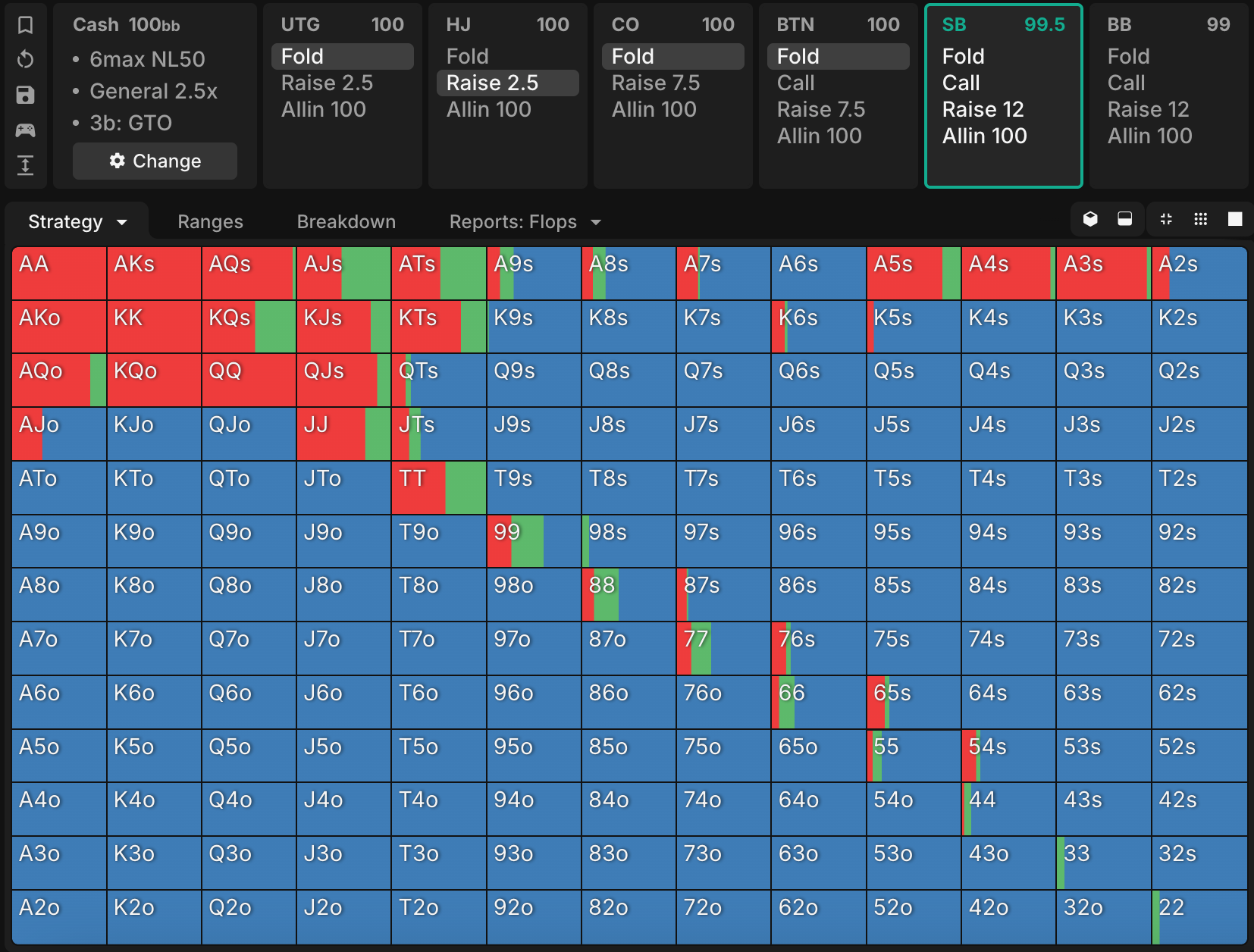
Is this a reasonable range for live poker? It feels close.
How do I adjust if I think my opponent is opening a tighter range than GTO? I can look at the SB response vs LJ opening instead.
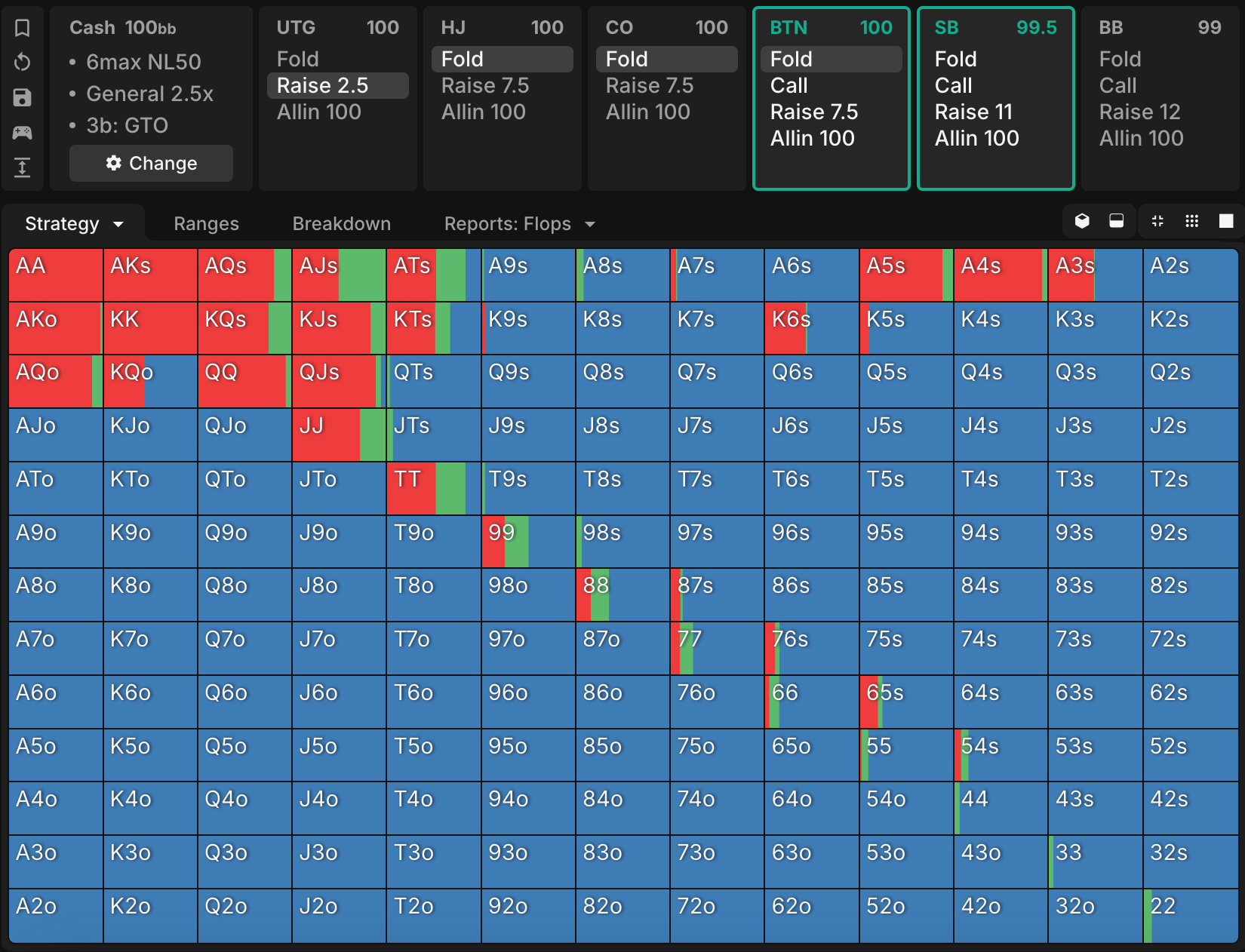
There isn't a huge difference here, but the 3bet range is about 1% tighter, from 8% down to 7% (no AJo, less KQo, less suited wheel AX etc). If I think the range my opponent is opening is even tighter than the Solver's LJ opening range, I can adjust further. What is a good heuristic here? If my opponent is opening a tighter range, I shouldn't be 3betting as much with offsuit broadways and bad suited aces.
How about if BTN calls?
SB vs LJ open and BTN call
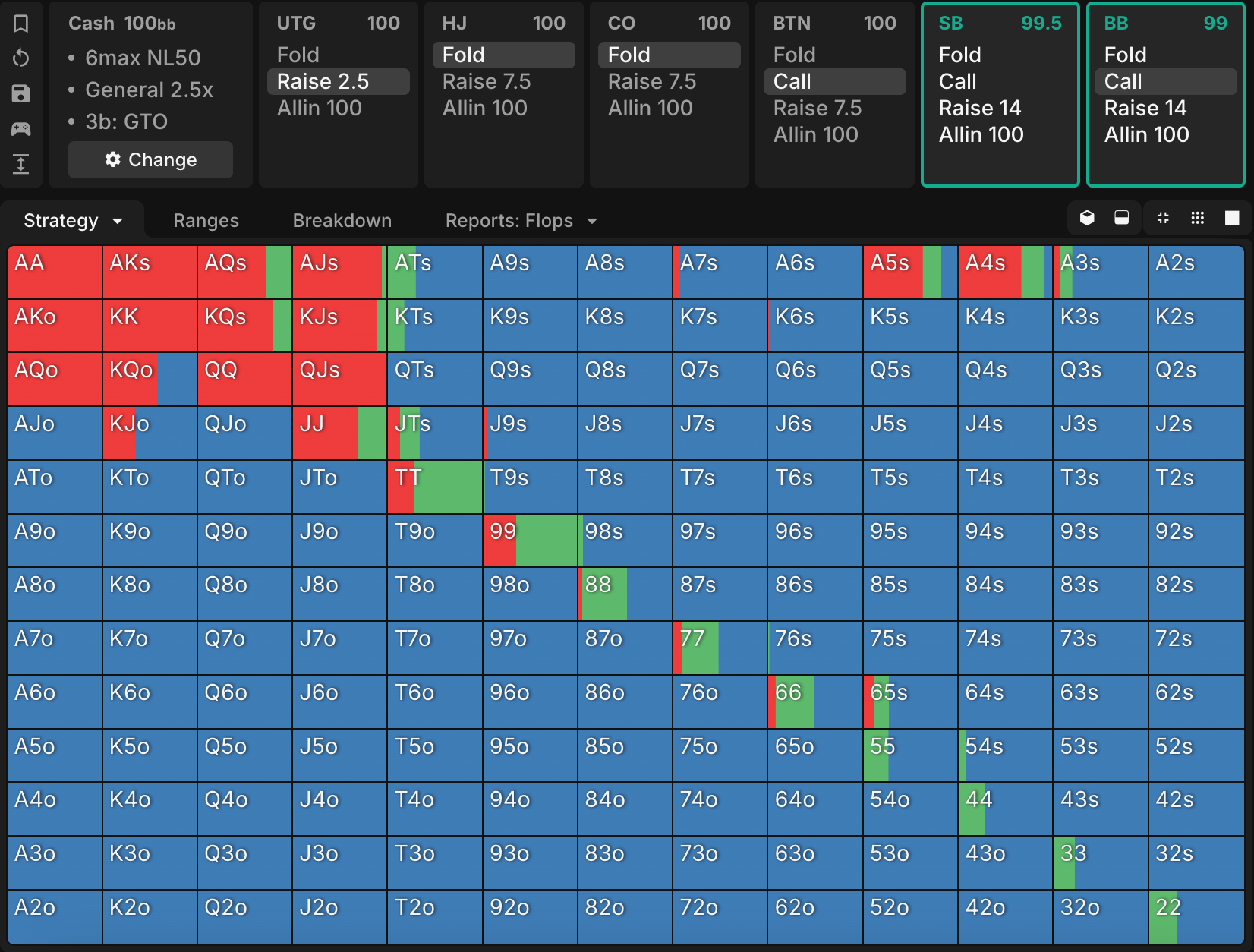
Again, we get 1% tighter and now we are calling more often.
If we don't expect the BB to 3bet a GTO range (spoiler: he isn't) all of a sudden, we can start to call a lot more. I would adjust by pure calling a lot of the hands that the solver is mixing in calls with.
Adjusting to larger open sizes is tricky to approximate. You can look at how the solver adjusts to different stack depths to start, as this will approximate the post-flop SPR. You can also toggle between min open and 2.5x open. The solver plays significantly tighter against a .5x difference, so we can expect the solver to play waaaaaay tighter against a 5x open vs a 2.5x open.
Similar to what you said in an earlier post, the purpose of my pre-flop study is more for learning heuristics and less for rote memorization. I am not trying to play exactly as the solver does, I agree that would largely be counterproductive.
I will also add a disclaimer that I am by no means a GTO truther. I don't even have a paid account with GTOWizard lol. If I did, my understanding is that it would unlock many more tools that would allow me to approximate live poker even closer (more multi-way, different opening sizes, different rake structures, basic node-locking, etc).
It was asked in the very first post in this thread. Not sure why it took so long, but I'm glad you got here.
As I suspected, the solver just has a big throbbing veiny hard-on for A5s. That just sounds like lighting money on fire. So does 3-betting KJo into two people.
All of your analysis is based on 6-max games, not full ring. So I presume we go even tighter? That seems to be a theme with this analysis. "Start with range X and then tighten up because....." What if we want to get looser? Like, why does the solver hate small and medium pairs so much? I think it's assuming we're playing Heads-Up against a GTO opponent and won't get paid off enough. Is that the case in actual live poker though? Does the player pool have a ton of loose-passives will will make and call bets on future streets with a myriad of holdings below 3-of-a-kind? I think there's value in set-mining all of those hands. How would I glean that from a solver?
I really could go on and on and on about this. But my overall point is that once you start "adjusting" the GTO ranges for the litany of exploitable variables present in low stakes games, you get so far away from GTO that it was pointless to even start there in the first place. And when a disproportionate amount of your adjustments go one way (tighter), I think you risk leaving a lot of money on the table
Instead, all we should be asking is "Which hands are +EV". The answer should be a list of hands that are largely indifferent to position and happy to get stacks in against loose passives a fair amount of the time. That means sets, overpairs, and really strong top-pair hands.
It was asked in the very first post in this thread. Not sure why it took so long, but I'm glad you got here.As I suspected, the solver just has a big throbbing veiny hard-on for A5s. That just sounds like lighting money on fire. So does 3-betting KJo into two people.All of your analysis is based on 6-max games, not full ring. So I presume we go even tighter? That seems to be a
This feels like it lacks a lot of important nuance to me. So you would advocate for playing the same range from the SB vs a UTG open as versus a CO open? To me, that sounds like it is leaving a lot of money on the table. I would playing much differently vs a CO open than vs a UTG open.
There are spots to loosen up relative to GTO for sure. It isn't all about tightening up, that was just the hypothetical adjustment that I gave. Playing from the SB in a high rake game with big opens should always be a pretty tight range though.
As you mentioned, this is a subject we could go on and on about. To me, pre-flop is the most important part of playing live low stakes poker though, so it is worth taking the time to study on a detailed level. You certainly don't need to know the GTO baseline to win at live low stakes but it gets more and more important as you move up in stakes live or as you play online.
Why? Assuming stack sizes and player tendencies are the same, what's the difference? You're still out of position on every street. The fact villain might be a few extra seats away doesn't change the cards.
I'm guessing you're giving a player opening in the CO a wider/weaker range than the opener UTG. That's probably going to be true and it deserves prominent consideration when deciding what to do from many other positions. However, in this thread, we're talking about how to play from the small blind specifically. Our range is going to be extremely narrow and value-heavy anyway. So our analysis shouldn't change.
Remember, your GTO solver is trying to do two things at once. It's trying to maximize EV while also remaining unexploitable itself. I actually don't care about the second one. The solver is bringing in tons of -EV hands for the sake of "balance". That's why it keeps trying to jam A5s down our throats. We don't actually have to do that in live poker. We're playing 20 freakin' hands an hour man. Balance is for the birds. So all I care about is maximizing EV. That means every single -EV combo goes in the muck.
I highly doubt our opponents will exploit us by over-folding post-flop when they have good made hands. No one is opening AJ, getting called by us, and then shutting it down on an Ace-high board because they somehow figured out our range is only AQ+.

