Venezuela

Is Venezuela lost for decades? Is it going to become a full blown pariah state? The opposition leader Guido seems like a

Dun, you really think America cosied up to Saddam's Iraq or Pinochet's Chile to install democracy I don't think it's unduly cynical to opine "no" to this question.
The US has been ok working with authoritarian dictatorships if they were the lesser of 2 evils. But Japan and Germany were 2 cases where there were always going to be democracies installed. Iraq and Afghanistan were also legit attempts to install democracy, as misguided as those efforts may have been.

i think the sinicization of africa is a great example of how tone deaf americans are about our own role on that continent and the rest of the globe. you constantly see opeds and news segments talking about the chinese rape of africa and it all quietly leads to the same conclusion: why are african governments choosing china over us? it must be corruption or evil regimes preferring other evil regimes
no, that is not it. african countries have already run the experiment of cooperating closely with the usa and adopting washington consensus economic policy prescriptions, and the results were often disastrous for local industry and long term development
when you tie aid and loans to lowering trade barriers and rapid liberalization, local businesses that are not globally competitive get wiped out by multinational conglomerates with scale and capital advantages. countries get locked back into being commodity exporters in a modern mercantile system instead of building diversified domestic industry
this is why you find coca cola and nestle products on shelves around the world and few if any local competitors. it is not that the entire world subsisted on water and beans prior to globalization. once markets are forcibly opened, foreign firms can sell at thin margins or even at a loss to crush local production, buy distressed assets cheaply, and then dominate once competition is gone. that is not a conspiracy theory, it is basic competitive dynamics when one side has overwhelming capital and we have seen it happen repeatedly
the post colonial period was not uniformly smooth across africa, but in a number of cases growth and quality of life were improving before the oil crisis of 1979 created severe debt problems for many african nations. that is when structural adjustment programs accelerated and washington consensus policies were enforced as conditions for assistance. what followed is often referred to as africa’s lost decade because per capita growth stalled or reversed across much of the continent and dependency on external financing deepened. in the 2000s, as new financing partners emerged and commodity demand surged, growth rebounded in many countries

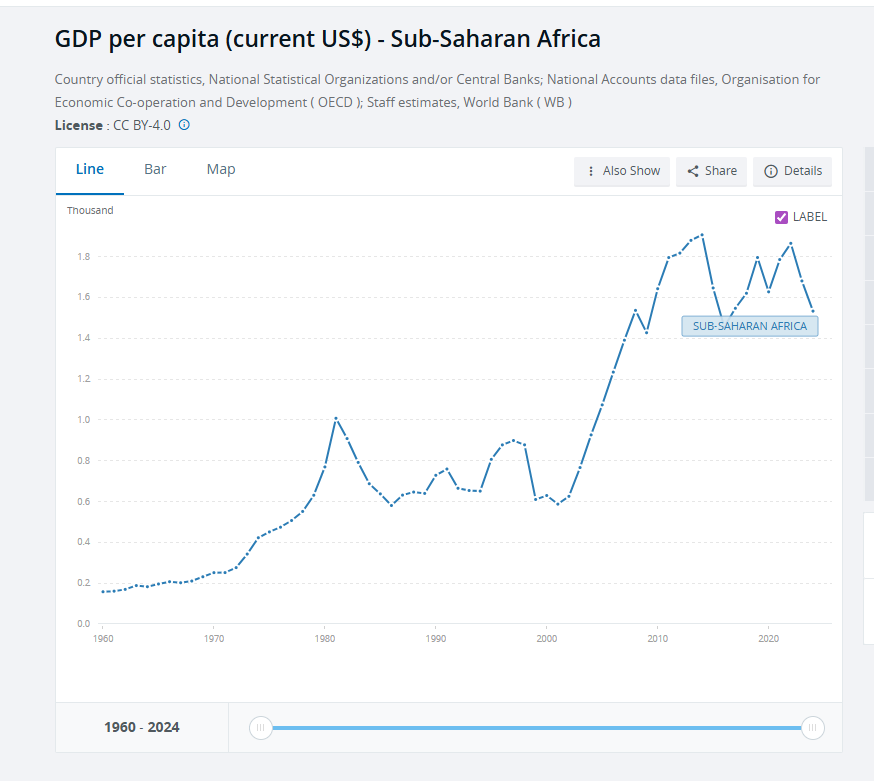
the impact is stark. yet to this day, you have highly intelligent and highly educated western commentators who insist china is uniquely predatory in africa and that african leaders choosing to work with them must be acting purely out of greed. a more plausible interpretation is that governments respond to incentives and historical experience. if one model hollowed out domestic industry and limited long term growth, it should not be shocking that countries explore alternatives
victor is right about a lot of the damage we have done abroad. the mistake is pretending that power politics and economic leverage are unique to one system or one country. great powers pursue advantage. the question smaller countries ask is which partnership leaves them with more room to grow and they've resoundly voted with their wallets to pivot to china over us and the results speak for themselves

the mistake is pretending that power politics and economic leverage are unique to one system or one country.
what is unique to the Ameri-Israeli-Anglo Empire is that they do mass slaughter on an untold scale to "pursue advantage." Russians and Chinese quite simply kill, incarcerate, torture, and rape exponentially fewer people.
i’m sure a lot of people very naively believed that a world free of tariffs and barriers is universally good. but the version of free trade that became dogma in the late 20th century was not some timeless consensus stretching back centuries
post wwii trade liberalization still operated in a world of controls. countries opened gradually and often protected key industries while they developed. what shifted in the late 1970s and 1980s was the push for rapid liberalization, capital mobility, and structural adjustment as a kind of universal template
it’s called the washington consensus because it was the framework our government and institutions in washington chose to promote. and just so coincidentally it aligned perfectly with where we stood at that moment in history. we had the most capital intensive and technologically advanced economy in the world. lowering barriers globally posed limited risk to us because very few foreign firms were positioned to overwhelm american industry. the effect was largely one way
in the post wwii era we had achieved similar outcomes more directly. foreign aid frequently came with buy american stipulations. if you wanted that bridge built with our money, you were using american steel. if you wanted the machinery, the tractors, the heavy equipment, it was coming from us
later the strategy evolved. instead of here is $100 in aid but it is essentially american store credit, the model became we will loan you $80 to help finance your $100 infrastructure project and good luck finding heavy equipment that is not manufactured by us. formally it looked like neutral finance, functionally it preserved leverage
what makes the modern orthodoxy strange is that it treats tariffs and industrial policy as historical aberrations when they were the norm for most countries during development. japan and south korea protected and nurtured domestic industries before becoming export powerhouses. taiwan used state backed finance and targeted sector support. even china, after opening under nixon and mao and later joining the wto, maintained joint venture requirements, market access restrictions, and tariff and non tariff barriers that were often higher than what we imposed decades later
protective tariffs and industrial policy built most modern economies. the idea that every country at every stage should instantly expose domestic industry to full global competition is not ancient wisdom. it is a relatively recent policy preference. debating whether that model still serves our interests is not radical
the irony is how the tariff debate unfolded. first tariffs were evil and stupid. then they were dangerous because other countries would reciprocate. which was the original justification in the first place for us implementing them vs china, that we were responding to asymmetrical barriers. and yet when european countries imposed reciprocal tariffs on us, that was framed as reasonable statecraft and reasons for us to stop... so remind me again why it's smart for euros to put in reciprocal tariffs on us in order to get us to lower ours but if we do that in order to get china to lower their tariffs then we are just idiots?
it pains me that trump became the tariff guy. you can argue that he executed it chaotically and without a coherent industrial strategy. that criticism is fair. but the underlying question of industrial capacity, bargaining leverage, and development strategy is not absurd. unfortunately now the entire discussion is tied to trumpism rather than to a serious historical and economic debate, which guarantees that millions will dismiss it reflexively rather than engage with it
this is why i abandoned the tariff thread - it wasn't ever about tariffs - it was simply pro trump or anti trump - trying to talk actual policy got you labeled as a political partisan and you got a constant circle jerk echo chamber of "everyone knows tariffs are bad mmmkay"
even after the biden admin correctly kept those tariffs in place (and even strengthened them) the tenor of the discussion never changed - it was pure aids posting from start to finish

i think the sinicization of africa is a great example of how tone deaf americans are about our own role on that continent and the rest of the globe. you constantly see opeds and news segments talking about the chinese rape of africa and it all quietly leads to the same conclusion: why are african governments choosing china over us? it must be corruption or evil regimes preferri
This is an interesting post. I would put it slightly differently. The U.S. over the last several decades has been tying aid to policy requirements, some of which are economic, some of which are environmental, some of which are geopolitical, some of which relate to social policy, etc. And the aid isn't necessarily aimed at what African leaders want, which very often is infrastructure.
China mostly doesn't give a **** about policy in Africa. If you want to dump industrial waste into your water supply in pursuit of economic development, nationalize this or that industry, or treat women whatever way, that's your business. It's more purely transactional. We build X in exchange for you giving us access to Y. That feels more equal and less paternalistic to African leaders and certainly a lot easier to deal with.
what is unique to the Ameri-Israeli-Anglo Empire is that they do mass slaughter on an untold scale to "pursue advantage." Russians and Chinese quite simply kill, incarcerate, torture, and rape exponentially fewer people.
i think it would do you well to actually read about how the ussr treated its allies economically
the idea that russia or china historically operated from some higher moral plane is just not supported by the record. the soviet union routinely extracted resources from aligned states in ways that were devastating
during the great leap forward, while china was experiencing catastrophic famine and tens of millions were starving, the soviets did not step in to provide relief. they continued to demand repayment on loans. china maintained grain shipments to the ussr even as people were dying in massive numbers
we are talking about roughly 9.6 million tonnes of grain shipped during that period to service debts
https://www.sciencedirect.com/science/ar...
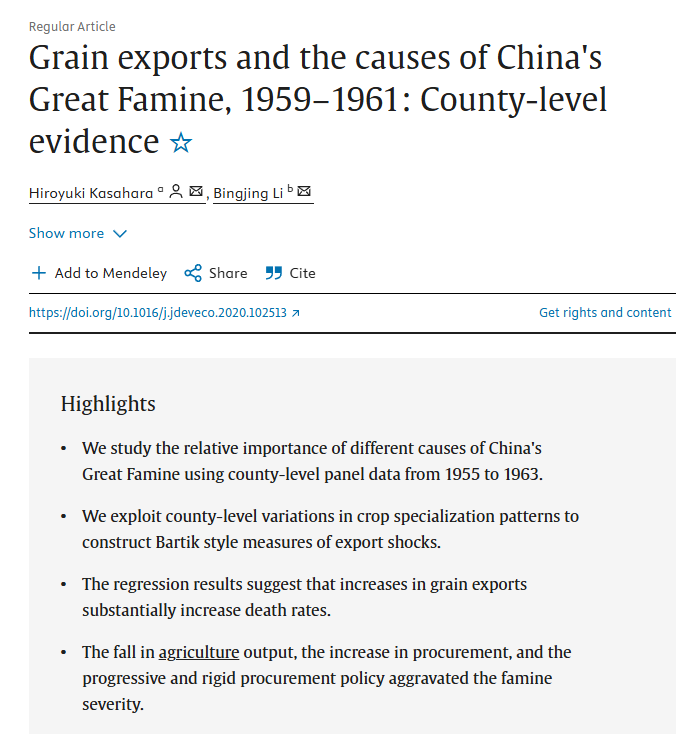
so the narrative that only the united states pursues advantage at the expense of others just collapses under scrutiny. the soviet union was perfectly willing to prioritize debt repayment and geopolitical leverage over the survival of its closest ideological partner
and it is not some minor footnote. that dynamic contributed directly to the sino soviet split. mao did not wake up one morning and randomly decide to sever ties. by 1960, in the middle of famine, he had had enough
notice something here
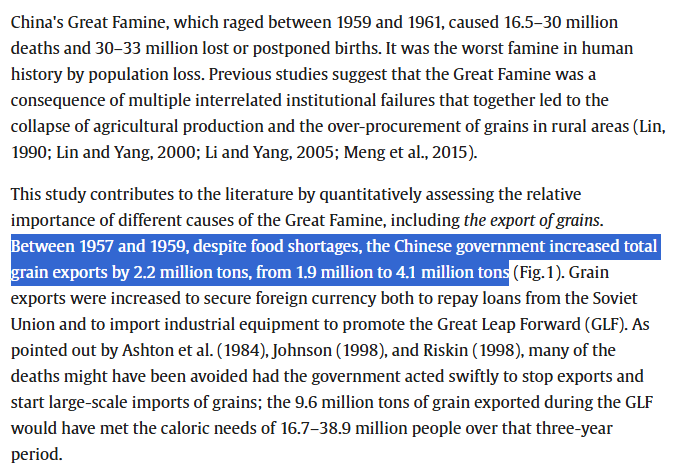
the timing of the end of the famine and the sino soviet split is no coincidence. when china finally broke with the soviets and stopped playing subordinate debtor the famine disappeared - they would have shut down the relationship earlier but had genuine fears of an american backed taiwanese invasion if they were unaligned with russia - in fact, they misread the situation and it wasn't until 1969 when things worsened to the point where hundreds of soldiers died in armed conflict on the border that the usa realized the split was genuine and began courting china as a partner - leading to the mao-nixon summit in 1970
had the usa never repeatedly threatened invasion of china, it's unlikely they would have even remained aligned with the ussr long enough for the famine to ever take place (some of those exports were not simply to pay off debt but rather to buy heavy industrial equipment needed to build up a national arms industry - which they felt was a perquisite to achieving true independence
yes, i'm aware you can find similar forced famines from the anglo-americans, but it is fantasy to pretend that russia historically refrained from brutal economic coercion or that they somehow behaved differently when power was on their side
what people want to hear is a simple morality play where one bloc is uniquely evil and the other is comparatively restrained. history does not cooperate with that framing. power politics looks ugly regardless of the flag it is flying
right so China and Russia demanded loan repayments while the US was slaughtering millions across dozens of countries. like I said, its no the same.
what people want to hear is a simple morality play where one bloc is uniquely evil and the other is comparatively restrained. history does not cooperate with that framing. power politics looks ugly regardless of the flag it is flying
After the split, the Soviets also soft supported Uyghur independence movements as a way of destabilizing China, with little intention of providing hard support and little regard for who would end up paying the price. The United States of course has done the same thing in various parts of the world.
right so China and Russia demanded loan repayments while the US was slaughtering millions across dozens of countries. like I said, its no the same.
The Soviet-Afghan war was approximately as destructive (fewer military deaths, but more civilian deaths and more displacement) as the Vietnam War and just as ill-advised. rick is mostly correct when he says it is hard to find heroes when major powers are in a Cold-War style geopolitical competition.
right so China and Russia demanded loan repayments while the US was slaughtering millions across dozens of countries. like I said, its no the same.
If a loan repayment causes more deaths than every war the US has participated in since WW2 combined, then yeah the loan repayment is worse or just as bad. Economic warfare has been one of the key tools of empire for thousands of years.
If a loan repayment causes more deaths than every war the US has participated in since WW2 combined, then yeah the loan repayment is worse or just as bad. Economic warfare has been one of the key tools of empire for thousands of years.
Agreed, but when you expand into adjacent areas like this, it won't look great for the U.S. either. The U.S. has done plenty of dubious stuff as well, like provide military aid to both sides of the Iran-Iraq war.
The Soviet-Afghan war was approximately as destructive (fewer military deaths, but more civilian deaths and more displacement) as the Vietnam War and just as ill-advised. rick is mostly correct when he says it is hard to find heroes when major powers are in a Cold-War style geopolitical competition.
This was the war that the USA armed and guided drug peddling Extremists to foment unrest and attack communists on the USSR's border right?
US sanctions killed 500k kids in Iraq and Madeline Albright bragged about it. you really think that the US looks better in the economic warfare department? ffs people are dying in Cuba right now bc the USA is about to put it under Gaza like siege.
US sanctions killed 500k kids in Iraq and Madeline Albright bragged about it. you really think that the US looks better in the economic warfare department? ffs people are dying in Cuba right now bc the USA is about to put it under Gaza like siege.
No, you’re actually supporting my point by bringing this up (assuming it’s true)
assuming it’s true
is it real or faked ignorance? does it even matter?
I’m not challenging if it’s true or false, I’m taking it as a given and pointing out how it supported my original point that economic warfare can actually kill more people than conventional warfare. It’s irrelevant to the inference I’m making.
Dun, you really think America cosied up to Saddam's Iraq or Pinochet's Chile to install democracy I don't think it's unduly cynical to opine "no" to this question.
Clearly there are empirical examples where US worked with authoritarian regimes where it was determined it was in its interests to do so. But generally there was a belief that modernization and free markets being introduced into the Third World would lead to liberal democratization. And this isn't generally what happened. And I dont think there is much optimism the Third World will democratize anytime soon, nor would such a democracy even be a good idea. For many Third World nations, the people are worse than the leadership.
i think the sinicization of africa is a great example of how tone deaf americans are about our own role on that continent and the rest of the globe. you constantly see opeds and news segments talking about the chinese rape of africa and it all quietly leads to the same conclusion: why are african governments choosing china over us? it must be corruption or evil regimes preferri
Do you have empirical examples of African countries that are doing better having turned to China?
Much of where the French had influence and left, Islamists are now rampaging through the country committing mass atrocities. I wouldn't' consider this an improvement. Maybe you have some empirical examples where things are demonstrably doing better thanks to Chinese influence?
I will say I have seen some documentaries on Chinese engineers working with African locals, and one thing the Chinese seem to understand better is just how corrupt and dysfunctional the Africans they hire and work with are if given opportunity. And plan their projects accordingly to mitigate this.
Whereas for ideological reasons, Westerns would refuse to recognize this and would keep throwing money into corrupt black holes.
idk enough to comment on that
a lot of that was based on various books by ha joon chang that i've read - his one that really deals with this stuff - kicking the ladder was published before china became a big player in africa - he dealt more with the fall and not with the rise
but that graph is real and indisputable - i think the main issue is africa is so big that some islamist narratives, while correct, don't represent the bigger picture of success outside of those niche regions
and frankly we or any other great power for that matter could probably fix that stuff if they wanted to without requiring trade concessions as payment - nobody chooses to intervene
the chinese probably do better in africa because they view all partners as temporary - if you're not blood it's a partnership of convenience that'll dissipate once the use case is gone
as i was often the sole foreigner working for whichever firm i was employed, i was often asked to run point on managing any relationship we had with any western business partners - it was a huge moral dilemna for me, knowing we planned on solely using their services for 6 months to learn from them and their methods with the ultimate goal of replacing them with in house people doing the same task - i would also know that we weren't going to simply end the relationship nor sign a 6 month deal even, we'd sign a 1 year deal and when they said they wanted to fly a team over to pitch a grander partnership at month 5, we would say "yes come fly over and pitch us" knowing full well we were not just going to drop them in a month, but rather just cease payment, try to brush it aside, explain it as bureacratic "it needs Joe's signature and he's on paternity leave for a month" etc and see how much additional work we can milk out of the partnership for free before they finally figure out they're never getting paid
i think that system works a lot better in systems where both sides understand that's how the game is played, and even when they are dealing with an american company that doesn't understand that, it's more of a prisoner's dilemma where you're better off screwing the other guy over first anyway
whenever anyone talks to me about partnering with a chinese company, i tell them one thing and one thing only, if you want it to work, you need to fly over there (or better yet fly them over to you) and wine and dine them, get drunk with the guys become genuine friends where it's not longer a "i better screw him over before he screws over me" because only if there's a genuine relationship will you be protected - either marry the guy's sister or become his friend - otherwise he's eventually going to stab you in the back
as i was often the sole foreigner working for whichever firm i was employed, i was often asked to run point on managing any relationship we had with any western business partners - it was a huge moral dilemna for me, knowing we planned on solely using their services for 6 months to learn from them and their methods with the ultimate goal of replacing them with in house people
Liberals choose to have no theory of mind for how the rest of humanity operates, as it doesn't conform to their ideological beliefs. It has always been very obvious how Chinese view business relationships. So if you allow yourself to be played it is on you.
That being said, the zero sum "screw you before you screw me" worldview is very self limiting. Which is why high trust societies operating with each other to grow the pie (where no bad faith is involved) is the more effective system. At least until the people become leftists and self-sabotage.

Liberals choose to have no theory of mind for how the rest of humanity operates, as it doesn't conform to their ideological beliefs. It has always been very obvious how Chinese view business relationships. So if you allow yourself to be played it is on you. That being said, the zero sum "screw you before you screw me" worldview is very self limiting. Which is why high trust
Replace "liberals" and "left" with "conservatives " and "right" and you might have a better argument.


