Do normal people make money opening so wide in EP??
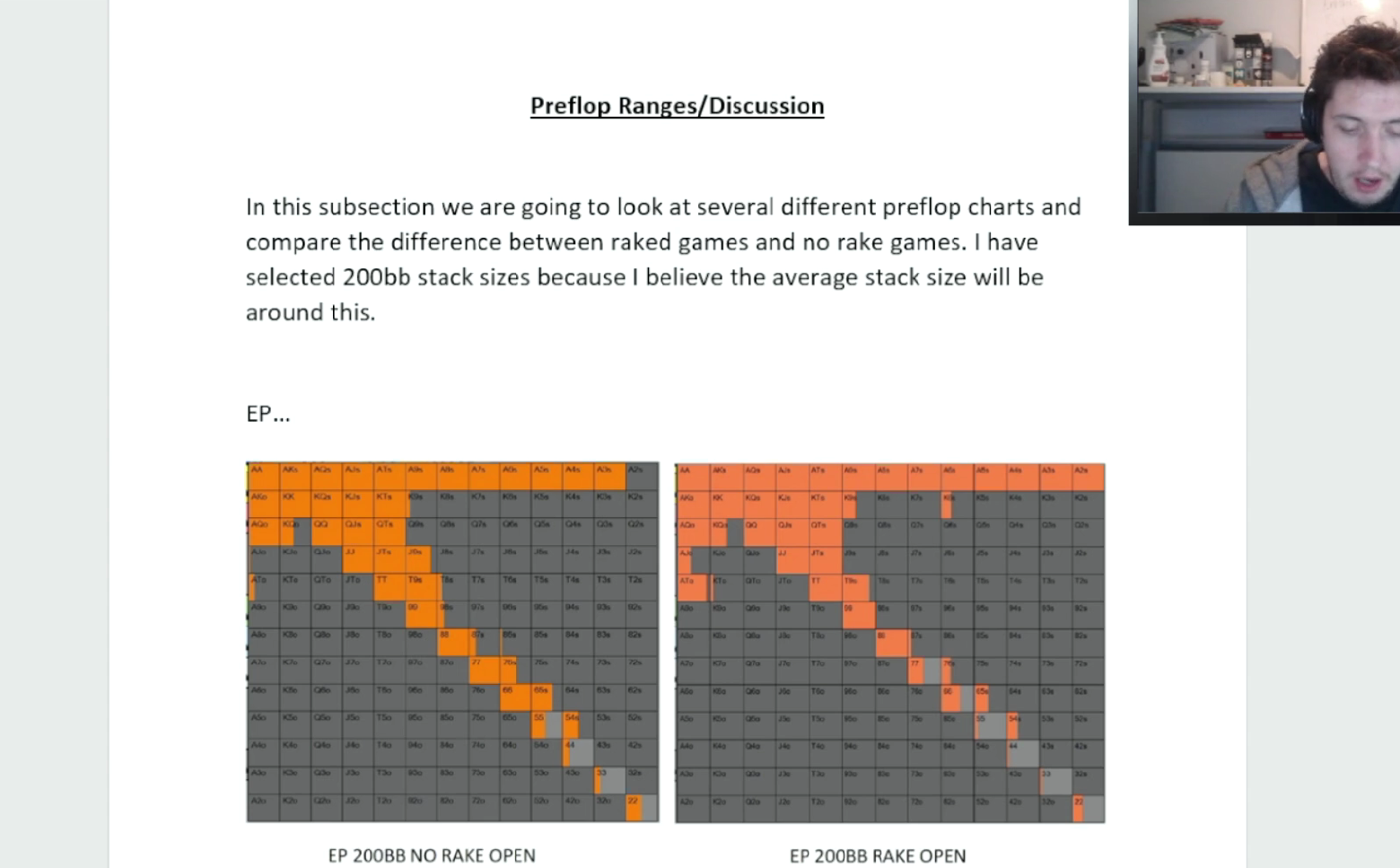
This is upswing live cash game courses(free from wpt gold). The very first video, he shows us EP opening range for 200bb.
I'm looking at this all those suited Ax, are they really profitable oop?? His rake open even includes ATo/AJo.
Btw, I'm not criticizing the chart. I'm just asking if you guys find it profitable.
I personally don't play such wide ranges in EP. I find it hard to make money oop. I try to play uber tight opening ranges.
I know these are charts used by GTO or pro players. But like for normal players, is it really profitable to open so wide?
There was 1 session, I was getting 3bet/squeeze quite a few times in utg open at the 2/5. Even if players call behind, postflop most of the time you miss. Even if you hit something decent like a nfd, we'd be oop.
So question is how many players here memorize all these preflop charts and play them by the book? Are they profitable for you?
How wide are your EP opens
Mine is something like AQo+/QJs+/ATs+/88+, then occasionally(once in a blue moon) throw in some SCs, Axs, some smaller pp.
It depends on our table reads. I don't memorize charts for every position. I watch what my opponents do, and decide how wide or tight I can open based on what they're doing in game.

Something doesn't look quite right about those ranges. The rake-adjusted range has us mostly opening AJo and ATo, while they are folding with no rake. That doesn't make sense to me.
I would think the rake-adjusted opening range should be tighter. I guess it's possible they're assuming everyone will play extremely tight facing your open with rake, and the offsuit aces just have blocker value?
In any case on an average 2/5 table I might open AJo but would usually fold ATo. Obviously the weaker your table is the more you can open, to a point.
I do open pretty much all the suited aces, and find that they're pretty profitable. Just don't get married to one pair. You're opening those hands to make a flush and stack someone 200 bb deep.
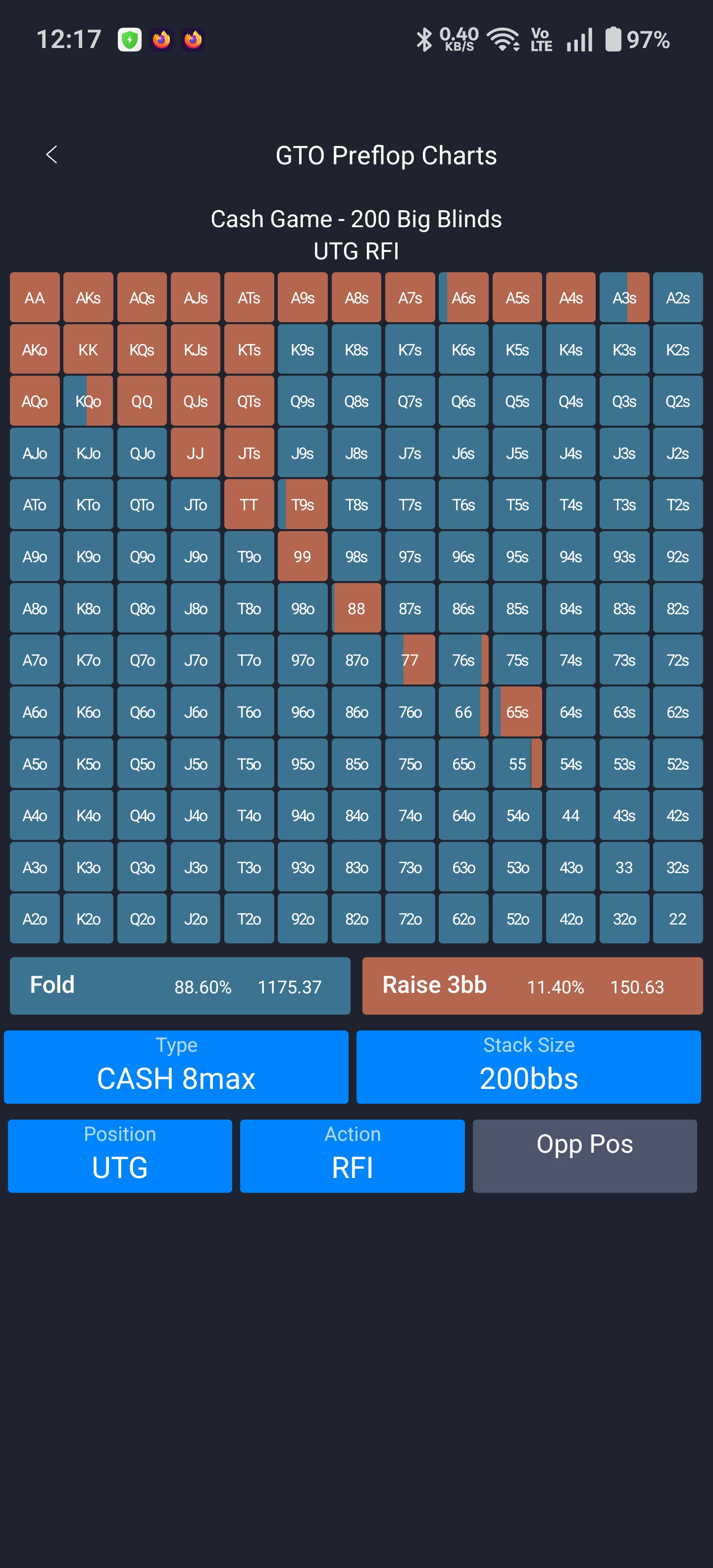
Here is the pokercoaching.com UTG range (8-handed) for comparison. This is supposed to be rake adjusted, but I don't know what rake structure they are using.
Those charts are attempting to create a range that is unexploitable by a balanced 3-bettor behind us. That's probably not something we really care about in live low stakes poker because people don't 3-bet enough, and they don't do so in any balanced way.
There's also plenty of times in live poker where limping is fine. Obviously it depends on table dynamics, but quite often you can limp speculative hands, even from EP. The charts are likely assuming you don't have a limping range at all. Though, most of the time these GTO ranges are based on tiny bet sizes that never seem to mimic real life. A 2.5x raise is basically a limp as far as I'm concerned, so I would put a lot of hands from that chart in my limping range. The small Ax suited hands are good candidates. They can make the nuts and I really want to see a flop. So limp, and call a raise if the conditions are right. I feel the same way about pairs lower than 8's

Yeah, I usually raise AJo. Limp or fold ATo. Raise or limp small pps. Raise, limp, or fold Axs. Depends on the table. I also have a limping range in ep, as well as a limp behind range in CO or BTN.
GTO is kind of garbage as applied to live games 2/5 and lower. Opponents aren't playing anything like GTO.
Yeah, I usually raise AJo. Limp or fold ATo. Raise or limp small pps. Raise, limp, or fold Axs. Depends on the table. I also have a limping range in ep, as well as a limp behind range in CO or BTN.
GTO is kind of garbage as applied to live games 2/5 and lower. Opponents aren't playing anything like GTO.
I agree with you here. That being said, to me the biggest value of GTO preflop ranges in low stakes games is just to give us some guidelines about the limits of profitability.
If we are opening hands far beyond GTO those hands are likely losing money. They might even be slightly +EV opens without rake, but they become -EV due to rake.
The other time I lean on GTO preflop ranges is when I'm facing a 3-bet or 4-bet from a very aggro opponent. The GTO ranges guide us as to how much we need to be defending so we don't get exploited.

What size are they opening?
Without quibbling over every combo (especially the mixes), that's <14% opening range, which is within the realm of reason if a bit high for a small size at a rake-free 8-handed table. (I would have expected it to get tighter in EP as you get deeper).
A good exploit of people who don't 3b enough and CC too much is to raise much larger with an all value range that could be half as tight.
I don't memorize charts both because it's impossible and because it misses the point of what charts teach you. I do memorize hand rankings, range widths, and a large number of arithmetic and range composition based heuristics that allow me to create any range at any width with any composition on the fly regardless of whether I've every played that spot in my life. No better way to learn exploits than to learn GTO.
What size are they openingWithout quibbling over every combo (especially the mixes), that's <14% opening range, which is within the realm of reason if a bit high for a small size at a rake-free 8-handed table. (I would have expected it to get tighter in EP as you get deeper).A good exploit of people who don't 3b enough and CC too much is to raise much larger with an all value r
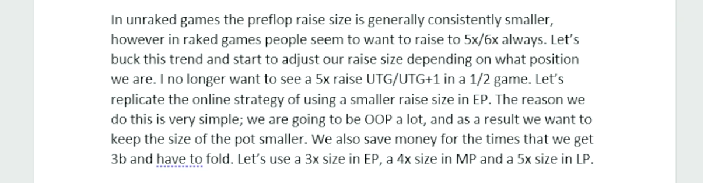
God knows the quoted instructor knows more about poker than I do, but I see no utility from opening EP to 2.5-3X live at stakes like 1/2-1/3. All it does is encourage a call parade and keep SPR high, which is exactly what we don't want with much of our value EP RFI range. I'd honestly rather L/RR it.
If the table has been liberal with 3!s, OK, different situation. Like Prez wrote, most of our Vs are just going to treat an open to 6 or 9-ish, as a limp. They shouldn't, but they will.

I personally don't play such wide ranges in EP. I find it hard to make money oop. I try to play uber tight opening ranges.
But like for normal players, is it really profitable to open so wide?
Everyone has to decide for themselves what they think is probably a profitable range in their conditions based mostly around an honest evaluation of their own skill level. The quickest way down the ski hill for the pro skier will probably be a double black diamond run, but for the novice skier it will probably be a green run / modest blue run. Draw a line in the sand that you think probably makes sense for you, because *you* are the one that will have to play the hand out (not the pro, not the forum poster, not the youtuber, not the training site guru, not the robot, etc.).
My EP range (which I actually simply limp in due to my style) is a very tight 77+/AQo+/ATs+/KQs (notice how I don't even have the weaker suited broadways in there) just cuz I doubt that much wider than this is profitable for my skillz level OOP in my game. Course none of us will actually know what hands are truly profitable for us in this spot due to not being able to track live results over what will be a lol sample size anyways, so all we can do is our best guess estimate (which will probably be a little wrong one way or another but hopefully not too much that it is damaging).
GdoyourthingG
There's too many dynamics at play in live games to come up with charts that are valid - furthermore good players should be adjusting if your making adjustments, and if not you can exploit them heavily. The problem with EP opens is the reality that you have 6 or more people behind to act with position and the likelihood of them having a good starting hand. I think in EP we have the least flexibility but you can play around with opening wider and see how people react - you can also play around with opening sizes if you feel there's an exploit to be had. The big profits should be coming from being IP esp if stacks are deep.
It really depends on how much respect is given to early position raises and image.
I’m folding QJs and other paint connectors unless the table is going to think I have KK when I open and overfold.
AQo+, ATs+, KQs, 88+
I’m a firm believer in position
It’s hard enough to play the strong hands OOP
Have no limping range, but if I did, I still wouldn’t widen my range.
I do worry about board coverage sometimes, because I don’t play many hands with a seven or below from any position. I know this can be exploited, but i still represent a caller’s board as most players know they could have some of that junk, so they think I probably do too. Only a very few understand that I can’t connect much better than the PFR if the board comes seven high.
I like suited aces better than suited connectors, if I do come in light.
Okay, that doesn't totally clear things up. So did they run the sim with those sizes or was the sim run with normal (smaller) sizes and they kept the output range but are suggesting different sizes?
I don't know of anyone who can replicate a sim of UTG in a 8-handed 200bb game opening 3x close to 14% of the time, even without rake.
I'd expect the pure opens to be AQo/99+/QJs/KTs+/ATs+/A5s, and the rest will be mixed at least some amount by at least some tools for at least some open sizes. That is completely different from saying "You should only raise these 7% of hands, "* but it is good to know what are the hands you're outright losing EV by folding, and the rest depends on a myriad of factors and strategic preferences.
The amount that people quibble over the mixes completely misses the point of how to implement lessons from sims into your game.
*Though you probably could literally just open those 7% of hands for a very large size and very closely approximate maximum extraction from this field's tendencies.
Opening smaller from early position and bigger from late position does make sense in theory, but the problem is how live opponents respond.
Basically they call way too much, which incentivizes us to open tighter in EP. Opening a tighter range against opponents who call too much then incentivizes us to open larger... And we're right back to opening to 5x.
My EP range (which I actually simply limp in due to my style) is a very tight 77+/AQo+/ATs+/KQs (notice how I don't even have the weaker suited broadways in there) just cuz I doubt that much wider than this is profitable for my skillz level OOP in my game.
If you are going to limp your entire range, I would limp wider. Would definitely limp all pps. You can always limp/fold for $3. I can't see how the tight range or limping it are optimal. Sure you can play really tight only play $4 blinds per orbit.
Your limping range is way tighter than my raising range and I do sometimes limp UTG. I am sure Banana's raising range is a lot wider than mine.
I used to also include 66-/A9s-/KJs/KTs/QJs/QTs/JTs, but I eventually guesstimated those hands are simply likely not profitable for me in EP. Especially typically playing in a shorter stacked game, especially one where 2x as many pots are raised versus limped and for large sizes.
Geveryonewillhavetodrawtheirownlineinthesand,andthat'ssimplywhereI'vedrawnmineG
I usually raise 99+/AJo+/KQo/A9s all suited broadway. I raise or limp all pps. Sometimes limp or raise some other hands. Sometimes limp some raising hands if there is a lot of 3-betting. Occasionally limp big hands to 3! them and sometimes balance that with bluffs.
I used to also include 66-/A9s-/KJs/KTs/QJs/QTs/JTs, but I eventually guesstimated those hands are simply likely not profitable for me in EP. Especially typically playing in a shorter stacked game, especially one where 2x as many pots are raised versus limped and for large sizes.
Geveryonewillhavetodrawtheirownlineinthesand, andthat'ssimplywhereI'vedrawnmineG
I feel like with your style you're likely missing out on some very profitable bluffing opportunities.
If you target the opponents that are capable of folding and take similar lines to how you play your best hands, I'll bet you'll get a ton of folds against regs who know how you play.
The bonus is that if you start getting caught bluffing occasionally it will improve your image so you get paid off more when you have it.
Upswing poker isn't saying that you must always open this wide, this range is theoretically defensible and +EV.
In the right environment Ax can be profitable UTG at 200bb especially A5s to A9s, they have value because: nut flush potential, wheel potential, strong semi bluff, board coverage on low textures, play well in 4bet pots, block stong Ax hands.
If you find you are getting squeezed a lot as you said, then if your game has frequent squeezing, aggressive 3 bettors, mulitiway pots, high rake, then UTG can lose EV quickly.
Live games have: massive rake, players who don't fold pairs, players who over realise position and people who flat everything behind.
Opening A7s UTG and going 4 ways OOP at 200 is not a solver sim, it's a rake trap.
People often use charts wrong,
Charts assume: you defend properly vs 3bets, you mix 4brts correctly, you barrel correctly, you check/fold correctly, you don't overplay marginal top pairs, you extract max when you hit.
If you're not extremely comfortable playing: deep stacked OOP, multi street bluffing, delayed cbets and thin value rivers, then widening EP is lightening money on fire.
Your range AQo+QJs+ ATs+ and 88+ that is a very standard solid live 2/5 UTG range. For most live pools, that is probably higher win rate than solver UTG . Because live poker punishes: thin opens, marginal OOP spots, fancy balancing and rewards: value density, nut potential, simplicity.
Missing flop: you miss the flop 65% every time with almost every hand. The difference is good players monetise fold equity and most live players cbet poorly and then shut down .
If you're not comfortable triple-barreling A5s on:
Kd 7c 2s + 9h + 4c, then you won't realise the EV that makes that open profitable
In live 2/5 very few winning players play chats exactly. Most live pros: start tighter than solver, adjust wider if table is passive, tighten if 3b heavy, open wider when blinds are weak
The GTO charts are not so much wrong in terms of how wide to open as which hands to open when applied to typical live tables 2/5 and lower. I know GTO is always right and unexploitable, but it can't be directly applying to live games where a 5xBB UTG open gets 4 flat callers.
The GTO charts are not so much wrong in terms of how wide to open as which hands to open when applied to typical live tables 2/5 and lower. I know GTO is always right and unexploitable, but it can't be directly applying to live games where a 5xBB UTG open gets 4 flat callers.
How so? Which hands are you opening that are not in a GTO range?
If you’re not profitably raising every AXs from every position and/or have any open limps from any position in live 2/5 200bb deep, you have a tremendous opportunity to improve your win rate with little to no effort
I don't know if my range is correct. However, I would open AJo/KQo, which will get called by hands they dominate. I would also open any pp, because it will likely go multiway, and players have trouble folding top pair or 2 pair. However, if the table was tight or there was a lot of 3-betting, I would limp small pps.
There's no way GTO charts would be accurate/useful for any live 2/5 game.
I don't know if my range is correct. However, I would open AJo/KQo, which will get called by hands they dominate. I would also open any pp, because it will likely go multiway, and players have trouble folding top pair or 2 pair. However, if the table was tight or there was a lot of 3-betting, I would limp small pps.
It's hard to know for sure in live poker which hands are turning a profit, but this seems pretty good. With AJo and KQo you're relying on people calling with more dominated hands than dominating ones. With small pairs you're relying on a low frequency of preflop aggression to push you off your hand.
The main adjustment I make to GTO ranges is that I always fold low suited connectors in EP. I don't think they're profitable, because you get called too much and end up playing multiway pots OOP.
At 200 bb deep I open something like AJo+, A2s+, KQo, all suited Broadways, and usually all pocket pairs if the table is relatively soft. I ditch the small pairs if the table is relatively aggressive.
That's actually not that far off from GTO ranges. I'm expanding my big offsuit hands slightly assuming people will play bad postflop. I'm also mostly substituting smaller pairs for small suited connectors, assuming less preflop aggression and more multiway pots where small pairs will realize their equity better.
The main thing is making sure to fold stuff like weaker offsuit Broadways in EP. There was a time I used to open those thinking people would still call with dominated hands, which is true to an extent, but I still think opening these hands is a pretty big leak.

