King Eight IP flops big

1/3 NLHE 9 handed
I've transferred to this table late in my session as mine got worse and worse. Several loose passives a

Once you call the flop bet, you are pretty much pot committed on the turn, even on a bad card.
You're right, he's not really raising into 3 players, the sequence is: 4 to flop, check, check, check, OP bet and it folds to villain and he re-raises, that does materially widen his range compared to SB x/r into 3 players or someone raising before folds occur.
However, and this is subtle, he still saw: 3 players decline to stab, OP stabs from the BTN, and now he attacks that stab
That dynamic still skews value heavy at 1/3, just not as tight as a true raise into 3 spot
The key structured factor isn't number of active players at the moment of raise, it's this: low SPR + large c/r sizing, he's making it 135 with 275 back, that's not a small probing raise, that's a we are playing for stacks raise.
At 1/3 that sizing heavily weights toward: strong made hands, nut flush draws, combo draws, occasionally ego blasts, so yes his, his range than I first framed it, but not wildly wide.
Jam vs bluff heavy range, you're right in principle: if villain is bluff heavy, and we are ahead, we prefer to call and let him continue bluffing. So why would jamming ever be correct? Because of SPR and equity realisation constraints
After this raise, pot = 80+35+100 =215, he has 275 behind, SPR = 1.3, if OP calls: pot = 350, he has 275 left behind, turn SPR =0.8 meaning: there is almost no room to manoeuvre, most turn in money going in.
So calling to let him bluff isn't really a deep tree decision. It's effectively a delayed all in spot. Now here's the key: if his range is bluff heavy and contains:
Ac Jx, Kc Jx, Jc Tc, T9c . These hands have 25-45% equity vs you, by jamming flop: OP denies their equity realisation, OP prevents them from seeing a turn that might kill OPs action, OP avoids scare cards that freeze, like club Q, overcard dynamics. At low SPR, denying 30-40% equity is massive
The correct decision depends on which of these 2 worlds OPs in: value heavy range, sets, AQ/KQ, nut draws, folding is best, draw heavy, ego heavy range, Ac X, random club combos, light Qx, weird spaz, jamming is best.
Calling becomes worst in both scenarios because: against value heavy range, OPs drawing and dominated, against bluff heavy range, OP allows equity realisation. Calling is the feels reasonable play, it's often not the highest EV one
Forget jam vs call for a second, the entire decision reduces to: does this player x/r this sizing with worse 8x and random air at meaningful frequency? If yes, stack off, if not fold
On the flop, you are putting in about 43% of the money and you are 30% against a set. On the turn, you are putting in about 30% of the money and you are 18% against a set. It doesn't change very much. You may be getting a better price on the turn, because you are getting better pot odds and you are a bigger favorite versus draws. However, some of the combo draws you were way ahead of are now ahead with pairs. On the flop, he didn't shove, so you can flat call and he can fold to your push.
I don't see how you fold either the flop or turn, unless you think he almost never has a draw or you just want to avoid a big gamble.
You have odds to gii on both the flop and turn. There is substantial money already in the pot. So on both the flop and turn if you knew villain had two pair, it would still be profitable to gii. You can't put villain on just a set when you know he is capable of making this sort of play with a weak draw. There is no way it can be really bad to gii. You just have to take a somewhat favorable gamble.

As the straddle he's calling with a lot of suited combos, so there are a lot of flush draws he could be raising with that we have dominated. If he has a FD worse than A high we have him completely crushed. That's the crucial portion of his range you ignored. I think if we just call there's a good chance he jams these on the turn, but he might fold if we jam flop.
Not that I hate jamming flop. I still think it's better than folding turn.
Deuceblocker pretty much summed it up. He doesn't really have to be bluffing much for us to be priced in, because we're not even that far behind the price we need vs a set.
Also, think about it this way. He should be raising pre with QQ so he can't really have that. We're blocking 88, so there is only one additional combo of that. There are 3 combos of 33.
So basically there are only 4 combos of sets and many more additional combos of flush draws and Qx that we either have crushed or are flipping against (in the case of Qx).
What hands are you drawing close to dead against on the turn? You are 18% against a set and need to put in 30% of the money. You are 27-38% against 2 pair.
The paintings with the dogs playing poker are from about 1903 to advertise cigars, which is why they are all smoking cigars. They are playing 5 card draw, probably no limit.
I don't know what the dog's playing poker painting has to do with this hand, or why you keep mentioning its vintage.
I'm just guessing that V isn't x/r'ing the flop and barreling turn with complete air.
V could have ATcc, which is a higher pair and a higher club flush draw, so hero's outs are reduced to 3 K's and 2 8's.
AJcc isn't ahead, but it's a higher flush draw that picked up a double gutter, plus can make a higher pair on an A or J.
J9cc is a straight, and has us crushed, holding two of our flush outs. J9ss is also a straight, with a re-draw to a spade flush.
JTcc and T9cc both made a better pair, and picked up a gut shot, and are holding 2 of our flush outs.
KQ, QT, Q8, Q3, 88, and 33 all have us in rough shape. Any QXss combo removes the Ks as an out.
Banana's read was that this guy could somehow show up with QQ. If that's true, I imagine he could show up with TT.
If we give him a range that included all the sets, all the 2P, all the straights, all the better 1P + better flush draws, all the better flush draws + double GSSD's, and all the KQ, we're not doing great.
I think the best case scenario here is we have 14 outs, and are around 28%-30%. I'd guestimate we're around 15%-25% versus his entire range.
What hands are you drawing close to dead against on the turn? You are 18% against a set and need to put in 30% of the money. You are 27-38% against 2 pair.The paintings with the dogs playing poker are from about 1903 to advertise cigars, which is why they are all smoking cigars. They are playing 5 card draw, probably no limit.
I don't know what the dog's playing poker painting h
Why can't he have worse flush draws?
Also, you guestimated we have around 15-25% equity. You do realize there's not a single hand in his range that we only have 15% equity against? We have more than that against sets and straights.

Also, you guestimated we have around 15-25% equity. You do realize there's not a single hand in his range that we only have 15% equity against? We have more than that against sets and straights.
It was mentioned that...
V could have ATcc, which is a higher pair and a higher club flush draw, so hero's outs are reduced to 3 K's and 2 8's.
Personally I disagree with the pessimistic assessment of hero's equity on the turn, as we play against a range, not a single hand. But I wouldn't be so hyperbolic to say theres not a single hand ..
(Unless you're referring to the flop)
Yes as a straddler he can many suited combos, but the real question is not, how many suited combos preflop? It's how many of those x/r large here at 1/3. Population reality: at low stakes players: call flop with medium strength draws, raise nut draws, raise combo draws, raise sets.
They do not reliably raise: 9c 6c, Tc 4c, random small club hands, especially not to a size that effectively commits themselves
And here's the quite but huge issue, many of the FD that do raise contain the Ac, Ac Xc is extremely common in x/r raises ranges, if he has Ac Jc, Ac Tc, Ac 5c, our Kc is not dominating, were actually in rough shape so the "we crush his FDs" statement is only true if: he raised non nut clubs at high frequency, that's the frequency assumption.
We're almost priced in vs a set, let's sanity check, against a set on Qc 8s 3c, we have roughly 35% equity. If stacks go in, we're investing about 410 total to win 760ish, so we need roughly 35-36% so yes we're close.
But being close vs the top of the range, doesn't mean stacking off is good, the real question is. What is our equity vs his full raising range, if this range is: sets, AQ, KQ, Ac Xc, some combo draws, our equity drops below comfortable levels quicky, especially because: when he has Qx we're not flipping, we're 40-45 and we have reverse implied odds on runout clubs vs Ac
Only 4 combo of sets, yes QQ probably 3b pre mostly, 88 1 combo we block, 33 3 combos, but that's incomplete, because value isn't only sets, what about AQ, KQ, Q8s, slow played AA
Low stakes players absolutely c/r AQ here and once you include AQ, KQ value combos increase significantly, and importantly value hands play aggressively at higher frequency than medium flush draws. The real crux, everything depends on this, does this player x/r medium FD at meaningful frequency, if yes, stacking off becomes good, if not folding becomes good
The hand reduces to, if villain raises, sets, AQ nut draws only then fold, sets, all FD, some Qx then Jam, sets, nut draws only, very close, so it's a frequency problem not a math problem

I realize painters might not be the best source ... but playing 5 card draw no limit seems pretty unlikely to me.
I do remember playing pot limit stud8 micro stakes online years ago, but I don't think that's a game that could last long at higher stakes than micro.
Why can't he have worse flush draws
Also, you guestimated we have around 15-25% equity. You do realize there's not a single hand in his range that we only have 15% equity against We have more than that against sets and straights.
It's possible for him to have a worse flush draw. I doubt this V type only has a worse draw when he takes this line. His worse flush draws that x/r the flop are likely to be JTcc/T9cc that turned a higher pair, or J9cc that turned a straight.
What's our equity against ATcc? It's around 12%. We have around 15% against J9cc.
I'm not saying we should fold turn against a jam from any/every V. I'm saying it's okay to over-fold when we think our opponent is under-bluffing in this line. And I think this V type is the type to under-bluff here.
I didn't plug his range into an equity calculator. We can't do that in game. That's why it's a guestimate. I think this guy is under-bluffing in this line, and his range is going to be weighted towards hands that already have us beat, or have a ton of equity against ours.
As a thought experiment, imagine V checked to us on this turn. Would we check back, or jam? I'm guessing we'd like to take the free card and check back, when all of V's most likely bluffs improved to a better hand or picked up additional equity.
If we wouldn't be confident jamming turn when V checks, I don't know how we'd be happy calling it off when V jams.
We're getting just over 2.25 to 1. If it was 3 to 1 or more, I'd be in there. Somewhere around 2.5-2.75 to 1 is where I start wondering if calling it off is break even.
Ok you guys got me I misspoke. There is literally 1 combo that we have less than 15% against. You see how far off your equity estimate is though Doc? When you're estimating we only have 15-25% equity against his entire range, and we have better than 15% equity even against a set or a straight?
If you give our opponent a range of sets of 8s, sets of 3s, QJ, KQ and AQ, it's a close fold.
Do you know how many flush draw semibluff combos you need to add in to that range to give us the right price to call the turn jam?
The answer is 2. Two total combos pushes us across the break even point!!!
That is also assuming they're nut flush draws that are drawing live against us. Against a range of 88, 33, QJ, KQ, AQ, A2s and A3s we have better than the 30.5% we need.
He does not have to be semibluffing at a large frequency to make this turn spot a call.
So DHAC, by your own standard when you said he could be semibluffing with the nut flush draw, that is enough to make this a call.
Doc, yes we may want to check back the turn if he checked to us, assuming we choose not to semi-bluff ourselves. That doesn't make the turn a fold when he jams.
To value bet you need to be good more than 1/2 of the time when called. To call off the turn jam you just need your 31% pot odds. It's not the same standard.
The reality is that this situation is an example of a loss aversion bias. The pain of losing money is greater than how good it feels when you win money. It doesn't feel good to put your money in when you are often behind.
Our feelings don't change the math though. It's still not a fold.
I realize painters might not be the best source ... but playing 5 card draw no limit seems pretty unlikely to me.
I do remember playing pot limit stud8 micro stakes online years ago, but I don't think that's a game that could last long at higher stakes than micro.
It looks like 5 card draw. It has 2 betting rounds, compared to 4 for holdem and Omaha, and 5 for stud. It is sort of a trap for fish, who call to much predraw hoping to hit on the draw.
Games were generally no limit before like 1960. No limit 5 card draw is a good game and what Wild Bill Hickock was supposedly playing when he got shot from behind by a losing poker player while supposedly holding AA88x.
Ok you guys got me I misspoke. There is literally 1 combo that we have less than 15% against. You see how far off your equity estimate is though Doc When you're estimating we only have 15-25% equity against his entire range, and we have better than 15% equity even against a set or a straightIf you give our opponent a range of sets of 8s, sets of 3s, QJ, KQ and AQ, it's a close
I don't know what DHAC means.
Again, I was guestimating, the way I would in-game. Sometimes guestimates are off. Don't hate a brother for not being able to run complex equity calcs in his head.
That guestimate is based on my own observations of this V type. My observation has been that this type tends to under-bluff to such a degree that he likely has next to no bluffs here, and may literally have zero bluffs.
OP says he thinks V can show up with QQ. I struggle to believe that, but it's OP's read. If we take it at face value, it certainly seems possible he's showing up with TT. There again, I struggle to believe V is x/r'ing flop with TT, but we're apparently giving this guy an unlikely combination of traits pre and post.
I can't help but think that if anyone told us that they got stacks in with 3rd pair + the 2nd NFD on the turn, after V defended his straddle vs a BTN raise pre, and x/r'd the flop, and then jammed turn for 80% pot, when the turn brings in a straight, we would never be surprised if V had the better hand, and we might think calling it off is a dubious decision.
The way I'd approach this decision is this - I don't think we're ahead on the turn very often, and maybe not ever. This is a fairly under-bluffed spot. We could have as many as 12 outs, or as few as 5. Even if we are ahead, our opponent likely has a ton of equity to improve.
Looking at it that way, and figuring we'd need to win around 30% of the time, it would be hard for me to find a call in game. If it's a mistake to fold, it wouldn't seem like a huge blunder that would warrant four pages of brow-beating anyone who doesn't know it's supposedly a mandatory call.
At the absolute worst, this seems like it would be a slightly losing fold. To be fair, it may very well be a slightly +EV fold. It would seem to depend on what range we assign V.
There's no such thing as a +EV fold. A fold is always 0 EV. The question is whether the call is +EV.
Anyway I'm not trying to brow beat you. I just suspect most of my winrate comes from pressuring nits in these types of spots and getting them to overfold. I'm trying to get you guys to wise up.
As I said earlier in the thread, I don't think the turn fold is like a huge donk move or anything. It's just indicative of a bigger problem where you're over folding vs aggression. That is where most of my winrate comes from, and in 2026 that is where most slightly losing to slightly winning players are giving up the most EV.
Anyway how are you estimating your equity in game? I use the rule of 2 and 4 when estimating equity with drawing type hands. Multiply the number of outs by 2 on the turn, or 4 on the flop for an approximation of our equity if we have to hit our draw to be good.
By my count we have as many as 14 outs. That's 9 outs to a flush and 5 outs to 2 pair or trips. I would discount a few of those outs because we might not always be good when we hit some of those outs.
So very conservatively we should have at least something like 11x2= 22% average equity on the turn. However that is assuming we're never ahead.
If he's got a worse flush draw he's close to drawing dead and even if he has the nut flush draw with no pair we have close to 80% equity. You factor in a few of those types of combos and it becomes a clear call when we only need 31% equity to call.
Anyway you called me out before for projecting my own tendencies on my opponent. You were right in that spot, and I think you're doing the same thing here. You wouldn't be bluffing much in this spot, but according to the villain description, this guy would.
There's no such thing as a +EV fold. A fold is always 0 EV. The question is whether the call is +EV.Anyway I'm not trying to brow beat you. I just suspect most of my winrate comes from pressuring nits in these types of spots and getting them to overfold. I'm trying to get you guys to wise up. As I said earlier in the thread, I don't think the turn fold is like a huge donk move
Now I've misspoken. Of course you are correct about folds being 0 EV. I meant that compared to calling, which may be -EV, a fold would be higher EV by comparison.
It's funny that anyone would describe me as a nit. Judging by the comments I get, I'd think my table image is maniacal. I don't think the image is entirely deserved, when it's mostly due to my typically playing raise-or-fold pre. If you saw some of the hands I raise pre, you probably would brow beat me, and I wouldn't have much of a counter-argument beyond "I'm bored and I'm playing against rec-fish clowns."
In another thread, I did suggest you may be projecting your play style onto the others in the pool. I actually suspect you may have been doing that here, with this V, especially in light of the mini-debate we had about V's range based on the read given of his player type.
I don't think I'm projecting my range onto V. If I'm in V's spot, and I x/r'd the flop with a reasonable range, I'd probably be more likely to jam turn as a bluff than I'd be to jam with 2P or a set that's been downgraded. If I have a leak in this spot, it's not under-bluffing, it's not following through with value because the turn card is scary.
I believe you may indeed be taking V's line with a range that would make it +EV for hero to call the turn jam. Even if you disagree with me, I trust you can accept and understand that I'm skeptical this V is showing up with that same range, or that he has anywhere near enough bluffs to make it +EV to call turn.
It's nothing to do with what I'd be doing here. It's everything to do with what I see MAAG's doing here. I'd be over-bluffing. They'd be under-bluffing. I'm guessing you're just jamming turn with all your value and all your bluffs, which may make you balanced, which may be optimal in your games, but I don't think would be optimal in mine.
IMO, ours is not a debate over math. The math just is what it is (even if I can't do it in my head). Ours is a debate over how we range V. We're debating the assumptions, and as a result coming to vastly different conclusions.
We never got a reveal. We can't know what V had, or what his range would actually be. It's hard for me to believe the EV difference between calling and folding is enough to warrant the argument that's taken place here.
Calling because GTO and math says we should? Fine. Folding because we're exploiting a V we think is under-bluffing? Also fine. Calling because we think V is over-bluffing? Sure. Still fine.
I think my disagreement is actually more with the math. That's probably why I'm still arguing with you guys. Lol. You're overestimating how much he has to be bluffing.
Assuming a reasonable worst case scenario where we give him full frequencies of QQ, 88 and 33 along with strong Qx he still only needs 4 total combos of bluffs to make it a call on the turn. Here is the equity breakdown assuming that nutted range plus A5, A4, A3 and A2 of clubs as his only bluffs.
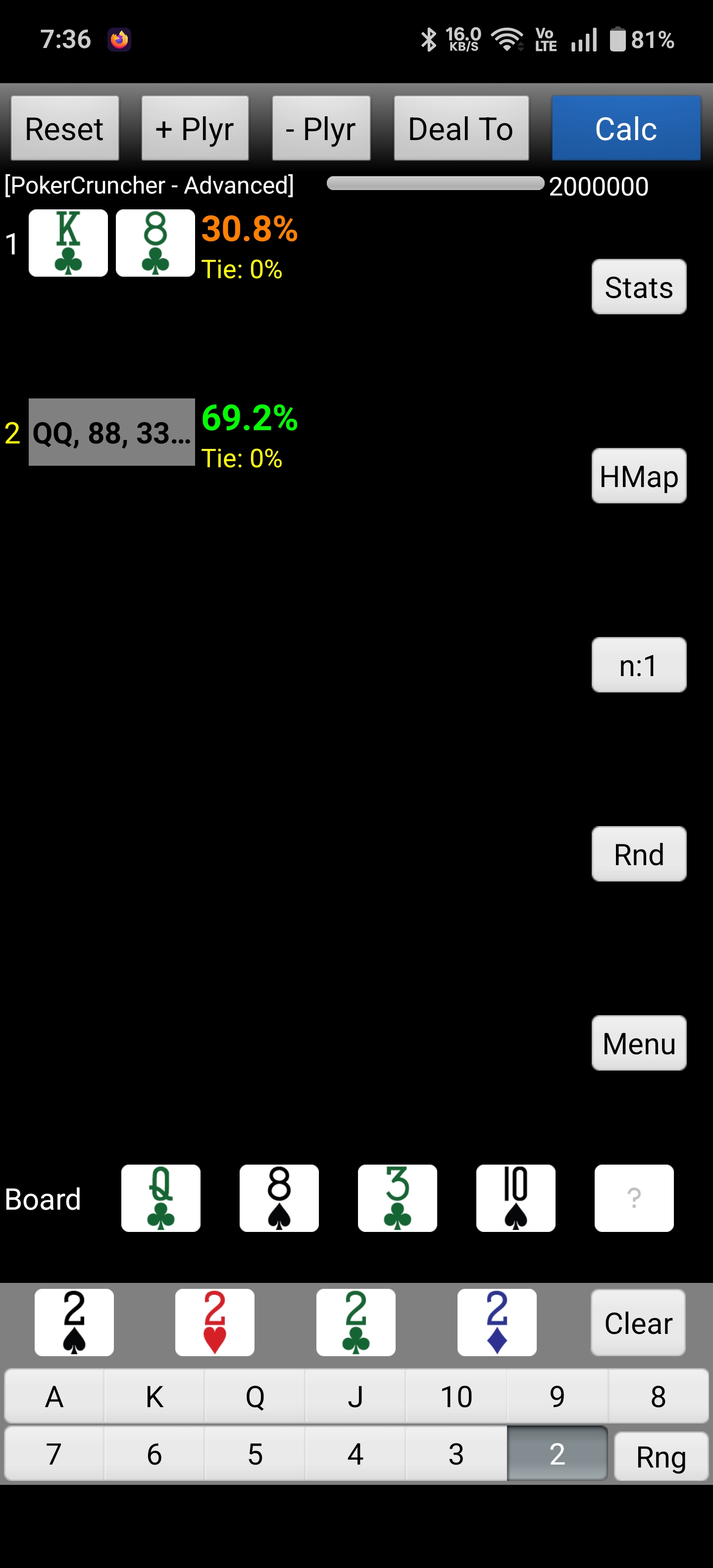
Not that I'm saying this is going to be his exact range, but given 2 flush draws and a bunch of possible straight draws, he literally needs to be bluffing less than 5% of the time with his draws to turn this into a call.
Anyway I'll let it go now.
I think my disagreement is actually more with the math. That's probably why I'm still arguing with you guys. Lol. You're overestimating how much he has to be bluffing. Assuming a reasonable worst case scenario where we give him full frequencies of QQ, 88 and 33 along with strong Qx he still only needs 4 total combos of bluffs to make it a call on the turn. Here is the equity br
That's fair. It does appear that at least I have been overestimating how much he needs to be bluffing.
I do think he's under-bluffing here, but of course there's a price at which it doesn't matter, and we have to call. Maybe the bluffing frequency here is just high enough, and anyone who folds is under-estimating our equity.
Good argument.
I think where we're differing is in the assumed bluff frequency.
I'm not saying the math is wrong if even 1-2 semi-bluff combos are there. I'm questioning whether this player player type is check raising flop and jamming turn with non nut draws at any meaningful frequency.
My experience with this type is that they underbluff this node pretty heavily. If that assumption is wrong, then sure, it becomes a call. But if he's mostly value here, folding isn't overfolding, it's just range construction.
Not that I'm saying this is going to be his exact range, but given 2 flush draws and a bunch of possible straight draws, he literally needs to be bluffing less than 5% of the time with his draws to turn this into a call.
Yeah, I think a little more than 5%, but that is what I was saying. On the turn, you are about even with pot odds against 2 pair. He only needs a small percentage of draws for hero to have odds to call on the turn. I don't think it matter much what villain's range is. It is still a call.

