An experiment with playing styles in live low-stakes tournaments.
I play in a local cardroom which usually has three tournaments each week. A $90 tournament typically with about 50 players ($45 with a $45 add on at first break), a $100 tournament with about 25 players ($80 plus $20 add on), and $160 ($130 plus $30 add on) with about 30 players. The club then posts pictures of the winners on facebook. So, I decided to conduct an experiment to see who has won the most over the last 65 or so tournaments. I gave a full point for people who won outright and 1/2 point for people who chopped with one other, 1/3 if three, etc. Now, obviously this is not scientific and players who play more often are likely to win more, but after doing it I started to wonder about playing styles in low-stakes live tournaments. Here are the top ten.
1. Plays a solid range of hands, mostly limps pre-flop, and not particularly aggressive, but will bet when he has a hand.
2. Plays a wide range pre-flop, raises/calls about 50-50 pre-flop, solid and aggressive post-flop.
3. Tight old guy. Rarely raises pre-flop, bets when he has a hand.
4. Loose and aggressive pre-flop, mostly raising when he enters pot, but will limp 30% or so. Aggressive after flop.
5. Very tight pre-flop. Raises about half of time when enters pot, mostly with premium hands, will limp with small pocket pairs, two big cards in position. Aggressive post-flop.
6. Do not recall playing with this player. Older woman.
7. Loose, mostly passive pre-flop. Moderately aggressive post-flop.
8. Moderately loose. Premium hand if he raises pre-flop. Will bet when he has a hand, but mostly passive post-flop.
9. Plays a solid range pre-flop, but only raises with premium hands. Bets when she has a hand, but rarely bluffs (will bet draws, second pair, etc.)
10. Plays a solid range pre-flop, raises about half of range. Aggressive after flop.
In the subjective opinion category, I would say that the actual best players are the ones ranked 1, 2, 4, 5, 6, and 10. Others on the list just play more often.
Anyway, the thing that struck me was that outside of numbers 4 and 10 (and maybe 2 and 5), most of the people who showed up on this list do not raise a high percentage of the times they enter a pot pre-flop. After the flop (including turn or river), most rarely bluff (4 is an exception). 2, 5, 7, and 10 will bluff some, but the others only rarely bluff, if at all. Of course all of these players will bet/trap after the flop if they have a good hand. Another comment is that at this particular club, there are a fair number of young and aggressive players but they do not seem to have the same success rate. There are also a number of passive players who do not make the list. Stylistically though, it looks like some limping pre-flop is more successful at this level than players who always raise entering a pot. Also, it appears that while being totally passive is not good, mostly just betting strong hands seems to be a successful strategy post-flop.
I understand that the tendencies that I have identified above will not work at higher stakes. But I am questioning whether some basic tenets of good poker play (in particular, don't limp pre-flop and post-flop aggressiveness) are best at these stakes.
I welcome any feedback.
5 Replies

Here's a variance calculator showing 20 samples of the same player playing 65 tournaments with a $100 buy in and 30% ROI. Notice the wide range of results:
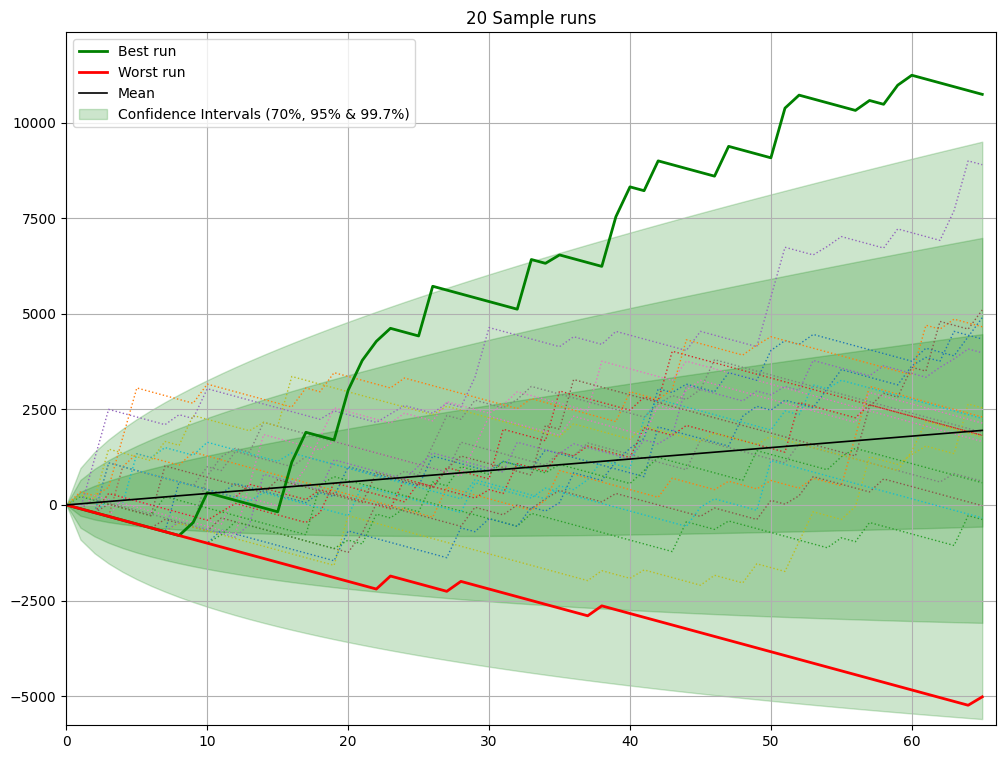
That sort of sample is too small to tell you anything.
I certainly understand that. I will tell you though that it matches my experience in these tournaments. The final tables (again, usually out of 30-60 players) are often heavily weighted toward this kind of players.
I think at the smallest stakes hand reading ability is probably the most important skill (it's pretty important at high stakes too). Players are incredibly imbalanced so the most important skill is just understanding who's a nit, who's a maniac, etc. You can make a lot of different styles work if you're good at adjusting to your opponents. I would tend to disagree that there's any advantage to playing passively and limping a lot though.
I certainly agree about hand reading and that there is no advantage to playing passively (unless we count limping pre-flop as passive). My experience has been that building big pots pre-flop, however, diminishes skill advantages later in the hand. Not that I am advocating limping all of the time. I would guess that I raise anywhere from about half the time pre-flop early in tournaments where I think I have a big skill advantage to almost all of the time later in tournaments where my skill advantage is diminished by stack sizes and by the fact that players who remain tend to be betters since lesser players have busted out.
Should mention that I only play WSOP tournaments. I have no experience with cardroom tournaments, so it may not be helpful, but a few thoughts:
I’m a FoR player in cash (fold or raise) pre-flop, because I can sit there all day. In tournaments, I don’t throw out this style completely, but you have to get involved in more pots (especially early) or card dead can ruin you.
For instance, AT
UTG I fold this hand in cash, but I might limp in a tournament.
On the button, I might fold to a bet in cash, but call in a tournament.
On the other hand, you can take this too far
It’s not smart to get too far out of line.
The hand readers & the lucky ones beat tournaments. It’s probably debatable, but I see a lot of weak players in tournaments that I never see in cash games. Good players get involved with these inexperienced players and find exploits along the way.
They know who they can make fold, they know when that bet-sizing is the nuts. Many average tournament players are playing tight and when they do get a hand, they get nervous, they telegraph it.
I’m not there yet, but Iike you, continue to study. I know a few crushers, but they’re not giving out any secrets. I don’t think zeroing in on style is what you’re looking for. It’s more about reading people in stressful situations.
I get near the money to the flip stage often, but the great players are deep and not flipping. They are the big stacks pressuring the rest of us.

