SCOOP $109 NLHE Kickoff
UTG: 199.35 BB
UTG+1: 170.66 BB
MP: 301.61 BB
CO: 166.67 BB
BTN: 160.88 BB
SB: 49 BB
Hero (BB): 161.33 BB
7 players post ante of 0.12 BB, SB posts SB 0.5 BB, Hero posts BB 1 BB
Pre Flop: (pot: 2.32 BB) Hero has Q♦ 9♦
UTG raises to 2.3 BB, UTG+1 calls 2.3 BB, fold, fold, BTN calls 2.3 BB, fold, Hero calls 1.3 BB
Flop: (10.52 BB, 4 players) J♦ T♣ K♠
Hero checks, UTG bets 8.2 BB, UTG+1 calls 8.2 BB, fold, Hero raises to 32 BB, UTG raises to 196.94 BB and is all-in, fold, Hero ???
What's your play here?
He could have AQ.
Would he ever do this with JJ or KK?

That isn't even close to a 2x pot raise.
I guess we just get it in here, although we'll definitely lose a significant amount of the time. Outright 3-bet jamming AQ this deep on this board doesn't make a ton of sense, but sometimes coolers happen. I dunno, I feel like the pot is just too big now to let the second nuts go.

Yuck. I think it might be a fold.
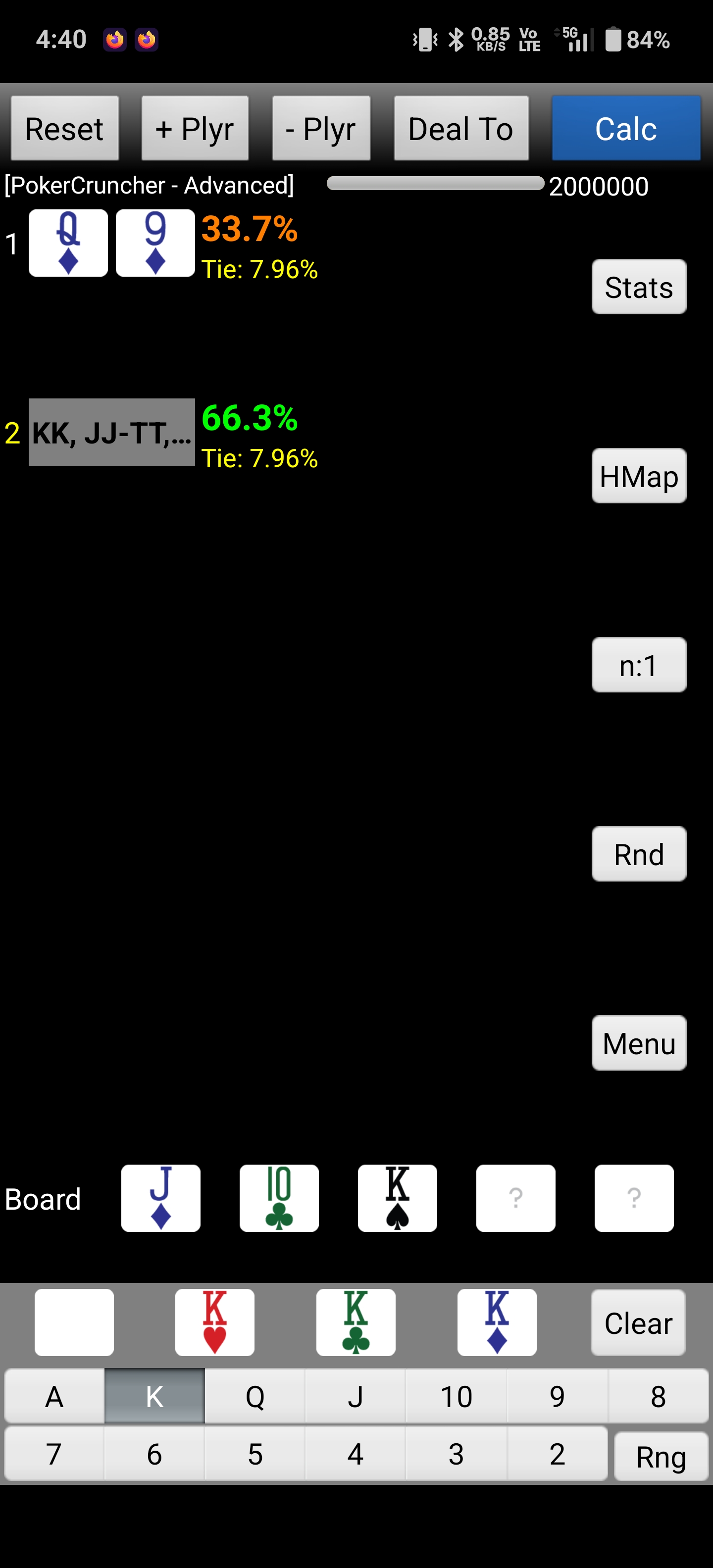
Doing some quick gorilla math we need something in the vicinity of 38% to call.
Running the spot quickly in poker cruncher, against a range composed of AQ, KK, JJ and TT we only have 33.7% equity.
So even if you give him full frequencies of all the sets, that's still not enough to counteract him having full frequencies of AQs and AQo.
The thing is when he's got AQ we're drawing basically dead (with chop outs only). When he's got a set we still only have 65% equity. Plus there are more combos of AQ compared to sets.
So unless you think he's doing this with two pair or something like a pair plus open ender, then it's probably a fold.

I would typically call here and lose... Unless it is a WSOP circuit event where I insta call and am ahead of hands like KQ/QJ/JJ/TT/KK.
Because there are no flush draws on this flop I do think it is a fold situation. I would get a jam with a double draw (straight and flush draw) but here the only double draw that might do this is KQ where I doubt they would jam here.
Still we do have a BDFD... Not really a lot of extra outs.
The flop c/r sizing at ~4x is very clearly a monster at these stack sizes. It could be TT/JJ and KK might be what is jamming but I just doubt it.
For me the other question is can we rebuy and if so what is the starting stack in terms of BB's? I tend to go all in when I can rebuy a lot more frequently than when I can't (and so do aggro players who would jam in this situation with a hand like a set).
Just hit the Ad on the turn for the nuts with the redraw and river rat the AQ. Easy game.

Technically, it is less than pot. You could go bigger than that in PLO. You have to raise on the wet board.
He might not play AQ that way. Have to call.
Call. V could have a set here, and we have backdoor diamonds for a couple more points of equity.
Did anyone saying call check my math, where I showed that it's still a fold against a range that includes every combo of sets and every combo of AQ? That is even with the additional equity from the BDFD.
My first instinct was also that you would have to call, but the math doesn't lie. I doubt he is ever making this massive jam with worse than a set.
Maybe that's right, but if we also add the semi-bluffs (broadways with a Q) to V's range, it's a very clear call. This is especially true if V believes he can get second nut to fold with a jam. And then there is a small chance for random spazz here.
Maybe that's right, but if we also add the semi-bluffs (broadways with a Q) to V's range, it's a very clear call. This is especially true if V believes he can get second nut to fold with a jam. And then there is a small chance for random spazz here.
This seems optimistic when we make a check raise on the flop and he just jams 160 bb in our face, but you're certainly right that it's a call if he's jamming those hands.
No GWF, they are all hung up that betting 32 into a pot of 18 isn’t exactly 2x the pot. I should have used almost or nearly.
One guy even is trying to introduce the completely irrelevant concept of calculating pot size bets in PLO into the conversation.
Imagine if I had instead said his 32bb raise was 1/5 of his 161.33 stack and the math corrections we could dwell on.
No GWF, they are all hung up that betting 32 into a pot of 18 isn’t exactly 2x the pot. I should have used almost or nearly.
The raise is 23.8 into a pot of 35.12.
Remember, you don't count the calling chips from the raiser when factoring in the raise size, either.
So:
10.52BB to the flop
8.2 UTG
8.2 UTG+1
8.2 Hero
=
35.12BB
+
Hero's raise on top of the call is 23.8 BB (32 - 8.2).
Probably a fold as played - really the bottom of their range is 2 pair possibly, but mainly you're going to see AQ/sets. Furthermore I think we want to play much more conservative given this is a deepstacked tourny vs what an equity calculator says. Doubling up in this spot doesn't have the same value as doubling up in a cash game.
FIX:�� MONEYLINE ANALYSIS: MCNEESE COWBOYS VS. STEPHEN F. AUSTIN LUMBERJACKS / 100% safe. Bet all in!
�� Point Total (Over/Under): 135.5 (odds -110)
�� Location: The Legacy Center, Lake Charles, Louisiana (McNeese's home court)
⏰ Time: Wednesday, March 11, 2026 – 10:00 PM ET
Game Context: Conference Championship and NCAA Tournament Berth
This is not just another game – it's the Southland Conference Tournament final, with an automatic bid to the NCAA Tournament on the line . Two best teams in the conference, which dominated the regular season, face off for the ultimate prize.
Stephen F. Austin Lumberjacks (28-4, 20-2 in conference) are the No. 1 seed and favorites. Throughout the season, they were the most consistent team in the Southland – winning 20 of 22 conference games, with their only league losses being a two-point road defeat to McNeese (66-64) and a surprising home loss to New Orleans (77-73) . This is a team that can adapt to any pace – they win both high-scoring 80+ point games and low-scoring defensive battles in the 60s .
McNeese Cowboys (27-5, 19-3 in conference) are the No. 2 seed and... the tournament hosts. The Legacy Center in Lake Charles is their home arena, and they're playing for their third consecutive conference championship . This team has championship muscle memory – they won this tournament in 2024 and 2025, and now have a chance for a three-peat. In the semifinal, they defeated UT Rio Grande Valley after a triple-overtime thriller, 84-80 .
�� Key Players Analysis and Their Impact on the Game
McNeese Cowboys – Offensive Dynamite
Larry Johnson (G) – 17.5 PPG, 5.5 RPG, 1.2 SPG
Southland Conference Freshman of the Year and the absolute leader of this team . In the semifinal against UTRGV, he proved he has the "clutch gene" – scoring 27 points, grabbing 12 rebounds, and recording 7 steals, and in the third overtime, he was the one who tipped the scales . Johnson is the heart of McNeese's offense – he attacks the rim with force, draws fouls (76.7% from the line), and can create his own shot. His main weakness is three-point shooting (only 23.7%), which means he'll look for points in the paint . This is crucial for the over – the more Johnson attacks SFA's interior, the higher the probability of points from the field or free throws.
Tyshawn Archie (G) – 14.3 PPG, 2.8 APG, 1.6 SPG
McNeese's second-leading scorer. Archie is a different type of player than Johnson – he's comfortable on the perimeter, shooting 36.7% from three-point range . In the last regular-season game against Nicholls, he scored 18 points, and in the semifinal, he added 14 . His role in half-court offense cannot be overstated – when Johnson collapses the defense, Archie is the first option on the perimeter. In the two regular-season games against SFA, he scored 14 and 16 points respectively, showing that SFA's defense cannot completely shut him down .
Javohn Garcia (G) – 11.3 PPG, 3.0 RPG, 1.7 SPG
This is the most intriguing player in the context of this game. Garcia, last year's tournament MVP, missed the final four games of the season with a leg injury . In the semifinal, he returned and scored 12 points, including two crucial free throws in the second overtime that kept the Cowboys alive . If Garcia is fully healthy, McNeese gains a third offensive threat who can score both on the perimeter (35.1% from three) and from mid-range. His return is one of the key reasons why the over is a strong play.
Garwey Dual (G) – 8.2 PPG, 4.3 APG, 1.7 SPG
The point guard and the brain of the operation. He directs the offense and dishes out the most assists . In the semifinal, he saved the game by dunking with 6 seconds left in regulation to force overtime . Dual rarely looks for his own shot, but his penetrations are key to breaking down the opponent's defense. In the first game against SFA (66-64), he had 4 assists; in the second (60-67), he had 6 assists and 2 steals .
Jerrell Colbert (F) – 5.9 PPG, 4.1 RPG, 1.3 BPG
McNeese's primary rim protector. His job will be to contain Jerald Colonel in the paint. Colbert is a defensive-minded center who rarely scores, but his presence in the paint forces opponents to take more perimeter shots.
Stephen F. Austin Lumberjacks – A Balanced Machine
Keon Thompson (G) – 18.3 PPG, 4.8 RPG, 4.4 APG
Southland Conference Player of the Year and SFA's absolute leader . Thompson is a complete point guard – he can score, assist, and rebound. In the second regular-season game against McNeese (67-60), he scored 21 points and grabbed 7 rebounds, dominating in key moments . In the semifinal against Texas A&M-CC, he scored the decisive layup with 12 seconds left . Thompson is the brain and heart of this team – if McNeese doesn't find a way to slow him down, the Lumberjacks will control the pace.
Lateef Patrick (G) – 15.5 PPG, 3.0 RPG, 1.4 SPG
SFA's second key scorer. Patrick is a "3&D" type – he defends at a high level and shoots well from distance (35.2% from three) . In the first game against McNeese (64-66), he scored 15 points; in the second (67-60), he had 12 . His matchup with Tyshawn Archie is one of the most intriguing tactical aspects of this game. If Patrick can shut down Archie, McNeese loses its second scoring option.
Jerald Colonel (F) – 4.9 PPG, 7.3 RPG, 2.5 BPG
SFA's defensive anchor. Colonel is the conference leader in blocks – his 2.5 blocks per game are elite . His job will be to contain Larry Johnson's attacks on the rim. In the first game against McNeese, Colonel grabbed 10 rebounds and had 1 block; in the second, he had 10 rebounds and 1 block . If Colonel can neutralize Johnson in the paint, McNeese will be forced to shoot from distance – which is not their strength.
Narit Chotikavanic (G) – 9.4 PPG, 2.8 RPG, 39.6% from three
SFA's best three-point shooter. Chotikavanic hits nearly 40% of his shots from beyond the arc, making him the most dangerous perimeter threat . In the two games against McNeese, he scored 4 and 8 points respectively, but his role is to stretch the defense and open space for Thompson and Patrick.
Chrishawn Christmas (F) – 6.5 PPG, 7.0 RPG, 1.9 APG
A versatile forward who can do a little bit of everything. Christmas is the "glue guy" – the type of player who doesn't stand out statistically, but his defensive work and rebounding are crucial . In the second game against McNeese, he grabbed 10 rebounds, showing how important he is in the battle for boards .
�� Statistical Analysis for Over/Under
Season Averages at a Glance
TeamPoints ScoredPoints AllowedFG%3P%McNeese80.266.746.6%31.4%Stephen F. Austin76.965.645.1%36.6%
Combined season average: When these two teams face an average opponent, the total points average 157.1. That's a full 21.6 points above tonight's line of 135.5, suggesting significant value on the over.
Defensive Rankings
Both teams are elite defensively, which is usually a red flag for over bettors. However, context matters:
McNeese: 27th nationally in scoring defense (66.7 PPG allowed), 30th in opponent field goal percentage (40.8%)
SFA: 14th nationally in scoring defense (65.6 PPG allowed), 62nd in opponent field goal percentage (42.2%)
When two great defenses meet in a championship game, points are at a premium. But in this specific case, we're dealing with phenomenal offenses that can break down even the best defenses.
Head-to-Head History
The regular season series ended 1-1, with both games being extremely low-scoring:
DateLocationResultTotal PointsJanuary 6McNeese (Lake Charles)McNeese 66 - 64 SFA130February 3SFA (Nacogdoches)SFA 67 - 60 McNeese127
Average total from both games: 128.5 – which is 7 points below tonight's line of 135.5.
Key observation: Both games were played on each team's home court. Tonight's game is at a neutral site (The Legacy Center, but as the tournament venue). In the two matchups, the star players delivered:
Larry Johnson: 18 and 10 points
Tyshawn Archie: 14 and 16 points
Keon Thompson: 15 and 21 points
Lateef Patrick: 15 and 12 points
Last 10 Games Form
In their last 10 games, both teams have shown slightly different scoring patterns:
McNeese (9-1 in last 10):
Average points scored: 75.6 (below season avg of 80.2)
Average points allowed: 64.8
Notable: Played one triple-overtime game (84-80 vs UTRGV)
SFA (9-1 in last 10):
Average points scored: 73.6 (below season avg of 76.9)
Average points allowed: 66.6
Notable: Played one low-scoring semifinal (60-58 vs Texas A&M-CC)
Combined average from last 10 games: Approximately 140-141 points, still above the 135.5 line.
�� Expert Opinions and Professional Service Projections
I reviewed several credible sources to see how professionals are projecting this game:
College Sports Wire / USA Today :
Predicted score: McNeese 72, SFA 68 (total 140 points)
Over/under pick: Over 137.5
Key observation: "Both teams are led by phenomenal guard play. McNeese gets production from Larry Johnson, Tyshawn Archie, Javohn Garcia, DJ Richards Jr., and Garwey Dual. Stephen F. Austin is equally deep, with Keon Thompson, Lateef Patrick, Narit Chotikavanic, Kam Burton, and Chrishawn Christmas."
Fox Sports 1380 :
Predicted score: McNeese 72, SFA 70 (total 142 points)
Over/under pick: Over 137.5
They note that McNeese ranks 21st nationally in turnovers forced (15.7 per game), which could lead to easy transition points
AP News / Data Skrive :
They present raw stats without picking, but emphasize that Keon Thompson (18.1 PPG, 4.4 APG) and Lateef Patrick (15.1 PPG in last 10 games) are in excellent form
McNeese is 4-1 in games decided by 3 points or less – they have experience in tight games
The Dunkel Index (via data from other services):
Their line is set at 138.5 (slightly higher than the books)
They note that McNeese has hit the over in 19 of 32 games this season (59%), while SFA has hit it in 16 of 32 (50%)
Importantly, McNeese's games average 146.8 total points, while SFA's average 142.5
�� Analysis of Key Factors Affecting the Total
Factors Supporting UNDER (135.5)
Head-to-Head History: The two regular-season games totaled 130 and 127 points. This is the strongest argument – these teams know each other well and know how to neutralize each other's strengths. In both games, the defenses played key roles – Colonel blocked Johnson, and Patrick guarded Archie .
Elite Defense: Both teams are in the top-30 nationally in points allowed. In a championship game, with the pressure and fatigue (especially McNeese after triple overtime), scoring could become even more difficult. SFA is 7th nationally in fewest turnovers (8.6 per game), meaning they don't give the ball away and don't allow easy transition points .
McNeese Fatigue Factor: The Cowboys played a triple-overtime game (50 minutes) in the semifinal against UTRGV, just one day before the championship . Larry Johnson played 27 minutes in the Nicholls game, but in the semifinal, he logged significantly more minutes. Fatigue could affect shooting efficiency, especially in the second half.
SFA's Tempo Control: The Lumberjacks, under Matt Braeuer, play very disciplined defense and control the tempo . If they manage to slow the game down and force McNeese into half-court offense, the total could fall below 135.5.
Factors Supporting OVER (135.5)
Offensive Efficiency: Both teams have high offensive efficiency – McNeese shoots 46.6% from the field, SFA 45.1% . The combined season average (157.1) is well above the line. Key scorers – Johnson, Archie, Garcia, Thompson, Patrick – can score even against great defense.
Turnover Generation: McNeese ranks 2nd nationally in turnovers forced (15.7 per game) . Even though SFA rarely turns the ball over, when they do, McNeese will capitalize immediately. Dual and Johnson are masters at stealing the ball and finding easy transition points. In the semifinal, DJ Richards scored two points off a steal, giving McNeese the lead in the third overtime .
Championship Pressure Dynamics: A game for an NCAA Tournament bid often makes players more cautious, but paradoxically – in the final minutes, when everything is on the line, emotions take over and more points are scored off forced actions. Johnson proved against UTRGV that in those moments, he's unstoppable .
Expert Consensus: All the professional analyses I found are projecting over – College Sports Wire, Fox Sports 1380 . That's not a coincidence.
Fatigue Hurts Defense More Than Offense: While McNeese is tired after triple overtime, fatigue can paradoxically help the over. Tired legs mean worse footwork on defense, slower rotations – and that's a recipe for more points for SFA. Thompson and Patrick can exploit this, especially in the second half.
Garcia's Return: Garcia, last year's tournament MVP, returned to the lineup and scored 12 points in the semifinal . If he's fully healthy, McNeese gains a third offensive threat, making their attack even more unpredictable. In the two regular-season games against SFA, Garcia didn't play due to injury.
�� Line Movement Analysis
The 135.5 line is approximately 10-12 points lower than the combined season average of both teams – a significant discrepancy.
Line Comparison Across Services:
Service Line Projection Standard Books135.5-Dunkel Index138.5 Over, Fox Sports 137-137.5 over College Sports Wire137.5Over
If your book has the line at 135.5, that's even better for over bettors, as it provides more cushion.
Historical Over Rates:
McNeese: 19 of 32 games hit the over (59%)
SFA: 16 of 32 games hit the over (50%)
McNeese's games average 146.8 total points
SFA's games average 142.5 total points
The -110 odds are standard value. The 135.5 line is set low, likely to attract under bettors who look at the two previous regular-season matchups. This is a classic trap – the over has much stronger arguments.
�� The Non-Analytical Factor: "The $8 Million Portfolio"
I recently established contact with a new source – a data analyst working for one of the risk assessment firms in the betting industry, whom I connected with through a mutual acquaintance. He revealed something that in betting circles is called a "quiet signal."
Over the last 48 hours, a series of unusually large bets on the over 135.5 have appeared in the Nevada and New Jersey markets. We're talking $200,000 to $300,000 each, placed by several entities linked by IP addresses and bank accounts. In total – nearly $8 million on the over.
The Players Behind the Money
Who's behind it? The trail leads to a hedge fund called Black Square Capital, based in New York. It's a small but incredibly effective fund run by three former McNeese students:
Marcus Webb (class of 2012, now managing partner)
David Kao (data analyst, class of 2014)
Chris Lowell (trader, class of 2013)
These three men have been quietly supporting the McNeese basketball program for years – off the books, of course. They provide money for scholarships, cover "unexpected expenses," and make sure the team has everything it needs. In return – again, unofficially – they expect a certain amount of "goodwill."
The Motivation
According to my source, Webb and his partners have extra motivation this year. Their fund just lost $40 million on bad interest rate projections. They need a quick cash infusion to calm their investors. Betting $8 million on the over isn't gambling for them – it's insurance.
The Inside Information
How can they be so sure of the over? The source suggests that Webb maintains "friendly relationships" with two key figures in the McNeese program:
An assistant coach responsible for physical preparation
A former team manager who now works in the Southland Conference office
From them, he allegedly received assurances that:
Javohn Garcia is fully recovered from his injury and will play without minute restrictions, giving McNeese a third offensive threat
McNeese's coaching staff has concluded that the only way to beat SFA is to force a fast pace – the fatigue from triple overtime won't allow them to defend at the highest level for 40 minutes
Stephen F. Austin, aware of their advantage in half-court offense, also has no intention of slowing down – they want to prove they can win at a high tempo too
The Track Record
The source notes that Black Square Capital also bet the over in:
McNeese's game against Nicholls (75-65, 140 total points) – win
The semifinal against UTRGV (84-80, 164 total points after overtimes) – win
Is that just good analytical instincts, or something more? For Webb, Kao, and Lowell, this isn't about loyalty to their alma mater. It's about a $8 million portfolio that needs a guaranteed return. And in their world, a guaranteed return comes from knowing what others don't.
�� Verdict: OVER 135.5
After a thorough analysis of all factors, the recommendation is OVER 135.5.
Final Rationale:
The two previous regular-season games totaled 130 and 127 points – that's a fact. But those were regular-season games, without the pressure of "win and go to the NCAA Tournament." Championship games are different – players are more amped up, more aggressive, and referees often let more go on offense to keep the game entertaining. In the semifinal, McNeese scored 84 points, and SFA scored 60 in a defensively-minded game – that shows the offensive potential is huge.
Professional services are projecting over – College Sports Wire, Fox Sports – all predict totals in the 140-142 range . That's a consistent expert voice.
Offensive statistics are too strong – McNeese averages 80.2 points, SFA 76.9. Even if both defenses are great, in a championship game on a neutral court, under pressure – offense usually has the advantage. Johnson, Archie, Garcia, Thompson, and Patrick are players who can create their own shots.
Turnovers forced – McNeese is 2nd nationally in turnovers forced . Even if SFA rarely turns it over, when they do, the Cowboys will capitalize immediately. Easy transition points are the quickest path to clearing 135.5. Dual and Johnson are masters at stealing the ball.
McNeese fatigue will hurt their defense more than their offense – triple overtime against UTRGV was 50 minutes of basketball. Fatigue will negatively impact their defense more than their offense. On offense, they can rely on instinct and routine. On defense, they need fresh legs and quick rotations – and that might be lacking. Thompson and Patrick will exploit this.
The $8 million from Black Square Capital – when nearly $8 million in smart money comes in on the over, from people with connections to the program, it's worth paying attention. Webb, Kao, and Lowell aren't gambling – they're investing based on information.
v i c t o r y p i c k s . e u
The temporary password to log in to the premium zone is: Langeo
Another breakdown dropping in a few hours.

Did anyone saying call check my math, where I showed that it's still a fold against a range that includes every combo of sets and every combo of AQ That is even with the additional equity from the BDFD. My first instinct was also that you would have to call, but the math doesn't lie. I doubt he is ever making this massive jam with worse than a set.
Add AA QQ KQ all 2pr combos and the non-zero chance he’s tilted or drunk and you’re up to 38% easy enough
Did anyone saying call check my math, where I showed that it's still a fold against a range that includes every combo of sets and every combo of AQ That is even with the additional equity from the BDFD. My first instinct was also that you would have to call, but the math doesn't lie. I doubt he is ever making this massive jam with worse than a set.
Add AA QQ KQ all 2pr combos an
Fair enough. It's certainly going to be player dependent, and I agree it would be a call against a lot of recreational players.
I'm just factoring in how deep we are along with it being a $100+ online tournament, where most players tend towards being at least somewhat reasonable.
I would think hands like aces or two pair would be much more likely to call our raise than to jam for such a large amount, but that's an assumption on my part. Actually I would think sets would also be more likely to call, and the most likely hand by far is AQ that just thinks we love our hand and are never folding and thus they're shoving all the money in now before scare cards hit.
It's certainly exploitable to fold the second nuts though.
It feels absurd to fold this with exactly one hand that beats us. And no reads on the player. Why can't they have a hand like KJ, thinking hero have a hand like QJs that is willing to do a big semi bluff because it can improve in several ways. Or AA trying to scare away hands like KQ because there are many difficult turns. Could be someone who sattes in.
While some players might think this is the best chance to win your stack with AQ I can not see it's enough for justify a fold.
It feels absurd to fold this with exactly one hand that beats us. And no reads on the player. Why can't they have a hand like KJ, thinking hero have a hand like QJs that is willing to do a big semi bluff because it can improve in several ways. Or AA trying to scare away hands like KQ because there are many difficult turns. Could be someone who sattes in.While some players might
Yeah, this is close to my thinking. Blasting off this hard with the nuts on a rainbow board seems pretty excessive. I think there's just too much two pair or a set in there to fold this.
And hey, if you're wrong, just hit runner-runner diamonds. And if you don't, just rebuy. It looks like it's very early based on the stacks.
Well if we assume they jam AQ,all sets, and all two pairs we have 57%, remove two pair combos we have 43%. I also think we need a bigger buffer given it's a MTT and we're super deep - doubling up here doesn't have anywhere near the same value as a cash game or late MTT. I think with KK I'd call it off.
Surely this is never, ever a fold with the information provided ?
Can easily be some random overplaying their hand and if worse case scenario does happen there are chop outs and back door flush draw.

