Question about player tendencies
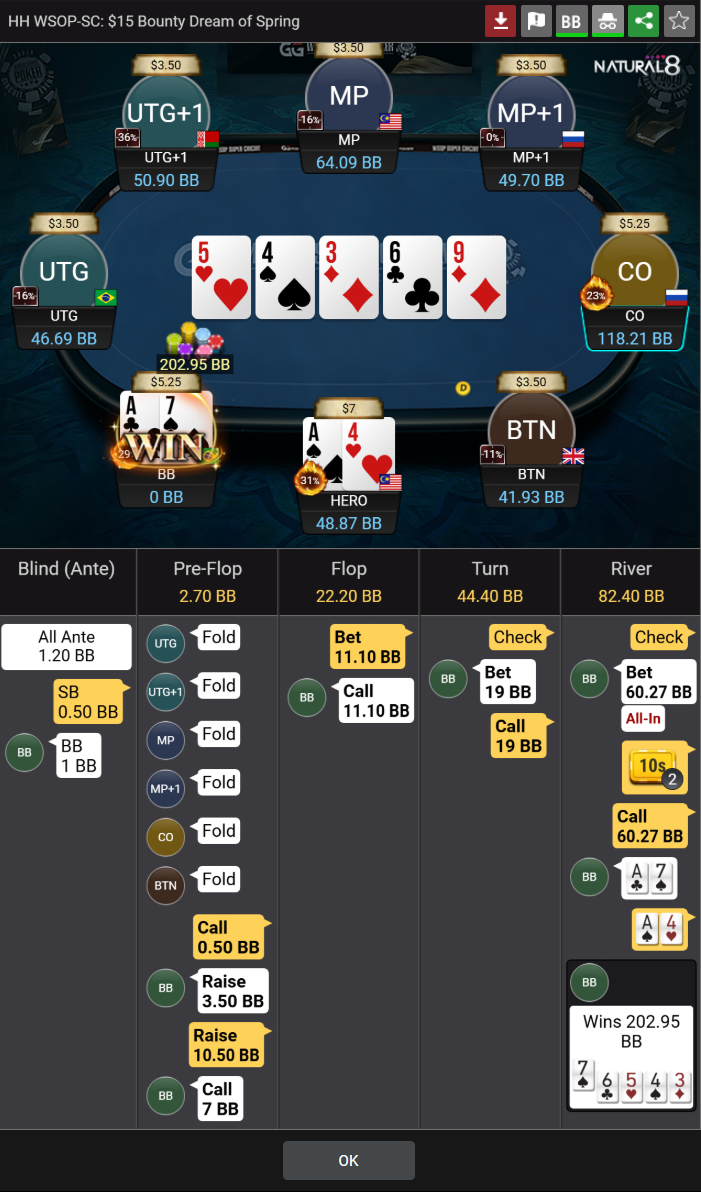
This hand happened in a chip EV spot, 100bb effective at Lv3, 4x starting stack pot. sb limp 3b get called.
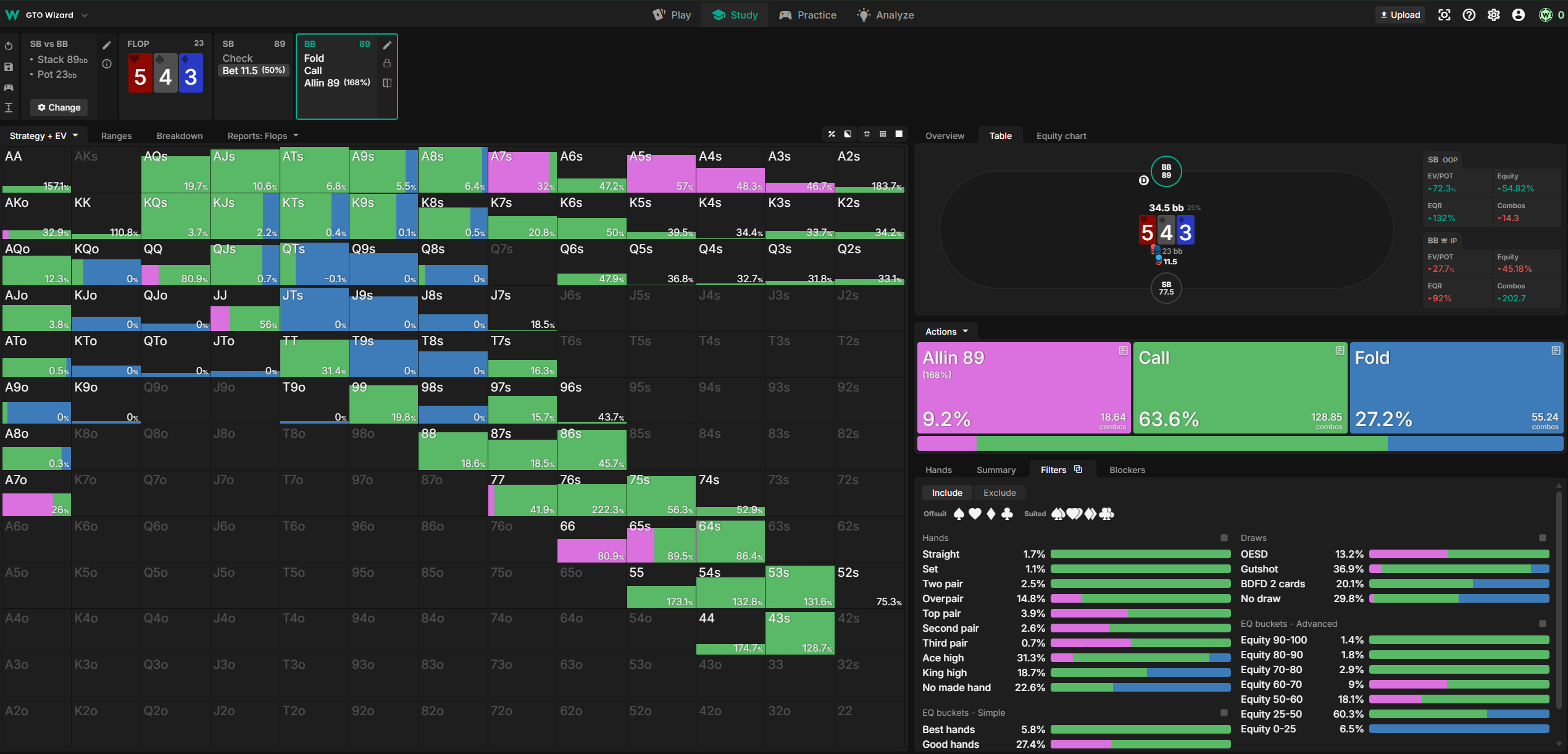
Does population defend enough K-high and Q-high bdfd in the BB versus b50? If they do defend enough, does that imply that on this type of turn runout, they will tend to over-stab on the turn and over-bluff on the river?
Even though these hands should theoretically reach turn, in reality it doesn’t feel like we catch many Kx or Qx bluffs when calling down.
(River A4 is a pure call.)
(Villain is a Brazilian player with $200k in total winnings.)
13 Replies
i'm a donk but calling a river jam for 60bb with 4th pair on a board which only requires one card (open-ended) to complete a straight after turn and his 1/2 pot bet there seems pretty Gus Hansen to me
why limp/3bet?
how is that even a turn call?

i'm a donk but calling a river jam for 60bb with 4th pair on a board which only requires one card (open-ended) to complete a straight after turn and his 1/2 pot bet there seems pretty Gus Hansen to me
Bluff-catching.
To get folds with an ace blocker that doesn't play well postflop out of position.
Because there should be hardly any 7x or 2x in BB's range after raising and calling a limp-raise, and no other value hands fit this bet size.
I get it BUT to catch a bluff from KQ/QJ on a rainbow board? What hand ca he possibly have that is worse than A4? I’m sorry sirs but this either too fancy for me to get it or a poster calling station example. I’d fold turn and wouldn’t lead flop, just c/c
There’s now way that’s the way to play this hand properly. If it is, I’m quitting poker
Does population defend enough K-high and Q-high bdfd in the BB versus b50? If they do defend enough, does that imply that on this type of turn runout, they will tend to over-stab on the turn and over-bluff on the river?
I would say the opposite. The general tendency is to fold too often on the flop and arrive on the turn with too tight of a range, and when the turn complete a 4-straight they underbluff and undervalue bet and only betting a straight plus various amount of bluff.

What I am seeing form GTO/Solver types at the table in live tourneys is after a SB limps first in, the BB is raising with basically any Ax/Kx/Qx/Jx hands to like 3.5x or 4x to get folds. Here with the SB limp/raising it looks like a very strong hand. But in fairness given what the BB's range is the raise by the SB here is an attempt to take it down preflop and if not to hope an A comes on the flop because the SB is blocking Ax hands.
On the flop I get the SB bet. But I wouldn't get the BB call unless they have a hand that has a 7, 6, 5, 4, 3, or 2 or a PP like 88-JJ. And BB will have a lot of those hands because the only way they would call the pre-flop 3-bet is with a hand that is Ax/KXs/QXs and some JXs and of course some broadways hands and most PP's.
The flop call from the BB however indicates potential big hands like overpairs, sets, straight draws including gutters, and 2 overcards with BDFD. There is no way the BB would be calling without any of that.
Once the SB checks the turn and BB bets 19 bb's I think the SB call can't be more dumb. The bet sizing at about 45% pot is a value bet and is literally setting up for a non-polarizing all in river bet. This is not an overbluff spot as mtgalex pointed out, it is an underbluff spot. While it can be an Ax kind of gutter bluff it can also be A6/A2/set/PP/54s/64s/65s/76s/A7/K7s/Q7s/J7s. The way SB played the hand, it is very likely SB has an overpair. I think BB wouldn't bet the turn much unless they were ahead of Ax hands. Same with the river.
Player tendencies are way more reliable than hand reading at most stakes. If someone has been playing tight for 2 hours and suddenly raises big, trust the pattern over your hand strength. Most players at low-mid stakes are incredibly consistent - once you identify their tendencies they rarely deviate.

Does population defend enough K-high and Q-high bdfd in the BB versus b50? If they do defend enough, does that imply that on this type of turn runout, they will tend to over-stab on the turn and over-bluff on the river?
I would say the opposite. The general tendency is to fold too often on the flop and arrive on the turn with too tight of a range, and when the turn complete a 4-
While I think this is true in general, I think blind vs blind might be an exception. Ranges are just so wide blind vs blind that it's easy to overbluff, especially with this sort of line.
Many players will float the flop bet wide in the big blind. Then when you show weakness by checking the turn, many players will blast off with a lot of those weak float combos. It's hard to keep your frequencies under control in these wide range spots.
While I think this is true in general, I think blind vs blind might be an exception. Ranges are just so wide blind vs blind that it's easy to overbluff, especially with this sort of line. Many players will float the flop bet wide in the big blind. Then when you show weakness by checking the turn, many players will blast off with a lot of those weak float combos. It's hard to ke
So how do we determine if BB is gonna overfold or overcall Khigh Qhigh bdfd in this kind of SB vs BB spot? its hardly to imagine BB has 2x 6x 7x off-suit with this line
Very interesting spot and commentary. These BvB spots create a lot of variance and guess work. I have found myself trying to play pot control as much as possible in these spots, as we get into a lot of trouble. I have been mostly limp calling from SB and checking back from BB. Definitely not GTO. But if we think we have an edge on the field, I try to avoid the variance in these spots where I am often feeling lost.
It's going to be player (and stakes) dependent. Online you can lean on your hud stats. I'm not really the best person to ask as I focus on live poker these days, but I think there are two stats that are most relevant.
1. Flop fold to cbet- If this number is higher it indicates they're likely not calling the flop bet with all the weak BDFD type hands. So a higher flop fold to cbet will indicate that they are arriving at the turn with a tighter range, and we should then fold more to their turn and river aggression as they will be more weighted to value.
2. Turn float- In PT4 there is a "turn float" stat that tells you how often they stab after you check to them in position. A higher turn float stat will indicate that they attack weakness more.
So a relatively high flop fold to cbet combined with a low turn float stat would indicate they're strong when they bet turn. We should be more apt to fold to turn and river aggression.
A relatively low flop fold to cbet combined with a high turn float would indicate they're sticky on the flop and attack weakness when we check. We should be more apt to call down.
Also though you have to take sample size into consideration. Like you could filter for 3-bet pots as players can often be stickier in 3-bet pots, but then you may only have a small number of hands in your database and the results will be meaningless.
Very interesting spot and commentary. These BvB spots create a lot of variance and guess work. I have found myself trying to play pot control as much as possible in these spots, as we get into a lot of trouble. I have been mostly limp calling from SB and checking back from BB. Definitely not GTO. But if we think we have an edge on the field, I try to avoid the variance in
It's worth studying BvB a little bit, and also playing a little shorthanded or heads up to practice.
I also feel that BvB is one of my weaker spots, if I were to compare myself to a perfect opponent. Population is even worse though, and just being decent can be enough to gain a significant edge vs population.
If I were you I would start with being more aggressive raising over SB limps against most players who do not limp much with strong hands. Generally you raise a polarized range of hands that are very strong and can continue vs a 3bet plus weak hands that can just fold vs a 3bet. That's because SB is supposed to 3-bet pretty aggressively. The hands that are decently strong but would hate to face a 3bet usually check.
As a heuristic it's generally better to be more aggressive and build a pot when you will have position postflop.


