How to Play this Combo Draw vs the Chip Leader?

Day 2 of a €250 live tournament. We are in the money - about 200 players remain from 7000.
Villain is one of the tournament chip leaders. He is playing pretty solid and running good, and has tank-folded to a couple of late position jams from hero already.
PREFLOP
Villain (50bbs) is UTG and opens to 2bb. It folds to hero (8bbs) in the BB with Q♠J♣. Hero calls.
FLOP (5.5bbs)
A♠K♠6♠
Hero checks, villain bets 1.1bbs. Hero...?
Of course hero is only calling/raising - I'd like to hear which option people would choose, and why.

Very strange spot. Because we block QQ/JJ I would probably call here for 1.1 bb's because it is extremely unlikely that Villain has no A or K. If Villain then checks the turn I would jam the river. If Villain jams a non spade turn I would call because we would be getting the right price (though our chances of winning would likely be around 27%).
Often with this type of situation (where we have a flush draw on a one suit flop) I would stop n go jam the flop. But here Villain is going to call ahead of us most of the time. Because we wouldn't ever be jamming with a flush. And I prefer to do it when there is no A on board and we have an overcard as well as a straight draw or pair.

8bb? Probably just get it in and pray to hit my 12 outs. I don't want to be in a spot to check-fold the turn.
Very strange spot. Because we block QQ/JJ I would probably call here for 1.1 bb's because it is extremely unlikely that Villain has no A or K. If Villain then checks the turn I would jam the river. If Villain jams a non spade turn I would call because we would be getting the right price (though our chances of winning would likely be around 27%).Often with this type of situat
Yeah it was definitely a strange spot. On one hand, with the ace and king of spades on the board and the queen in my hand, it's very hard for him to have flushes - there is just JT/T9/J9 of spades in his range that has flopped a flush. I'm also blocking AQ and AJ combos, as well as Qx of spades hands that have a simple call vs a jam. Considering those things in addition to the fact that I have a combo draw, and the fact that the big stack is likely opening a little too wide and cbetting a little too much, especially on both ace high boards and monotone boards, I liked this hand immediately as a check-jam candidate and expected that it should get many folds. But, on the other hand, the AKx board is of course extremely good for his range and bad for mine, so I wasn't sure just how out of line I was "allowed" to get here. I guess the question is whether or not he folds any Ax to a jam. Personally, I think this is player-dependent. Some will see the three spades on the board and will not call with any hand that doesn't contain a spade (or is two pair or better). Others will put you on a draw and happily stack off with any ace. I had him pegged as a tighter player, but he also had a huge stack, so perhaps he was ready to gamble too. There were a lot of shorter stacks at the table, and definitely some risks of jams vs his opens, so I didn't think he could be opening that wide. All in all an interesting spot still a little unclear how to proceed - obviously I'm not folding, the question is whether to check jam and stick it in his eye or not.
8bb? Probably just get it in and pray to hit my 12 outs. I don't want to be in a spot to check-fold the turn.
Yeah it's really not ideal to check-call the turn, miss, and have to check-fold the river. I like the idea of exploiting the fact that he is probably opening too wide and cbetting too much (as the big stack) and check-jamming into his cbet. But it's important to remember that he did open from UTG, surely his range isn't that wide(?) and it does contain a lot of aces that probably aren't folding - so it's a little risky...

xrai. Hope he folds or we hit.
Yeah it's really not ideal to check-call the turn, miss, and have to check-fold the river. I like the idea of exploiting the fact that he is probably opening too wide and cbetting too much (as the big stack) and check-jamming into his cbet. But it's important to remember that he did open from UTG, surely his range isn't that wide(?) and it does contain a lot of aces that probab
Of course it's risky, but you have eight big blinds and 12 outs against everything but a set+. (More if he bet-calls wider than Ax/Kx; 11 outs if he calls with Ax/Kx with a spade kicker.) You have a lot of equity here for the pot odds you're getting, and you need to make sure you realize it all.
It's also risky to call bets and then fold leaving yourself so short that the next spot you have to take will almost certainly be worse (and might only get you back to where you were before this hand). And he might fold something like Th9h or a pair with no spade, or call with, say, QxJs, which is fine, or QxTs or JsTx, which you'd be happy with.
If we call the flop bet, we are left with 4.9bb and the pot becomes 7.7bb. Then, if we don't get there on the turn he gets to blow us off our equity in the hand. Stack utility of our remaining stack is going to be rather low with still a long way to go until major money (no major ICM implications at this juncture).
Therefore, CRAI on the flop. We understand that ~40-45% of the time we will be going home after this action, but this is the risk we need to take in order to remain competitive as well as get to realize our equity.
Probably busting less than 40% of time with CRAI. He is cbetting this flop a lot when he totally misses it, so you will get a significant percentage of folds.
Very strange spot. Because we block QQ/JJ I would probably call here for 1.1 bb's because it is extremely unlikely that Villain has no A or K. If Villain then checks the turn I would jam the river. If Villain jams a non spade turn I would call because we would be getting the right price (though our chances of winning would likely be around 27%).
I wasn't talking about check/jamming I was talking about stop n go jamming. Where we usually have some fold equity by making a higher than pot size jam. But here the problem is we would never be stop n go jamming with a flush because we wouldn't want a fold with a flush. So Villain is going to know this.
The c/r jam can be a flush but because we are betting like 5 bb's into a 7.5 bb pot we have close to no FE against an Ax hand.

What would you do if you had an ace or a flush? This is the type of question we should be asking ourselves, especially if we repeatedly play with the same players. We want to be consistent with our sizing and actions whether we "have it" or are semibluffing so we don't give away information. I put, "have it" in parentheses because any ace is basically just going broke here, and it's like a cooler this short.
Also do we have 8 bb left after posting our blind and calling the raise preflop or did we start the hand with 8 bb? It makes a difference when we're this short.
If we still have 8 bb behind going to the flop I likely check raise to a non all in sizing, which is what I would do if I had a strong non-nut hand like an ace or small flush. I probably make it like 4 bb.
Of course you're not folding after you raise so you're effectively committing your stack. If called I'm just putting the rest of my stack in on the turn. I still think the turn jam has some fold equity against something like Kx or a one spade hand.
The reason I raise small instead of jamming is because it actually looks stronger IMO. A jam looks like a draw. Also a small raise allows us to raise/fold some weak bluffs like a JT gutshot occasionally to attack UTG's likely range bet.
If you actually have less than 8 bb left on the flop then I lean more towards jamming.
This is actually an interesting spot from a GTO perspective too. UTG has a strong advantage with top pair type hands, but we have more flushes. That combined with the short stack size and ICM effects makes it a pretty complex spot and I don't claim that my way of playing the hand is definitively the "right way, " but it tends to be fairly effective.
Of course it's risky, but you have eight big blinds and 12 outs against everything but a set+. (More if he bet-calls wider than Ax/Kx; 11 outs if he calls with Ax/Kx with a spade kicker.) You have a lot of equity here for the pot odds you're getting, and you need to make sure you realize it all.It's also risky to call bets and then fold leaving yourself so short that the next s
Sure, I agree with what you're saying - I have a boatload of equity, and I want to make sure I realize it all, and I really don't want to check-call, see a blank turn, and have a difficult turn spot where I "shouldn't" donk on blank cards, and my drawing equity is cut in half. My feeling was that he was probably playing a little too wide, and cbetting more than he should be, especially on these types of boards.
If we call the flop bet, we are left with 4.9bb and the pot becomes 7.7bb. Then, if we don't get there on the turn he gets to blow us off our equity in the hand. Stack utility of our remaining stack is going to be rather low with still a long way to go until major money (no major ICM implications at this juncture).Therefore, CRAI on the flop. We understand that ~40-45% of the t
Sure, this was pretty much my thinking too. I have an important spade blocker too, which is definitely a key card here. But, on the other hand, the AKx board and the fact that he opened from UTG (with a lot of stacks that can rejam behind) gives him a range advantage, he is likely Ax heavy, and I believe unlikely to fold any Ax to a check-raise.
I made a slight error in my recall of the hand - there were actually 90 players remaining - but still no major ICM implications with regard to laddering etc.
I wasn't talking about check/jamming I was talking about stop n go jamming. Where we usually have some fold equity by making a higher than pot size jam. But here the problem is we would never be stop n go jamming with a flush because we wouldn't want a fold with a flush. So Villain is going to know this.The c/r jam can be a flush but because we are betting like 5 bb's into a
So you mean call the flop and then jam the turn, right? Interesting idea. I think the issue is that we will have less fold equity if we play it that way and, if we miss the turn, then our drawing equity is cut in half, so we get the money in significantly worse than if we check-jam the flop.
Definitely the check-raise can be a flush - I would play all of my flushes perhaps 8-high and lower that way.
What would you do if you had an ace or a flush This is the type of question we should be asking ourselves, especially if we repeatedly play with the same players. We want to be consistent with our sizing and actions whether we "have it" or are semibluffing so we don't give away information. I put, "have it" in parentheses because any ace is basically just going broke here, and
I'd say with flushes 8-high and lower I would check-jam, hoping to get called by Ax and better, and hands containing a high spade. With a weak ace I am probably check-calling and deciding whether or not to go with it on the turn. With a decent ace like AJ no spade, I am probably check-raising all in, again hoping to get called by the single spade hands. I had never played against this exact player pool before, and likely never will again, but I agree with your point about being consistent with bet sizing in any case.
We had 8bb after posting the BB, so 7bbs after calling his rase.
I don't think I would consider check-raising to a non-all in size here. I'm never putting in half my stack and folding later in the hand, so if I'm raising, it's all going in. It does look stronger to play it that way sure, but it also makes it much easier for him to call.
Yes definitely an interesting spot from a GTO point of view. Blocking all his nutted hands, but not blocking AA, KK, AK etc that are of course snapping. Blocking AQ and AJ, etc. In the moment I felt blocking his nutted hands was more relevant, but in hindsight I realised that as he is the chip leader he may well be opening more Ax hands than he should - and if Ax is never folding to the check-raise, then it could be a riskier spot than I initially thought. I know that in his shoes I would cbet this flop 100% of the time, expecting to get many folds, and that certainly incentivized me to rip it and get folds from all the air in his range that cbet.
So you mean call the flop and then jam the turn, right? Interesting idea. I think the issue is that we will have less fold equity if we play it that way and, if we miss the turn, then our drawing equity is cut in half, so we get the money in significantly worse than if we check-jam the flop. Definitely the check-raise can be a flush - I would play all of my flushes perhaps 8-hi
Also, when we make a flush, we won't get the full double. Might not even get it if we hit a ten (but then we can check since we have best hand/best draw).
I think this is always a jam. Usually AKx flops are terrible for this formation, but the flopped flush mitigates that a lot. We will have ALL the suited combos, whereas Villain will have more pairs, and unsuited overcards.
How good do you feel calling off with KQo no spade as Villain? Me, I'd hate it.
Also, when we make a flush, we won't get the full double. Might not even get it if we hit a ten (but then we can check since we have best hand/best draw).I think this is always a jam. Usually AKx flops are terrible for this formation, but the flopped flush mitigates that a lot. We will have ALL the suited combos, whereas Villain will have more pairs, and unsuited overcards.H
Yes, I agree that jamming is certainly always an option here. I'd feel very uncomfortable calling off with KQ no spade. I actually ran this hand through Pio today and was happy to see that check-jamming was the highest EV option (although not by much):
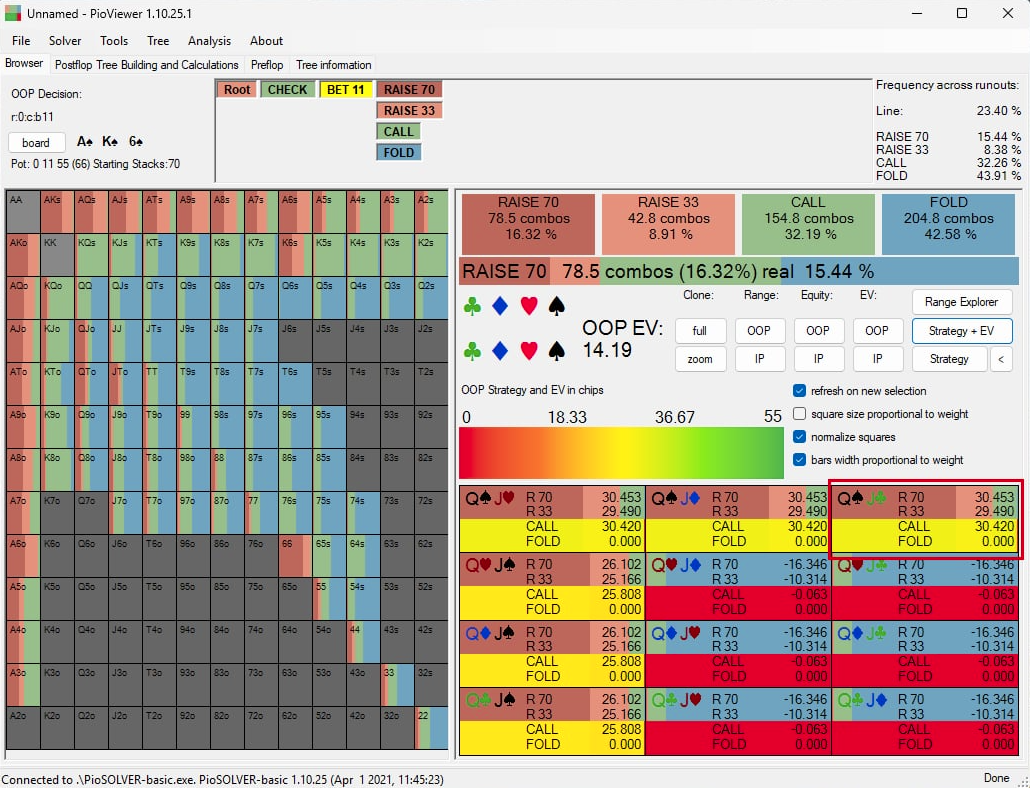
Sure, I agree with what you're saying - I have a boatload of equity, and I want to make sure I realize it all, and I really don't want to check-call, see a blank turn, and have a difficult turn spot where I "shouldn't" donk on blank cards, and my drawing equity is cut in half.
All the more reason to check-raise all-in. Don't want to give him some free outs to a pair if he has a hand he'll bet-fold.
I'd say with flushes 8-high and lower I would check-jam, hoping to get called by Ax and better, and hands containing a high spade. With a weak ace I am probably check-calling and deciding whether or not to go with it on the turn. With a decent ace like AJ no spade, I am probably check-raising all in, again hoping to get called by the single spade hands. I had never played again
I think with basically all of these hands you should check-jam the flop. You're too short to start looking for folds with top pair, even on a monotone board with a weak kicker and no redraw.

Range bet ~1BB from utg is standard here
Crai 8BB seems fine, gl!
Okay well - I did decide to check-raise all in. Villain did not take long to call and showed A♥3♦ - obviously a very loose open from UTG and played due to his being the chip leader. The turn was a queen, and the river was a blank - so I busted out of the tournament. I had not considered the fact that villain may be very ace-heavy in his opening range, and also that apparently he is going to be happy to call a jam with even his weakest Ax hands that don't have a spade. But that said, I'm still happy with the jam and how I played the hand. I think the check-raise gets a fold a large portion of the time, and of course it's the best way to ensure I realise all my equity.
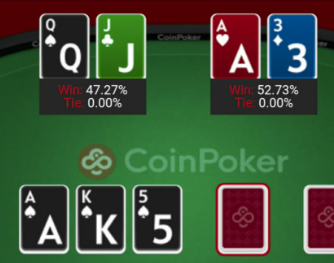
You gotta win flips to win tournies! My opponent went on to take the tourney down for €165,000. I got a €2250 cash, which was nice, but I would have loved to play on a bit longer.
I had not considered the fact that villain may be very ace-heavy in his opening range, and also that apparently he is going to be happy to call a jam with even his weakest Ax hands that don't have a spade.
I had, but it's still a shove. And he should be calling with any Ax.
There are some decent guidelines for heuristics to use for what you're willing to stack off with depending on stack depth / SPR on the flop. This short (you have 7bb with 5.5bb going to the flop), any top pair is good enough to stack off with. As is a combo draw to the nuts.
GG, WP by all.
I had, but it's still a shove. And he should be calling with any Ax.
There are some decent guidelines for heuristics to use for what you're willing to stack off with depending on stack depth / SPR on the flop. This short (you have 7bb with 5.5bb going to the flop), any top pair is good enough to stack off with. As is a combo draw to the nuts.
GG, WP by all.
Yeah, I guess so, but I was still somewhat surprised he called so quickly. He's either a mile behind or slightly ahead. I thought perhaps he could fold his worse Ax hands facing a potsize raise, but perhaps not - the solver says he is meant to call, of course.
GG
I had, but it's still a shove. And he should be calling with any Ax.There are some decent guidelines for heuristics to use for what you're willing to stack off with depending on stack depth / SPR on the flop. This short (you have 7bb with 5.5bb going to the flop), any top pair is good enough to stack off with. As is a combo draw to the nuts.GG, WP by all.
Yeah, I guess so, but I
It's 7 BB. He really can't fold top pair. When you jam it's a success if you fold out something like pocket 8s with no spade that has a decent amount of equity, but I don't think you can expect an ace to fold. That doesn't mean there's anything wrong with jamming though. You're still flipping even with an ace.
One note about your PIO sim... Your ranges are totally unrealistic. You should be jamming preflop with many of the pairs, Ax, suited Broadways, etc. so your calling range should be a lot weaker.
My suspicion is that if you ran it with more realistic ranges calling would play a more prominent role in your strategy, because he should have a big advantage especially with Ax and strong Kx.
I still probably raise in practice.


