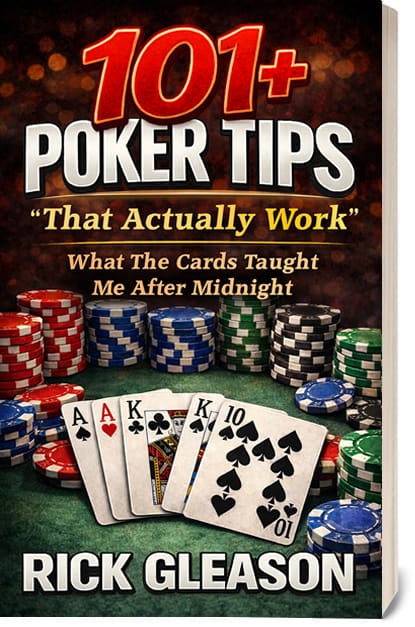
101+ Poker Tips and What The Cards Taught Me After Midnight
Hello Everyone,
My name is Rick. I’ve been playing poker seriously for twenty years and have spent the past decade living in Las Vegas, logging thousands of hours in live cash games, and taking notes.
Like many of you, I’ve read a lot of poker books over the years — more than 60 myself. Some were brilliant. Some were… a little heavy on theory and light on what actually happens when you’re sitting in a real poker room at 1:30 in the morning.
After enough late-night sessions, good decisions, bad decisions, and the occasional painful lesson courtesy of the river card, I took all those notes and voila', they became a book. It’s called:
101+ Poker Tips – What the Cards Taught Me After Midnight.
The idea behind the book is simple: Poker can be learned… but it can never really be conquered.
Most players don’t need a 300-page manual. What they want are practical insights that actually help at the table — the kinds of things you only learn after hundreds (or thousands) of hours in real games. So the book is built around short, direct tips — observations about discipline, reading situations, bankroll survival, table psychology, and the small decisions that quietly determine whether you win or lose over the long run.
It’s written especially for recreational and low-to-mid stakes players — the people grinding out sessions in rooms like the Bellagio, Aria, the Wynn, the Horseshoe, and everywhere else poker is played.
No complicated math.
No theory lectures.
Just practical ideas that might help someone make one better decision the next time they sit down. Because if one good idea saves you a bet, a buy-in, or a bad session… the book has done its job and paid for itself.
If anyone here is curious, you can learn more at: RickGleason.com
I’d also genuinely enjoy hearing feedback from players here — good, bad, or skeptical. Poker players tend to be the most honest (and sometimes even the most brutal) critics in the world.
And that’s a good thing.
So, thanks for letting me introduce it here. I'm looking forward to the sharing of my tips, discussion and the trading of comments questions and observations.
— Rick
8 Replies

The filter auto-deleted this at first because it thought it was spam. It's not spam, but it's also not appropriate for the strategy forum, where we discuss strategy directly, rather than discussing books etc. that discuss strategy. I undeleted and moved it to the books and publications forum.
Can you give us a few sample tips as a preview?
I assume this was self-published. Did you use a professional copyeditor/proofreader or get input on your manuscript from other poker pros?
Yes, it was recently self-published, and I used both an editor (with poker experience) as well as a professional book designer who made a huge contribution to the layout and look of the book, including the design of the front and back covers.
What follows is a tip from the book.
Poker Tip #6
Position Isn’t Just A Place,
It’s The Engine Of Profit
This is one of those bedrock poker truths. Position is the
one advantage you’re guaranteed to have every orbit.
Acting last means you see how interested everyone else
is before you commit a single chip. That information is
priceless and the thing that prints money over time. I’ve
won countless pots with mediocre hands simply because
I had position and my opponent didn’t.
When they checked, I bet. When they hesitated, I applied
pressure. And when they fired confidently, I folded like a
cheap Walmart chair and lived to fight another hand.
None of that is possible when you’re guessing from early
position. The button is your best friend at the table.
If you ever wonder why good players love the button so much,
it’s because poker is so much easier when you’re the one
asking the questions instead of answering them.
Comment, questions and observations are encouraged.
The filter auto-deleted this at first because it thought it was spam. It's not spam, but it's also not appropriate for the strategy forum, where we discuss strategy directly, rather than discussing books etc. that discuss strategy. I undeleted and moved it to the books and publications forum.
Sorry, it was always my intention to have a strategy discussion by posting occasional tips from the book. I should have done that within the first post.
My apologies to everyone for maybe posting in the wrong forum and if I've do something against forum standards, please give me an opportunity to correct the mistake.
Respectfully
****. I had no idea that position was that important
LOL, your sarcasm aside, and remembering theses tips are written for beginners to intermediates, there are plenty of players -- likely you included -- that think they know about the importance of position, yet don't walk the walk, nor do they take advantage, when they have position.
They limp into too many pots, even calling raises. Then they waste more valuable chips, without regard to odds, often chasing unfulfilled draws with far too many marginal hands. Those losing "wing and a prayer" hands add up and it can often be the difference between a winning and losing session. I see it every single time I play, while opponents -- like me -- get to capitalize on those mistakes.

LOL, your sarcasm aside, and remembering theses tips are written for beginners to intermediates, there are plenty of players -- likely you included -- that think they know about the importance of position, yet don't walk the walk, nor do they take advantage, when they have position.They limp into too many pots, even calling raises. Then they waste more valuable chips, without r
I think that virtually every strategy poker book ever written talks about the importance of position. So, to help your book sell, why don’t you post a tip that is more unique. This will help potential buyers decide if they want to pick up a copy.
... to help your book sell, why don’t you post a tip that is more unique. This will help potential buyers decide if they want to pick up a copy.
Mason,
Thank you so much for sharing your thoughts and your advice.
Remembering this book was written for beginning, recreational, and intermediate players here are three tips.
Thanks again!
POKER TIP #24
Good Folds Deserve Respect
Good folds won’t make highlight reels. They won’t get
applause. Someone might say, “good fold, ” but better than
that pat on the back, a good fold quietly preserves stacks and
protects your win rates. Making them a part of your arsenal is
part of becoming a profitable player.
Most players measure courage by how often they call.
Winning players measure discipline by how often they don't.
A good fold means you were paying attention.
You saw the sizing. You heard the story. Letting go of a strong
hand doesn’t mean you’re weak. It means you understand
ranges, tendencies, and the simple truth that not every pot
belongs to you. Ego hates folding. Bankrolls love it.
=====
POKER TIP #36
Rivers Decide Sessions
Early streets set the stage, but the river writes the check. Small
mistakes earlier get magnified when the final bet goes in. By
the time you reach the river, ranges are narrower, stacks are
committed, and emotions are on the rise. This is where
impulsive calls and stubbornness do the most damage.
Approach river decisions deliberately. This is where patience
and discipline pay the biggest dividends. Pause. Reconstruct
the hand. Ask what story has been told, and whether it makes
sense.
One thoughtful fold or one properly sized value bet can
swing an entire session.
=====
POKER TIP #77
Variance Doesn’t Care How Well You Played
This is one of poker’s hardest truths. You can play perfectly
and still lose, and that hurts. You can play terribly and still win.
Neither result proves much on its own. It’s called variance and
it isn’t personal, nor is it fair. Accept it, it’s just part of the
game. The sooner you do that, the faster you’ll stop arguing
with reality.
The only thing you truly control is the quality of your decisions,
not the outcome of any single hand. Measure success over
time, not by today’s, or this month’s results. When you detach
your ego from short-term wins and losses, poker becomes a
game of discipline instead of emotion. That’s where long-term
edges are realized.
=====
Finally: A little "About The Author"
Favoring small-stakes, No-Limit Texas Hold’em, Rick respects the
legends, and maintains that hoodies, sunglasses, the chatty
Cathies, and bad beat stories are all needless distractions to his
favorite game.
His motto is simple and timeless:
“Play fewer hands. Make better decisions, and let the rest take care of itself.”
There are 104 additional tips to be found in 101+ Poker Tips


