1/2, AA, $400 deep: Small flop bets are getting me into trouble
1/2 live, ~$400 effective.
4 limps, I make it $25 from the SB with AA, two callers.
Flop ($80): 9♣ 8♦ 3♠ rainbow
I c-bet $35. In theory, on many boards the preflop raiser gets to use a small sizing with range advantage, and I’ve been trying to incorporate more small c-bets into my game.
Both players call.
Turn ($185): 8x
I bet $55, first player calls, second player jams for $295 total.
What struck me after the hand is that these “small theory bets” seem to create awkward live low-stakes situations. By betting less than half pot on the flop, I keep both players in with all their 9x, 8x, gutshots, straight draws, pair+draws, and random sticky hands. Then by the turn I’m playing a bloated multiway pot against condensed ranges and facing a miserable decision with an overpair.
In a live 1/2 environment where people overcall and underfold, is trying to implement these small range-bet sizings actually counterproductive? Should I simply be betting much larger multiway on boards like 983r with AA—something like $55-$65 into $80—to charge draws, thin the field, and avoid creating these turn spots?
Interested in hearing from people who have studied theory but also play a lot of live low stakes. Is this a case where solver-inspired small sizing is being misapplied because the population doesn’t react the way theory assumes?
19 Replies

Really? The same thread three times within a year? Do you remember these?
https://forumserver.twoplustwo.com/170/l...
https://forumserver.twoplustwo.com/170/l...
The last time I asked if you learned anything from the first thread and got no reply. The goal here is to learn, not just post as many hands as you can.
Low stakes games are exploitative, not solver approved although there is use for solvers here.
No offense, but you seem to be ignoring the advice you've gotten in your prior threads on this topic.
First off, it's debatable whether or not you should be c-betting here, for any size. You're OOP to two opponents on a 9-high board that will hit their range. Your c-bet size isn't all that small for a multi-way pot, and your turn barrel size is kind of small, not that it's a bad thing in this spot.
They could have all the sets and top 2P here, as well as a ton of draws. If you check, there's a pretty good chance one or the other will bet. You might even see a bet and then a raise.
Secondly, opponents will slow-play more when they're IP. The larger you bet, the more they'll slow-play. If you start sizing up on your bets, you'll just end up running into the top of opponents' ranges more often.
Third, once again, you're being results-oriented. When you c-bet the flop, were you hoping they'd fold? Are you now wishing you would have bet larger, so they would have folded? Is that really what you want if you have the best hand?
Go back to pre-flop. Notice that you're starting 200BB effective in a super-low-stakes game, where we can expect the action to be loose and splashy. Four players limped in. We're in the SB, and we'll be OOP for the rest of the hand.
We should expect that at least one opponent will call any normal size raise, and we may get more than one call. That's not an argument for raising larger. We got two of the four limpers to fold, which will make it easier to realize our equity post.
Assume that V1 had 9x and V2 had 8x. We had them both crushed pre-flop. We want those calls when we have AA. But we won't always get the best run-out for our hand. Our opponents can catch up. If V2 had 87, he spiked a 5-outer. It happens.
If V1 had T9 and V2 had 87, we were hoping to dodge 10 cards twice. We're going to get run down around 40% of the time.
Any over-pair on this board is kinda thin value. We beat all worse 1P. We're behind all 2P and sets. We don't really want to start piling it in on the flop just because we're scared one of our opponents will improve to a better hand. We could be over-playing our hand. We prefer to check or bet small.
How do you think theory assumes people will react? And how are your opponents reacting differently? I don't see anything out of the ordinary here. Did you even get a reveal on what either opponent had?
Pretty sure I pointed this out in one of your other "small c-bet" threads - your small bet sizing here likely accomplished something you don't seem to realize. You avoided bloating a pot you were bound to lose, and pressured your opponent to tip his hand strength by raising. You lost the minimum, which adds to our long term win rate.
Really? The same thread three times within a year? Do you remember these?https://forumserver.twoplustwo.com/170/l...https://forumserver.twoplustwo.com/170/l...The last time I asked if you learned anything from the first t
You missed one.

I don't think small cbets are good in general live, even if solvers like them.
This is a bad flop for your range, but you are usually ahead. One approach would be to cbet largish with th idea of usually getting the money in. Another is to check and see what develops. Based on the action, you can maybe x/r and maybe fold to a bet and raise.
Small turn bet looks weak. Not sure is villain really has trips. Tricky situation when raised.

Middle card pairing is typically bad for the pfr+cbettor. Even heads-up you will want to check this turn oop a lot.
Betting small opens you up to get owned and now you're wondering gee, did they pick on me cuz I bet small or are they raising bc they know I like my hand due to my 2nd barrel?
I think it was in another thread in this series where your turn sizing sucked so what do we think now?
The paragraph where you say that the small bet keeps in all kinds of hands... That part is mostly correct. But you can't have a wide range call and also say you're facing a "condensed range".
Being results oriented…
Solvers discovered that betting 25 to 35% pot folded out nearly the same hands as a pot-sized bet. You want villain’s calls with many weak hands.
Think of it like if you bet $75 preflop, they probably fold, but you won - not much. So, you bet smaller to keep them in. Sometimes they crack you, but it’s the best play. Be happy that the players let you know when you’re beat.
A pot-sized bet pressures draws, builds the pot, denies equity, and creates leverage on future streets. I like it when the nuts likely change on future streets. I also like it multi way when denying equity is more valuable.
The disadvantage of the big bet is you isolate yourself against a strong range - which you don’t mind here. Can’t balance bluffs
‘balance, we don’t need no stinkin balance’
So, I think it’s closer than those that would shoot me down. Mixing these plays has value.
But you’re asking how the play you make is affecting the “luck factor” and that’s not how it works
You play the hand as it unfolds

OOP vs two players the standard play is to check most flops with AA and see what happens.
as played check turn and i dont think its close. probably fold to a big bet and call a small one.
I’m just surprised some people are suggesting checking the flop and giving free cards to 2 opponents.
BART Hanson literally hates not cbetting $50-60 in these spots for fat value because 9x and all straight draws, maybe even 8x never fold to a bet, and population way underbets when checked to.
I feel like it would be a sick player to XRAISE a hand like AK-AJ here instead of AA. People nowadays bet/fold TP in these games all the time when deep, putting me on an “overpair”.
the thing about the forum is no one has ever used a solver but everyone constantly cites their output and have long winded explanations about why an omniscient computer can't possibly beat the guys in their low stakes games as effectively as they can. i think if you don't have a track record of crushing games / are playing reasonable (read upper echelon of midstakes+) stakes you're going to be infinitely better off learning poker / theory as opposed to trying to find edge cases about why it doesn't work. obviously everyone has mental leaks / motivational issues / laziness and doesnt do it, but at least be honest with yourself that it's you not the computer.
flop strat as you. i kind of made up ranges for pre but i dont think its going to matter much. you have the top left, they mostly have the bottom right. you check your overpairs that need less protection sometimes along with traps and board pairs to try to realize equity with your ace highs / missed overs. i think expecting people to consistently fold tp in spr 4 situations is wild. we don't really see the small sizing getting used as much on dynamic boards when the spr is low i guess. the hand is much more similar to a 3b pot than srp given the spr and the ranges in play to an extent
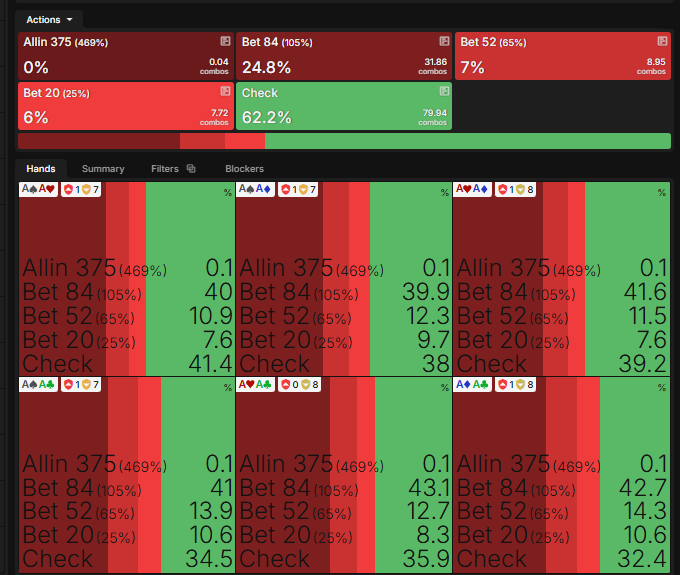
flop strat as you
consistent theme in all of your threads is you have insanely polar / nitty / black and white expectations of ranges and your opponents reactions. from the an observer standpoint they seem wildly incorrect and given that you are struggling at low stakes i would think you're going to do better if you discard that way of thinking. start with what's right and stop worrying about what you think people should do or why theory won't work at your games. if you could consistently read your opponents' minds you would be rich / playing higher / not need to post on here.
All due respect to Sub, because he's adding value when he posts sims, what's often missing is the logical explanation for why the solver does what it does.
OP - if you look at this sim, and likely most sims, you'll see that the solver tends to mix with its actions, but generally takes one or two actions more often than the others. We can't ask the solver why, so we have to interpret using logic.
Here's my interpretation:
Its basic strat when OOP is to check or make a slight over-bet. The reason it does a lot of checking is because our opponents will have more 2P+ on this board than we will. The reason it balances with some over-bets is probably because it cares about being balanced, so it's unexploitable. The check or over-bet strat polarizes us and makes it hard for our opponents to find the optimal response.
If we wanted to mimic this strat, we should continue to examine what the solver does in future nodes. It quickly gets complex, and probably hard to remember, which is why we humans tend to rely on heuristics, or we need to be able to continue thinking logically.
I would bet that the solver does a lot of checking on the turn, especially following the flop over-bet that gets called, and probably less checking when the flop checks through. It probably checks a lot of turns when the flop bet gets called because AA doesn't have a ton of equity versus the range that calls the over-bet. It bets a lot of turns after the flop checks through because AA has a lot of equity vs the range that checks back. It probably does a lot of check-calling on flop and checking again on turn when V bets flop, because the range that bets flop has some better hands and some draws.
You can look at this and understand that theory does NOT call for range-betting for a small size in all situations. You could logic your way to understanding what to do and why at each decision point.
But if you needed a super simple strat for this spot, you could check range. That would be better than betting range. Note that the solver is checking over 60% of the time.
If we were to node-lock the solver, and force our opponents to bet all their TP+ and OESD's, and check back everything else, the solver would likely adjust to checking range from OOP. This is actually how most humans play, so simplifying to checking range from OOP is a reasonable way to simplify the game tree when playing live.
So when is the small c-bet used? Generally when we're IP, and betting most or all of our range when action checks to us. Again, the solver probably mixes, but we can simplify vs human opponents as a way to exploit them for not finding anywhere near as many raises, compared to what the solver would find.
It may help to remember that the solver finds equilibrium by balancing offense and defense, and constantly reacting to however its opponent reacts to whatever it does. It's constantly adapting by probing, attacking, inducing, trapping, etc, as the situation dictates and develops.
It's like a dance where partners take turns leading. If all you're doing is thinking about offense all the time, you're forcing things whenever you have a good starting hand, and probably under-defending with other parts of your range.
Like, if we check flop and an opponent bets, AA is now on defense, not offense. If you're never finding your way here with 99, 88, 33, 98s, A9s, K9s, T9s, JTs, 87s, or 76s, you're leaving your team without enough players who can be on offense or defense, and your results will suffer.
with AA on this board you probably want to give people a chance to catch up and make a pair. also by checking flop if it gets checked around and you bet the turn it looks FOS.
All due respect to Sub, because he's adding value when he posts sims, what's often missing is the logical explanation for why the solver does what it does. OP - if you look at this sim, and likely most sims, you'll see that the solver tends to mix with its actions, but generally takes one or two actions more often than the others. We can't ask the solver why, so we have to int
yeah i mean alot of this isn't right
idk man im trying to be relatively diplomatic
its ok to take a shot and i know you worked hard on your post bc its super long but like look at the previous post where i said people have 0 solver experience and can't wait to opine for hours at legnth about hypothetical solver output and think if maybe that applies to you.
re the hand you are not taking into account how much things change at low spr situations. solver is trying to play a 2 street game here (similar to what you see in 3b pots on various textures) and force the money in with overpairs. it doesnt matter if they have more sets /2 pair than u (debatable if this is true) here when you are this shallow
The goal is to put the money in, and V put the money in for you. Seems like the desired result was achieved. Call. Sometimes you pick up a big pot versus TT-KK or a spazzy JT/A9, sometimes you run into 98.
Yeah, OTF you could have gone larger. Go as big as you think JT or 9x is going to call. This doesn't seem like the kind of flop a solver would bet small. "Solver inspired" isn't going to work for you if you mean what you heard on YouTube that a solver might do. For starters, you don't have range advantage, as the PFR you have way more air on this board than the callers do.
This is a flop that, in theory, you should bet less frequently and therefore favor betting relatively large. And in practice, Vs are going to get really sticky with JT, 9x, and TT-KK are going to be willing to play for stacks. You can pot it and look to jam a lot of turns. I mean if V turns over J9, do you think you're going to bluff him off it for less than $100?

Neither flop nor turn are small cbet spots in theory, and this hand is a very frequent check
You have a nut advantage on flop but not much of a range advantage and have a desire to get a lot of money in before overcards come with your TT-AA nutted hands. Then on turn you are polarized so again do not want to bet small, there's almost no marginal value bets in your range that want to squeeze out a tiny bet. Probably more like half pot
Really? The same thread three times within a year? Do you remember these?https://forumserver.twoplustwo.com/170/l...https://forumserver.twoplustwo.com/170/l...The last time I asked if you learned anything from the first t
Naturally OP has no comment on this. Or perhaps learning anything about poker. Too bad.

