1/3 - Line-check for AA in 3-way pot in loose-splashy game.
1/3 with UTG $5 straddle, $100-$500 BI, 9-handed. Not sure what the rake is. There's a high-hand and bad beat promo.
Reads - it's a loose-splashy game, even by 1/3 standards, with many, if not most pots going multi-way, players getting pretty sticky with their draws and weak 1P holdings, and players jamming pretty wide pre and post. There's been an absurd amount of donking in both heads-up and multi-way pots, with hands that didn't make much sense, like 2nd or 3rd pair with some backdoor BS or whatever.
V1 - UTG straddle. He's white, maybe mid-30's. Scraggly beard. Man-bun. Skinny. The sort you'd expect to work into a conversation that he's wearing something made from hemp. I think he's a reg, and I get the sense he's one of the better players in the room, but I'd be shocked if he's not a slightly losing player based on how wide he VPIP's pre, especially when he calls a raise. He's been calling hero's pre-flop raises VERY light. Around $400-ish to start the hand after sitting down with $500 and doing a bit of raising pre / folding post.
V2 - he's in early-mid position, UTG3. He's black, late 40's-late 50's. Dreads or braids. Loose. Has some light opens, but not any light 3B's as far as I could tell. Does a fair bit of limping and calling, and a whole lot of post-flop donking. Will over-fold to aggression. Likes to see flops. Will fast-play his thick value post. Hasn't done anything remarkably bad in the hour or so he's been at the table, but that bar is set pretty low in this room. Around $200-$250 to start the hand, after bouncing around between $150 and $300 since sitting down.
H - CO, white, early 50's. Mostly playing TAG with recurring bursts of LAG. Hasn't lost a big pot all night. Hasn't gotten caught bluffing by either V. No one's seen hero show a bluff in hours. Hero's been raising big pre, checking or betting small on flops, and over-betting turns. Only shown down winners, with a couple chopped pots after getting OOL pre. Mostly been taking pots down without having to show. Around $850-$900 to start the hand.
OTTH...
V2 limps UTG3. Hero raises to $35 with AcAh in CO. V1 and V2 both call, and we're 3 ways to the flop.
FLOP ($100-ish after rake / promo drop) - QdJc5d.
X, X, H $25, C, C.
TURN ($175) - QdJc5d 5c, adding another FD.
X, X, H $125. V1 calls, V2 folds.
RIVER ($425) - QdJc5d5c 4h.
V1 X. He's got about $215 behind.
Hero?
Hero's thoughts in-game:
PRE - game is splashy. V1 and V2 hate folding pre. V1 seems like he's doing a challenge involving never folding to hero's pre-flop raises. Raise big.
FLOP - these V's could show up here with literally any two cards. C-bet small to get value from anything / everything, but also open the door for either of them to x/r with 2P+ or get OOL if they think a 1/4 pot looks weak.
TURN - if either V had 2P+ or a big combo-draw they probably would have x/r'd over our 1/4 pot c-bet. V1 probably wouldn't call flop with 5x next to act. I don't think V2 would over-call with 5x, and if he did he's not deep enough for me to avoid doubling him up. Let's size up to target QX, stubborn Jx, and their inelastic draws.
RIVER - his range is likely to be weighted towards QX and busted draws. Not sure if he'd ever block-bet, or donk for value or as a bluff. I suspect he wouldn't do anything but check here. Not sure if he's price-sensitive when he's only got around half-pot left.

Preflop size is great with a loose straddle & limper. You should carry that thread to your flop size, and go bigger, somewhere around 1/2 to 3/4 pot. The bulk of our opponents' calling range isn't really going to care if it's $25 or $65, and you're likely overvaluing the potential of them getting out of line. Turn bet size is great for the same reasons that flop size is bad. River is a slam dunk jam. Every draw missed and the board paired a card that's "bad" for your range. It's a recipe to get called down by any showdown hand, and the idea of trying to milk for a lesser size will likely be cutting your value in the long run.
I like it so far. Might even go slightly larger on the turn.
Definitely jamming river. If you were OOP you might have a decision as whether to bet or check-call, but facing a check this is a jam all day long. You'll often get folds, but when called you are ahead far more often than not. You even called out his most likely hands yourself!
I would size larger on the flop, theoretical point of view we should go larger on this dynamic of a texture - if your looking for value combos with the small sizing reasonable options are QQ and AA w/ Ad since there are less turn cards we are concerned with these combos. Exploitatively against 2 loose V described larger sizing is even better to me given they will have more
trash FD/SD Qx/Jx than they should. As played river is straightforward jam, you will lose to some 5x given your small flop sizing but they will c/jam turn decent frequency, and plenty of Qx to get value from and even AJ if continue on the turn.
So much missed, we are gonna get heroed a lot.
No arguments with the jam on river and I like the small flop bet as long as you call any check raises.
V has a pair, if it’s Qx you get called a lot, if it’s QJ you should always get called.
WP
Thanks for the feedback so far. I wasn't sure about my flop and turn line, specifically the bet sizing, which led to the obvious jam spot on the river.
My usual c-bet size here would be 1/3 pot, but I think I may have gotten mixed up while considering their ranges, stack sizes, my bet size, and what happens if either V raises.
I thought if V1 called a $35 c-bet, and V2 check-raised, he might just jam, putting me in a weird spot where I'd have to choose between flatting the raise or re-jamming, and I wasn't sure which would be better. If V1 x/r'd, V2 would still probably jam if he wanted to continue, and I'd be faced with the same choice.
I thought a smaller bet size would let them continue with wider ranges, and also keep the SPR more manageable if either x/r'd, allowing me to continue as a call and evaluate turn.
In hindsight, I should probably bet larger, not smaller. The smaller raise size doesn't keep me from having to make a difficult choice if either raises.
That brings up an obvious question for anyone suggesting a larger c-bet size. If we c-bet 1/2 pot or more, are we calling a raise, 3B'ing, or folding? Are we just committed to getting the rest in once we see this flop?

In a loose splashy game (which I'm assuming has a lot of preflop raising) I'd be so tempted to attempt a LP LRR (especially with the straddle on and having that one other player that could raise for me preflop). But otherwise fine with raising a decent large size.
SPR is < 4, game is loose splashy, board is drawy, we offered fairly poor IO preflop, and a bunch of sets / two pear combos on this board are a bit unlikely (although never impossible). So I consider myself committed at this point, and on this board would PSB the flop to setup a turn jam on a non-stoopid card. I don't think this is the type of board we want to eke stacks in over 3 streets (especially if we do feel committed). Note that if we're expecting people to go nutso against a small bet I guess I can get behind that (but that's not the normal reaction for most postflop in multiway pots, imo).
Fairly awesome turn card as the only real reasonable two pear just got counterfeited. Our turn bet has setup a nice sizing for the river, so fine.
Think I just shove the river. I don't think we have enough behind to bet lol small and induce a shove from busted draws, so let's just target TP.
GcluelessNLnoobG

Well played, now jam river.
Against more standard opponents I can see betting larger on the flop and jamming turn, making it a two street game.
Against the described opponents who are arriving to the flop with all kinds of junk, I like the small bet to put pressure on all the weak parts of their ranges. This has the added benefit of getting them to raise most of their strongest hands that might just call against a large bet. So when they just call you're pretty much golden going to the turn. Sure they occasionally will show up with 5x, but you will win most of the time when you play for stacks.
I also like the turn sizing. Size up with all the draws out there to make the max when they're drawing and set up an SPR where they are likely to feel priced in to call on the river with stuff like weak Qx or Jx. It seems like a good exploitative line to me.
Reveal:
Spoiler
Hero jams. V snap calls, and shows 54o.

Trendy small cbet is just awful. Shove river. Only a half pot left and you bet QJ.
Seeing results, V1 of course defended his straddle and you priced him in on the flop.
Trendy small cbet is just awful. Shove river. Only a half pot left and you bet QJ.
Seeing results, V1 of course defended his straddle and you priced him in on the flop.
Really?
If we c-bet huge we're only getting called by better hands and draws to the nuts. Or we get x/r'd.
V probably shouldn't be defending his straddle that wide when I raise big pre and there's a limper left to act still. He probably shouldn't be flatting the flop with bottom pair, no kicker.
Yeah, sometimes we get beat by 5x, but I think more often we get paid by Qx and even some Jx.
I didnt say huge. You bet 1/4 pot.
You may get a small bet from weak holdings but you wont get that much unless they improve, which ususlly means aa is not good
If we c-bet huge we're only getting called by better hands and draws to the nuts. Or we get x/r'd.
From a theory perspective, on SRP MW pot here on two-tone dbl broadway textures w/ lowcard - QJ5dd, KJx, QJx etc we get to use a larger flop sizing with our range. You can check for yourself if you want to put in the effort to improve with off the table study work. Reason is that we have a top-range advantage AA/KK/QQ/JJ/more AQ and notably there are MANY hands that will continue without question against a sizing larger than 1/4 - KT/T9/Qx/ALL dd that is a LOT of combos if you count them all out! This also puts pressure on gutters/weak single pairs that we do not mind getting folds from, where otherwise they can profitably continue against your small sizing. You can make the argument that Jx will fold out but loose 1/3 recs facing a single bet extremely unlikely to me they snap fold all Jx combos vs a single bet. I have no issue making exploitative adjustments but larger sizing than 1/4 is unquestionably theoretically sound here. I would also argue against loose players that call too wide betting smaller than you should is an adjustment in the wrong direction. Regarding your concern about potentially facing a c/r using a larger flop sizing, at this stack depth we can comfortably stack off on this texture.
Something else that you may find interesting that I doubt most 1/3 live players are utilizing is that in a SRP CO v BB on these two-tone dbl broadway textures the size differential is even larger with overbets being used from a theory perspective. Take a look below at a few examples:
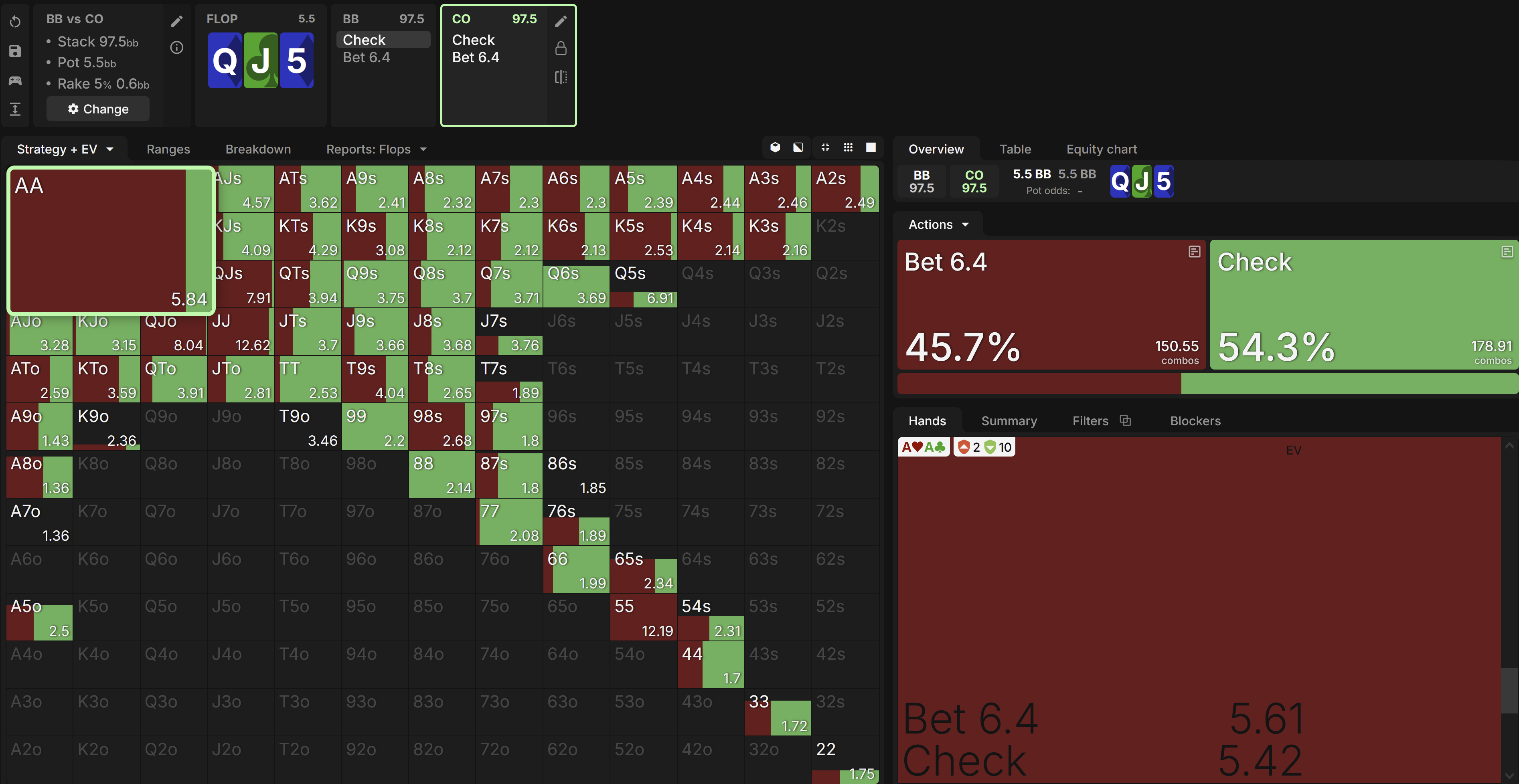
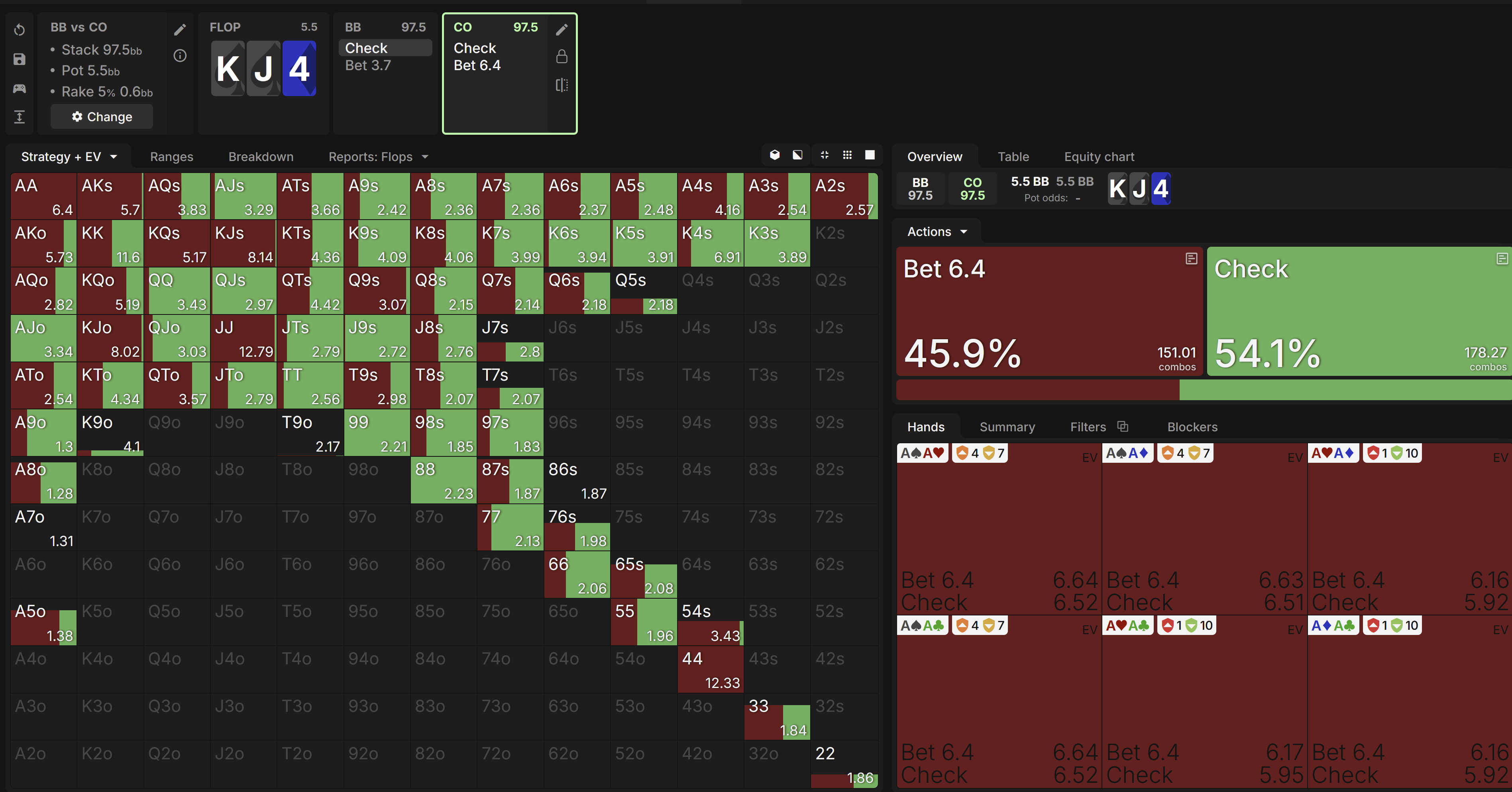
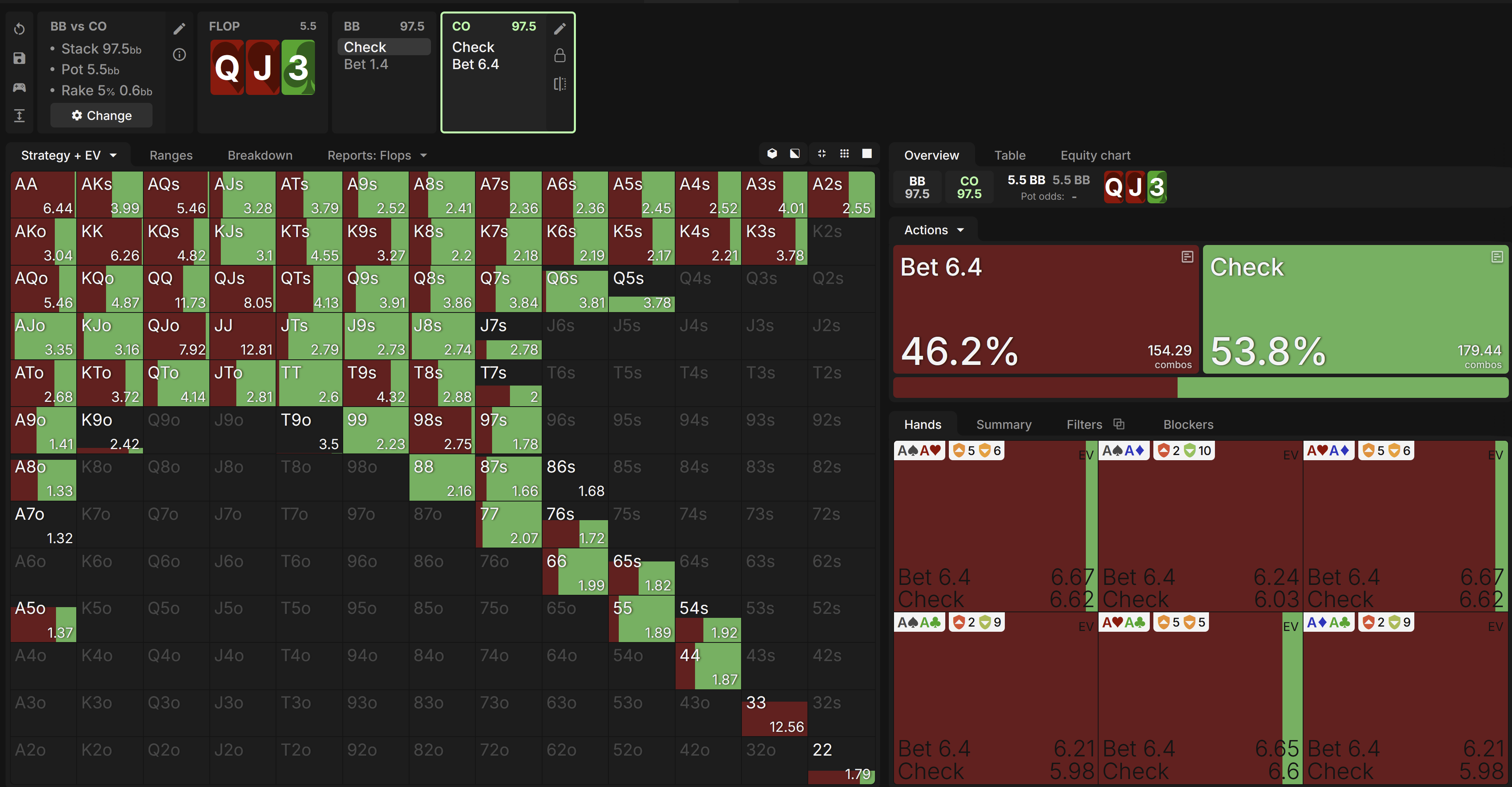
Hope that helps.
If we c-bet huge we're only getting called by better hands and draws to the nuts. Or we get x/r'd.
From a theory perspective, on SRP MW pot here on two-tone dbl broadway textures w/ lowcard - QJ5dd, KJx, QJx etc we get to use a larger flop sizing with our range. You can check for yourself if you want to put in the effort to improve with off the table study work. Reason is that
Those look like heads up sims. Multiway you typically cbet smaller in most instances, but 1/4 pot might be too small.
Anyway you can make many different cbet sizing schemes work with little EV difference if you structure your ranges properly.
Typically when you're up against stronger ranges you cbet less often, but use a larger size when you do bet.
Against wide ranges composed of lots of offsuit garbage (such as this spot), it's reasonable to use a smaller sizing and cbet more often. The SPR is low and you can still easily get all the money in.
You could argue AA specifically plays better on this board as a large bet, but a relatively small cbet plays well with a larger portion of your range. Our opponents are going to end up overfolding with their overly wide, weak ranges, so the benefit of a small cbet is that we'll gain EV with a lot of our weaker holdings that would have to check if we're using a larger bet or check strategy.
You have valid points here - can be a productive discussion. The sims listed are indeed HU, brought up tangentially for similar texture where if he is using a flop 1/4 sizing for his overall strategy is missing out on quite a bit of EV. No disagreement on using multiple different cbet sizing schemes MW w/ only a marginal EV loss difference than if you used a single larger bet sizing scheme. For the listed example from the OP hypothetically if you wanted to perfectly mix in a 1/4, 1/3, and 1/2 pot sizing or check with your overall entire range that can be valid and allows you to bet more frequently. In fact in my original comment I listed AA w/ diamond and QQ as hands I would most frequently include in the 1/4 bucket if you wanted the smaller sizing. Sounds like we are both in agreement that AA no diamond serves better as a larger size here. To be frank I am doubtful players at 1/3 are balancing perfectly with these sizes, but no shame in trying to learn and improve.
Another point regarding the 1/4th sizing, it is valid if mixed appropriately but dangerous if you utilize strictly a 1/4 pot bet size for your entire range in this spot - I am confident that will lose a substantial amount of EV if your entire strategy is 1/4th bet or check compared to single larger sizing. Not suggesting that is what you were saying but want to be clear if people use strictly a tiny bet or check on this texture is a mistake.
You have valid points here - can be a productive discussion. The sims listed are indeed HU, brought up tangentially for similar texture where if he is using a flop 1/4 sizing for his overall strategy is missing out on quite a bit of EV. No disagreement on using multiple different cbet sizing schemes MW w/ only a marginal EV loss difference than if you used a single larger bet s
Agreed. If you wanted to simplify to one sizing, probably something like 1/3-1/2 pot or check would be the sizing you would want to go with.
I would typically split my range here, using a 1/3 and 2/3 sizing, but leaning more on the 1/3 sizing multiway. Not that I'm claiming that is completely optimal, but those are the sizings I have studied. In similar spots I've studied AA often splits between the smaller size, larger size, and also sometimes checks as well. The larger size is probably used most often with AA unblocking top pair hands, but I don't think using a 1/4 pot bet with AA in this specific spot is a massive error. I like betting small sometimes with strong hands against reg-types as I find they often assume that I'm range betting due to the sizing, and attack with check raises with a lot of weak draws. I'm generally happy to stack off here with AA on this flop and at this SPR, so inducing raises is a benefit of cbetting small, IMO.
Cbetting 1/4 pot may be good against regs if it induces a raise. I know solvers tend toward small cbets and theoretically you are supposed to cbet smaller multiway. However, you are up against live low stakes players who will call larger sizes with marginal holdings. You are not playing bots who will fold a lot to 1/2 or 2/3 pot. The QJx board is likely to hit opponents. KTs and T9s are OESDs. It is better to build the pot because you want to gii by the river with AA.
Cbetting 1/4 pot may be good against regs if it induces a raise. I know solvers tend toward small cbets and theoretically you are supposed to cbet smaller multiway. However, you are up against live low stakes players who will call larger sizes with marginal holdings. You are not playing bots who will fold a lot to 1/2 or 2/3 pot. The QJx board is likely to hit opponents. KTs an
I did get it in on the river. We had around 1/2 PSB left. It was a very easy jam. Again, what size would *YOU* c-bet on the flop, if you think 1/4 pot is too small?
V shouldn't have 5x getting to the flop. He shouldn't call the flop c-bet, even if it's only a 1/4 pot. If he's getting there and calling $25, is he folding for $35? Is he folding if we make it $50? If we have to make it $50 to get him to fold bottom pair, no kicker, what hands are calling? What hands are calling 2/3 pot?
Maybe QX and JX are the bottom of the 1/2 pot calling range. Maybe it's only QX. At what point are we betting so large that we fold out everything worse and only get called by better? Is that 2/3 pot?
How likely is it we'll be able to get stacks in vs a worse hand if we c-bet larger and one of them folds? If we make it $35-$65, and V1 folds, is V2 going to call flop and get the rest in on the turn?
Like, if we bet $35 or $50 and V1 folds, does V2 call? If V1 calls, does V2 fold? If V1 calls flop, V2 folds, and then V1 check-raises turn, are we calling, or folding? If V1 folds flop and V2 x-jams for $200-$225, are we calling, or folding?
It's easy to be results oriented, and say the 1/4 pot flop c-bet is too small. But if we bet $50 and they both fold, it would be easy to say that 1/2 c-bet size is too big in a multi-way pot.
If I bet $35 and they both call, and the rest of the hand plays out the same way, would you say "perfectly played; you just got coolered"?
I'd like to know what size you and others think we should take here. If it's 1/3 pot, $35, that's $10 more. Do we really think that's going to lead to V1 folding but V2 still calling? A difference of 10% pot? What if V2 only called the $25 because he was being laid 7 to 1 once V1 calls, and he would have folded if I made it $35 and V1 folded?
I think a difference of 10% pot isn't likely to drive more than an incremental decrease in V1's calling frequency, but a difference of 25%-40% pot (c-betting $50-$65) might reduce it to the point that the hand just ends on the flop, and we don't get any more value.
We could be debating if my $50-$65 c-bet was so large because I was scared of the draw, or trying to target too narrow a range for value in such a splashy game. If I bet $35 and the hand played out the same way, we could say that was too small in such a splashy game, and I should have gone larger.
Bottom line, I don't think the 1/4 pot c-bet size is "too small" if we're trying to get value from two wide ranges, and we think they're going to increase their x/r frequency vs a smaller size.
If we think our V's will call a larger c-bet with the same ranges, or most of those same ranges, okay, then we can consider betting larger, but then of course the result is the same, if the same ranges are calling. The only difference would be when we get more money into the pot before they start folding on later streets. But in this scenario, that would require betting more than $50 and getting called by at least one V, since my $25 bet got called by both.
So, if that's the goal, are you saying you'd bet more than $50 here? If I bet more than $50, what would you say if they both folded?
These are live low stakes players. They don't want to fold. When you make it 1/4 pot, you give 3rd pair and gutshots or whatever better odds to call. Better to not let them draw cheaply and build the pot. They don't understand GTO and will call with whatever. If you make it 1/2 or 2/3 pot and they fold, they didn't have much at all, and probably wouldn't have called your large turn bet.
These are live low stakes players. They don't want to fold. When you make it 1/4 pot, you give 3rd pair and gutshots or whatever better odds to call. Better to not let them draw cheaply and build the pot. They don't understand GTO and will call with whatever. If you make it 1/2 or 2/3 pot and they fold, they didn't have much at all, and probably wouldn't have called your large
So you believe that they'd call 1/2 or 1/3 pot with the same range, because they don't want to fold? Or you believe they fold more to the bigger size, and you want them to fold their draws?
It seems like you're saying they'll call with the same range. If that's the case, then I'm not sure I see the point in a bigger bet, unless we're planning to check back turn and fold river when we don't like the run-out.
There's logic behind the small c-bet. Not sure I see the logic in the large bet.
This hand is why I don't normally cbet <50% of the pot. I'm fine winning a bunch of smallish pots on the flop It's also why I like SC 87 - TJ more than AA.
As to V calling a big bet pre with 54s, IME across a lot of rooms, they do it all the time in 1/2 & 1/3. In 2/5, a smaller number of the fishier players do so. They are all losing players; adrenaline junkies for the most part.
As to V calling a big bet pre with 54s, IME across a lot of rooms, they do it all the time in 1/2 & 1/3. In 2/5, a smaller number of the fishier players do so. They are all losing players; adrenaline junkies for the most part.
Villain had 54o, not 54s.
Yeah, this would be my main takeaway here too. Especially when we're likely committed. Especially in a game that OP describes in reads (where I'd be very surprised if even 2nd pear + a backdoor folds to a large bet).
Leave the 1/4 PSBs to uncommitted deepstack / difficult game/opponents spots, imo.
GcluelessNLnoobG

