Massive draw MW at level 1

1/3 NLHE 8 handed
Game is all fish, no one knows what they're doing. Mixed between tight passive and loose passive.
CO - Mawg smoker next to me. Sucks at poker. Level 1. 525$.
BTN - H - Covers.
SB - Drooler Mexican guy. 100/2/0.001 pre. Betting range is either the second or mortal nuts..even for small size. 101$.
MP - Generic loose passive 50's white guy. A bit tighter post, prides himself on a good fold. ~300-400$.
----
MP limps, CO to 10, H to 30 OTB with A♣ K♣, SB calls 30, MP calls 30, CO calls 30. 4-ways IP.
Flop 120 - J♣ T♠ 7♣
SB check, MP check, CO check, H looks at SB stack and bets 71, SB AI for 71, MP folds, CO x/r to 285 giving a speech with 210 back...
Am I missing something? We have 2 overs and a huge draw vs someone who sucks at poker and he wants to put all the money in the middle....
Good luck us?
PRE - obviously 3B. 3x size is fine. We could probably go a little bigger in general, and especially with our read of these opponents / this game, but whatever.
FLOP - wouldn't hate a check back, this multi-way, with these stack sizes. Also don't hate betting with our hand. Not sure what size makes the most sense.
I kinda think betting $35 so that we can re-raise if SB jams is better than putting SB all in. Small bets in multi-way pot tend to be GTO.
As played, I'm guessing we have at least 12 outs, maybe as many as 18. Expecting CO to jam brick turns. Kind of a disaster if we make our hand and he check-folds. Doesn't seem like we'd have any FE if we jam now.
What sort of speech did he make? Was it more "can't let you get there" or "I need help" or "I'm not good enough to fold"?
I tend to think he'd just jam 2P+, unless he has exactly 98cc. This sort of looks like some TXcc combo, like QTcc/T9cc/T8cc.
I don't think we're ever ahead, unless CO has something like Q9cc. I don't think he's bluffing very often. I don't see how we can call the $285 and then fold turn for another $210. There would be $970 in the pot and we'd be getting 4.6 to 1. So it seems like a jam or fold spot.
So, jam or fold.
Admittedly initial thought reading this post was laughing to myself about is what in the world is your question here, clearly + EV to continue and in-game here as played I would always play as shove if we are betting the flop in the first place and facing this action. And if you are not comfortable playing for stacks here w/ NFD and nut gutshot why are you betting the flop in the first place. Just calling giving us a pot of 761 w/ 210 back seems pointless to me, since we are not folding on any turn. BUT in your defense CO will have a strong range - so I'll breakdown a realistic "worst-case" scenario.
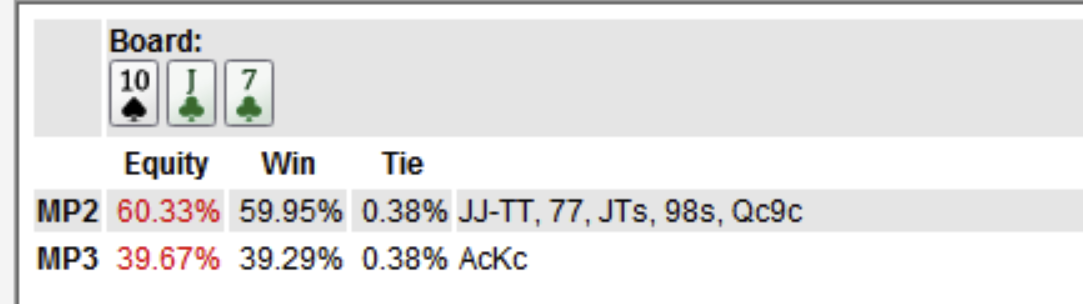
We need 35.9% to profitably continue AI here, 39.67% against this somewhat realistic "worst-case" scenario. Obviously we have the side pot to contend with, so will be a more slightly more complicated equation that you can further breakdown the equity against if you want for updated equity in the main and side pot, but our hand functionally with many direct cards to the nuts is not a hand negatively impacted here being MW AI. Bottom line continuing is going to be unquestionably +EV here. Understand it may be challenging facing this scenario in game, but if you become more comfortable with the back-end math portion of poker spots like this will become easier for you in time. Equilab is a useful free software that can help to run AI MW equity against different ranges if you want additional practice. Once you are more practiced spots like this will become automatic to you in-game.
Minor point for preflop, personally would 3b slightly larger size given there is a limper involved and we are 175 BB effective. As for flop, is completely fine to bet here - cleanup some equity. But checking is also a reasonable option some of the time 4-ways here as I expect SB to stack off w/ any J, or pair + gutter here so having a dry sidepot will make it dubious for semi-bluffing later streets if other players continue as well.
Other small note for you and some other posters on this forum is that I notice quite a bit of detail from posts in terms of fixating on bet timing - I.E. "I tank checked, he snap-shoved, he tank-called ETC". These small details can very slightly impact a perceived range or adjustment to your action in an extremely close spot but bottom line in poker you should stick to fundamental strategy and math rather than fixating on this particular detail of how a random 1-3 live fish takes on a timing for his decision. For a hand recap if you are posting these details for entertainment/hand storytelling every time it is fine, but from a strategy perspective focus on more important things in each hand if you want to improve.
Bet 35 so sb can open up the action, maybe a fish cold calls 71 and folds to our shove.
Just a little thing but I wouldn't bet 71 on the flop. Might offend the drooler and could telegraph strength to opponents (which, given we have Ace high, may not be a disaster!). In any event I'd just try and be a little subtle about it, make it 70 or 80 or whatever (or smaller, OmahaDonk has a nice plan to inflate the pot)
Why not make it $36-$70 so that when the $71 shove comes there is no risk of a further raise. We build the pot at our price and see at least the turn card at that max of $71.
If Mr $71 folds, or just calls and we get 3bet it will be for less and we will have less invested. Not saying we should fold in that scenario but it's all happening in a slightly smaller pot.
Why not make it $36-$70 so that when the $71 shove comes there is no risk of a further raise. We build the pot at our price and see at least the turn card at that max of $71.
If Mr $71 folds, or just calls and we get 3bet it will be for less and we will have less invested. Not saying we should fold in that scenario but it's all happening in a slightly smaller pot.
Action checked to hero. It doesn't matter if he bets less than &71, whoever checked can raise over his bet. We'd rather bet to $35 and have the option to re-raise over the $71 jam than bet $71 and not be able to re-raise if someone else calls the $71.
Why not make it $36-$70 so that when the $71 shove comes there is no risk of a further raise. We build the pot at our price and see at least the turn card at that max of $71.
If Mr $71 folds, or just calls and we get 3bet it will be for less and we will have less invested. Not saying we should fold in that scenario but it's all happening in a slightly smaller pot.
Our hand is so good we want all the money pouring in on the flop.
Result: We just reshove and gii, CO has red 77, SB has 55, Turn is a ♣ and river blanks...we gut everyone.

I'm assuming CO is only opening a tight range? With that in mind, and no other dead money in the pot, and us being sooted (and thus fine going multiway), and with a guy in the blind we really want to come along, I might just flat preflop. Although, lol, the guy in the blind came along anyways, so awesum.
JJ/TT make up a large percentage of a raise/call range, no? Plus we probably have no FE 4ways, and especially against the shorty (unless we think a bet is for value against him). I just check this back.
As played, looks like we're getting about 2.5:1 plus some IO. So I don't think we can fold. We have no FE and need to hit to win, so shoving also seems pointless. Yeah, he'll most likely follow up with a shove on the turn, but we'll be getting the odds to call then, so we can just wait for that to happen (and someone who sucks at poker is going to give us a free card some small percentage of the time). Although, lol, we could put ourselves in a interesting position versus a shove on a paired board on the turn.
GcluelessNLnoobG

I'm assuming CO is only opening a tight range? With that in mind, and no other dead money in the pot, and us being sooted (and thus fine going multiway), and with a guy in the blind we really want to come along, I might just flat preflop. Although, lol, the guy in the blind came along anyways, so awesum.JJ/TT make up a large percentage of a raise/call range, no? Plus we prob
The money is going in one way or another. Might as well shove ourselves. We should have zero fold equity but if he sucks at poker there might be a nonzero chance he’d make a blunder and fold. Besides we don’t need any fold equity in this spot for a profitable shove. We risk 424 more to potentially win 757 - we only need 36% equity to profit. (I’m simplifying by ignoring the possibility that we beat CO and lose to SB and assuming we win both pots when we hit. It seems unlikely we’d hit and only win the side). With 10 outs and two cards to come we have about 38% equity. (Ten outs because two of our flush outs pair the board, and we actually are very slightly higher since a Tc Qc runout gives us the royal and beats villains boat)

Bet 35 so sb can open up the action, maybe a fish cold calls 71 and folds to our shove.
Also thought this, as bet size is more normal for us too but with a slight worry that randoms with 71 left behind here will just call 35 often enough ... then looked back at the read that SB will call it off but won't put more money in without the nuts.
Eh, not sure. Probably still bet 35 anyway, but going big ~110 might be better ... not sure about 71 exactly, as it means if anyone calls there'll be a dry side pot on the turn.
I think we always have at least 11 outs when we're behind. Sometimes we'll have 12-15.
I'd assume CO is never folding if we jam over his x/r, and we have more than enough equity to want to play for stacks. Jamming has to be better than calling, if there's any chance he folds when we make our hand on the turn.
The only thing I'd be thinking about on the flop is how best to get as much money as possible into the pot.
I'd love to see hero c-bet $35, have SB jam for $71, MP call the $71 or raise, and CO call the $71 or raise. At that point, the betting is re-opened, and we can re-raise. The pot would be $368 getting back to us. MP would have $200-$300 behind, and CO would have $424. Seems like it would be a pretty sweet spot to re-jam.
Alternatively, if SB just flats the $35, maybe MP and CO also flat. We'd be getting another $140 into the pot, worst case scenario. There'd be $260 in the pot on the turn, with the remaining stacks being $36, $235-$335, and $460. If action checks to us again, it's a pretty easy jam.
It would be pretty amazing if MP decided to raise with some JX or TX combo he thought needed protection from all the obvious draws and over-cards, or if he thought our small c-bet looked weak, and he decided to raise with a worse draw.
Seems like we might have made another $35-$71 or more if we c-bet $35 instead of putting SB all in for $71. We let MP off the hook if he connected with the board in any way.
Also thought this, as bet size is more normal for us too but with a slight worry that randoms with 71 left behind here will just call 35 often enough ... then looked back at the read that SB will call it off but won't put more money in without the nuts.Eh, not sure. Probably still bet 35 anyway, but going big ~110 might be better ... not sure about 71 exactly, as it means if an
Was I not here the day they handed out Stupid Banana secret decoder rings for his reads?
How do you get "won't put more money in without the nuts" from "betting range is either the second or mortal nuts"? Why can't SB just check-shrug-call with 1P?
Even if we were to infer some degree of post-flop nittiness for SB based on that limited read, I'd argue that we need to allow for a lot of unexpected reveals when considering Banana reads.
Case in point - SB had 55.
Totally agree we shouldn't be betting $71 exactly here. $35 or full pot is better than $71.
PRE - obviously 3B. 3x size is fine. We could probably go a little bigger in general, and especially with our read of these opponents / this game, but whatever.
As there has been a lot of prior threads with "raise pre bigger" discussions, I would definitely recommend a bigger raise and was surprised you didn't say such this time.
At a minimum, I would do 3x10 + 6 = $36, but with a call pre happy table (as is true for most 1/3 games) and strong starters, bigger is better IMO. I would do 40 - 45 depending on what I think will get me 1 or 2 callers. I'm going to be betting the same with 78s. I need to keep up appreances.
I kinda think betting $35 so that we can re-raise if SB jams is better than putting SB all in. Small bets in multi-way pot tend to be GTO.
Not sure i would have thought of this in the moment, but I love this approach. I greatly prefer winning a pot without having to catch a draw, so bet 35 in the hopes of a big reraise when it gets back to me is ideal.
It probably wouldn't have mattered either way this hand due to the V with a set.
AP - if I really believe I have zero FE, on the 285 bet, I call. More often I jam against a rando.
Also thought this, as bet size is more normal for us too but with a slight worry that randoms with 71 left behind here will just call 35 often enough ... then looked back at the read that SB will call it off but won't put more money in without the nuts.Eh, not sure. Probably still bet 35 anyway, but going big ~110 might be better ... not sure about 71 exactly, as it means if an
I do get burned by shorties not shoving but in this case it’s not a big deal. Keeping everyone in or forcing everyone out both generate a lot of EV and it’s hard to estimate which is better.
As there has been a lot of prior threads with "raise pre bigger" discussions, I would definitely recommend a bigger raise and was surprised you didn't say such this time. At a minimum, I would do 3x10 + 6 = $36, but with a call pre happy table (as is true for most 1/3 games) and strong starters, bigger is better IMO. I would do 40 - 45 depending on what I think will get me 1 o
I did say we could probably go bigger. I'd be more adamant about raising bigger if we'd be OOP post. Banana hasn't been super receptive to the raise bigger pre advice, so I've backed off. I wouldn't want to obscure more salient points with continued brow-beating.
My initial thinking about using a smaller c-bet size was focused on having the opportunity to apply additional pressure with a re-raise, and being happy to get folds. But with so much equity in our hand, I think the focus should just be on how best to extract the most value from our opponents, and we can be somewhat indifferent to whether or not we get any folds.
My guess is the mistake of CO folding to a jam or not putting it in himself on the turn are quite unlikely, so it probably doesn't matter much, but in general there isn't much good reason to purposely put our stack in if we don't have FE and we have to improve to win (assuming our draw doesn't currently have a massive equity advantage, which I think is fair to assume given the action). So technically I think calling is actually the preferred play (even though 99% of the time it will be going all-in by the turn).
GimoG
Jamming has to be better than calling, if there's any chance he folds when we make our hand on the turn.
You'd have to breakdown the EV to prove this, but I doubt it? By just calling we're getting to the turn as a dog for way cheaper.
GcluelessEVnoobG
My biggest concern with calling wouldn't be what to do on brick turns.
Biggest would be if we call/fold when the board pairs on the turn and he shoves. Probably call given it's 200 into 800, but I'm not a big fan of drawing dead.
Next biggest would be wtf we do if the turn is the random club and we get checked to. Probably shove (again 25% pot behind), but our flop call is terrible if V finds/has folds.
We have position and if the 7 was a 5, then I could get behind it more. Also maybe if our read on big stack V was different.
Biggest would be if we call/fold when the board pairs on the turn and he shoves. Probably call given it's 200 into 800, but I'm not a big fan of drawing dead.
Yeah, this would admittedly be a funny spot.
Next biggest would be wtf we do if the turn is the random club and we get checked to. Probably shove (again 25% pot behind), but our flop call is terrible if V finds/has folds.
If Villain finds folds for this amount then he probably somehow has less strong a hand than we think and we ended up having far more outs than we thought (thus flop call was fine). Even as is, we're getting about 2.6:1 to chase at least 11 clean outs to the nuts (not exactly what we need but not coming up a heckuva lot short either).
GcluelessNLnoobG
You'd have to breakdown the EV to prove this, but I doubt it? By just calling we're getting to the turn as a dog for way cheaper.
GcluelessEVnoobG
^This post, in which you seem to assume he's always raising with a huge hand, making us a dog that should want to see a cheaper turn card, flies in the face of this next one, in which you seem to suggest there's a world in which he isn't raising with a huge hand, and we may not have been as much of a dog...
If Villain finds folds for this amount then he probably somehow has less strong a hand than we think and we ended up having far more outs than we thought (thus flop call was fine). Even as is, we're getting about 2.6:1 to chase at least 11 clean outs to the nuts (not exactly what we need but not coming up a heckuva lot short either).
GcluelessNLnoobG
I try to avoid allowing myself to get sucked into logical debates with you, but this one seems worthy of indulging.
Hopefully you'll agree that when V raises bottom set on this flop, he believes A) he probably has the best hand, and B) it needs protection from the bazillion draws available to his opponents. You might also agree that he may be putting in this huge raise hoping we'll fold, not call, because we may not fold a worse hand, but we'll always call with a better hand.
Without the benefit of the reveal that he had bottom set, how many less strong hands can he have here, in this line? How often is it worse than top 2P? How often is it worse than bottom set? He could have flopped a straight.
Especially when playing against bad recs at low stakes, this raise is almost always a strong hand that needs protection from the draws. When it isn't a strong hand, it's likely to be a very strong draw.
Hopefully you'll further agree that A) when his raise gets called, he may worry that he isn't actually ahead if he wasn't raising with the nuts, and you'll also agree that B) when the most obvious draw comes in, and his opponent jams, he's very likely to conclude that even if he was ahead, his opponent was on a draw that just got there, and his hand is dust.
Even getting 3.96 to 1, he should find a fold in that scenario. Easily. Like, it's the easiest rage-fold in the history of rage-folds. His straights are drawing dead when the flush comes in. His sets would be drawing to 1 out vs bigger sets, to 10 outs vs straights / flushes, and drawing stone dead vs straight flushes.
I can almost guarantee that YOU would fold all your non-nutted hands in that scenario (correctly), confident your opponent is never bluffing, and you wouldn't be getting the correct odds to continue.
If we flat call, hoping to make our hand, but he folds when we do make our hand, we should admit flat calling is not the highest EV play. He doesn't even need to fold ALL the time. If he just folds SOME of the time, flat calling is a bit of a disaster.
You can't have it both ways. He's either:
A - raising with a huge hand that needs protection, and we're a dog vs that range, but he'll find a fold if we make our hand, or;
B - not raising with a huge hand that needs protection, and we might not even be a dog vs his range, and he might not find a fold if we make our hand, since some of his raising range might be a worse draw that also gets there when we get there.
Even if we all agree that he's got 2P+ and we only have 11 outs, 11 is a lot on the flop. We have around 40% equity vs a range of JJ/TT/77/JTs/98s/Q9cc. Add in some combos of TXcc, and our equity improves. Throw in some random Q8cc/86cc and other trash, and we should be pretty close to flipping.
We may be a dog more often than not, but we're never that far behind.

