To hero or not to hero? That is the question...

This hand was played in the 6th level of an $11 mystery bounty turbo tourney on Stars. 78 players remain from 130, late

say we kinda have a read on opp being more aggressive with bluffs, then it goes checkraise flop, checkcheck turn, and river he jams.
he're I feel we have a much better bluffcatch, depending on concrete runout, bluffcatcher, feel.
we're in full control every street, over the board and in our mind - always aware of what's developing and where we're at, to finish off with a precise click and scoop the pot
while in the other line, our opp's complete range composition is hard to pin down, random, which makes playing it tough and unappealing

As I indicated above, we might get check raised 10% of the time, and villain might just call 50% of the time. Neither of those are good outcomes after betting the flop with bottom pair.
What is also not a good outcome is capping your range while finding out nothing about villain's range and facing big bet / shove where you're essentially guessing.

Surprised at everyone calling a check raise on the flop.
May end up alone on this, but I’m still bf even if that’s just an exploit strat v standard live opponents I come up against.
sure, regards some opponents, it's so obvious they're not raising anything but value, then we fold of course. if they make it too big, we also fold

Surprised at everyone calling a check raise on the flop.
May end up alone on this, but I’m still bf even if that’s just an exploit strat v standard live opponents I come up against.
I fold to a flop c/r with this hand because at best we are flipping. But this Villain would never c/r with 96o on this flop because we can have TT+ and never fold. Many c/r here will be flush and/or straight draws. Sometimes two pair and sometimes even Jx. But in the end people don't c/r with air because if they get called moving forward there is nothing they can do but fold on later streets especially because they are acting first.
So you are not alone on this...

Surprised at everyone calling a check raise on the flop.
May end up alone on this, but IÂ’m still bf even if thatÂ’s just an exploit strat v standard live opponents I come up against.
I'm also B/F this hand for the same reason you fold the turn facing a bet after checking back. Sure you're going to be ahead a fair amount but all their "bluffs" are basically flipping against our hand with two overs and a draw of some sort. It's going to be impossible for us to discern which cards connect with them on the turn and river and A3 is not a good hand to call down with.
We're better off calling the check raise with various draws that will provide us with more clarity as to where we stand on future streets (also calling with Jx and Tx). Occasionally we'll also have to call a check raise with some sort of draw and bluff on future streets when we miss but other draws connect.
I just checked the solve I ran and against a 1/2 pot flop raise to 7 the solver is pure folding A3s without a flush draw. The only A3 combos solver is calling with are flush draws and A3o with one diamond. That makes sense and I would definitely call with the Ad, but the solver is even calling with the 3d.
good reasons,
I have in mind if we go b20, b25 or b30 and opp raises to less than pot. it gets marginal or -EV around that mark.
in this setting an ace usually gives us the best two pair, since opp often rejams AJ pre.
so he does JJ, TT and 33, thus a clean 3 gives us the best hand often too. it's not many outs, and some are diamonds. having the ace of diamonds will be much better, or even the 3 of diamonds, or if we have A3s and one of the cards on the board has our suit.
opponent can be overbluffing here, which may be a condition for us to profitably call A3 without a diamond.
because there's one problem. solver rejams KQoff with 50% frequency pre, which will often be down to 0% in reality. and opposite to Q9off (with a diamond), solver never checkraises KQoff.
If our opponent does checkraise KQ, then A3 performs much worse in that line after a call. and a random opponent may do so, and potentially even have AJ there too.
why is KQ not a checkraise for solver?
I can think of not folding out Kx and Qx trash, that will be dominated if both hit top pair.
if a 9 comes we make the nuts, while Qx turns an openender and Kx a gutshot.
if we have Q9 and hit a 9, we can bluff blocking two pairs and straights, while if we hit a pair with KQ, we've no need to bluff having the best pair usually, but might look to bluffcatch instead.
with KQ we've also more showdown equity.
looks like a fold without a diamond now, even against a small checkraise.
solvervillain also checkraises some 3x that we dominate with A3.
but realvillain's checkraising strat is also unclear, honestly.
edit: if solver raises 3x like Q3off or K3off with a diamond, he only does it with a larger sizing above pot.
Surprised at everyone calling a check raise on the flop.
May end up alone on this, but I’m still bf even if that’s just an exploit strat v standard live opponents I come up against.
Sure, exploitatively. The solver's check-raising range is going to be much more polarized, with top pair hands they'll stack off with, high-equity draws that can't win at showdown or cooler another draw (i.e. KdQd doesn't check-raise here but 8d7d does), and bluffs with relevant blockers. Against that, calling with bottom pair and seeing what the turn is and if they give up (or if you improve, still a possibility) is fine.
If your opponent's check-raising range is going to be tighter and more linear, or if they don't bluff-raise enough, then yeah, you should fold.
Sure, exploitatively. The solver's check-raising range is going to be much more polarized, with top pair hands they'll stack off with, high-equity draws that can't win at showdown or cooler another draw (i.e. KdQd doesn't check-raise here but 8d7d does), and bluffs with relevant blockers. Against that, calling with bottom pair and seeing what the turn is and if they give up (or
Excellent, thanks nath
This rly is a great hand to analyse. We haven’t even got to the pfr-call-flop-chk-small-call-turn-check-decide part of the tree yet.
And we aren’t just auto checking back with A3 (credit to Eggs for this insight)
This does get to some things I think are misunderstood by solver-resistant people:
1)The best use of solvers isn't to say "Oh I played this specific hand right/wrong." It's to look for patterns in spots, determine what classes of hands the solver plays a certain way, and most importantly, figuring out why. Both in terms of things like "Why are these the bluffs?" or "Why do these two seemingly similar hands take different lines?"
2)While GTO play is supposed to make you unexploitable, obviously no one plays perfect GTO, and unless you're playing the high-roller circuit, you probably don't have to worry about most of your opponents playing close to it. But GTO is an optimal baseline for your game. You're going to find leaks in opponents you want to exploit, of course, and to best exploit them you'll deviate from GTO. But without having that theoretical baseline, how do you know what you're deviating from or if you're deviating at all?
GTO is a strong foundation to build on and it's fine to fall back on when you don't know anything about your opponent. But if you think you know something about your opponent such that deviating from it is a more profitable play, then you should do that.
when it comes to checkraising, villain will struggle on many runouts with relatively complex decisions compared to simpler ones when passively calling.
especially on lower limits I wouldn't expect a too high general checkraising frequency for this reason in this setting and scenario.
many hands like Jx might be played passively more often than solver does, and also some draws - while "easy" checkraises that play themselves - very strong hands and very bad hands - will most often constitute villain's checkraising range.
for same reason, villain may often just checkjam certain hands, vulnerable top pairs, draws with good equity, instead of tangling up in situations he'll make more mistakes than benefit from.
if Im right and field is polar - much more polar than solver - in this spot, then, because there aren't many strong hands villain can have here, and so many weak hands (with a blocker) to choose from, it's easy to overbluff.
we'll have opponents who don't bluff at all, and others who overbluff if they bluff - while opponents with more linear (or solverlike linearXpolar) checkraises will be rare.
hence, calling a checkraise looks much better again ;-)
regards opp having and checkraising KQ -
if he does, then he'll also follow through on any turn with his solid equity and we wont be able to defend A3 unimproved - thus we wont get to realize our equity in 9 out of 10 cases.
if we hit one of our two threes, we'll get to stack him often - but if we hit one of our three aces (which will happen thus more often), he'll get to stack us - if we don't find a miracle and get away.
with 16 combos of KQ our opponent may have sometimes in that line our EV in that strategy will suffer relative to GTO.
if someone chooses only the combos with a diamond, it's six combos.
Equity realization seems like the key consideration in this hand.
What line allows us to realize our equity to the greatest extent and deny our opponent from realizing theirs?
It's an interesting spot because on the flop we're ahead a lot of the time but we're pretty crushed by their "value" range and a lot of even trashy hands have six or more outs against our hand.
Denying equity to trash hands is a reason to favor betting on the flop.
If we're raised after our small flop bet, equity realization is again a major consideration.
I think that's why the solver is likely folding vs a check raise. An equilibrium opponent is going to follow up a lot with additional aggression and we'll have a hard time realizing our equity on most runouts.
If we expect our opponent to check raise bluff and then give up a lot then we can likely call a small check raise. Also if we really think they're getting out of line over bluffing we could even consider jamming over the top as a semibluff. Not that I'm recommending this but it could be profitable in extreme situations.
I think we can bet 75%
- zero action from polar bluffs like Kd4 or gutshots like Qd8, no action too from backdoor flushdraws,
then fold to a jam that will be high equity draws or top pairs worst case,
and if called we check behind turn and realize, to decide to bluffcatch if unimproved (or bluff some legit runout ourselves)
if opp jams kq on us on flop - no problem, thank you.
will he jam 89? unlikely, so he'll arrive with missed draws on river that have no showdown equity,
and hence could try to bluff out something - like missed higher draws.
he could jam or call flushdraws on flop and is unprobable to jam small flushdraws.
his response is likely to be honest, he might chicken and fold Tx, or find no jam with Jx
- giving us two streets for a fair price to spike a three and win more chips
- since he wont believe we bet three quarters pot with bottom pair / don't think our story makes sense,
and think we checked back turn to hit our draw that apparently did not get there ..
hands opponent might not reshove pre: small pockets, KQ, AJ.
we're not seeking showdown vs his small pockets, so we bet large and say goodbye to them.
we may tangle into problems (equity realization, reversed implieds on hitting an ace) vs KQ and AJ if we bet small and defend a raise, while they may shove and spare us of that outcome if we bet large - or we get to see two streets at least.
three on river is good, ace is unlikely to be bluffed by opponent, so we might find a fold if he jams.
(preflop assumptions are more solverlike if it's for example lowjack vs big B 25bb deep)
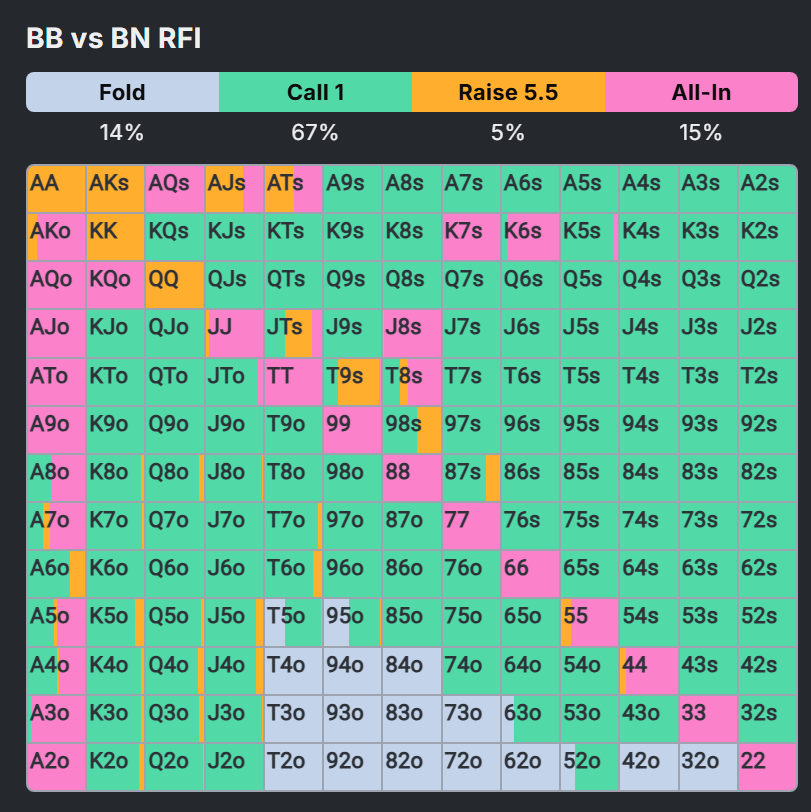
This chart makes it more clear why we prefer betting small on the flop. So much of the BB's calling range is just going to be trash hands. It makes sense to size our bets to attack that part of their range since it's a large percentage of their total hands. Many of their "good" hands are going to be rejamming preflop at this stack depth.
Interestingly the solver is not using a larger size at all. It's betting small 85% of the time or checking the remaining 15%. You could almost get away with range betting small. Against weak recs who will overfold range betting small might be the best play. Or just mostly range bet and check back the obvious hands that prefer checking like 99 and 88.
Against better competition the lesson from the solve I ran on the first page is that we should be checking back our worst Jx and Tx. Most players probably don't do this, and that's why they struggle to defend enough against turn bets after they check back flop.
I wouldn't exactly say "should",
as there are regs who are exploitatively opening wider - then reshoving has better EV,
and recs who are opening too tight - then reshoving ranges should be tighter, though it will depend on their calling ranges, which may often be too tight too.
should if goal is unexploitativity - and differ if wanting to exploit.
@greatwhitefish
even though it's vs button, I don't think people will attack that JT3 two diamonds board, also with these stacks, too wide,
someone who's doing it, will maybe find some occasional Qd8, but may pass on Kd4 often.
so a small bet will work well in general, and without a diamond we may lean toward a fold if raised.
regards a larger 75% size, solver will like it much more if nodelocked and tailored accordingly versus field and in particular few villains. here, having a diamond is also good.
imo one-street checkraise-bluffs are much more prevelant than doublebarrel potsize bluffs into ambiguous ranges. here more or less for sure and probably at higher stakes too.
our small flop cbet will be raised a staggering 20% of time by solver. but Im much happier to call that flopraise, than his turnbomb after our checkback.
Well if he check raised with value/draw, he is likely to rip many turns imo.
I'm totally comfortable with checking back flop and calling down on the right runouts.
Who says those people are right?Who says the were actuallt contemplating the existence of a small xr sizing strat?You sure were folding when he clicks it to 3bb? This the hill you wanna die on?Says who its not a good outcome? The Nash equilibrium says youre dead flat out wrongYouve got 70+ posts to work with. Why dont you give something back: node lock a tree in various way and
Well "those people" do include an MTT pro.
Be serious dude, he's not going to minclick checkraise - and if he did, of course I'm not folding.
It's obviously not a good outcome to get check-raised when you have bottom pair. You're behind all the value and maybe 50-50 with draws.
It doesn't serve any purppose to claim "the Nash equilibrium says youre dead flat out wrong" - it's a lot more constructive for the debate to highlight any differences, and discuss how/why.
The "max exploitative strat" is going to be very wacky when you start node locking. It's a useful tool but needs to be used correctly. You shouldn't just assume that villains are going to play that way.
What is also not a good outcome is capping your range while finding out nothing about villain's range and facing big bet / shove where you're essentially guessing.
Sure but - like it or not - it's the correct way to play with some of our range. When played I felt that part of my range included bottom pair. Poker is a game of incomplete information where we have to guess sometimes. I'm happy to call down with bluff catchers on the right runouts and I'd argue that it's better to play that portion of your range that way, rather than bloating the pot when you have a weak holding and are reasonably likely to get called/raised.
@greatwhitefisheven though it's vs button, I don't think people will attack that JT3 two diamonds board, also with these stacks, too wide, someone who's doing it, will maybe find some occasional Qd8, but may pass on Kd4 often. so a small bet will work well in general, and without a diamond we may lean toward a fold if raised.regards a larger 75% size, solver will like it much m
Regarding bet sizing, I really don't think a large bet on the flop is the best way to approach this spot. You said a solver would prefer a large bet if you node locked it, but what assumptions are you referring to node locking that would make a large bet better?
A BB defense range is almost always going to be wide and full of lots of trash hands that will have a hard time defending against a small bet. That's no different vs field. A small bet pressures lots of marginal trashy hands like K or Q high with a BDFD, whereas vs a larger bet they're easy folds.
Also another reason to cbet smaller is that we don't want to set up a profitable check raise all in with lots of hand classes. Betting small leaves us room to maneuver and leverage our positional advantage. We're still short enough that we will have no problem getting all the money in by the river, even if we start with a small bet.
Finally remember we're opening on the button, so we're going to have lots of relatively trashy hands ourselves. Most of these hands can stab profitably on the flop for a small bet, but it would be a big mistake to bet large.
A big bet sounds nice with the stronger parts of our range, like when we have at least a decent pair or draw, but we need to also think about what we're going to do when we have various weaker combos like Q6s or whatever.
how does field's checkraising strat usually differ from solver's?
does anyone know?
a) for example, solver just outright folds some two card backdoor flush hands against small cbet sizing, and checkcalls the best ones with apparently low EV.
does field raise them more often?
what is the real, exploitative EV of checkraising them?
b) solver checkraises gutshots like 97off or 87off preferably with a diamond, and checkcalls others vs smallish cbet.
do opponents prefer to checkcall, checkfold, or checkraise them more often?
c) does field preferably checkraise stronger draws and has a more linear checkraising range?
like:
checkraise : high equity draw (openender, flushdraw, ...)
checkcall : low equity draw (gutshots, backdoor fd's, ..)
checkfold : trash blocker bluffs
in general, no matter if gutshot, openender, bottom pair or trash runnerrunner bluff, solver prefers to have a diamond.
does field care about having a diamond at all?


