[2-4]: Flopped Straight but Flush comes in on the River
HJ - V2 - 1000€
CO - Hero - 700€
BN - V1 - 800€
V1 can prob be called a whale, he's been there for around

The other streets were talked about because preflop and flop were terrible.
There is 220 is the pot and you went 100 on the river. I wouldn't go less than that in position reopening the action.
Not only is it possible, it is routine that hands will overrealize or underrealize their raw equity. [...]
My main response to this is that most of what you said is again a generic argument against equity realization multiway. But this argument can't be correct because it proves too much. All six players have the same issue here. What you need to prove your case is an argument that is asymmetrical with regard to the hand. It would have to be an argument that QTo is uniquely worse at equity realization than other hands that opponents have. (And not just worse than hands you think are worth limping, like 76s or something, but worse than hands that other people limp! Which probably includes QTo for most of them.)
E.g.,
It all comes down to the reality that we aren't always going to be able to realize our equity on all flops. With QTo, if the flop comes out A52FD, you are going to underrealize your equity. Even if no V has an A, there are a ton of hands that had worse equity preflop that might bet, and you aren't calling anything right Vs can bet any FD and often might. Say a V has T7dd on a A
I agree there are instances where you fold out equity. But this is also true for all opponents! It's not an argument that you under-realize your total equity. You'd have to analyze the entire range and how often you end up folding out equity relative to all other players (and how often you pay too much to see future cards relative to all other opponents), not point to a single branch in which you folded equity. Equity realization is a function of the entire tree.
(And in fact most people call too much mutliway, not too little. So the main leak here isn't folding out equity, it's not folding out equity when you should. Overall equity realization will go up if you fold out more equity because most the drain here is putting more money into the pot postflop. And actually even the term equity realization is kinda a misnomer because it makes it sound like it's about how much you get back of what you already paid for, when it's actually a function of the entire future money you put in as well. It would be possible to have negative equity realization.)
Well, if you actually got in stacks every time you flopped the nuts, then those scenarios would almost itself pay for the 4€ since it happens a little less than 1% of the time. But there's lots of other branches where we can win (hitting 2 pair, trips, just a Q, or bluffing). So we really don't need to get stacks in after flopping the nuts to feel good about the call.
I would just come back to this ↓. In fact I kinda regret focusing on the equity case (even though I 100% believe in it) because I think this may be the most intuitive argument:
I don't think "86s is good but QTo is bad" passes the sniff test. 86s is better, sure, but not by much. These are very small differences, and I highly doubt that QTo reliably falls below the 0 mark and 86s above it. It seems much more likely that the difference is outweighed by other factors, such as the probability of someone raising behidnd you, whether there's bad players in
If you're someone who thinks that QTo is a bad limp here but 86s would be a good limp, it's just, like I said, you're focusing on small preflop differences that are unlikely to be decisive. It's like you're taking two points that have maybe 0.2€ equity distance and asserting that one is always above 0 and the other is below 0, while other factors will jointly move both points by way more than 0.2€. So yea I guess I'm just repeating myself now, but it's just way more likely that both are positive or both are negative. Like it would require pretty narrow tweaking of variables to make it so 86s and QTo happen to land on different sides of the 0 point. If the SB will raise half of their hands then you shouldn't even limp 87s on the BN, and if you know for a fact that no one behind you will raise, you could limp JTo on the LJ. We're just being by default way too rigid about the roles of opening hands because we've memorized charts.
I mean I'm guilty of this as well to an extent, I adjust preflop ranges but not as much as I know I should. It feels dirty to open, idk, QJo UTG on a 9handed table, but I think it's probably +EV if the table is sufficiently passive. And I should snap-fold AJo and 87s and probably QJs if the table is super aggressive.
Germany (and I'm a girl), but otherwise yea -- and I think this is one of those factors that probably already matters more than the difference between QTo and 86s. It's not that rare for multiway pots to stay below 50, and taking out 4 bucks or however much it is every time is a pretty big deal.
My main response to this is that most of what you said is again a generic argument against equity realization multiway. But this argument can't be correct because it proves too much. All six players have the same issue here. What you need to prove your case is an argument that is asymmetrical with regard to the hand. It would have to be an argument that QTo is uniquely worse at
After more thought it’s still fold pre
Somewhere in the equity conversation has got to be playability. We wait for the strong hands because they are easier to play.
A hand with equity means nothing to me if I can’t figure out where I am. It doesn’t matter if they have worse hands, unless I can take advantage of it. When it becomes a guessing game, I don’t think it can be profitable.
Equity logic does interest me as I love MTTs and I can’t play tight to ride out the card dead like in cash. I understand fundamental logic of when a draw has more equity than a made hand, but I’m sure there’s some nuance I’m missing.
I guess what you have to prove is not that it’s better than the other hands in equity realization, but that you can beat the other players with it enough to be profitable.
I guess you can say you got beat by a worse hand than yours this time.
Yea I also submitted this hand thinking River is the only interesting street, but somehow it's the least talked about one.Agree I should have bet bigger on the Turn. Idk about overbetting but like 10 more.Anyway I guess I can post reveal before going back to the preflop stuff.Reveal:Hero bets 100. V2 calls. V1 folds. V2 wins with T♥6♥.My own take is that the bet is okay but 100 w
I mean you've written entire essays defending your pre-flop decision, so it's clearly more interesting than some pretend it is. I do agree btw pre is not interesting. It's just a fold.
You've also got answers for post-flop. Bigger flop, bigger turn and bet/fold river all though I think bet/fold is super thin here. You're just going to be up against FDs a lot here when we get to the river 3-ways.
I would just come back to this ↓. In fact I kinda regret focusing on the equity case (even though I 100% believe in it) because I think this may be the most intuitive argument:
It's odd you don't understand that focusing on pre-flop raw equity makes no sense when post-flop is full of mistakes. On the one hand the entire argument you and Sub make is ''we have a skill advantage we'll play hands better than our field therefore we should play hands like QTo 6-ways'' and on the other hand, you play post-flop like this. I know you disagree, but I think flop and turn sizings are significant mistakes from an exploitative perspective, turn definitely is, I'd go much bigger flop too. River is too big too but you acknowledge that.
I can probably be convinced on this point but I don't really see much of a case for going bigger. I mean you either think that people call too much mutliway or too little. I think they call too much. If in fact they call too much, then they will make mistakes if you just make a normal-sized bet.14 into 24 is almost 60% pot which already is unusually large given that we're 6way.
If they call too much, wouldn't they make mistakes vs most if not all bet-sizes? Are we now supposed to believe on boards this wet that villains like V1 are going to react differently to 24 instead of 14?
Awfully balanced take for someone who hates GTO + you're up against 5 ranges with a lot of flush draws, Jx, Kx, Tx, Qx, these are the ranges you came up with. Why wouldn't we bet more vs those, none of these hands are folding.
I don't like bet/folding small in position on the river. I would fold preflop, larger on flop and turn, check back the river.
If they call too much, wouldn't they make mistakes vs most if not all bet-sizes? Are we now supposed to believe on boards this wet that villains like V1 are going to react differently to 24 instead of 14? Awfully balanced take for someone who hates GTO + you're up against 5 ranges with a lot of flush draws, Jx, Kx, Tx, Qx, these are the ranges you came up with. Why wouldn't we
I don't think it's about balance. I have no issue choosing different sizings with bluffs and value. I just thought that this value size makes the most money on this spot.
I think that
- against normal looking sizes, people will call too much ( ... only in multiway pots! In heads-up, they usually call too little.)
- I'm not sure what they do against large-looking sizes. Maybe they still call too much. I approximately never bet more than Pot if it's 6 way.
Basically I think other people will think in categories about bet sizing like "small" and "normal/medium" and "large" and "gigantic" with sharp changes on how much they call as you transition between categories (just talked about this with RaiseAnnounc...) so when you go for value, you probably want to scrape the upper end of a category. My guess is that 16 or 18 doe that (look "normal" even though it's really pretty big) whereas 20+ risks looking "big". But idk, low-ish confidence on this, maybe 24 on the Flop is better. But yea, I do think 20+ risks folding single pairs / plenty of hands with negligible equity against us.
Agree that against flush draws specifically, larger is better. But we probably have < 50% chance to have any opponent with a flush draw here, if I had to guess. I would not size assuming they have a flush draw.
After more thought it’s still fold pre Somewhere in the equity conversation has got to be playability. We wait for the strong hands because they are easier to play.A hand with equity means nothing to me if I can’t figure out where I am. It doesn’t matter if they have worse hands, unless I can take advantage of it. When it becomes a guessing game, I don’t
one thing is that opponent's ranges probably have lots of worse hands in them, so I'm not sure we have a playability disadvantage.
but also I Just can't imagine that mattering enough to move the needle. This is like the real issue here, that my point estimate for the EV of limping this hand in this spot is, idk, maybe +1.2€, so if I overestimate playability it might be +1.05€. But 0€ is not really in the margin of error. Just really doesn't seem like it's very close based on equity + position.
This is not going to have any bearing on this discussion because it will take months to get a relevant sample, but I'll start wriring down the net winnings/losses of all my preflop limps. I already do the same thing for all my 3bet bluffs, and I write down how much rake I pay, and various other stuff, so no reason not to add one more thing.
Yea I also submitted this hand thinking River is the only interesting street, but somehow it's the least talked about one.Agree I should have bet bigger on the Turn. Idk about overbetting but like 10 more.Anyway I guess I can post reveal before going back to the preflop stuff.Reveal:Hero bets 100. V2 calls. V1 folds. V2 wins with T♥6♥.My own take is that the bet is okay but 100 w
So...
Submersible's comments made me reconsider the EV of over-limping. If there's an argument to be made in support of it, his is the only/best argument case, ie that we want to play IP with the whale, and we're probably better off just limping, rather than raising, to keep the SPR higher.
The challenge is that if we want to over-limp to capture that EV, we have to prove that we can make good decisions post, and actually win max value when we make a nutted hand.
As enough people here have pointed out, and as you seem somewhat reluctant to completely admit, your post flop decisions in this hand wouldn't seem to justify your loose pre flop action. The reveal only cements it.
I mildly agree the river decision is interesting, but strongly disagree flop and turn aren't. In fact, I think the river is only interesting because of the suboptimal decisions on flop and turn.
The river isn't even all that interesting, and wouldn't be worth discussing at all had you made better decisions on earlier streets. But those are the decisions you apparently view as good, or inconsequential, or at most only incrementally improvable.
If you're going to over-limp multi-way to exploit the whale, you should size up with thick value. Especially when it's a dynamic board, and we have another opponent like V2 behind us. We should have gone for max value on flop and turn, and if V2 is still there when the flush comes in on the river, we can probably just make a fairly trivial check-fold.
Before you make an argument against the above, this goes directly to the points made about our ability to realize our equity in multi-way pots. As you noted, the pot goes somewhere. In this configuration, we increase the risk it goes to V2 by taking the line we did.
This is results oriented, but is there any doubt that V2 folds pre if we raise? Does he call a 2x pot bet on the turn?
You took the line I suggested on the river, after getting there in a way I wouldn't have. It's the one decision I wouldn't criticize.
You're focusing on a $20 difference in bet size there, and mentioned possibly going $10 bigger on turn. This is just tinkering around the margins. Netting those two against each other may have saved you $10. But playing raise or fold pre, or going for max value on flop and turn likely would have netted you much more EV.
I would urge you to reconsider your position on over-limping pre, or implore you to work on improving your lines post. It must be one or the other. If you believe it's neither, you're likely to keep losing lots of EV.
Reading the rest of the posts, I'm starting to wonder if all German women are so stubborn about accepting advice. It would explain a lot about the women in my wife's family. Can't get a one of them to change their minds about anything.
is odd how much time is spent on this forum trying to convince people their strategy is wrong while offering no proof beyond trust me bro. i think most of the feedback in the thread is lol
@prim if u want to guesstimate pre ranges for the 3 of you i dont mind taking a look at the solve and play around with it. my guess is we are "supposed" to use the b20ish size when board changes 3 ways into 2 even more so if v1 isnt leading, and its kind of hard for me to think v2 is gonna run massive river bluff with no blocker (i find it v difficult given pre and turn call to find alot of Ah combos, and you got the Qh so hed have to call with what QxJh or run it with like 2p and 3nfb) when he still has whale behind. you can also just size your flushes that size if you want. it feels like 100 is not great both theoretically and exploitatively (btn prob got flush idk 25-30%? of the time given turn)
im aware i going to open up more problems here but i think prim is both right re pre and signif better at poker than most of the posters in this thread. think if you guys continue to do this stuff you are just going to keep driving off the better posters
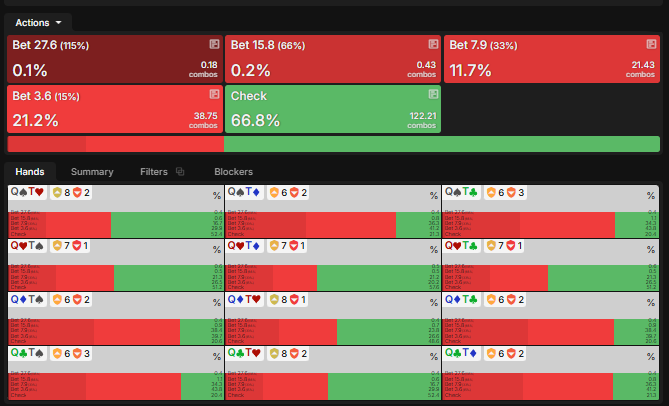
flop preference 3 ways. that means optimal sizing 6 ways likely smaller than this. can compensate i guess by just playing more polar / exploitably with i guess a range around 2p / straights / fds.
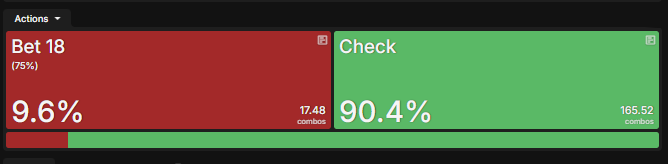
something like this. is worth pointing out vs 5 with symmetrical ranges its going to too big in theory but it would appear our opps dont care about theory. interestingly v1 supposed to play raise / fold vs this once v2 calls but whatever, (v2 playing no raises on the flop!) i will force him to call.
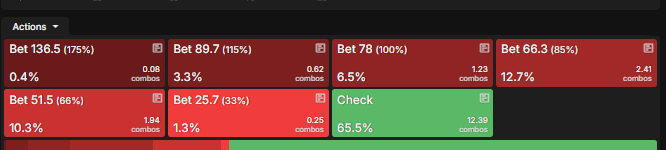
turn sizing by you. am just going to simplify to pot. had to do a lot of nodelocking to get v1 to the river on both flop and turn
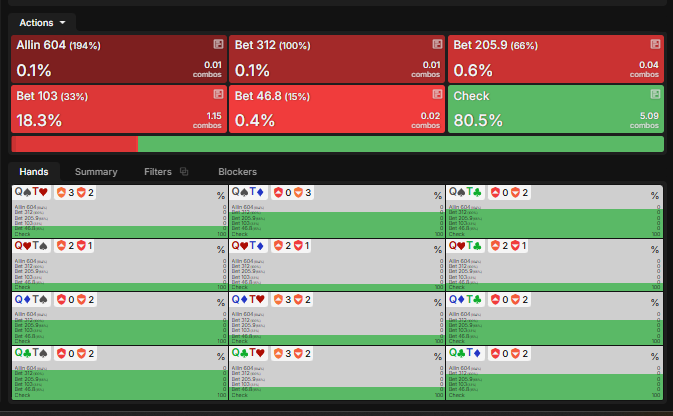
this is river while allow v1 to lead. it wants you to play super defensively bc btn has 25% flushes. would guess if i dont let v1 donk u are supposed to pure check. obviously we are not going to do that when ip is nit and v1 is whale but it might mean that QT is just too thin to actually bet if v2 is playing either well or tight. am inclined to think people are going to peel too loose everywhere in limped pots because unfamiliar with mutliway dynamics / limped pot ranges / the bets are smaller but is interesting to think about.
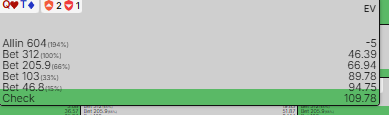
it does look like ev loss for us to do anything except check otr. will v1 whaling compensate for that? maybe. i guess i could lock him to call w like 2p+ but im unconvinced this player type goes for c/c instead of bet otf with those most of the time?
pre ranges are legit pure guesswork but im not sure it matters what we put in when v2 peels this ott, even more so when we see from results he have a bunch of suited hands
small addendum but i see it converging around b25 and b33 when i give it many river sizes for you otr (assuming oop doesnt have leading range) and only betting Q hi flush+. whether you want to play like that is up for debate. my guess is btn will be tighter facing aggression than whatever the sim suggests in every node but whale may be loose enough that we get compensated for it. when all the ranges are symmetrical and the board changes, it appears we are using smallish sizes (sim indicates whale has flush 38% which i doubt, you have flush 30% which i also kind of doubt given turn sizing and i expect you are playing your hand not a strategy as you almost definitely should be here, and that btn has flush 25% which seems most believable to me) and mostly playing defensively / deferring to ip. it also seems like given how often they have a flush combined we really struggle to value bet. again if whale doesnt know or care about this it probably adds enough ev to be able to put a bet out there
now if we could return to talking about how prim is the worst poker player of all time / light years behind the forum skillwise for overlimping pre / not getting all in postflop in a 6 way 30spr scenario thatd be great
i dont have a way to test the ev of the two (really 3 options) but from experience limping seems to work best.
is odd how much time is spent on this forum trying to convince people their strategy is wrong while offering no proof beyond trust me bro. i think most of the feedback in the thread is lol
Meh.
im aware i going to open up more problems here but i think prim is both right re pre and signif better at poker than most of the posters in this thread. think if you guys continue to do this stuff you are just going to keep driving off the better posters
This hand most certainly doesn't back up any of the claims you make. As for the second part of that sentence, it's a poker forum, if people want to discuss pre, they can discuss pre no matter how uninteresting to you, if that means people leave, too bad for them?
Thanks for the river sim btw.
is odd how much time is spent on this forum trying to convince people their strategy is wrong while offering no proof beyond trust me bro. i think most of the feedback in the thread is lol@prim if u want to guesstimate pre ranges for the 3 of you i dont mind taking a look at the solve and play around with it. [...]im aware i going to open up more problems here but i think prim
Thank you! For both the solver work and the kind words.
[...]this is river while allow v1 to lead. it wants you to play super defensively bc btn has 25% flushes. would guess if i dont let v1 donk u are supposed to pure check. obviously we are not going to do that when ip is nit and v1 is whale but it might mean that QT is just too thin to actually bet if v2 is playing either well or tight. am inclined to think people are going to pe
Yea, I'm sold on River being a check. Also because of this
and its kind of hard for me to think v2 is gonna run massive river bluff with no blocker (i find it v difficult given pre and turn call to find alot of Ah combos, and you got the Qh so hed have to call with what QxJh or run it with like 2p and 3nfb) when he still has whale behind.
I hadn't thought it through. Agree that this is not a plausible time for the asian guy to run one of his huge bluffs (which are super rare to begin with).
If I had checked, my guess is V2 would bet something small-ish like 90, maybe 120 but not larger, and then realistically I can fold despite the great price. He's approximately never value betting anything other than a flush here and also approximately never running a small-ish bluff in this spot. Least of all against me + an unpredictable player. So yea check-folding would have been the play. it does look like the bet just gets worse the bigger you make it, so I guess second best play would be to bet 30-40.
flop preference 3 ways. that means optimal sizing 6 ways likely smaller than this. [...]
Knew my sizing was already larger than theory! But in fairness to everyone else, this is the street where I am least interested in what the solver says because I do think absolute bet size matters a lot in live poker. Basically I do think you want to just bet your value for as much as you can without scaring people out of the pot, even if it means betting 4.5x as large as solver recommends. I mean solver literally wants to bet 4€ lol. I wouldn't ever do that. But yea then I'm effectively back at ¯\_(ツ😉_/¯ for which sizing is best, and would just default to my intuitive sense of betsize categories that says that people will probably perceive it as unusually big somewhere up from 20. If I played it again right now, I'd bet 18.
Reading the rest of the posts, I'm starting to wonder if all German women are so stubborn about accepting advice. It would explain a lot about the women in my wife's family. Can't get a one of them to change their minds about anything.
I'm sorry you think I'm stubborn :/ it's not intentional.
It's not that Flop and Turn aren't interesting. It's just that I haven't seen any strong evidence that they were misplayed. I mean, poker is a decision tree. For me to update on an argument, it has to give some evidence that the entire tree looks different than I thought. There wasn't really any argument about Flop or Turn that passed that bar iirc. Most of it was just pointing at parts of the tree. I already know that there are parts of the tree that are better with an alternative strategy! E.g., it's not enough to say that flush draws would pay more, you gotta at least gesture at a quantitative argument that relates it to the expected number of flush draws out there. Especially on the Flop. People's limping ranges are probably already more off-suit hands than suited hands, and there are only 10 ♥s out there, so each suited combination is again less than 25% to be a flush draw on the Flop. So yea there probably just aren't that many flush draws out there, so just talking about what happens against a flush draw isn't very informative. (It would matter more on the turn, but again, I'd need something quantitative to make it update my view.)
And if the arguments themselves don't do it then the only thing I'm left with is the appeal to authority, like just the fact itself that you guys advocate for something. But, um. I mean, most of you also think that preflop call is -EV, so I gotta discount your views, especially everyone who is confident about preflop. Like if you can be confidently wrong about one thing, I can't really just trust you on the next thing. Not saying that if everyone agreed preflop is +EV, I'd necessarily just take everyone's word for Flop and Turn. But I would worry about it more than I do in the actual timeline.
I didn't read through the thread but I either raise preflop or fold, I hate overlimping except in the BTN and SB but especially with this kind of seldom-the-nuts hand.
Flop whatever.
Turn I pot or overpot. Reasons a) we have the nuts b) we have a whale c) if I'm ever here with a draw I want to maximise fold equity. Probably wouldn't choose a whale to bluff the turn with but just thinking of balance this looks like a decent spot to overbet.
EDIT
3 ways I check river.
What is your basis for thinking that QTo is a better hand to limp behind with than 86s? Because of equity allin preflop?
If you are limping QTo, you should be playing about 40% of hands, which is too much.
What is your basis for thinking that QTo is a better hand to limp behind with than 86s?
I didn't think or say that QTo is better than 86s. What I said was that 86s is better, but the difference is going to be so small that it's implausible to think one of them is +EV and one -EV when there are several other factors who will move the EV of both by more than their difference. Sorry if this point was confusing.
So if you start from the premise that 86s is a good limp-behind in the CO at, say, an unknown table with 10%/6-cap rake structure, then it logically follows that QTo must be a good limp on this table because the other factors (lower rake, whale, and most importantly low % of being raised preflop), will increase the equity of both by much more than the delta between QTo and 86s.
QTo is worse than low suited gappers. Not is limit holdem and not as a shove or reshove hand short stacked. But playing it fairly deep in a cash game, it is a huge trap hand.
QTo is worse than low suited gappers. Not is limit holdem and not as a shove or reshove hand short stacked. But playing it fairly deep in a cash game, it is a huge trap hand.
ngl this kind of thing really just makes me ???? at what's going on. I mean it's just so completely and totally not a response to what I said. I guess you're not obligated to respond to me, you're free to just make an unrelated point? But it sounds like you were trying to respond to me.
This is also not the first time I feel this weird cognitive dissonance in this forum. Like I'll make a pretty specific point that somehow involves X, and then I get a reponse that's essentially "no man X is bad actually", and when I point that I wasn't saying X is good and don't believe X is good, it doesn't seem to matter. Do people just literally not grasp the point I was making? Do you guys just pattern-match anything mathy or complicated as noise/rationalization? Like if it sounds complicated it must be BS? Idk. But this is what it feels like sometimes. Maybe I'm just really bad at communicating :c
Allin equities do not make a hand playable. A7o probably has good allin equity, but it is not a playable hand to limp behind with. It is a dominated hand like QTo. Your math is irrelevant and misleading.
Stay with us Prim - we are at different levels of experience & development, but discussion does us all good. We may be in different states of mind IDK when we get involved in conversations.
I know that I appreciate all the angles people are coming from and I truly appreciate that there are others that share my love for the ‘decisions’ that make it such a great game.
I think it’s also ok to passover a reply if it’s awkward, I don’t think you have to respond to everyone. But take note: some of us appreciate your take on things and take a closer look at why we might disagree.
The cognitive dissonance is mostly on your part that you can't understand that your table of allin equities in not a guide to what hands you can play.


