TPTK in 3bp facing likely river give-up
I have looked at a solve of this, but mostly curious inclinations around exploitative adjustments and what to do in this
again. read my posts. ip is betting thin enough, its why you are seeing a b10 sizing. i pretty sure his river check is not his standard line but an adjustment to jasamgale. this is during cash game world championships where they played 10s of thousands of rake free hands reg battling over a few weeks. although river check gets mixed in very slightly w b150 as oop if i give ip a bunch of sizing options.
i dont think you really understand my posts and just blindly argue against them in these threads. i get its hard to understand whats going on in solves if you dont have a solver open but you have really strong opinions without any real reasoning behind them. at some point you play 2/5 and live mtts, maybe you dont know everything? i feel bad to shame you for that but man this is like absurd levels of dunning kruger. is possible paque made a mistake, but i can get solver to do what he did both at equilibrium and facing some iteration of jasamgales actual strategy. whats more likely when you see a hh played by someone who has made 1000x what u have in poker? him making a mistake or you not understanding the hand in question? exponentially more so in a very weird river spot vs another hs reg

river strat as oop when i change the node lock from betting 100% as ip to 90% (so still overstabbing). given that paque is incredibly good would think this is very likely to be what's going on. a8 will pure xjam when it checks. you're looking at ip betting the river from a normal sizing context but the driver for betting 10% is that he gets to bet any ax.
Why would you value bet Ax for 10% IP on the river into a range that is literally nuts and air? I guess there's a sliver of rivered Qx. The only reason would be that OOP is a total maniac who will over bluff to an insane degree, and are they really going to go insane against someone who just called a turn overbet?
Also I did look at the spot this thread is based on in a solver, and AQ is checking back at equilibrium, which is what I've been arguing for all along.
Why would you value bet Ax for 10% IP on the river into a range that is literally nuts and air I guess there's a sliver of rivered Qx. The only reason would be that OOP is a total maniac who will over bluff to an insane degree, and are they really going to go insane against someone who just called a turn overbetAlso I did look at the spot this thread is based on in a solver, an
they have 90+% equity vs oop's checking range is i guess the logic. that was suggested in the video you refuse to watch and i see it in solver. he maybe wants to force hands like Jx to indifference? we're not really sure why he does it, its not a play and explain video. its a high stakes and a mid stakes reg doing very light hh analysis from a pool they mostly dont play in. but its long time high stakes reg so theres probably some logic behind it
aq is mixing jam and check in the solver, i posted a ss of it earlier. if i introduce b10 i can sometimes get it to use that depending on rake and exact sizing constraints pre node locking. if you can post a ss of the solve of it pure checking i can try to see where the solvers are diverging. here op used custom ranges on odd software which is why its glitchy
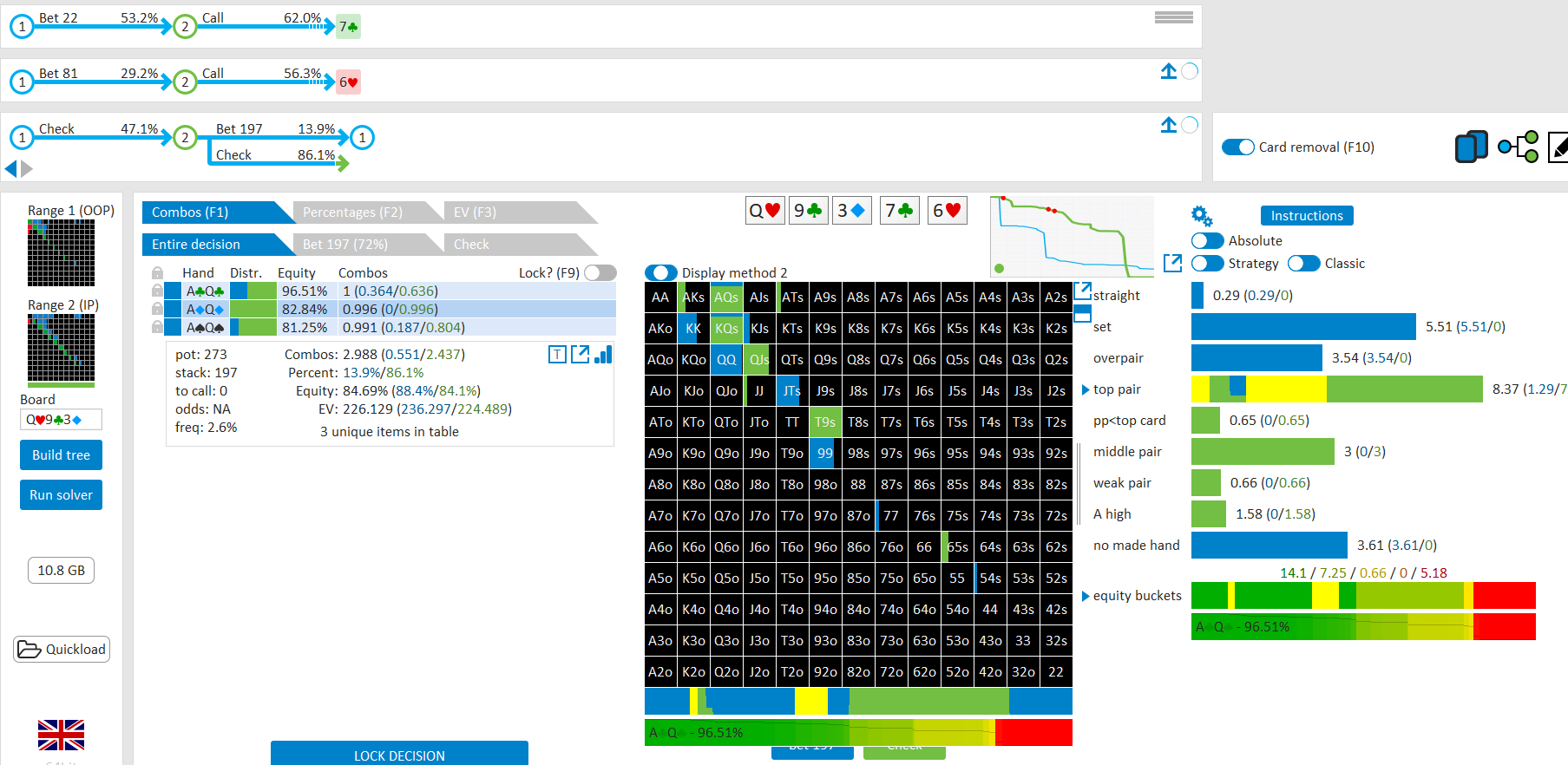
I didn't save the previous solve. Just reran it quickly with default sizes in a premade sizing format, which has opponent betting smaller 22 flop and 81 turn. With the smaller bets AQ is now mixing. The sim I ran before with proper sizing had it checking back. Blue is jam green is check.
[image]NiPv0A6.png[/im
..]
Anyway I'm stepping out of this discussion. It's a waste of time and energy focusing on these one off river spots where the assumptions are everything. As we both know you can pretty much node lock a solver to support any idiotic argument someone wants to make.
Also man I don't know why you constantly resort to insults when you disagree with someone. It creates a toxic dynamic which is the other reason I'm stepping away from this discussion.
I could make appeals to authority and start dick sizing citing results as a professional poker player, but that is stupid. I don't claim to be the best poker player in the world but I'm absolutely qualified to have an opinion about a hand.
Peace.
ok im not trying to personally insult you. we can put a pin in it here if you want
Also for reference the jasamgale hand is here and seems a little bit of a stretch to apply to LLS since the level of play is so much higher but it's definitely an interesting discussion of the place of this strategy in general and does feature a polarizing bet followed by a seeming give-up. I'll transcribe here with jasamgale as "Hero" although the cast shows it from Villain's
This is like the thread I started twenty years ago asking for dating advice and Billy Campbell replied with about when he first shagged Jennifer Connelly on the set of The Rocketeer. Fascinating discussion, and it even had pics and video links like this thread, but it was a bit above my bankroll at the time.
OP, at low limits, you can maybe toss 2-4 red chips in there when checked to, though you’d hate a $1K xr shove into an $800 2-5 pot.
But eke or no eke, checking back and saying either Nice! or Whew! and going on to the next hand isn’t ever going to materially affect your bankroll.
So I played around with this less than I would really like in the solver with nodelocks looking at b10 in particular and I feel like as usual with solver work it leads to some fairly mundane conclusions.
I actually couldn't reproduce AQ checking back here, must have been slightly different pre ranges as the equilibrium give-up was always no better than AQ except perhaps a slight sliver of KK. But in a world like this, we could consider b10 with other Qx, etc.
By default, the solver is always polarizing IP on river, shoving AQ+ to bluff all the missed draws that get here (mostly JTs). I added JJ/TT and all Qx to the OOP river range, didn't change too much about strategy OTR.
I experimented with forcing it to b10 when it would prefer to check (the dreaded "reopening the action") and I think the most interesting thing is that the danger and punishment from OOP comes almost entirely from check-shoving things like AQ and KQ. It's a huge (like $100 for AQ) mistake not to raise these hands versus this strategy. Unfortunately my solver can't nodelock only specific hands, but if I force Qx and TT/JJ to flat the b10 then the solve quickly adopts the "b10 instead of check" strategy.
My conclusion at the end of the day is that b10 can be a valid exploitative strategy here, and it mostly relies on the standard heuristic that you can often get away with betting way, way too much in LLSNL since the equilibrium response is usually way more raises than the population is capable of finding. On the other end of the spectrum, the solver is just going to start moving toward shoving much more if OOP is going to overfold to a shove of course.
Essentially, we need to shove a polar range here to get max bluff value from missed draws. Then any strategy to b10 the remainder of range are -EV in equilibrium because OOP now has enough polarity advantage to shove back at us. But this requires an aware enough OOP to recognize this and raise significantly lighter (specifically with value) than I think almost any live player will.
So I played around with this less than I would really like in the solver with nodelocks looking at b10 in particular and I feel like as usual with solver work it leads to some fairly mundane conclusions.I actually couldn't reproduce AQ checking back here, must have been slightly different pre ranges as the equilibrium give-up was always no better than AQ except perhaps a slight
Curious what assumptions you gave the solver regarding how often V calls larger bet sizes with JJ or TT, and / or what the solver does with JJ/TT at equilibrium. I imagine it probably mixes.
Of course we can't know what V will do before we act and he responds. My suggestion to bet around 1/2 pot was based on the assumption that those hands could be at least somewhat elastic here, though I wouldn't be confident trying to guess how elastic they might be.
It will often vary with our read. The more splashy V is, the more I'd jam. The tighter he is, the smaller I'd bet. I don't think I'd ever go less than 40% pot here, because I don't think the spaz raise frequency is anywhere near high enough, and we're just leaving money on the table when we bet less. At the stack depth, it's really just a matter of dialing in what size bet to use from around 1/2 pot to 70% pot jam.
So I played around with this less than I would really like in the solver with nodelocks looking at b10 in particular and I feel like as usual with solver work it leads to some fairly mundane conclusions.I actually couldn't reproduce AQ checking back here, must have been slightly different pre ranges as the equilibrium give-up was always no better than AQ except perhaps a slight
i am sure our friends who spent the whole thread telling me the river was a check will show up soon to acknowledge their error
I'm still waiting for someone, anyone to admit I was spot on in my ranging of V, and that betting half pot to all in was the move.
I'd hold my breath, but my brain needs all the oxygen it can get.

So I played around with this less than I would really like in the solver with nodelocks looking at b10 in particular and I feel like as usual with solver work it leads to some fairly mundane conclusions.I actually couldn't reproduce AQ checking back here, must have been slightly different pre ranges as the equilibrium give-up was always no better than AQ except perhaps a slight
What preflop ranges were you using? I think I was using HJ GTO ranges for a call vs SB 3-bet, and SB GTO 3 bet range vs HJ open. I know he was in the LJ, but I was assuming he would open at least a little bit tighter after the fish limped compared to a standard RFI range, since you know you're probably not stealing the blinds.
Doc, I'll give credit where credit is due as I think your line may very well be best. In my mind it is a close spot between checking back, jamming or betting 1/2 pot.
The reason I advocated for a check back is because of villain's line, 3-bet pre, bet flop, bet turn big. That (should be) a polarizing line. When he checks river I expect it to be with a lot of give ups that won't call a bet. Against the hands that would call a bet I think AQ is thin and borderline between value and check back/showdown.
My personal assumption is that the pre flop 3-bet is likely a tighter than GTO range. There is incentive to keep the fish in plus people just don't find a lot of the lighter 3-bets. He might not be 3-betting with KQs and QJs types of hands.
That all leads me to prefer checking back, but if there's a more aggressive dynamic so that small blind is 3-betting a wider range then it can turn into a fist-pump shove if he's showing up here with a bunch of worse Qx.
What preflop ranges were you using I think I was using HJ GTO ranges for a call vs SB 3-bet, and SB GTO 3 bet range vs HJ open. I know he was in the LJ, but I was assuming he would open at least a little bit tighter after the fish limped compared to a standard RFI range, since you know you're probably not stealing the blinds.
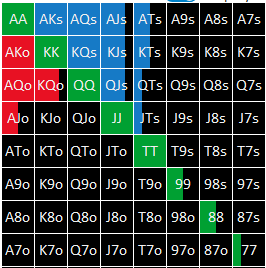
No strict GTO range, but OOP:
IP:
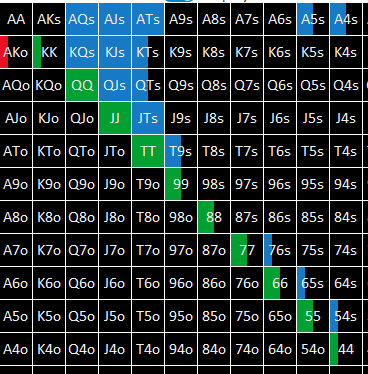
I just used LJ vs SB 150bb standard sized as a starting point, but in practice I really doubt the average LLS player who 3b a non-stupid range has the number of flats that GTO does here for standard opening sizes, so I converted a decent bit of that range to rasie, and trimmed some of the bluffs because people don't make them especially with a limping fish.
IP at the table, I am likely 4b significantly more linear than GTO here as I don't trust anyone to have an adequate 3b/f range and I am not actually opening 33/22 here.
You can easily play around with these ranges but they are going to yield substantially similar results, namely OOP barreling turn large with a polar range that shouldn't include JJ and giving up river with missed draws protected by a little bit of Qx or QQ or whatever.
My personal assumption is that the pre flop 3-bet is likely a tighter than GTO range. There is incentive to keep the fish in plus people just don't find a lot of the lighter 3-bets. He might not be 3-betting with KQs and QJs types of hands.
I would be surprised if this V is not finding a 3b with KQs, and honestly KQo which is why I put it in the range. Solver pure folds KQo versus a LJ RFI which is maybe one of the single hands that I think live players will deviate the most from theory.
Live players, at least in my experience, really overvalue offsuit Broadway cards compared to theory.
Curious what assumptions you gave the solver regarding how often V calls larger bet sizes with JJ or TT, and / or what the solver does with JJ/TT at equilibrium. I imagine it probably mixes.
Once I force OOP to bet turn large with 100% of the TT-Qx that bet flop, then the river at equilibrium:
Sets and overpairs shove river, along with a few bluffs most of which are AKo with specific suits for solver reasons, everything else checks. KsKd specifically mostly checks, I think because it unblocks the most missed draws?
If IP shoves, KQ+ calls pure, worse (including JJ) folds pure, except AK with the right suit properties is mixing calls. Solver is defending about 45%.
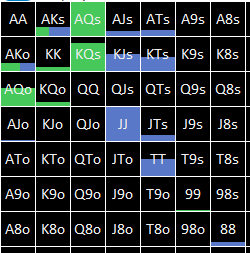
River OOP facing check/all-in (green is call blue is fold, hate GTO+ default colors lol)
still dont really think he barrel tt / jj like this with much frequency and dont think he x river w KK ever and probably not AQ
i think its interesting thread. the biggest thing w b10 and subsequent exploits is how much betting volume oop can expect ip to put in (i know my explanation of the jasamgale hand is confusing but its worth looking at on your own). even if b10 is exploitable by a solver i dont think people are going to understand the counter exploit (check good hands / range) and implement a strategy around it (vs average person / equilibrium checking the river with value hands here is large mistake). many people w neglible solver experience are experts in this thread. it would never occur to me to not do something vs a rec player because an omniscient solver could take advantage of it, yet i have probably more study / solver hours than all of you combined. am saying this because everyone keeps saying we cant do x because solver wouldn't do it at equilibrium but that isnt what we're using solver for
usually my main incentive to b10 as ip is i just think prior line has oop capped so much that my hands have ~100% equity when they wouldn't vs a computer. i dont really do the jasamgale strategy adjustment where its my only size, its just i think villain has very little and can't call much but my hand is good an overwhelming amount of the time. here is tricky because our hand *is* good enough to jam i just think b10 might outperform vs a range of probable giveups.
What preflop ranges were you using I think I was using HJ GTO ranges for a call vs SB 3-bet, and SB GTO 3 bet range vs HJ open. I know he was in the LJ, but I was assuming he would open at least a little bit tighter after the fish limped compared to a standard RFI range, since you know you're probably not stealing the blinds.
No strict GTO range, but OOP: IP: I just used LJ vs
Fair enough. You're making different assumptions and with those assumptions AQ is a pretty clear jam or at least a medium value bet.
The main difference between my sim and yours is that the range you put him on has many worse Qx. At equilibrium KQo is a pure fold and QJs and QTs are mixing 3-bets with calls (and actually mixing folds too with QTs). I agree with you that people overvalue hands like KQo, but I expect them to mostly call with this hand and also call a lot with QJs, QTs, maybe even KQs. So I'm assuming less worse Qx which is an important distinction that is totally player-dependent.
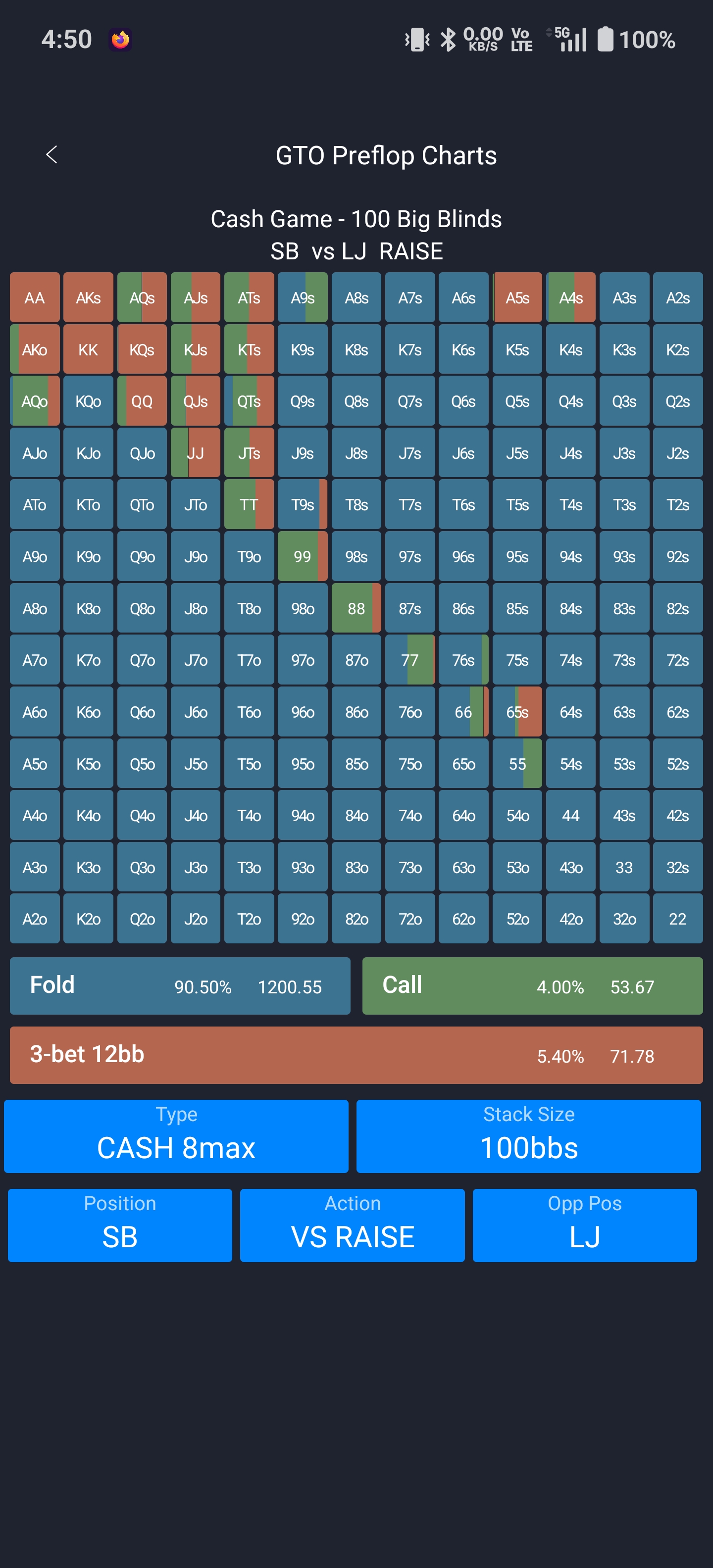
SB GTO range vs LJ open:
[image]Rfo3Jvg.jpg[/im
..]
Once I force OOP to bet turn large with 100% of the TT-Qx that bet flop, then the river at equilibrium:Sets and overpairs shove river, along with a few bluffs most of which are AKo with specific suits for solver reasons, everything else checks. KsKd specifically mostly checks, I think because it unblocks the most missed draws?If IP shoves, KQ+ calls pure, worse (including JJ)
Interesting. I understand you made IP jam. I'd be curious what the OOP response is when IP bets 1/2 pot. Not asking you to run it. Just guessing that there's some frequency of calls with JJ and TT as the bet size goes down.
I honestly don't know if Submersible is throwing shade or giving props. We're all looking for an edge in good exploits. If this was a higher stakes game or just a higher skilled opponent, I'd defer to his guidance. In that scenario, sure, bet 10% pot.
But for crying out loud, this is a trying rec playing 1/2. We know what the player pool is like. This line screams JJ and TT. If the game is a race to take the fish's money, we're not setting ourselves up to win that race by letting the fish off the hook with a 10% pot bet.
I get flamed for some of the suggestions I give, and maybe I'm not helping myself when I seem too confident. But at low stakes, the bet-bet-check line from the OOP PFR is usually, if not always indicative of some SDV that can't beat TP2K.
the turn sizing and barrel isn't indicative of tt / jj is what we're all trying to tell you lol
recs are mostly recs at any stakes, although as you get higher (though not too high!) recs will play better as they are smarter / less degen / play more vs better players and at least try to mimic on average.
i would guess the average player has an unpaired hand here something like 5-8x as often as 2nd pair, and alot of people will *never* have those hands
im not throwing shade or giving props. the whole thread (and forum) is people who rarely use solvers talking about solver output. the whole point of using solver is to figure out poker theory / generally applicable lessons. here the more mid stregnth hands we believe he has the more u want to size up. the more you think he has unpaired hands i think you want to exploitatively size down. if he says call out of turn and its binding you should jam. if he goes to muck his hand when we touch our chips you should minbet. its your job as a poker player to figure out on what end of the spectrum hes on and how hes going to react to different sizes / lines / dialogue / actions. when you dont have an opinion at all on player / population you defer to the default solver output so you don't (accidentally or intentionally) get owned.
i play in a variety of pools and am for the most part a large winner in all of them, idc if you play live low stakes regularly you are going to be better off listening to me, i promise you. this is the only time really ive gone for any kind of appeal to authority (without actually listing qualifications) on this forum and will probably be the last.
the turn sizing and barrel isn't indicative of tt / jj is what we're all trying to tell you lol.
And yet I instantly and correctly recognized the situation for exactly what it was (lol).
You could save yourself some typing by just saying, "you nailed this one, doc." It wouldn't hurt your forum image to show some faint hint of humility.
do you think the point of the forum and threads is to get hands "right" or to get better at poker?
the turn sizing and barrel isn't indicative of tt / jj is what we're all trying to tell you lolrecs are mostly recs at any stakes, although as you get higher (though not too high!) recs will play better as they are smarter / less degen / play more vs better players and at least try to mimic on average. i would guess the average player has an unpaired hand here something like 5-
I agree with this, at least this is true in the games I play in, which is mostly 2/5.
I can see the logic betting 10% pot to target stuff like AK that is mostly giving up, but might call a small bet.
I'll try to simplify what my issue is with it... I think we would both agree that a player with a polarized range can generally extract EV. Our opponent gave up this privilege by checking. By reopening the action we are giving him another chance to jam with a polarized range.
So the EV we gain extracting value with a 10% pot bet has to be greater than the EV we lose if he raises and we choose wrong whether to call or fold. With this particular hand I think the decision is going to be pretty borderline vs this opponent.
That's pretty much the reason I don't like the play. If we have a very clear idea what to do vs a raise I like it better, like we're clearly betting small to induce or clearly bet-folding because they're never bluffing. Maybe he's not raising much, but I'm not confident enough in that read to want to reopen the action.
Like in that example hand you posted it was a clear induce, and he's never folding to a raise. In that case I like the play much better.
do you think the point of the forum and threads is to get hands "right" or to get better at poker?
It's getting better at poker, obviously.
I see you didn't include "ridiculing others" as one of the choices.
How often do I need to be right before you consider I may actually be pretty good? Have you ever admitted you were wrong, or do the reveals not matter when they contradict what the solver tells you we should do?
Why do I think "this is what the solver says" is your all-purpose "never admit I was wrong" card?
I agree with this, at least this is true in the games I play in, which is mostly 2/5. I can see the logic betting 10% pot to target stuff like AK that is mostly giving up, but might call a small bet.I'll try to simplify what my issue is with it... I think we would both agree that a player with a polarized range can generally extract EV. Our opponent gave up this privilege by ch
the example i posted is really tricky because its nosebleed reg vs nosebleed. i didnt do a great job of explaining the hand but they are playing strategies with adjustments vs each other. the biggest difference between that hand and this hand, is here i am advocating for playing our combo whereas they are playing their range / strategy. is actually a really interesting hand when you dive into it and both played it well under the solver parameters i gave it.
a decent heuristic for here is if you can jam your hand for value you are definitely not b/fing it.
It's getting better at poker, obviously.I see you didn't include "ridiculing others" as one of the choices.How often do I need to be right before you consider I may actually be pretty good? Have you ever admitted you were wrong, or do the reveals not matter when they contradict what the solver tells you we should do?Why do I think "this is what the solver says" is your all-purp
it shouldn't matter to you what i think of your play. but you play 1/3, don't study, and most of your posts are meandering and based in your feelings instead of logic. if you want me to think you are pretty good at poker then you are going to need to get good at poker lol. i don't think less of you for not devoting your life to poker or anythinig, but im also not here to give you a participation trophy
i have fairly open dialogues with people of basically any skill level on here despite it being incredibly assymetric in value for the most part, and honestly you would need to pay me >100$ an hour to talk strategy with you in any context besides this one if i didn't know you. thats all totally fine but you want unearned accolades / adulation and to be treated as an equal re poker skill, and that isnt really the case. im sure you're a good dude and theres alot of skills in life you have that dwarf mine but this isn't one of them
im frequently wrong in hands, but the way to prove that is to show math / solver output. theres probably nodes you have a better grasp of than mine but i have had a great deal of success doing things my way and i am not going to change something i have a strong opinion about because a rec that plays low stakes tells me that i am with nothing back it up.
again this isnt a personal attack or me ridiculing you and i debated not posting it because i assume its going to cause more problems. try to read all of this without malicious intent from my pov
Agreed about the heuristic, but I was advocating for a check back! So you can see where I'm coming from.
My thinking was that when passive live opponents take such a strong line, 3-bet pre, bet flop, bomb turn... The range they get to that point with is generally pretty strong so it's questionable how much meat on the bone there still is (weaker hands we can get value from). I think it's at least debatable and opponent-dependent.

