Developing a heuristic for 4-Broadway boards.
The most recent video posted by Bart Hanson made me realize I don't have a good heuristic for playing 4-Broadway boards,

It was buried in another post, but at least in this one scenario I was looking at, the OOP player does have a 21% checking range, per solver. So it's not necessarily a mistake for OOP to check. I was agreeing with you that a small range bet could be a good exploit/simplification but in theory OOP is supposed to have some checks.
As for your idea to only bet the nuts IP, think about it from your opponent's perspective. What would you do with top set if your opponent only bet the nuts? You would fold of course. If you're never betting anything worse than the nuts then they should never call unless they have the nuts.
I'm not sure why you're assuming OOP won't be check folding anything when IP bets. Most of their range is hands worse than straights. If you make a big bet IP, their only incentive to call with a "bluffcatcher" (in this case 2-pair might only be a bluffcatcher) is the chance that you are betting with worse (bluffing).
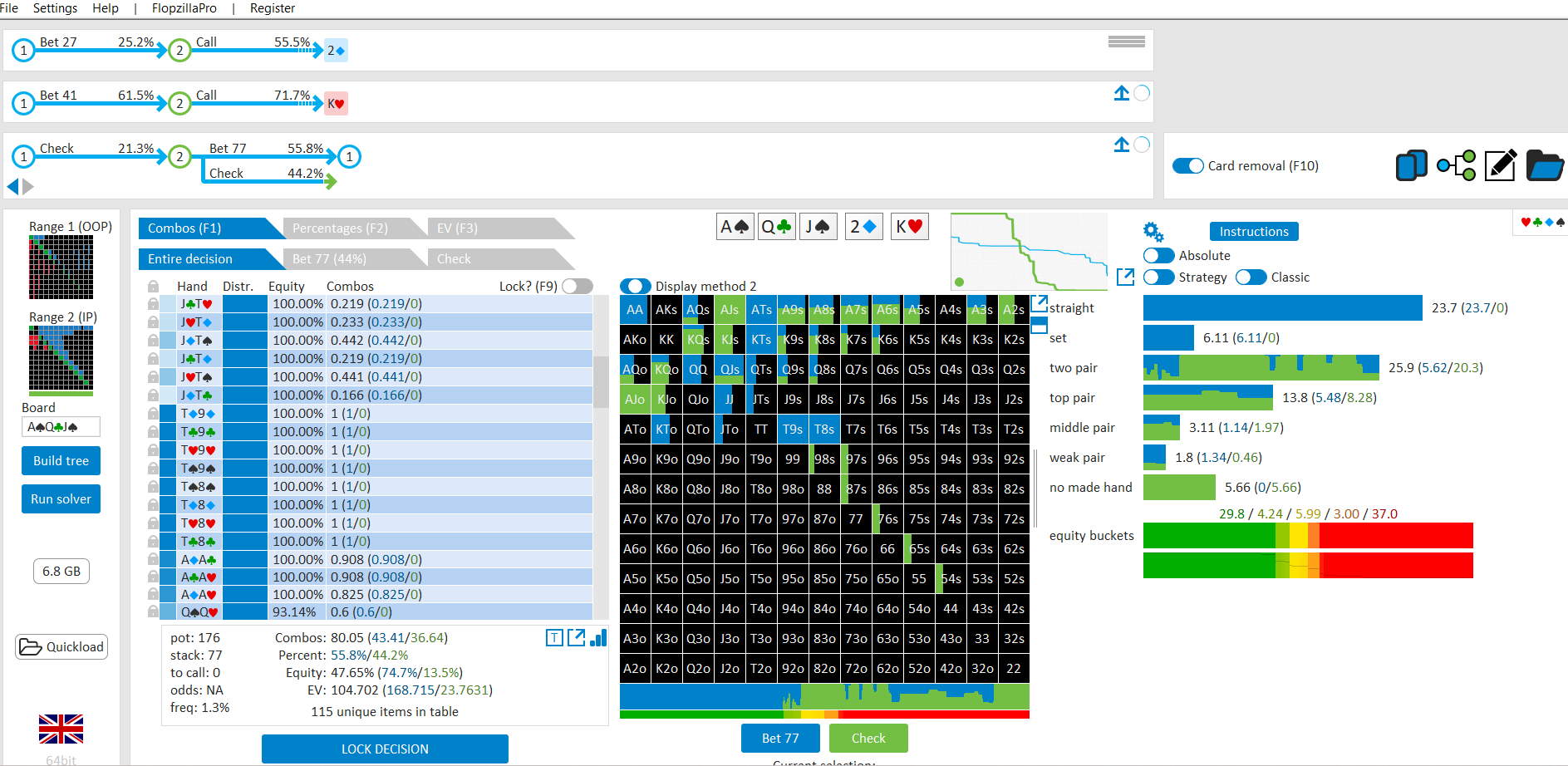
Here is a solver example.
Preflop CO opens, BB 3-bets, CO calls.
Flop: AQJ BB bet, CO call.
Turn: 2 (offsuit) BB bet, CO call.
River: K (offsuit) completing AQJ2K
Now in this scenario OOP is betting 78% with much of their range. Interestingly in this scenario OOP is ALWAYS betting when they have a ten. You would think they would be trapping some, but I guess they just miss out on too much value and have other strongish hands they can call with to keep IP honest.
Now let's say OOP checks. This is BB response:
[image]emNwIyX.png[/im
..]
Blue is bet, green is check.
They bet every time with a ten, and they're also betting with a lot of thinner value, like AA and QQ sets bet every time too. Notice that they're also bluffing though with A9s, A8s... All the way down to A3s (not every time, but a portion of the time).
By betting a polarized range with hands like straights, sets and strong 2 pair (for value) and weak 1 pair hands (for bluffs), you are making your opponent's weaker 2-pair hands indifferent between calling and folding.
To take your game to the next level I have a suggestion. Read Modern Poker Theory, which explains the game theory about why you theoretically need bluffs in your range to incentivize your opponent to call. Or alternatively Janda's book, Applications of NL Hold Em, is also good, but it was written in an era before solvers so it's more out of date.
I can already tell from your posting history that you vastly under bluff in many spots. This works well against weak opponents who are not aware of your tendencies and call anyways. However when you play better opponents they will just never pay you off if you're not bluffing enough.
Modern Poker Theory is a great primer to get you thinking more in line with how a solver would "think, " then if you want to really get good and start running your own solves, GTO+ is only 75 bucks.
Slight disclaimer: When I first read modern poker theory, I initially went from winning to losing slightly as I was incorrectly implementing some of the more advanced strategies. However I stuck with it and within a couple months I started CRUSHING way harder than I had ever won before (at 2/5). It set me up to start moving up in stakes and having good results.
I appreciate you hanging with me in this thread, and being patient.
Re, the 21% OOP check frequency on the river - I am generally looking to simplify when deciding what lines to take in live low stakes games. It makes sense to simplify if we're looking for a heuristic to act as a guide. I think decent players will understand that block betting our entire range is very likely a deviation from a more GTO strat that mixes checks and bets.
Re, the question about what to do OOP if we know IP is only betting the nuts when we check - you're assuming we know that. I'm not. I view this as OOP turning it into a guessing game, taking a chance that IP may bet for value or as a bluff, or just check back. He's just forcing IP to guess first.
I may not have made this point clearly, but if the OOP player isn't block betting range, then presumably he's either planning to check-fold, check-call, or check-raise. Assume he check-folds 2P, check-calls with sets, and check-raises with the straight. If that's his strat, what should IP do? It wouldn't seem like there's enough value in bluffing or betting thin for value.
Re, assuming OOP won't check-fold - that isn't my assumption. My assumption is that OOP's range is divided into buckets of nutted value, thick value, and SDV, and if he checks, that range likely check-calls or check-raises more often than it check-folds. Logically, there's less incentive for IP to bluff or bet thin when OOP checks.
The main point is that if IP understands that OOP could be trapping, bluff-catching, or giving up, it's understood that OOP isn't expecting IP to only bet the nuts. OOP is assuming IP will sometimes bluff or go for thin value. If OOP knew IP would only bet the nuts, he would never check. He'd block bet with his entire range, and force IP to decide how to respond. We're back to the heuristic for OOP.
Like I said, the logic starts to get circular.
Re, your solve - We can understand what a solver is doing, and why, and still deviate to exploit human tendencies. If our human opponents aren't folding enough, it doesn't make as much sense to bluff. For example, in a 3BP, where the BB c-bets flop and barrels turn, I'm not sure humans are getting to the river with nearly as many weak aces that can be turned into bluffs when BB checks.
That said, I'm open to the possibility that the better heuristic for IP when OOP checks might be to bet range for a medium size, if we're still trying to simplify and avoid guessing. I'm not sure if it's the better strat, as it would seem to be much higher variance.
Re, the book recos - thanks. I'll check them out.
Re, my bluffing frequency - I'm sincerely surprised that would be anyone's assessment. I've been thinking I bluff way more than the player pool, and need to concentrate on dialing back on the aggression.
I appreciate you hanging with me in this thread, and being patient.Re, the 21% OOP check frequency on the river - I am generally looking to simplify when deciding what lines to take in live low stakes games. It makes sense to simplify if we're looking for a heuristic to act as a guide. I think decent players will understand that block betting our entire range is very likely a d
When I said I would expect you're under bluffing, I mean specifically in bigger bet spots. You may well be cbetting plenty. That's not necessarily a bad exploitative adjustment BTW, because live players tend to over fold turn a lot so their ranges tend to be pretty strong by the river.
I see what you're getting at regarding the 4-broadway boards. You're assuming your opponents won't be able to find a fold with something like two pair on the river, when you bet repping a straight or set. If that's true then sure, don't bluff those players.
However, that being said I think your river heuristics specifically for IP is far too simplistic. "Always bet only nuts, " or "always bet range, " are both far too extreme.
There are some great opportunities to turn a weak made hand into a bluff here, but if you overdo it they will pick up on that and call you down every time. Likewise betting for thin value with a set will usually be a good play, unless you realize the OOP player is overly trappy, checking all their Tx straights. Then you might want to check back your thin value.
If I was going to come up with a heuristic for IP when checked to, it would probably be something like, "Always bet the nuts and sets. If you have a one pair hand, bet 1/3 of the time as a bluff, " or something like that.
That being said I think it's just a pretty player dependent spot. If your opponent isn't capable of laying down two pair you wouldn't want to bluff them. If they check a straight to trap every time you probably don't want to go for thin value with a set.
The only thing you can say for certain is that you're going to be betting the nuts every time, then what you're doing with bluffs and thin value should probably be adapted to your opponent.
When I said I would expect you're under bluffing, I mean specifically in bigger bet spots.
It crossed my mind earlier to ask you for an example, some post of mine that would suggest I under-bluff. I didn't want to ask, but please do me a favor - if you see me post something which supports the idea I under-bluff, in any spot, do please point it out to me, so I can make a note of it.
Be warned, I may ask you for an explanation.
You may well be cbetting plenty. That's not necessarily a bad exploitative adjustment BTW, because live players tend to over fold turn a lot so their ranges tend to be pretty strong by the river.
Eh, I'm honestly not sure I am c-betting plenty.
Maybe about a year ago, I started to think the low stakes player pool had evolved to the point that everyone was auto-c-betting as the PFR, and that was likely too often, likely over-bluffing, etc, and as a result the pool was starting to float more, especially IP.
I was already toying with the idea of range-betting IP and range-checking OOP as a way to avoid over-bluffing when I found the Hungry Horse YT channel, which espouses mostly doing just that. So, for the past year, my default has been range-check OOP / range-bet IP, with deviations made when the situation seems to call for it.
I'd guess I don't c-bet as much as the pool does. Not sure if I'm not c-betting enough, but I'm pretty sure I'm not c-betting too much. The default setting of range-checking OOP generally seems to make my post-flop decisions easier.
I see what you're getting at regarding the 4-broadway boards. You're assuming your opponents won't be able to find a fold with something like two pair on the river, when you bet repping a straight or set. If that's true then sure, don't bluff those players.
That's not exactly what I'm saying.
I'm saying that when OOP checks (and this is going to come into play in a moment, when I bring all this full-circle), his strat probably isn't to check-call with his entire range, or bet the nuts and check-fold anything that isn't the nuts. We don't even know if he's checking range when he doesn't bet.
We don't know what OOP's strat is. It's possible he's checking range, or he might have some bets, and some check-calls, and some check-folds, and some check-raises.
But of all the options available to him, only one is check-fold, and it would seem like the portion of his range that check-folds is a minor portion, unless he's just betting the nuts and check-folding everything else, which seems unlikely.
Like, if he 3B from the BB, and he goes bet-bet-check on AJTXK, what's he check-folding? JT? AT? KJ? How big a portion of his overall range do those combos make up?
I guess we should count the combos. If we assume IP is going to bluff with KJs (just one example for the sake of correct combo-counting), and we assume that BB doesn't 3B pre with any non-AK or AQ combos that aren't suited, then his range getting to the river may be:
AA - 3 combos
KK - 3
JJ - 1
TT - 3
AK - 6
AQ (nuts) - 8
AJs - 1 to 3, depending on the suits on board and in our hand
ATs - 1 to 3, ditto
A5s - 3
KQs (nuts) - 2
KJs - 1 or 2, ditto
QJs (nuts) - 2
JTs - 1 or 2
Out of 35-40 combos above, maybe OOP folds 3-7 combos that are the worst 2P combos, and maybe another 3-6 combos of some 1P AX combo we didn't count. If he check-calls with all his other 2P and sets, and check-raises with his straights, he's just not check-folding very much.
That's assuming OOP is checking everything in the above list. If he has some bets, we have to ask what he's betting? Just the nuts? Sets and better? Does he turn anything into a bluff? Does he have any bet-folds?
Since we don't know if he ever has any bets when he just checks, and we think he could have some traps, we have to include everything from single-pair AX to the nuts in his range. How often is he check-folding when IP bets? 1/3 of the time? 1/2 of the time?
If he only check-folds hands worse than AK, he's only check-folding 10%-25% of the time, assuming he only has 2P+. If he folds 1/3 to 1/2 of the time, he's either over-folding or getting to the river with a weaker / wider range.
If IP has more or less the same range, and he doesn't want to guess, how does he structure his bets vs his check-backs so he's not over-bluffing, or choosing the "wrong" combos to turn into bluffs? Can we figure out a good rule of thumb for him?
It's kind of hard for IP to have many sets here, in a 3BP, where OOP was the PF 3B'er and goes bet-bet on AJTXK. How often is IP going to show up on the river with a set when he doesn't 4B pre, and just flat calls flop and turn?
It seems like IP's range getting to the river is going to be either the nuts or 2P. His straights are just 12 combos out of the 35-40 in the list above. If OOP is only check-folding 10%-25% of the time, how many "bluffs" should IP have? It seems like the right answer is just 1 to 4.
For IP to get this right, he has to know what OOP is doing, and he doesn't. If we're just (reasonably) assuming that OOP isn't check-folding much, and he's only folding the bottom of his range, IP doesn't need many, if any true "bluffs", and can just bet linear.
Maybe he doesn't want to only bet the nuts, but he certainly doesn't need to find many non-nutted hands to bet.
However, that being said I think your river heuristics specifically for IP is far too simplistic. "Always bet only nuts, " or "always bet range, " are both far too extreme.
Bringing it back to my OP, in which I said I think the OOP player tends to under-bluff in these spots, and the IP player tends to over-bluff, a big part of the value in having a good heuristic would be to get the OOP player to not under-bluff, and keep the IP player from over-bluffing.
The OOP strat of blocking with range meets the criterion. If he's betting range, he certainly can't be under-bluffing. Conversely, and tying this into my point above, if he's range-checking, or only betting with the top of range, then clearly he is under-bluffing. (And, if OOP is under-bluffing, it would seem logical that IP should strive to avoid over-bluffing when OOP checks.)
The IP strat of only betting the nuts would keep IP from bluffing at all, so obviously he can't be over-bluffing. But, for the sake of argument, let's agree that only betting the nuts and betting range are both far too extreme. I think we can agree that betting range is over-bluffing, so we can just toss that strat out entirely.
That brings us back to what strat keeps the IP from over-bluffing, and which is easy enough for humans to implement in game? Rather than think of it in binary terms of nuts-and-bluffs, maybe the most useful strat is to just bet top 2P or better?
That would have IP betting a linear range of 28 out of 35-40 combos - 12 straights, 10 sets, and 6 top 2P. If he has no sets, then it's 2 nuts for every 1 combo of top 2P that would be our "bluff", which seems reasonably sane and easy enough to implement, as long as OOP doesn't catch on and adjust.
There are some great opportunities to turn a weak made hand into a bluff here, but if you overdo it they will pick up on that and call you down every time. Likewise betting for thin value with a set will usually be a good play, unless you realize the OOP player is overly trappy, checking all their Tx straights. Then you might want to check back your thin value.
While that's all logically true, it brings back to where we started - when OOP checks, he's turning it into a guessing game for IP. Now we're relying on our reads and OOP not adjusting in-game. We're making up our strat on the fly.
If I was going to come up with a heuristic for IP when checked to, it would probably be something like, "Always bet the nuts and sets. If you have a one pair hand, bet 1/3 of the time as a bluff, " or something like that.
I think we may be getting close to finished figuring out if there's a good default strat for IP and what it is.
In my example above, IP is only betting the best 6 out of 10 to 16 of his 2P combos.
I don't know what the theoretically correct frequency would be, but depending on IP's range (does he have sets? 1P?) betting top 2P would be taking the bottom 30%-50% of our range and "bluffing" with the top 40%-60% of it (approximate percentages depending on range).
That certainly seems like it wouldn't be over-bluffing, and seems easy enough to remember and implement as a heuristic - just bet top 2P and better.
I wouldn't think we'd need to pull bluffs from 1P combos. That would probably lead to over-bluffing.
My reasoning for betting top 2P+ basically goes back to the assumption that OOP isn't going to check-fold all that often, so we probably want to just bet a linear range with reasonable SDV and decent blocker effects. We can think of our non-nut combos as a "bluff" when OOP has better and "thin value" when OOP has worse.
That being said I think it's just a pretty player dependent spot. If your opponent isn't capable of laying down two pair you wouldn't want to bluff them. If they check a straight to trap every time you probably don't want to go for thin value with a set.The only thing you can say for certain is that you're going to be betting the nuts every time, then what you're doing with blu
Again, all true, but relying on player-dependent reads is an adjustment we maybe want to make after we have a good heuristic as a starting point.
When I said I would expect you're under bluffing, I mean specifically in bigger bet spots.
It crossed my mind earlier to ask you for an example, some post of mine that would suggest I under-bluff. I didn't want to ask, but please do me a favor - if you see me post something which supports the idea I under-bluff, in any spot, do please point it out to me, so I can make a note of
I'm going to have to refer you to modern poker theory. They go into specific game theory examples where they prove which strategies have the highest mathematical EV. There are several different principles acting simultaneously, which makes it very difficult to explain.
For one OOP has a large incentive to bet their own nuts along with some corresponding bluffs. Otherwise if they check their nuts they risk IP checking back, and then they miss out on value. So they should be betting a lot with their strongest and weakest hands. The strongest hands bet for value and the weakest hands bet because betting and getting a fold is the only way for them to win.
Most of OOP's checks SHOULD be medium strength hands, which in this case is a lot of 2-pair type hands. In fact in my example hand the solver NEVER checks a straight on the river, even OOP. Now that's not true in every scenario. Sometimes it's correct for OOP to trap with a small amount of nutted hands, but MPT explains why much better.
When we're betting IP on the river we are generally attacking our opponent's medium strength hands. For that reason we want to bet with a polarized range. Our opponent's medium strength hands beat our bluffs but lose to our value. So we put them in a dilemma. If they call when we have value they pay us off, but if they fold when we are bluffing they give up the pot when they had the best hand. When we have the correct ratio of value hands to bluffs our opponent will "lose" in the long run no matter what they do.
We do not want to bet IP with a linear range because that would include our medium hands. Our medium strength hands mainly want to check. That's because you're betting either to fold out better or get called by worse. When medium strength hands bet they mainly get called by better and fold out worse, so they do not gain anything by betting.
Anyway this situation is starting to make my head spin. Lol. I really do think it would benefit your game to read MPT.
You're missing some of the incentives for why we prefer to bet with certain hand classes. Strong hands prefer to bet for value to get called by worse. Weak hands can sometimes bet as a bluff to fold out better. Medium strength hands want to be doing a lot of checking because they don't benefit from betting in the same ways.
This situation just gets extra confusing because our "weak" hands with incentive to bluff still look relatively strong. They're just weak relative to the runout and the ranges of hands that arrive here. It's definitely a challenging spot to balance, but no heuristic really takes the place of properly balancing your ranges.

