KK at sharp game

1/3/6 NLHE 9 handed
Crusher LAG who's not a pro but is one of the best semi-pro (pro-wannabes) I regularly play with invi
V1 opens 20, V2 calls, H to 75 with K♠ K♣ OTB, both call.
Flop 225 - 9♠ 8♣ 3♠
Check, check, we cbet 85, V1 calls, V2 x/r to 225....
Late, read the result….
Take the ‘fish’ read out of it, and this becomes the hardest problem I have to solve per session. Maybe the ‘never-fold’ people have never run into that set that I usually see.
From the other view, you should probably always bet big when you hit a set, hoping a big pair is out there.
I’m glad you won, but I got no closer to solving this type of problem. Do I want to be the fish that can’t fold a big pair with a set likely? Or do I want to fold and let villain show me 72o?
It still seems like a guess…
A guess that could make or break a session
If one of you could teach me how to detect the player sitting in the weeds with a set, I would surely win more often.

V1 opens 20, V2 calls, H to 75 with K♠ K♣ OTB, both call.Flop 225 - 9♠ 8♣ 3♠Check, check, we cbet 85, V1 calls, V2 x/r to 225....
Late, read the result….Take the ‘fish’ read out of it, and this becomes the hardest problem I have to solve per session. Maybe the ‘never-fold’ people have never run into that set that I usually see.From the other view, you should probably always bet big
There really is no way to know for sure (that's poker), but one key is to identify who is capable of bluffing and who isn't.
When you have kings in a 3-bet pot and your opponent makes a set, sometimes you're just supposed to get stacked, assuming they are playing reasonably balanced and are capable of bluffing and/or overplaying a worse value hand.
When facing a flop check raise on this board and holding KK, it's going to be a pure continue against most opponents. It's usually more of a question of whether to call or reraise. You just can't be folding hands this strong and high up in your own range to one small flop check raise. You should have a bunch of unpaired overcard type hands that would be folding first, so if you're folding a hand as strong as kings they can just bluff the hell out of you.
Now if your opponent is a nit who never bluffs, then in some cases you can make an exploitative fold and escape. That being said when two very strong hands collide it should generally result in a large pot, and someone's got to lose. Losing a big pot doesn't always mean anyone did anything wrong. Sometimes the cards just set someone up.
When facing a flop check raise on this board and holding KK, it's going to be a pure continue against most opponents. It's usually more of a question of whether to call or reraise. You just can't be folding hands this strong and high up in your own range to one small flop check raise. You should have a bunch of unpaired overcard type hands that would be folding first, so if you
You're not playing a computer!
This is something you would say if you're a machine trying to be unexploitable while attempting to break-even against another unexploitable player. Just because we're at "the top of our range" doesn't mean we have to keep playing. What a silly thing to say. Where's that rule written? I'd say if the top of our range is absolutely crushed, then maybe we should think about folding it. In real life winning money in poker comes from exploits, not balance. Here, the exploit is to fold to a value-heavy range with a strong nut advantage. The presence of another good player in the middle just makes things worse. Also, KK is not that high up in our range. We should have 88, 99, and AA here too.
The real lesson here is that we should never be in this spot. Against a V who likes to check/raise, our c-bets should be very polarized. KK is too middle-ish for that. So check back the flop. That's how you exploit the check-raiser. Not by paying him off. Trying to be "unexploitable" after you already exploited yourself is pretty kooky in my opinion.
As played we ran into a villain who punted with the bottom of his range, probably still had 50% equity against us, and just happened to brick out. That's just variance. We didn't win this hand with good strategy or sound decisions. We overplayed our pocket pair like a fish and got lucky.
when two very strong hands collide it should generally result in a large pot, and someone's got to lose. Losing a big pot doesn't always mean anyone did anything wrong. Sometimes the cards just set someone up.
I like the way you framed this….
I still lean toward getting out early (even with strong hands) when it looks like you’re behind and drawing dead. This situation has clues
If you have KK, the flop comes Axx, Villain pots it, do you shove - not likely, but if you do you will win often. A mirror of this situation.
There’s just a lot of guessing in this game.

Take the ‘fish’ read out of it, and this becomes the hardest problem I have to solve per session. Maybe the ‘never-fold’ people have never run into that set that I usually see.
All I saw was "we've seen him x/r shove A4hh on J63hhs flop" ... the problem at most 1-2/1-3 games is that people just aren't x/r semi bluffing anywhere near enough, so when they raise here it's almost always sets so you have to fold (but on the other side they aren't raising very often).
983 two tone is close to the wettest flop in the world, so we can't fold vs. people who can raise draws.
From the other view, you should probably always bet big when you hit a set, hoping a big pair is out there.
This is maybe good, if you are the one exploiting the bad player.
Late, read the result….Take the ‘fish’ read out of it, and this becomes the hardest problem I have to solve per session. Maybe the ‘never-fold’ people have never run into that set that I usually see.From the other view, you should probably always bet big when you hit a set, hoping a big pair is out there.I’m glad you won, but I got no closer to solving this type of problem. Do
Adding to what GWF said, I suspect part of the challenge you're experiencing is due to your own range. I'm guessing you're probably not 3B'ing 99/88/98s pre, just premiums. If that's true, then you'd never have the experience of flopping top or middle set or top 2P on this board, and getting check raised when you c-bet.
When you flop a nutted hand here and get raised, yeah, it could be 33 when you have 98, or a set over set situation, but you start to see more draws being x/r'd from aggro opponents. Suddenly you see all the other hands V can have that don't have any showdown value, but have enough equity to x/r as a semi-bluff.
I also suspect that as a human, you likely remember the times your KK ran into 88 more vividly than the times your KK held up against a draw. If you always fold and don't get a showdown, you're likely assigning tour opponents too narrow a range of nutted hands, without having the data to support that conclusion.
I don't know what games you're playing in where they always have KK beat when they make one small check raise on this wet flop...
I was thinking about this hand last night at the 2/5 table I was playing. Admittedly the table was more aggressive than an average 1/3 table.
At that particular table there was one guy who I would fold kings to vs a flop check raise. He was like the stereotypical OMC who was just folding everything and waiting for nutted hands.
There was one other guy who I would call against, but I would be proceeding very cautiously and likely folding facing additional aggression. He was a recreational player who would occasionally make a one off bluff, but if he sustained aggression over multiple streets he always had it.
Against every other player at the table I would have been happy to continue with kings. Of course any one of them could have had a set, but against reasonably aggressive players there are many more hands worse than kings that could be check raising here.
I don't know what games you're playing in where they always have KK beat when they make one small check raise on this wet flop...I was thinking about this hand last night at the 2/5 table I was playing. Admittedly the table was more aggressive than an average 1/3 table.At that particular table there was one guy who I would fold kings to vs a flop check raise. He was like the st
He plays 2NL online. Didn't you know he's a crusher?
I know. I've heard and I don't know why he speaks so authoritatively and disrespectfully (also often incorrectly). Why do you do that Deuce? If you scrolled back 10 years in my posting history, when I was at that stage I was just humbly asking people what I was doing wrong and was happy to get some feedback.
Still we're all here to get better, and I try to avoid the "appeals to authority, " type arguments... Just because I have X results, doesn't necessarily make me right here.
Let me try to explain why you generally can't fold kings to one small flop raise.
Banana didn't give exact positions preflop, but our range facing a LJ raise and HJ call should be something similar to this:
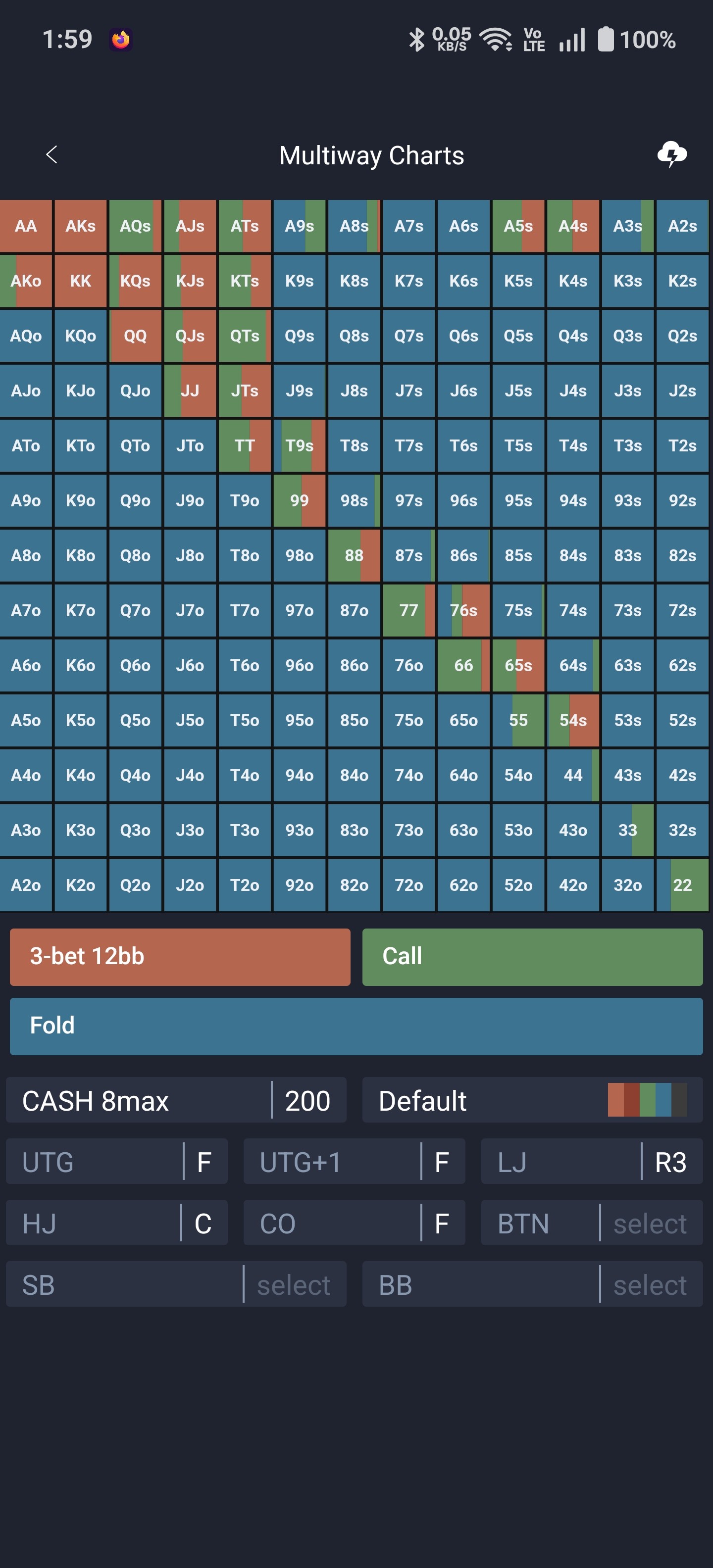
Notice a large part of that range is unpaired overcards. 99 and 88 are only 3-betting at partial frequencies. So KK with the Ks is close to the top 10 overall combos in our range.
Now I'm going to reference a heads up sim that I ran with multiway ranges. So take it for what it's worth.
First let's look at what our opponent is supposed to be doing. This is assuming they are raising to a larger $350 sizing:
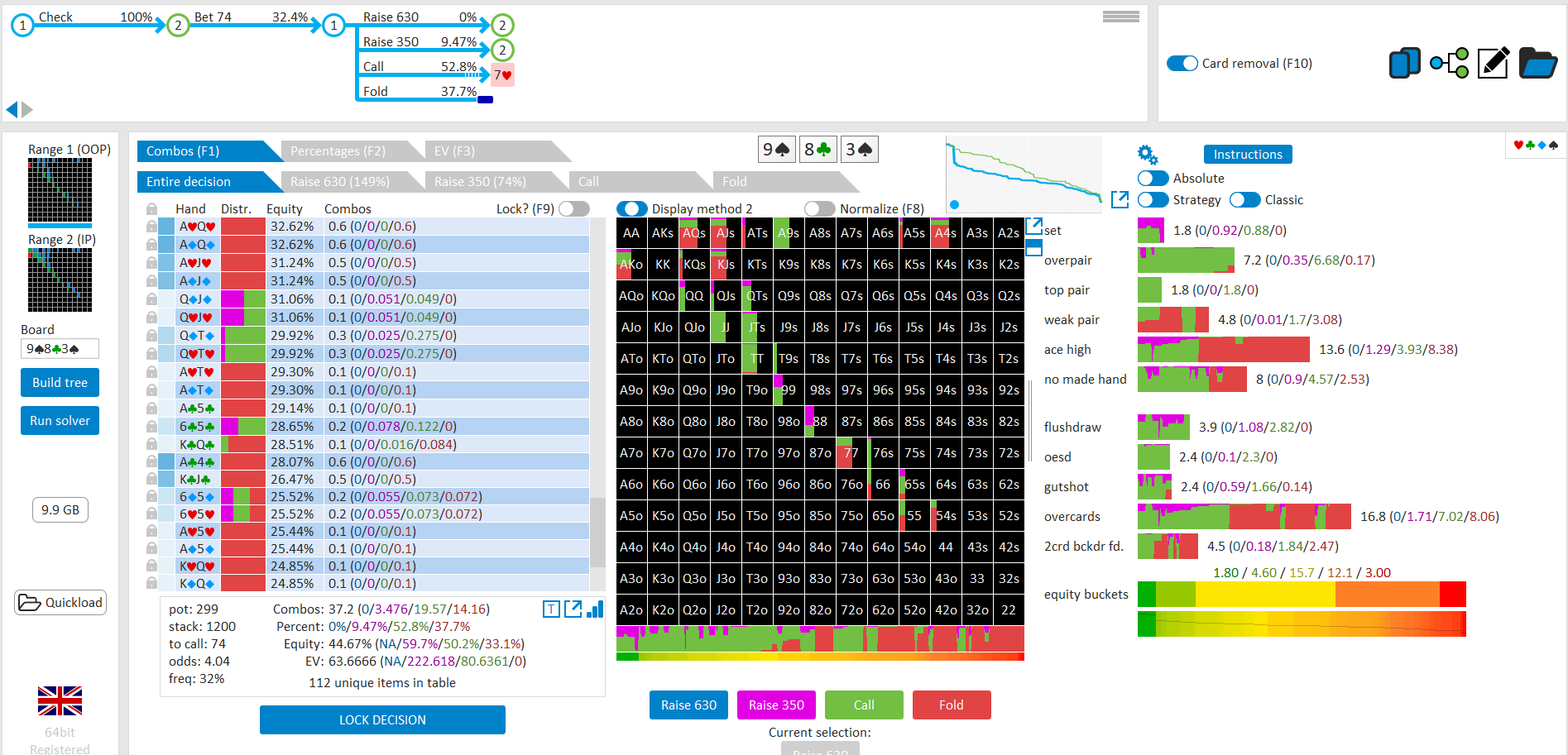
Does this look completely off the wall and different from what a human opponent would do? I don't think so. Notice they are mostly calling with flush draws, but sometimes raising. They are also sometimes raising with gutshots. They sometimes slow play sets, but are mostly raising. If they arrive here with QQ they are also sometimes raising with that. I would think if anything they would be raising more aggressively as this is a good squeeze spot facing a small cbet and a call.
Against the C/R strategy posted above (to a larger $350 sizing) here is our response:
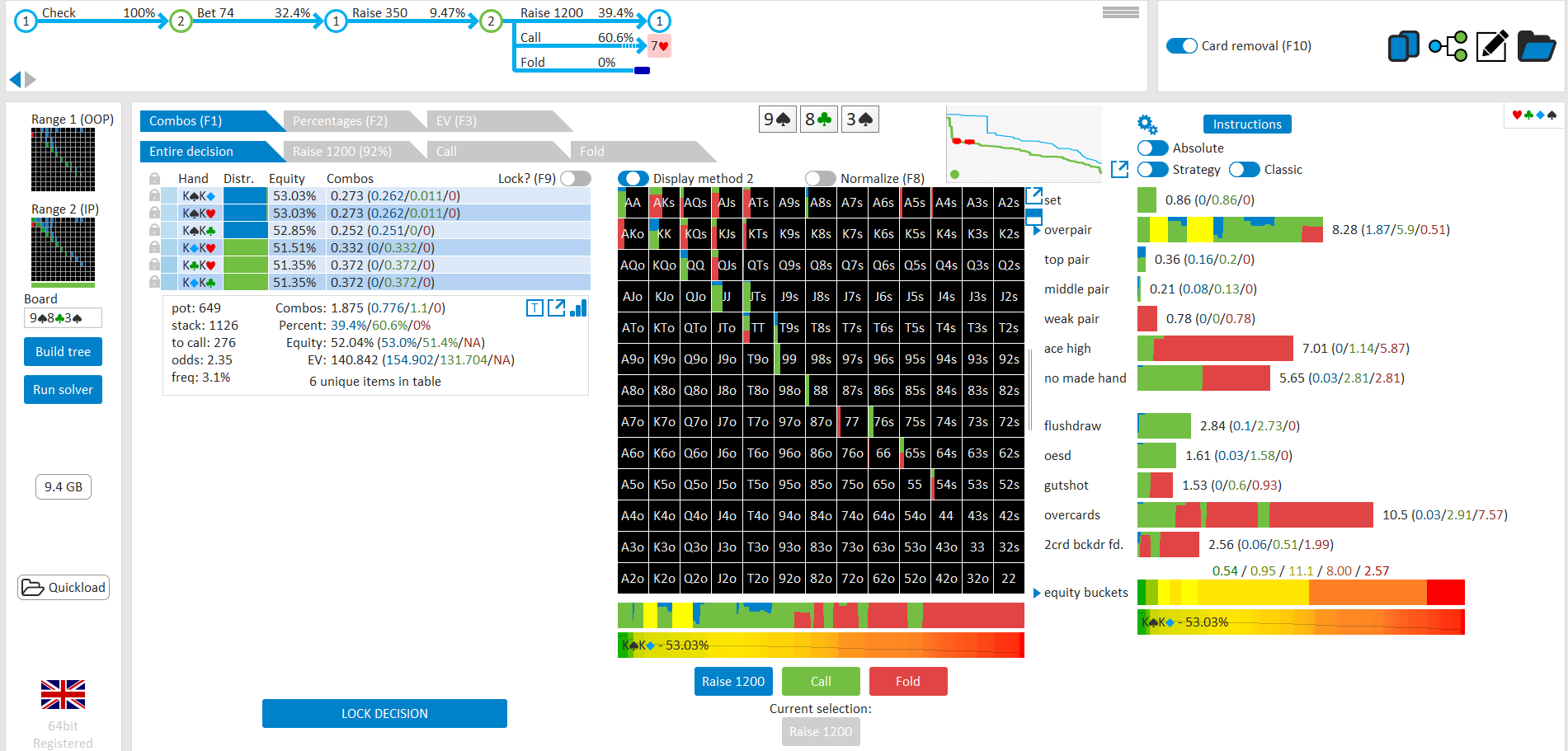
KK with the K of spades is actually a pure raise. KK without the K of spades is calling. Now again this is heads up sim so we do have to be more cautious. That being said...
Notice what we're doing with our range. We're folding all our junkier hands that may have been cbetting. We're continuing in position with strong pairs, flush draws and open enders. Also notice that TT is mixing calls and folds. There is a big difference between KK that is ahead against other overpairs and TT that is losing to JJ and QQ. We're beating some potential value combos here.
Anyway I've gotten into many arguments with people on here when they want to fold the top of their range. Generally speaking when you're exploiting an opponent you want to do it proportionally. If you think they're under bluffing you fold borderline combos first. Here maybe you fold open enders and TT. Stuff like that.
The further up in your range you are the more confident you have to be in your reads to justify overfolding. Reread banana's description of the villain. There's no reason to think he's incapable of bluffing here.
I like the way you framed this….
I still lean toward getting out early (even with strong hands) when it looks like you’re behind and drawing dead. This situation has clues
If you have KK, the flop comes Axx, Villain pots it, do you shove - not likely, but if you do you will win often. A mirror of this situation.
There’s just a lot of guessing in this game.
Between you folding overpairs AND sets on the flop, you must get to showdown close to never? You're doing far too much folding.
I don't know what games you're playing in where they always have KK beat when they make one small check raise on this wet flop...I was thinking about this hand last night at the 2/5 table I was playing. Admittedly the table was more aggressive than an average 1/3 table.At that particular table there was one guy who I would fold kings to vs a flop check raise. He was like the st
After 20 years of live poker he is now crushing 2nl. Quite the success story.
First, your attempts to tilt me over playing 2NL are futile. The story begins with a $2 bankroll. What stakes should I play if my goal is to never deposit? For the record, I've moved on from 2NL. After an initial downswing, I'm now beating 10NL for 40BB/100 over my last 15,000 hands. I plan to continue playing stakes appropriate for my free-rolled bankroll, and don't feel the slightest bit embarrassed about that.
Moving on.....
GWF - I'm not reading all that sim and solver nonsense. It's unnecessary. You're playing in your first session ever against unknowns. Everything you're showing me prioritizes balance, and I simply don't give a crap about that. You shouldn't either.
This hand is a basic exercise in planning hands around SPR and commitment thresholds. If I'm stacking off with KK, against 1 opponent then I'm targeting an SPR on the flop that is under 4. Maybe under 5, but that's stretching it. In this hand, we have an SPR of 5.4 and two opponents. So it's way out of bounds. Before the flop is dealt, I've already decided that I'm NOT going broke with this hand, so I won't try to get committed.
That awkward SPR highlights the pre-flop error. I would have preferred some other line. We could possibly just flat pre-flop. We could play a strong hand in position, get three small streets of value and score $200-$300 which is a fine result with an unimproved pair. Or we could 3bet larger, and go to flop with a lower SPR. Or we could 3-bet smaller hoping to induce a 4-bet. (OP did mention that 3 and 4 betting was common). I like all of those options better than what Banana actually did.
The next error was betting the flop. As I said, I've already decided NOT to get committed in this hand, so there's no reason to build a pot right now. We can just check back and keep the pot small. But we didn't. So that's two total f-ups that we've committed to this point. Trying to save the hand after it's already a trainwreck doesn't seem like a discussion worthy topic. But clearly you disagree, so we'll continue.
My commitment threshold is 1/3 of stacks. Once one-third of the money goes in, we're getting 2-to-1 on the rest of it. We'll almost always have a hand that's good enough to play those odds. Calling V's check raise means we've invested 25% of our stack. That's not quite committed, but it's very close. If any more money goes in on either of the next two streets, then we're playing for all of it. So this flop check/raise is effectively a commitment decision, and I don't want to commit with this hand.
He could 9 full combos of sets, two combos of 89s, and 25 pair+ and combo draws. We're smothered by 1/3 of V's range, and basically flipping with the other 2/3. We're either way behind, or break even. And we haven't even started to talk about the other villain in the hand. He's definitely not folding. Against 2 villains with that range, we have 28% and would need to fade somewhere between 14 and 18 outs twice.
Almost everything you wrote is wrong, president. I don't have time to respond to all the nonsense claims you make throughout the forums, but I will do it just once...
First off, calling a flop raise doesn't commit you to stack off.
Quickly:
First, I would have preferred some other line. We could possibly just flat pre-flop.
Horrible. This hand should basically be a pure 3-bet and we should be 3-betting a whole range of hands this deep, including occasional stuff like suited connectors for board coverage.
next error was betting the flop. As I said, I've already decided NOT to get committed in this hand, so there's no reason to build a pot right now. We can just check back and keep the pot small. But we didn't. So that's two total f-ups that we've committed to this point. Trying to save the hand after it's already a trainwreck doesn't seem like a discussion worthy topic. But cle
Wrong again. We have a massive range advantage as the preflop 3-bettor and should be C-betting often, especially with this combo, overpair plus BDFD.
First, My commitment threshold is 1/3 of stacks. Once one-third of the money goes in, we're getting 2-to-1 on the rest of it. We'll almost always have a hand that's good enough to play those odds. Calling V's check raise means we've invested 25% of our stack. That's not quite committed, but it's very close. If any more money goes in on either of the next two streets, then we're
That 1/3 of stacks you cited is a preflop commitment threshold. That doesn't mean that you never fold postflop after committing 1/3 of your stack.
First, And we haven't even started to talk about the other villain in the hand. He's definitely not folding.
He folded.
$75 is too small pre this deep with 2 players showing interest. Make it $100-$120. $75 is just inviting in too many speculative hands that you will have a hard time folding against.
Flop is great. 9 high flops with draws like this want to be bet pretty big. I think it's a mistake to only bet 1/3rd pot. I like 60% pot in this spot. This spot gets attacked a lot vs weak sizes if he has a draw and out of position so you cannot fold flop. I think i'm going to keep calling and only fold on an A or spade. If he has a set i'm probably just stacking off vs a lag or fish because there is a high chance he has a draw. I don't like jamming over the flop raise because we have position and no real need to do that. Wait for a decent turn before we commit our stack.
Turn isn't great but i'm still not folding. Just jam it in and hope for the best. Some mistakes are the small pre flop and the small flop. Otherwise, well played as long as you didn't fold.
Edit - after reading some of the comments, i noticed a lot of people said to fold. That is insane. Why would any of you want to fold in this spot? I mean we can find spots to hero fold all day long - so ask yourself this. What flop are you confortable stacking off on? It doesn't get that much better for us - and while the turn isn't great, it's not enough to fold out our equity even if we are 40%

i still cant believe that people cannot grasp the concept that if you bet 1/3 pot with an overpair, you cannot fold the flop to a 3x flop CR.
the whole point of calling the flop CR is you get to see what he does on turn. at this level if villain bets 1/2 pot or less on a turn card that does not favor your range, he is not confident in his hand vs what he perceives your range is. if he bets 2/3 pot or more, he's nutted.
Bigger pre. At this flop spr we probably shouldn’t be folding overpairs, especially given the sizing tell. Punish his draws by jamming.
massive overplay. if his range is sets plus massive combo draws you are actually punishing yourself by doing this. even if you include Ax FDs you are still behind his range. if you had access to his hole cards and can calculate your equity that way, then sure i like it.
First, your attempts to tilt me over playing 2NL are futile. The story begins with a $2 bankroll. What stakes should I play if my goal is to never deposit? For the record, I've moved on from 2NL. After an initial downswing, I'm now beating 10NL for 40BB/100 over my last 15,000 hands. I plan to continue playing stakes appropriate for my free-rolled bankroll, and don't feel the s
Embarrassed wouldn't even begin to describe how I'd feel if I was playing 2nl and/or 10nl after 20+ years of poker., live or online.
Moving on.....GWF - I'm not reading all that sim and solver nonsense. It's unnecessary. You're playing in your first session ever against unknowns. Everything you're showing me prioritizes balance, and I simply don't give a crap about that. You shouldn't either.This hand is a basic exercise in planning hands around SPR and commitment thresholds. If I'm stacking off with KK, aga
Total gibberish.
And we haven't even started to talk about the other villain in the hand. He's definitely not folding.
We call the 225, V1 folds thankfully
Turn 760 - 9♠ 8♣ 3♠ 7♥
V2 barrels 300, he has 600 back...
Lol
It kinda does. Let's say you call and V open-shoves the turn. You'll be getting just under 2 to 1. You'll need 35% to call off. Are you calling or folding? If you're calling, then you're saying you're committed. If you're folding, then it means you don't think you have 35%. And if you're in that bad of shape, you should really just fold now.
If the other V calls as well, or if the check-raiser bets anything less t han all-in on the turn, then you'll be getting even better odds. Are you folding then? Is there any scenario where you fold after putting in 25% of your stack and getting offered 2 to 1 or better on the rest?
If not, then you've committed.
Horrible [flatting pre-flop]
.
Meh, I don't think it's all that bad. Still, I never said that's what I would do. I just said it's better than what Banana did.
We have a massive range advantage
Ok, so what? That doesn't mean we're obligated to shovel money into the pot. We'll still have an advantage on later streets, and it's important that we control the size of the pot.
plus BDFD.
Stahp, you're embarrassing yourself.
That 1/3 of stacks you cited is a preflop commitment threshold.
hmmm, nope. Who said that? Where is that written?
If there is any point in the hand where at least 1/3 of the starting stack gets into the middle, then you can't possibly be offered any worse than 2-to-1 odds on the the rest of it. That's true on all four betting streets, for all stack sizes. Go ahead and check the math. Im sure I've got this right.
That doesn't mean that you never fold postflop after committing 1/3 of your stack.
Ok, but if you do fold it means you concluded you had less than ~30% equity after committing a third of your chips. If that happens, it's usually a sign we irreparably botched the hand somewhere along the way.
He folded.
Incredible result given the pot odds. Simply a stunning outlier that shouldn't be considered in our analysis.
...Incredible result given the pot odds. Simply a stunning outlier that shouldn't be considered in our analysis.
Yeah, let's ignore what actually happened and analyze the hand based on what we think should have happened.
Hey, why not change hero's hand and make V take a totally different line?
It kinda does. Let's say you call and V open-shoves the turn. You'll be getting just under 2 to 1. You'll need 35% to call off. Are you calling or folding? If you're calling, then you're saying you're committed. If you're folding, then it means you don't think you have 35%. And if you're in that bad of shape, you
You're demonstrating a common leak at the lowest stakes. That is to assume if you call flop you have to call turn, if you call turn you have to call river, etc. That is a fallacy.
You are supposed to have hands that are strong enough to call flop but have to fold turn and hands that can call flop and turn but have to fold river.
The reason 1/3 stack is a common commitment threshold preflop, is because PREFLOP any reasonable hand will have at least 33% equity against any reasonable range. So you price yourself in.
Postflop the math is different. You gain information and narrow your opponent's range as the hand progresses. In extreme cases you might be able to narrow your opponent's range so much that you have 10% or less equity, in which case you can fold even after committing the majority of your stack.
In the hand we're discussing, when facing a flop check raise you have plenty of equity to continue.
The portion of his flop raising range that jams turn is typically a small subset of that range (and the strongest subset). You're assuming that just because you don't have 35% equity against his turn jam range that necessarily means you didn't have it against his flop check raise range. That is a fallacy.
He will also have weak draws that check raise flop and give up turn. He will have hands like this hand that continue barreling with a scared-money sizing, giving away that he's weak. Basically at low stakes the following is usually true:
i still cant believe that people cannot grasp the concept that if you bet 1/3 pot with an overpair, you cannot fold the flop to a 3x flop CR.the whole point of calling the flop CR is you get to see what he does on turn. at this level if villain bets 1/2 pot or less on a turn card that does not favor your range, he is not confident in his hand vs what he perceives your range is.
You gain information as the hand progresses and narrow your opponents' ranges accordingly.
When V1 called your flop cbet he was saying he had enough equity against the ranges at that point.
Once V2 check raises (strong) and you call the check raise (stronger), V1 is now facing a much stronger subset of your ranges. He is getting a good price but he is NOT facing the same ranges as when he called the flop cbet.
You're demonstrating a common leak at the lowest stakes. That is to assume if you call flop you have to call turn, if you call turn you have to call river, etc.
No I'm not demonstrating that. Nor am I making the assumptions you just listed. I asked you a question that you're dodging (which is a tell). I asked what you would do in response to aggressive action on the turn and you haven't given me an answer. Under what conditions would you find a fold?
If I recall correctly, YOU were just touting our back-door flush draw. So I assume you're not folding to a spade on the turn then?
You are supposed to have hands that are strong enough to call flop but have to fold turn and hands that can call flop and turn but have to fold river.
You're referencing a minimum defense frequency (1 - alpha). Villain check raised 140 to get back 620, he needs to get that through just 22.5% of the time to profitably bluff. He needs to be defended against 77.5% of the time. However, we don't have to do that all ourselves. There's another V in the hand. If he calls even half the time that we fold, then We can realistically fold 50-60% of our range without being exploitable.
The reason 1/3 stack is a common commitment threshold preflop, is because PREFLOP any reasonable hand will have at least 33% equity against any reasonable range. So you price yourself in.
That's neat how you think putting the word "preflop" in all caps somehow makes it a rule with boundaries and stuff. I wanna try it....
If you get 1/3 of your stack in ON ANY STREET AT ANY TIME, any reasonable hand will have at least 33% equity against any reasonable range. So you price yourself in
It worked!!
Postflop the math is different.
Nope. The math is exactly the same. Get 1/3 in, you get 2-1 odds on the rest. Any time. Any hand. Any street. Any stack size.
In the hand we're discussing, when facing a flop check raise you have plenty of equity to continue.
What's "Plenty of equity"? I'm giving V a range of 99-88,33,98s,AsQs,AsJs,QsJs,AsTs,QsTs,JsTs,As8s,Qs8s,Js8s,Ts8s,As7s,Js7s,Ts7s,8s7s,As6s,Ts6s,8s6s,7s6s,As5s,8s5s,7s5s,6s5s,As4s,8s4s,As2s. Against that range we have 42% equity. Against two such ranges, we have 24%. From this point, our % contribution to the pot has to be less than those equities for us to turn a profit. I don't see how you can expect that to happen with any reliable frequency.
The portion of his flop raising range that jams turn is typically a small subset of that range (and the strongest subset). You're assuming that just because you don't have 35% equity against his turn jam range that necessarily means you didn't have it against his flop check raise range. That is a fallacy.
Ya know man, let's just stick to the words I've actually said. There's plenty there to work with. If you have to invent ideas, stuff them into my head, just to argue back....then we're not really having a good faith discussion anymore.
He will also have weak draws that check raise flop and give up turn
No he won't. Look at the range I gave above. All those draws have at least 11 outs. Do you really think he's check/raisin this small with JhTh or something like that?? Come on dude.
He will have hands like this hand that continue barreling with a scared-money sizing, giving away that he's weak
How's it "scared money" sizing? What kinda voodoo baloney are you spewing man? He eventually went broke in the hand. He's not looking for a way out. He's not looking to fold. He's clearly not "scared" to get it all in. That turn bet of any size is pot-committing. His sizing here screams "call me".
You gain information as the hand progresses and narrow your opponents' ranges accordingly.
No, YOU do that. When V barreled the turn, committing his stack, YOU learned that he had a hand he was never folding. I, somehow, was already aware of that information.
[V1] is getting a good price but he is NOT facing the same ranges as when he called the flop cbet
Geeeeezus man. Just admit it was a shocking fold given the absurd low price.
You're demonstrating a common leak at the lowest stakes. That is to assume if you call flop you have to call turn, if you call turn you have to call river, etc.
No I'm not demonstrating that. Nor am I making the assumptions you just listed. I asked you a question that you're dodging (which is a tell). I asked what you would do in response to aggressive action on the turn and you
I have tried really hard to have a respectful discussion, but you don't make it easy.
When he raises flop to $225 off of a $1200 stack it is no where close to committing his entire stack.
It's a pretty simple spot vs low stakes opponents.
1. You call flop (against his initial C/R range you're ahead).
2. If he jams turns or commits most of his stack. You fold (against his turn jamming range with most low stakes opponents you're crushed).
3. If he checks turn or bets some small portion of his stack. You don't fold (against this range you're ahead).
The only real exception is if the board pairs on the turn and he suddenly slows down. In that case he could have a full house or quads and no longer be concerned about draws, so proceed with caution.
Anyway, no more free lessons for you.
Between you folding overpairs AND sets on the flop, you must get to showdown close to never? You're doing far too much folding.
.
Fair point
I probably fold more on the forum than real life because I’m reading ‘people’ not just the action. I have a much better understanding of villain’s play than ever gets described here.
I know it’s gotten a little ‘chippy’ but this is good stuff: people passionate about their opinions. The back and forth is helpful.
I don’t mind being criticized and I deeply consider what is said. I may not change my opinion, but I try to understand your point.
When I first got here, I ran into conflict trying to prove I was right, rubbed some people. I hate conflict and my discussions were ineffective. I realized that I’m not trying to prove anything here, I’m trying to learn.
Some of the people that wrote me off are now giving input and that makes me happy. Some of these situations are too close for anyone to say ‘I’m right & you’re wrong.
More from you Pab, I usually like your thoughts


