Lodge Card Club Raided / Grand Jury does not indict any Lodge employees
Came looking for some info on this, but I guess I will kick the thread off. Anyone there at the time or know more detail

Is there a casino or card club in the entire world that isn’t guilty of at least one of these violations
Legal bills are going to be crippling.
All of these outfits are going to feel the pressure of Vegas as it defends its territory through functionaries at the state level.
Companies like Monkey Tilt have a near zero chance of survival, and even Kalshi is on the radar. And many others like Phenom Poker, etc.
I don't think this has anything to do with local religious sensibilities but larger companies defending their turf.
Kalshi has been on very thin ice for a while now. I think they’re just getting theirs while the getting is good but know full well what’s coming for them.

People need to realize TX procedures are unique. There are two nearly independent tracks that can occur here. TABC can choose to press their case under administrative law. Also a local DA or state AJ can pursue criminal cases. And these paths are independent. Even if Lodge beats the criminal charges or those are not even pursued TABC can revoke liquor license or even fine Lodge
I was thinking of opening a card room in texas but now I'm not sure. The Big House Card Club
I hate politicians and I hate cops. I hope some of the cops who served that warrant love poker and it pained them to walk in there and shut it down and tell people they cant play a game amongst themselves for some of their hard earned cash
Edit: throw prosecutors in there too. They're sometimes worse than cops

Is there a casino or card club in the entire world that isn’t guilty of at least one of these violations
Which “these”? Some on the list aren’t illegal in many places.
As to the possibility of money laundering, sure it can happen in any room but I suspect the major casino rooms have adequate AML procedures and follow them. So it could happen but the room likely doesn’t have much liability.

Or they can afford to buy their way out of it, resorts world did that last year for those unaware.
They agreed to a "settlement" for 10 million with the NGC.

Is there a casino or card club in the entire world that isn't guilty of at least one of these violations
This thread has kind of devolved into a debate over whether the Texas social-club model is legal or not.
That is not really the biggest issue in the affidavit.
The more serious piece is the money laundering angle, which goes directly back to AML risk and compliance, which no one is discussing seriously.
The U.S. Department of the Treasury’s 2026 National Money Laundering Risk Assessment specifically says casinos and card clubs remain attractive places to launder funds through methods such as chip-walking, minimal play, structuring, money mules, and even “patrons’ collusion on bets to launder funds.”
Treasury also says gaming risk is worsened by uneven regulatory frameworks and deficient compliance practices.
Treasury link: https://home.treasury.gov/system/files/2...
Excerpt:
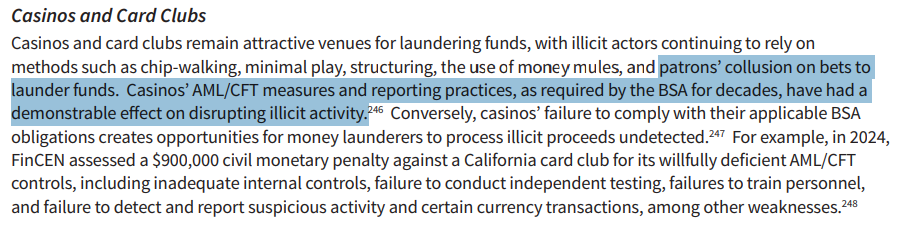
That is why just saying “the social club model is legal” is too shallow of a defense.
Even if the model is arguably lawful in Texas, that does not insulate a room from separate allegations that its actual conduct, cash handling, membership practices, player behavior, or overall operating environment crossed into illegal gambling or money laundering territory.
Also, people were talking about some of these warning signs years ago (2022).
There was already 2+2 chatter about Euro pros, game selection, and collusion concerns at the Lodge.
Even Mason Malmuth commented on this years ago in a reply:
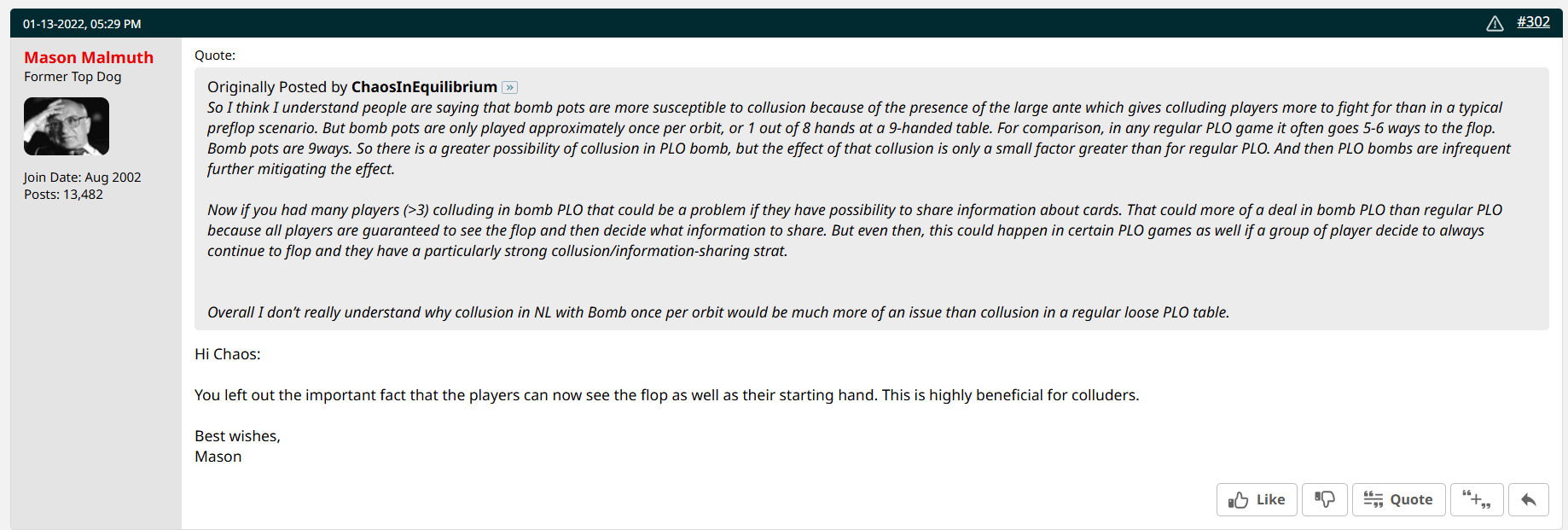
https://forumserver.twoplustwo.com/29/ne...
Mason's comment does not prove criminal conduct, obviously, but it could be viewed as one more contextual indicator that the room may have been operating in an environment where collusion-sensitive behavior and AML red flags were plausible risks rather than purely theoretical ones.
So no, I am not accusing anyone of wrongdoing based on forum posts. What I am saying is that people on 2+2 have been raising concerns for years that the Lodge was spreading games that were especially vulnerable to collusion, and there has been speculation on this forum for a long time that collusion may have been occurring, and collusion is called out as an AML risk by the US Treasury.
My point is simply that these warning signs and red flags have been discussed for years, and the current allegations seem far more serious than the overly simplistic “is the social club model legal, yes or no” argument that people keep falling back on.

Is there a casino or card club in the entire world that isn't guilty of at least one of these violations
This thread has kind of devolved into a debate over whether the Texas social-club model is legal or not.That is not really the biggest issue in the affidavit.The more serious piece is the money laundering angle, which goes directly back to AML risk and compliance, which no on
What specific AML violations are you talking about? All that’s been alleged is they deposited too much cash at bank. Which isn’t an AML violation as far as I know.
Jade Lew Robbi has some of the best commentary on the subject right now, which is interesting since Doug Polk accused her of "probably" being in a cheating racket. If he was correct then she would know about the financial irregularities the best. Therefore I think Doug is most likely not going to be ultimately prosecuted and that jury's will most likely declare his innocence.
When did she learn anything about poker?
It looked like that was what happened if you look at the poker news article. There were wire transfers into the casino as well. And that’s common practice for many high-stakes games.
What's being discussed is the $1.3M of cash the Lodge deposited into their bank account, which a 2+2'er said could just be funds from high-stakes players buying chips, to which I replied how can the
Let’s assume that the Lodge hosts a high stakes poker game one week with a dozen or so players, most from out of town. Let’s assume each player brings an average of $100k to cover their play.
The out of towners will likely wire those amounts to the Lodge. The locals may just buy in every day using cash or chips they already have. Either way the Lodge has up to $1.2M in new deposits from their accounts. Cletus the cop reviewing their deposits for the week/month may say, holy heck, that’s far more than their rake/booze/food revenues, something sHaDy mUsT bE gOiNg oN!!!!!!!
Then that Sunday when the game is finished for the week and everyone goes home, the Lodge buys back those chips from the out of towners, presumably in wires but maybe some cash. The locals might keep their winnings in their box if The Lodge offers them or at a bank safety deposit box or even a home safe.
But now most of those deposits are reversed from The Lodge accounts. But if the locals won big, hundreds of thousands may not be as those chips remain in their possession. So again deposits for the month would remain well beyond what a simplistic estimate of room revenues would predict.
This thread has kind of devolved into a debate over whether the Texas social-club model is legal or not.
That is not really the biggest issue in the affidavit.
The more serious piece is the money laundering angle, which goes directly back to AML risk and compliance, which no one is discussing seriously.
There's a critical reason to focus on whether the Texas poker-club model is legal or not: if it's determined to be illegal then the money earned and transferred from its activity by definition money laundering.
This is because the definition of money laundering is (source):
Money laundering is a term used to describe a scheme in which criminals try to disguise the identity, original ownership, and destination of money that they have obtained through criminal conduct
So any focus on money laundering separate from the illegality of the underlying activity which produced the money doesn't make much sense.
Let's assume that the Lodge hosts a high stakes poker game one week with a dozen or so players, most from out of town. Let's assume each player brings an average of $100k to cover their play.The out of towners will likely wire those amounts to the Lodge. The locals may just buy in every day using cash or chips they already have. Either way the Lodge has up to $1.2M in new depo
If this were true then there would be offsetting transactions for the cash deposits, ie a combination of outgoing writes to players and/or withdrawals of cash back to the LODGE, neither of which are documented in the search warrant affidavit.
There's a critical reason to focus on whether the Texas poker-club model is legal or not: if it's determined to be illegal then the money earned and transferred from its activity by definition money laundering. This is because the definition of money laundering is (source):
Exactly, and that is why I posted the U.S. Treasury link.
You are reducing this to a single abstract question about whether the Texas social-club model is legal, while Treasury is talking about how gambling environments can actually be used in practice for money laundering through suspicious transaction patterns, weak controls, collusive betting, minimal play, chip movement, and other AML red flags.
That is the point.
Saying that illegal underlying activity can produce unlawful proceeds does not make the AML discussion irrelevant. It makes it more relevant, because the entire reason investigators look at cash handling, player behavior, transaction flow, collusion concerns, and control weaknesses is to determine whether the operation was creating exactly the kind of risk Treasury warns about.
The 1.35 million point is being over-simplified too. The fact that investigators focused on that amount does not automatically mean every dollar was dirty in some neat cartoonish sense. It means the movement of money itself was important enough to scrutinize. That is a very different point than just arguing on the internet about whether the social-club concept is legal in theory.
And as for the argument that any card room could be guilty of this, yes, that is basically true in the abstract, which is exactly why Treasury identifies casinos and card clubs as AML-risk environments in the first place. But that does not help the Lodge. It actually cuts the other way. If Treasury already says these environments are vulnerable to this kind of abuse, then people should stop acting like money laundering concerns are some irrelevant sideshow just because they want to argue social-club legality.
I do not expect anyone here to go read an 80-page Treasury PDF, but that is still the proper framework to approach this from because that is the framework the authorities will use. They are not going to analyze this the way a poker forum does. They are going to look at the operation through an AML and financial-crimes lens, which is exactly why the Treasury guidance matters more than the repetitive social-club talking point.
My point is simple. The legal theory of the business model is only one part of the story. The operational reality, how the room handled money, what risks were tolerated, and whether the environment had the kinds of red flags Treasury specifically warns about, is the bigger issue.
Exactly, and that is why I posted the U.S. Treasury link.You are reducing this to a single abstract question about whether the Texas social-club model is legal, while Treasury is talking about how gambling environments can actually be used in practice for money laundering through suspicious transaction patterns, weak controls, collusive betting, minimal play, chip movement, and
It wasn't my intention to reduce the issue to just the legality of the poker club model but right now that is the best theory of what's behind the money laundering charge so the heavy focus on club legality in this thread is warranted. There aren't many other obvious criminal activities we can theorize that are behind the money laundering charge, if we presume (as I do) that Doug Polk and crew are straight-up poker businessman making an honest, transparent living and not engaged in something crazy like drug dealing, theft rings, gun runners, etc..
Now we know why Benny Binion left Texas and settled in Nevada.
I hate politicians and I hate cops. I hope some of the cops who served that warrant love poker and it pained them to walk in there and shut it down and tell people they cant play a game amongst themselves for some of their hard earned cash
Edit: throw prosecutors in there too. They're sometimes worse than cops
the vast majority of all the groups you "hate" here are made up of your friends and neighbors acting as public servants doing mostly good.
Limon,
Why would you think id befriend those individuals? I did know a couple prosecutors, cops, and politicians in my time while owning a restaurant near the court house. I grew up in a fairly small town. Never personally had an issue with them, but I know what most of them stand for.
Do we need all of these groups? Unfortunately we do. But a large percentage of them are not too bright or have nefarious intentions.
This thread has kind of devolved into a debate over whether the Texas social-club model is legal or not.
That is not really the biggest issue in the affidavit.
The more serious piece is the money laundering angle, which goes directly back to AML risk and compliance, which no one is discussing seriously.
I'm not sure why you think the underlying legality of Texas poker clubs isn't the central issue in this case. The counts listed in the Poker News article include:
Texas Penal Code 47.03 - PROMOTION OF GAMBLING
Texas Penal Code 47.04 - KEEPING A GAMBLING PLACE
Texas Penal Code 47.06 - POSSESSION OF GAMBLING DEVICE, EQUIPMENT OR PARAPHERNALIA
This sounds like they are going after what they perceive as illegal gambling. This does also include a money laundering count, but as pocket_zeros has already pointed out, if the club is ruled illegal, all the money they are moving might constitute money laundering without any other evidence that anything nefarious is going on.
I don't think we have enough information right now to know exactly what is going on. But I haven't seen anything to suggest that the legality of this poker model isn't the main thrust of the case.
I'm not sure why you think the underlying legality of Texas poker clubs isn't the central issue in this case. The counts listed in the Poker News article include:Texas Penal Code 47.03 - PROMOTION OF GAMBLINGTexas Penal Code 47.04 - KEEPING A GAMBLING PLACETexas Penal Code 47.06 - POSSESSION OF GAMBLING DEVICE, EQUIPMENT OR PARAPHERNALIAThis sounds like they are going after wh
Yes, one layer is the Texas poker-club issue and whether the social-club model is legal or illegal as actually operated. I am not denying that. Obviously if the state believes the room crossed the line into illegal gambling, that matters.
But my point is that the biggest exposure here may not even be that layer by itself.
The bigger exposure, in my opinion, is the financial-crimes side of this and wherever the FinCEN and IRS angle ultimately goes, because that is where the net gets much wider and where the consequences can become much heavier.
That is why I keep pointing back to the Treasury and FinCEN framework instead of just getting stuck in the endless “are Texas poker clubs legal, yes or no” loop.
Once you move into the AML world, the question is not just whether the poker itself was lawful in some abstract sense.
The question becomes how the money moved, who brought it in, who took it out, whether those transactions were recorded properly, whether suspicious patterns were identified, whether records were retained, and whether the room had actual controls in place that could be handed over to the authorities.
That is the exposure I am talking about.
Because even if Doug himself is completely clean personally, he is still the owner. He cannot just wave his hands and say he had no knowledge of any of this if the issue is that a cash-heavy gaming business under his ownership was supposedly moving large sums of money without the kind of documentation and controls that the feds expect to see.
That is the whole point of AML and that was a big part of my concern 4+ years ago when I raised this very issue.
If you are saying your room is legitimate and above board, then you are also implicitly saying that you should have records, reconciliations, receipts, wires, identification procedures, logs, and a paper trail that explains what happened.
If that material exists, then in theory that should be the very thing that clears this up. You hand over the records, show where the money came from, show where it went, show how it ties to actual player activity, and show that everything reconciles.
If you cannot do that, then that is where this becomes a much bigger problem.
So when people keep reducing this to “well if the club is illegal then the money laundering count just follows from that,” I think that is way too shallow.
Maybe that ends up being true in some legal sense, but it still misses the point that the financial-crimes side of this may be the hardest part to disprove because it is not just about theory. It is about records, controls, and whether the business can actually document its own money flows.
And that is also why I think the IRS angle matters so much.
The IRS being involved tells me this is not just some narrow morality play about whether poker clubs should exist in Texas. It suggests they are looking at actual financial conduct, and once that starts, the exposure is broader, the questions get more detailed, and more people can potentially get pulled into the orbit of the investigation.
So yes, the layers can be separated.
The Texas legality issue is one layer.
The financial-crimes, recordkeeping, and AML-control issue is another layer.
And in my opinion, that second layer is where the real exposure may be, because if the records are clean, then great, that should help explain everything.
But if the records are incomplete, inconsistent, or missing, then the problem gets much more serious very quickly.
That is why I keep saying the bigger issue is not just whether the social-club model can theoretically exist. The bigger issue is whether this particular operation was being run in a way where the owners could actually sit down with the feds, hand over the receipts, and make the story make sense.
So is this a witch hunt? Maybe, maybe not. But whether Doug personally did anything wrong may not even be the right question.
The bigger question is whether the operation itself was being run in a way that could withstand this kind of scrutiny.
The Austin American Statesman
with additional. details from the search warrant that I don't believe were reported in the PokerNews article. Here are the interesting details I've culled from article:
Title: How a Round Rock poker club landed in an illegal gambling, money laundering probe
The allegations against The Lodge Card Club The Lodge Card Club operates as a members-only venue with round-the-clock cash games and multiple daily tournaments. It describes itself as the largest card club in Texas and one of the largest in the world, with more than 60 tables. The business holds a state mixed beverage permit, according to TABC.
That members-only model has been used by some Texas card rooms to argue they host legal social gambling rather than operate casinos. But investigators allege The Lodge crossed that line. According to the affidavit, the club made money from games through seat fees and tournaments, allowed broad public access despite the “private club” designation and operated inside a liquor-permitted venue where real-money poker tournaments are not allowed under state guidance.
...
The affidavit also cites a public complaint filed April 3, 2024, referencing a 2005 opinion by then-Attorney General Greg Abbott stating that businesses with on-premise alcohol permits cannot host poker tournaments with real money at stake. The club’s mixed-beverage permit was issued to Sleamond’s Ice LLC, which authorities described as an associated entity with Tempus.
Texas law broadly prohibits betting money or other things of value on card games, operating a gambling place or profiting from one. Exceptions for social gambling are narrow: games must take place in a private setting, no one can receive an economic benefit beyond personal winnings and all players must have equal odds.
...
The affidavits said bank records showed money being spent on things like poker tables, livestream setups and advertising, along with large amounts of money moving between related companies and getting wired to professional poker players.
Bell conducted surveillance on June 13, 2024, and reported the entrance appeared open to the public. Two weeks later, he began subpoenaing financial records tied to the club and its owners, eventually expanding to a network of banks and financial institutions.
According to the affidavit, one Tempus Holdings account received about $2.36 million in cash deposits between November 2023 and June 2024, including roughly $1.13 million in January alone. Investigators said records show money spent on poker tables, livestream equipment and advertising, as well as large transfers between related companies and payments to professional poker players.
...
Bell wrote that some people entered without verifying membership, that the club advertised “Play Poker Now” along Interstate 35 without identifying as a private club, and that a Jan. 30 tournament appeared to leave $1,080 with the house. He cited ATMs, livestream operations and repeated cash play as additional indicators of what investigators allege was an illegal gambling operation.

I don’t see any involvement of any federal agencies or any federal charges so far. I doubt the fed courts would agree with the Texas definition of money laundering as outlined in the news article.
I haven't read the affidavit, but Pokernews claimed
"Investigators noted that, during the first two months of 2025, approximately $1.35 million was deposited from The Lodge through the Loomis cash vault, located inside the club, into a bank account held by Tempus Holdings, Inc., a business associated with The Lodge Card Club.
The above listed transactions are believed to be in support of, and constitute evidence of the illegal activity taking place at the Lodge Card Club, " the search warrant reads.
Says deposits. Not offset by anything. If it turns out they actually did offset withdrawals, then I'll admit my criticism was wrong.
But think about it, which withdrawals would they offset by? Withdrawals to pay vendors, rent, wages, taxes, owners, etc? How do they know any would be illegal?
I hate politicians and I hate cops. I hope some of the cops who served that warrant love poker and it pained them to walk in there and shut it down and tell people they cant play a game amongst themselves for some of their hard earned cashEdit: throw prosecutors in there too. They're sometimes worse than cops
the vast majority of all the groups you "hate" here are made up of you
Mostly good ain't enough to stop from criticizing those who don't do good. And note, when these "friends and neighbors" commit crimes or strip citizens of their rights, they have substantial protections under the law from being prosecuted and sued, unlike you and me.


