The Impending Death of Modern Capitalism
Let's make sure we're all on the same page on the definition of capitalism.
It's basically a system in which private owne
I’m not really denying that capitalism in its modern form had coercive historical development. Marx’s idea of “primitive accumulation” and the enclosure process are part of that story. Where I think we’re talking past each other is the leap from that history to the conclusion “property is theft.” That property rights were enforced and structured historically, doesnt lead to: therefore property itself is illegitimate. Those are different arguments.
My main point is more about what happens once relatively stable property rights and enforceable contracts exist, and large-scale coercion is no longer the primary mechanism governing exchange. At that point, we see fairly consistent patterns of behavior across societies. Not because capitalism creates those instincts, but because it channels ordinary human incentives into predictable outcomes.
Nor do I think it necessarily follows that if primitive accumulation had never happened, people today would be better off. More than a few socialist economists would agree that market mechanisms are the fastest way to scale a modern economy--China is probably the clearest example of that.

property rights and enforceable contracts exist ... large-scale coercion is no longer the primary mechanism governing exchange
quite the contrary, actually
It is exactly the permanence of armed police forces that enables the "enforcement" of contracts (seizure of assets) and property rights (seizure of persons).
Or you can look at the role of police in breaking up workers' strikes, eg here, for the sake of perpetuating capital exploitation.
I'm not saying socialism doesn't ultimately require some degree of violence, but I think you are saying that capitalism doesn't and if so you are not correct.
market mechanisms are the fastest way to scale a modern economy--China is probably the clearest example of that
I'm not sure you want to hold up China as your paragon of capitalist virtue, but that aside I don't think "scaling an economy" should be the goal of a socio-economic system.
Personally I prefer a focus on individual well-being rather than material accumulation.
I’m not denying that any legal system ultimately has enforcement behind it. My point was that there’s still a difference between that and the original coercive formation and consolidation of property relations (like enclosure). Treating “state enforcement of property” as the same thing as “historical dispossession that helped establish those property relations” flattens the distinction between founding violence and ongoing institutional maintenance under conditions of broad legitimacy.
On China / scaling: I wasn’t defending China as some capitalist ideal, just pointing out that market mechanisms have a strong track record of scaling economies. Saying “scaling isn’t the goal” doesn’t really engage that.
But neither of these really touches my original point, which is that even if property rights were historically formed through coercion, it doesn’t automatically follow that property itself is illegitimate or “theft.” That still needs an argument. That isn't straightforward because that enclosure wasn’t simply the creation of property from nothing; it was basically the legal formalization of pre-existing local claims and customs regarding private property

Would you be willing to offer opinions on how you’d accomplish that? Because things like healthcare, housing, and food all depend on material production and require a system to produce and distribute them. I'm going to assume you can do this without going with a military barracks route of assisted living who are looking to hire folks with shooting experience and fixing trucks.
I’m not denying that any legal system ultimately has enforcement behind it. My point was that there’s still a difference between that and the original coercive formation and consolidation of property relations (like enclosure). Treating “state enforcement of property” as the same thing as “historical dispossession that helped establish those property relations” flattens the dis
Is it a worthwhile distinction such that it shouldn't be flattened? It was created through coercion and is maintained through coercion. Capitalism does not work with without coercion.
On China / scaling: I wasn’t defending China as some capitalist ideal, just pointing out that market mechanisms have a strong track record of scaling economies. Saying “scaling isn’t the goal” doesn’t really engage that.
I don't want to spend a lot of effort arguing towards a goal that I don't share, but historically the USSR saw wild industrial growth under their planned economic systems. The cost on human lives and well-being was not worth it, imo, but that's getting back to my earlier point on goal-setting.
But neither of these really touches my original point, which is that even if property rights were historically formed through coercion, it doesn’t automatically follow that property itself is illegitimate or “theft.” That still needs an argument. That isn't straightforward because that enclosure wasn’t simply the creation of property from nothing; it was basically the legal formalization of pre-existing local claims and customs regarding private property
The notion of "theft" itself begs the question because it stands for the deprivation of a property right, but the important part isn't the semantics, it's that people had something (land to live on) and then were suddenly told they don't have it anymore, purely so the people who through your "local claims and customs" could expand their already significant privileges.
A modern parallel might be a worker who stays with a company for 20 years and then is laid off prior to vesting retirement benefits, while the company is able to continue profiting from the fruits of that worker's labor absent continued compensation for that worker. Really this modern parallel even more closely captures my rendering of Proudhon's statement than the early-stage encounter...
Would you be willing to offer opinions on how you’d accomplish that? Because things like healthcare, housing, and food all depend on material production and require a system to produce and distribute them. I'm going to assume you can do this without going with a military barracks route of assisted living who are looking to hire folks with shooting experience and fixing t
Are you asking me to weave whole-cloth a total political economic system in a forum post?
My point is that for a given policy proposition, the evaluative question should not be "do we end up with more stuff" but "do we end up happier" as a consequence, and the two considerations are not close to equivalent.
The criticisms of Bezos etc having billions of dollars isn't that they get to be so much happier than everybody else. It's that their scale of money is completely irrelevant to their happiness (aside from counting-house joy, so say "in use") while those funds could be used to provide healthcare, housing, and food to those in need - starting (for common-ground sake) with children, disabled veterans, and retired life-long workers.
The criticisms of Bezos etc having billions of dollars isn't that they get to be so much happier than everybody else. It's that their scale of money is completely irrelevant to their happiness (aside from counting-house joy, so say "in use") while those funds could be used to provide healthcare, housing, and food to those in need - starting (for common-ground sake) with childr
It's not about the dollar; its about how that money can reallocate capital and human resources to do all that stuff you want.
This is a macro issue but we can look at it sector-wise as with housing. If we want to provide millions of poor people with more-better housing, that can only come from less-better housing for millions of upper middle class and lower affluent. Same with food and everything else because that's where the volume of consumption necessary to elevate living standards for the poor comes from.
But back to the macro, the only way to make things better for the lower class is to raise taxes significantly on HHs in the $120K-$300K range... or something that has a similar effect on that demo's living standards. The former is a tough if not impossible sell. The main candidates to accomplish the latter are a UBI or a targeted value-added tax coupled with redistribution to lower incomes. That's the economic reality; revolution isn't.
If we want to provide millions of poor people with more-better housing, that can only come from less-better housing for millions of upper middle class and lower affluent
No. Not only are you applying a fallacious zero-sum analysis to an area with plenty of excess potential (plenty of opportunity for new builds but for funding), you are also failing to grasp the principle of diminishing marginal return.
Another million for Bezos would not be noticed by him, but it could drastically improve the nutrition of a school system's lunch program.
No. Not only are you applying a fallacious zero-sum analysis to an area with plenty of excess potential (plenty of opportunity for new builds but for funding), you are also failing to grasp the principle of diminishing marginal return.
That's false. I do agree that our economy isn't technically zero-sum, but it effectively is short of increased productivity.
What I’m getting at isn’t that helping lower-income households literally requires making upper-middle-income households worse off in a one-for-one sense. It’s that when an economy is operating near full employment and high capacity - which is roughly where we are - the main constraint isn’t money, it’s real resources, eg, labor, materials, land, and production capacity.
Money is just the mechanism that moves those resources.
So for example, building more affordable housing at scale isn’t mainly a ‘money’ problem, it’s about construction labor, zoning, land, and materials. If those resources are already heavily used building higher-end housing or other projects - which they are - shifting them toward affordable housing means something else gets built less or not at all.
Same with food, healthcare, childcare, etc. If we want more of these for lower-income households, we need more workers and capacity in those sectors. In a tight labor market - which were in - that means pulling workers away from other sectors, which reduces output elsewhere.
Another million for Bezos would not be noticed by him, but it could drastically improve the nutrition of a school system's lunch program.
I agree that diminishing marginal utility matters.... at the micro level. But at the macro level, the bottleneck isn’t just money sitting idle-- it’s how much labor and productive capacity we have, and where it’s being used. In other words, we don’t redistribute dollars; we redistribute what the economy produces. Dollars just decide who gets it.
U-6 unemployment is currently at 8% and we just aggressively deported like a million laborers (because bully needed a bogey), there is plenty of land, and zoning is simple fiat.
But for the sake of argument, even if it is a question of priority, I don't agree that non-primary residences for the wealthy are more important that starter homes for young families, yet the logic of finance capitalism compels the worser product.
U-6 unemployment is currently at 8% and we just aggressively deported like a million laborers (because bully needed a bogey), there is plenty of land, and zoning is simple fiat.But for the sake of argument, even if it is a question of priority, I don't agree that non-primary residences for the wealthy are more important that starter homes for young families, yet the logic of fi
I doubt we're far apart on the ends. I think we have the output capacity to get every household up to median HH living standards. My disagreement with the far left is more about the means. For instance taxing the super rich and pulling all that wealth out of capital holdings and giving the money to the poor to spend on consumption will just cause inflation for everyone above, especially right above since we're not actually producing any more goods. As I said the improvements for the poor will need to come at the upper middle and affluent class since that's where the excess volume of consumption takes place.

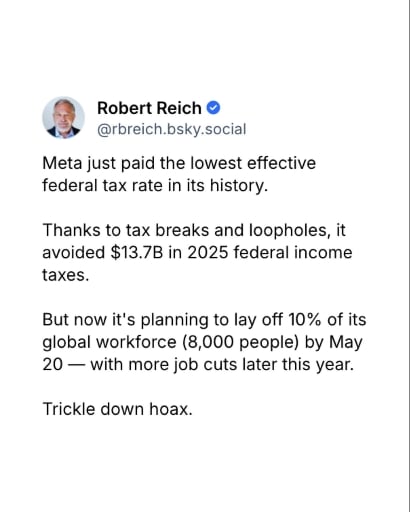
taxing the super rich and pulling all that wealth out of capital holdings and giving the money to the poor to spend on consumption will just cause inflation for everyone above
So poor people getting bread makes bread more expensive for everyone, and thus it's better to leave the wealth of our nation's labor sitting in investment accounts and the poor can keep making do without bread.
I guess I never thought of it that way, thanks.
So poor people getting bread makes bread more expensive for everyone, and thus it's better to leave the wealth of our nation's labor sitting in investment accounts and the poor can keep making do without bread.
I guess I never thought of it that way, thanks.
Wealth isn't money; Iit's just the monetary value we assign to an asset. Nor is money bread; its just a medium of exchange.

Another million for Bezos would not be noticed by him, but it could drastically improve the nutrition of a school system's lunch program.
So how do you convince the 2.7 billion people who voted to make Jeff Bezos so rich to stop voting for him? It seems like a tall order to convince these people that they would be better off donating lunches at their local schools instead of buying a shirt off of Amazon.
The problem with trying to take more money away from billionaires is that you can't do it unless you are willing to hurt the poor and middle class to do so.
The problem with trying to take more money away from billionaires is that you can't do it unless you are willing to hurt the poor and middle class to do so.
What a massive load of bullshit.
Baba fails to understand that the top brass at companies funnel the profits of the company straight to the top. They do this by holding down worker pay as much as possible. It's literally trickle (actually pour) up.
How about this? We pass legislation that compensation for any single person (like CEO) cannot ever exceed a set multiple of the lowest paying worker. This includes all compensation. If the ceo gets stock, the employees get stock. The board and management can continue to spend the exact same money for compensation that they always do, it's just distributed fairly. Shouldn't affect the bottom line or the top line, and therefore corporations will continue to function as they do now.
This also stimulates the overall economy. Instead of billions sitting in the starbucks ceo bank account unused, the workers have more and spend more.
https://www.theguardian.com/us-news/2025...
Some of the US’s lowest-paying large firms increased their CEOs’ compensation by an average of almost 35% over five years, according to new research. Their workers’ salaries did not keep up.
As executive remuneration ballooned, the average CEO-to-worker pay gap across the 100 companies in the S&P 500 with lowest median worker pay – dubbed the Low-Wage 100 by the Institute for Policy Studies – widened by 12.9% between 2019 and 2024, from 560 to 1 to 632 to 1.
“Median pay increased only modestly, whereas CEO pay really skyrocketed,” said Sarah Anderson, director of the Global Economy Project at the Institute for Policy Studies, and author of the report.
Starbucks’ CEO pay was the largest gap in 2024, with its CEO, Brian Niccol, receiving total compensation worth $95.8m, 6,666 times as much as the company’s $14,674 median pay.
John do you not understand that retailers all overstock and that production can be upscaled with increasing efficiency?
also, and really even more so, that we import consumer goods like nobody's business?!
spend more....
... on the same quantity of goods they produce.
this is just not what's up, man
John do you not understand that retailers all overstock and that production can be upscaled with increasing efficiency?
I undertstand the people can't consume more stuff without the people producing more stuff and we can't produce more stuff without more people.... or without the same number of people working more hours. This is a macro economic issue and sans increases on efficiency you just can't get increased labor output without increased labor input.
also, and really even more so, that we import consumer goods like nobody's business?!
this is just not what's up, man
I'm not going to play wack a mole with everything you can imagine. It all comes down to a redistribution of consumption and the top 1% just don't consume enough to make any meaningful impact on the bottom 50%. Only the upper quintile can.
It's like we're on an island and some aren't getting enough to eat--shuffling paper around won't feed them. We either work longer hours, work more effiently or do a better job sharing what we do produce.
but we're not on an island, our economy operates amongst a hundred others
nor do we consume 100% of our supply
nor do we produce 100% of our capacity to supply
but we're not on an island, our economy operates amongst a hundred others
nor do we consume 100% of our supply
nor do we produce 100% of our capacity to supply
True. But at best they would only make a marginal impact on the lower class's consumption. The 2 large blue stacks are doing the consuming:
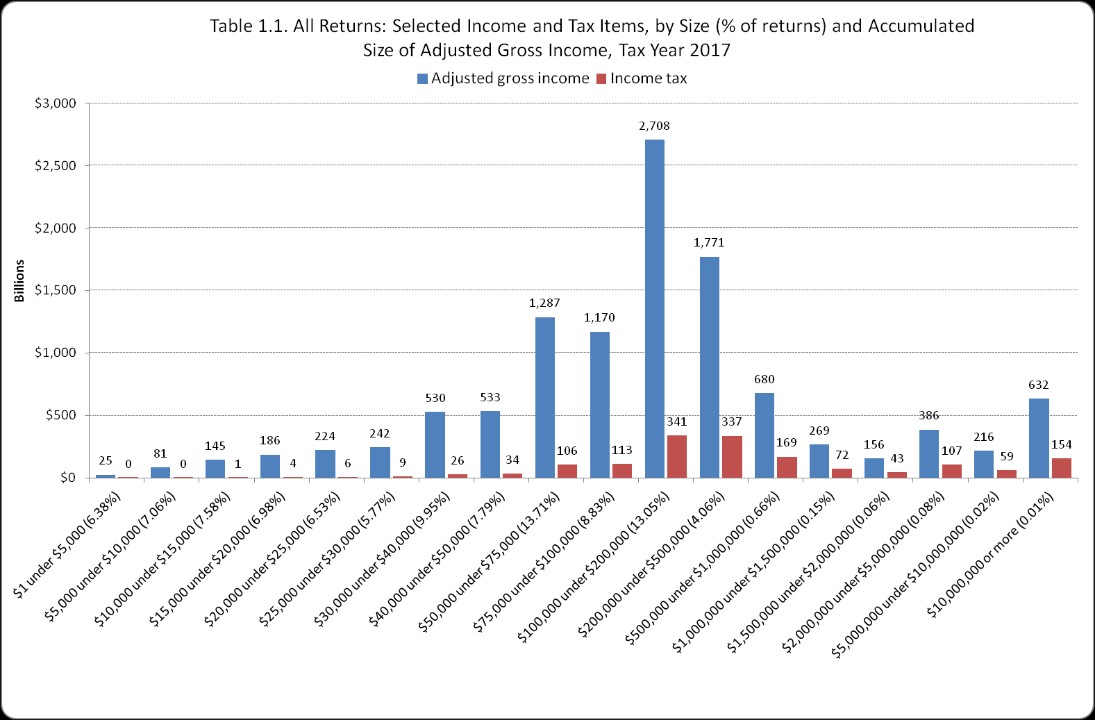
If you're not even willing to address that you have some other agenda or priority other than helping the poor. Same goes for the politicians who don't as well.

