Lunatic shoving all in blind UTG
Game is 9 handed $5 $5 with the odd $10 straddle with a lunatic who was shoving all in blind $500 pre flop when UTG. Unf
Doc, the part you forgot was all the EV we gain from shoving non-AA hands in the 96.4% of the time our opponents donÂ’t have AA. Yes, we lose considerably when we are up against AA, but that is counterbalanced by the fact that we gain considerably when we successfully isolate. To make the math simple assume we play for 500 when we iso and 2000 when we are called. If we have equ
Haven't forgotten anything. I don't think they call a $2k re-jam with worse anywhere near often enough for there to be any EV in VPIP'ing worse than AA.
If V was jamming dark every hand, from every position, I'd think we could play re-jam or fold with ranges that start insanely tight next to act in UTG1, and gradually get wider as our position improves and more players in front of us fold. But if he's only jamming dark when he's UTG, I'd think we want to rejam AA and fold everything else from UTG1. Maybe some of our other oppon
If you really think opponents would only call the UTG+1 jam with AA, that argues for a much WIDER jamming range for UTG+1, not a narrow one. Suppose we chose a jamming range that gives us 60% equity against UTG. We are certainly +EV jamming that range if we only get called by AA. Out of 100 hands we will play 96 against UTG only, winning 58 and losing 38. At 500 per hand that’s 10000 profit. Even if we always lost the other four when called by AA we still are up 2000.
I'm not folding KK to a blind shove because I'm concerned about what he has. I'm just not VPIP'ing KK for 400BB's when we have 8 uncapped ranges to get through.
My basic assumption is that we're never getting called by worse. We're only getting called by better. And we'd be giving up $60 of EV (3% of $2k) every time.
I am all for thinking outside the box and being a contrarian but folding KK is silly here.
Ok lets take the same situation but put it in a different setting. You are playing NL25 on ACR and you find yourself in an identical spot against a maniac shoving ATC and same stack depths behind. You look down at KK, you click fold? I'd guess not.
Your opponent is giving away free $, you take it.
I will say I found myself in a similar spot recently where I was playing online NL100 and at a table with a maniac and he open-shoved 100bb into the middle in EP and I looked down at AKo in CO and called and lost to Q8o when they hit an 8. Surprisingly the solver suggested a fold 100% of the time so there is sliver of merit to consider folding premiums, KK in this configuration though, not being one of them.
You're willing to pass up 12BB in EV? You see 12 big blinds on the ground you are just walking right by it and not picking it up off the ground?

Doc is totally wrong. I would jam really tight from early position. However, you have enough profit with JJ+/AK and probably lighter when you isolate. With KK and probably QQ you profit versus a calling range from later players. What he is saying doesn't make sense at all.
I'm not folding KK to a blind shove because I'm concerned about what he has. I'm just not VPIP'ing KK for 400BB's when we have 8 uncapped ranges to get through.
My basic assumption is that we're never getting called by worse. We're only getting called by better. And we'd be giving up $60 of EV (3% of $2k) every time.
Except given we are not starting the action but calling a blind bet every time the blind bet has worse than KK we are already effectively being called by worse.

I was thinking ATs seemed close, and it appears that it is a close jam in a given worst case scenario where we can only jam or fold and everyone covers us. Here's what I came up with in HRC:
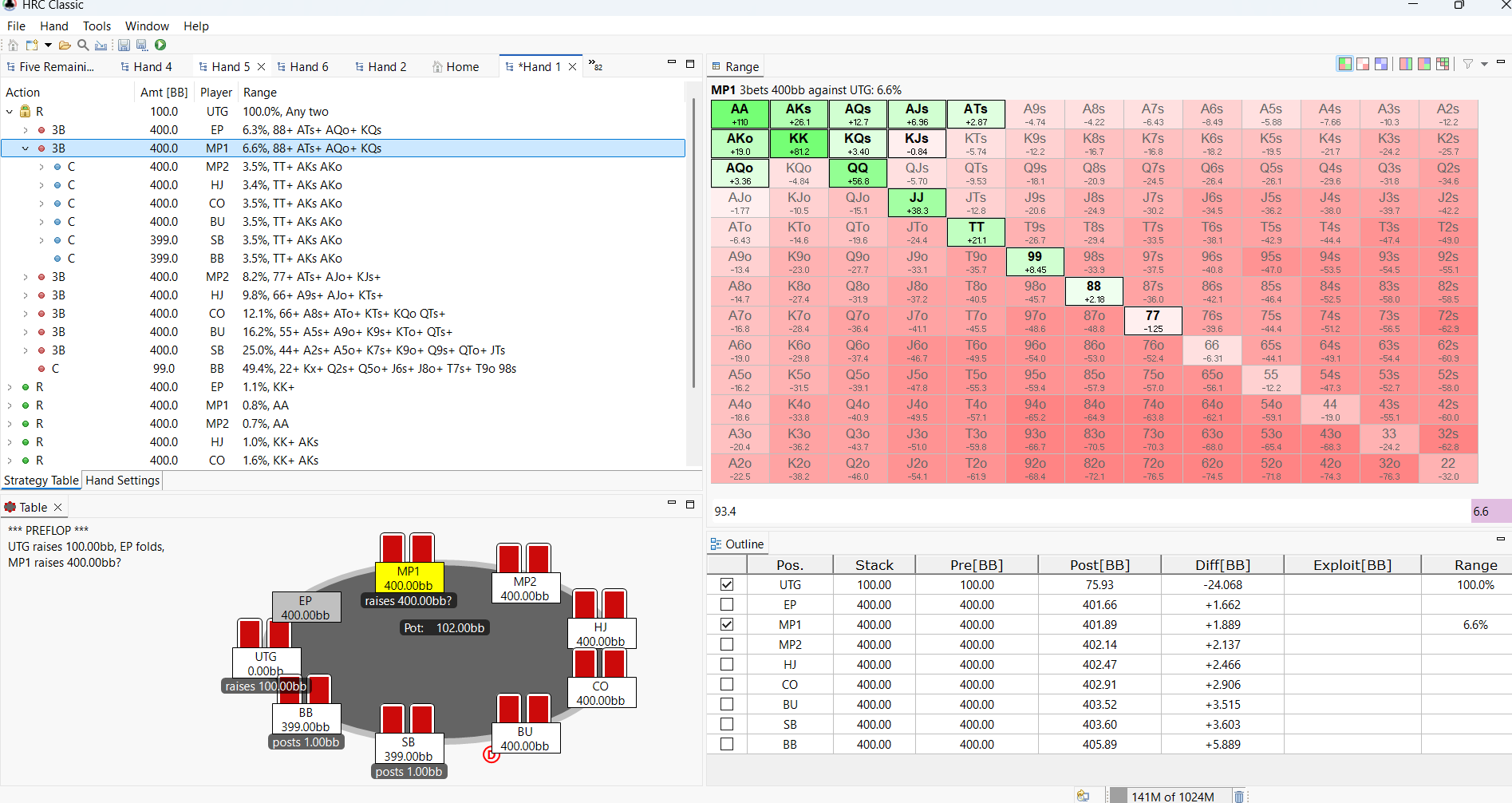
..]
I had to use simplified parameters to get around processing limitations at deep stacks (PC limitations plus I only pay for the basic version of HRC). I haven't used this mode much but I think this is correct. This sim assumes all other players cover us except for the blind raiser, and we can only go all in fold. We're continuing with 88+, AQo+, ATs+. This is assuming opponents respond optimally and we can only jam or fold.
In practice I'm calling with most of my continuing range and then deciding based on actions behind. Basically I'd call off against any maniac players that rejam and fold if a nit rejams, obviously taking into account the overall actions, positions, stack size of player who rejams, their tendencies, etc. Since I would be calling with hands like AA and KK my range should be pretty well protected. So players couldn't just go crazy rejamming, but we'd have to be willing to call off light if another maniac jams.
In my experience most players play way too tight even against a blind all in, and after I call they assume I'm nutted and play extremely tight. Against our jam they're supposed to be calling off 400 BB with TT+, AK but I'm thinking most players shove something more like QQ+, AK. I've even seen players like Doc who fold KK face up and say they don't want to flip for all that money.
A couple other things. I didn't account for rake. Also ATs is only making less than $3 (so losing with rake). However if other players behind are folding stronger hands like TT and JJ that are calling our rejam in the sim, then our EV would go up. Likewise if they call with hands like dominated aces, A9, etc., our EV also goes up. This is our EV if all the other players behind play basically perfectly, which is impossible. So I'm thinking ATs would be a (high-variance) jam if we can only jam or fold. As I said above I probably call, then fold if a deep stacked nit rejams.
I will look into sims, but that seems like way too loose a range. Not sure tournament software handles a 100xBB blind shove. it may assume some large blinds or something.
I would also flat a lot, but shove the middle of my range. Yes, you can adjust your action based on the shover and the shover's position. However, low-mid stakes cash players probably over flat call a lot.

I mean call/fold has to be 110% correct every time or it's terrible. Like depending on exact stacks you should call if they rip it and show KK/QQ/JJ.
Then there's the fact that 99/88/77 might decide they can also call if you just call, and you'll be playing a dry side pot OOP.
Thread is so weird with some people saying ATs is a fold because we always get called by better, and KK is also a fold because we only get called by AA.
Yes, the game became "not normal" and super high variance ... and, also yes, you can play it well and still lose.
Life sucks, no money in chess, gamble or leave.
ATs is probably the threshold hand. A9 and AJ seems obvious what to do. I think we should call because this guy will be broke soon.
ATs is probably the threshold hand. A9 and AJ seems obvious what to do. I think we should call because this guy will be broke soon.
ATs may be about the same as AJo, because suitedness has about the same value as a kicker playing against a random hand and a calling range of like JJ+/AK.
I don't see the relevance of the guy going broke soon. Not a reason to take an EV- gamble. Also, seems perfectly OK to pass up a huge slightly EV- gamble.
Thanks for posting that. That range is a little wider than I would've gone with for sure. It's interesting that even AQo only wins like 3bbs here. I think almost everyone folds TT here if we call. A lot would also fold JJ & AK, correctly I believe, due to how tight people are in this spot. If you can take that into account for at least a third of the players left, I wouldn't mind going with hands like AQ, AJs, or 99 here. I know how swingy push/fold games can be. I was grinding Coinpoker push/fold games back when they had 100% RB with fishy players and I still ended up down despite doing the work on HRC for GTO and exploit ranges.
Anyway, you have to determine how much variance you're willing to stomach for 400bbs (I would rarely be sitting this deep personally). Do you want at least a 10bb edge? Good for a 5% increase to your stack? Or do you need more?
I also wouldn't play shove/fold here, but we're trying keep things simple...
You all are approaching this as if it's going to be a situation that persists. If this guy and everyone else at the table, including us had an endless bankroll and unlimited time to sit and play, I'd understand the effort to construct a profitable long-term counter-strategy if we were forced to play with this guy jamming dark, and us next to act, with no end in sight.
But the situation won't persist. It won't be long before the situation ends. It won't last long enough for us to realize the EV of any theoretically correct strategy built around long term averages over hundreds of trials. We might only be in this spot for 3-4 orbits, such that the risk of ruin is pretty high, and the time available for recovery impossibly short.
These situations don't arise often enough to invest the energy in studying them well enough to have a sound strategy committed to memory and at the ready. And we won't have access to solvers while sitting at the table. I don't think anyone here is going to unexpectedly and suddenly find themselves in this situation, and mentally devise a theoretically optimal counter-strat, and also have the mental fortitude plus the bankroll to withstand any early downswings.
Like, if you have 2-3 buy-ins on you, and you get stacked for 400BB's the first time you VPIP for $500 or more, and then it happens again, are you really going to keep reloading? Do you really have that much faith in your own ability to devise a counter-strat on the fly, the moment you see this happening?
It's not like he's telling us up front that he'll be doing this every orbit, or guaranteeing us how many times he'll reload. How many times do we need to see him do it before we can expect him to keep doing it? How many more times will he do it after that?
It's a great spot for the guy sitting to his right. It's a $hlt spot for us, sitting to his left. The only silver lining is that it can't last. And if it can't last, maybe we ought to focus on stack preservation in the short term more than maximizing our long term EV.
Maybe it's an interesting puzzle to solve away from the table. But sitting at the table with only a few hours to play, I don't mind letting some good hands go while we wait for the maniac to go broke or get bored. I'd rather save my ammo for the war to come, when we go back to playing normal poker.
Y'all can think I'm a nit or an imbecile. I'll be the nitty imbecile whose stack is the same size or bigger when the shenanigans end.
You all are approaching this as if it's going to be a situation that persists. If this guy and everyone else at the table, including us had an endless bankroll and unlimited time to sit and play, I'd understand the effort to construct a profitable long-term counter-strategy if we were forced to play with this guy jamming dark, and us next to act, with no end in sight.But the si
It's reasonable to fold something like AJ because it's a thin edge with high variance, or because you haven't studied the spot and think it could be negative EV with deeper stacks behind or whatever.
If you're folding KK to a blind all in you really have no business sitting in that game. Move down in stakes to where you're not scared money.
It's reasonable to fold something like AJ because it's a thin edge with high variance, or because you haven't studied the spot and think it could be negative EV with deeper stacks behind or whatever.
If you're folding KK to a blind all in you really have no business sitting in that game. Move down in stakes to where you're not scared money.
It's not about being scared.
It's about recognizing the difference between finding an optimal strat for a game that will last long enough for that strat to realize its EV, versus trying to apply that long-term +EV strat to a game that isn't likely to persist long enough for our strat to win if we suffer early losses.
To me this is like when someone hits and runs. It's annoying because we never got the chance to recover what we lost. If we torch 400BB's playing our optimal strat, and then the guy goes broke and leaves, our strat never got the chance to prove out.
I'm all for giving action when there's a maniac in the game, up to a point. I'll VPIP wider, put more money in pre and post, and make my share of light calls. I'll accept higher variance when I think my skill edge is enough and the game will last long enough for me to recover early losses.
When the game won't last long enough to recover from early losses, I'd prefer not to accept the variance, especially not when we'll always be forced to act first, effectively taking giving 8 opponents a free roll.
I've probably messed the calculations up somewhere, but if we GII with KK and either run it against the original maniac with a random hand for $500 or (disaster!) we GII with another player for $2,000 who calls with exactly and only AA, then I make it +$266.49 EV to play.
Scenario 1: we either win $490 (assuming $10 rake) or lose $500. I make this +$323.90.
Scenario 2: we go 3 ways to win $490 (rake) or lose $500 and then HU for $1500. I make this -$1287.30.
Chance that zero of 8 players have AA is 96.4369%. Multiply scenario 1 by this value and multiply scenario 2 by 1-value. Gives us $312.36 - $45.87 = $266.49.
Seems crazy to give up this kind of edge.
I think Doc is trolling, no way he finds this spot and folds kings.

So the optimal +EV long term strategy should never be used here because there isn’t enough time to properly use it? And therefore the better strategy is significantly different from the highest EV play?
Sure. Makes total sense.
I love poker.
Semi-trolling.
Every month it's another "lunatic shoving dark pre, what do I do" thread.
Why can't we just play poker?
Honestly, the situation is so ridiculous and unusual that it wouldn't seem to warrant examination.
The effect it has on our win rate (loss rate?) is pretty significant considering we might play a 4.5k pot or more every time we go with it.
Semi-trolling.
Every month it's another "lunatic shoving dark pre, what do I do" thread.
Why can't we just play poker?
Honestly, the situation is so ridiculous and unusual that it wouldn't seem to warrant examination.
The effect it has on our win rate (loss rate?) is pretty significant considering we might play a 4.5k pot or more every time we go with it.
If I'm playing a lot of cash games I usually encounter someone going all in blind at least once a month. It's high variance but also one of the higher EV scenarios you can find yourself in. It's good to develop an intuition for where the stack off thresholds are even if you choose to fold the marginal hands to avoid unnecessary variance.

There's some variation of this behavior pretty often at live poker tables so it doesn't hurt to take the time to think away from the table.
This particular scenario is extreme and less common but you do see a good amount of things like 90% rfi, tilted short stacks, out of control straddle & BB squeezers, etc. Basically any time someone puts it a big bet with a wide range we should be ready with a heuristic for when to step in or step aside. Plus when you do get the extreme situation you're ready for it.

